Headaches After Tonsillectomy & Adenoidectomy: Is It Normal? ENT Explains-various aspects
Author: Dr Sagar Rajkuwar, ENT Specialist, Nashik, Maharashtra, India
🌐 www.entspecialistinnashik.com
Headaches after tonsillectomy and adenoidectomy are one of the most under-discussed yet very common symptoms of recovery. Up to 60% of children and 70% of adults report at least one episode of headache in the first 7–10 days after the combined procedure, according to the Swedish Quality Register for tonsil surgery (2024) and the Royal College of Surgeons of England. This complete 2026 ENT doctor’s guide explains every mechanism, every red flag, and every evidence-based remedy for headaches after tonsillectomy and adenoidectomy, drawn from NHS Lothian, NICE, American Academy of Otolaryngology (AAO-HNS) 2024, and peer-reviewed literature.

Table of Contents
- Introduction — Why This Matters
- Why Headaches Occur After T&A Surgery
- What’s Normal vs What’s a Red Flag
- Managing Headaches at Home — Evidence-Based Protocol
- Pain Medications — Dose, Timing & Safety
- When to Contact a Doctor Immediately
- Rare but Serious Complications
- Outlook & Recovery Timeline
- Frequently Asked Questions
- Summary & Conclusion
- References
1. Introduction — Why This Matters
A tonsillectomy and adenoidectomy (together abbreviated T&A or adenotonsillectomy) is one of the most frequent paediatric surgeries worldwide — over 530,000 are performed every year in the United States alone (AAO-HNS 2024 data), with similar high volumes in the UK, Europe, and India. Although surgeons and anaesthetists have focused mostly on throat pain, airway safety, and bleeding, a growing body of research shows that headaches after tonsillectomy and adenoidectomy account for 20–30% of unscheduled calls to the surgical team in the first fortnight. Here is a short explainer:
2. Why Headaches Occur After T&A Surgery
Several physiological mechanisms converge to explain headaches after tonsillectomy and adenoidectomy. Understanding the cause helps you target the right remedy rather than reaching blindly for painkillers.
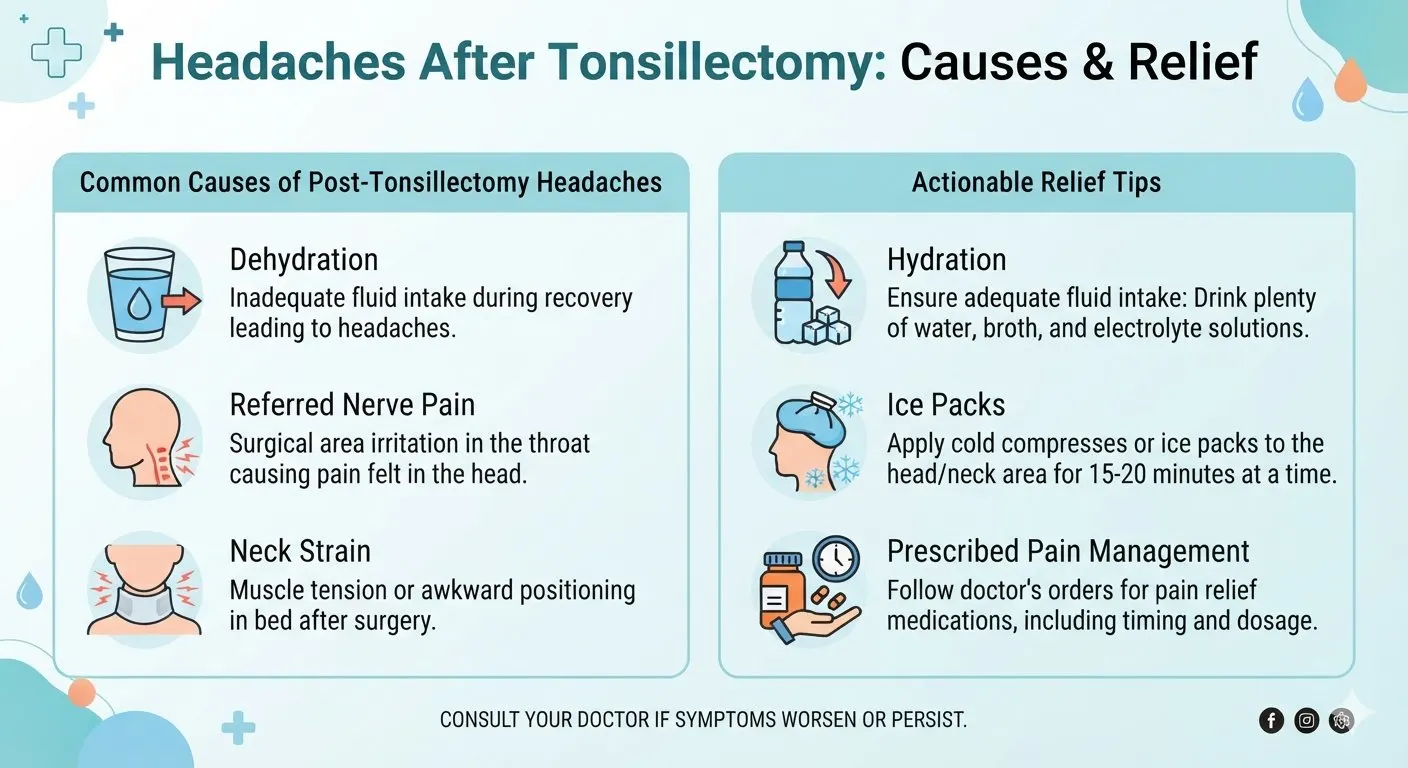
a. Dehydration — the number one cause
Painful odynophagia (pain on swallowing) makes children and adults refuse fluids. A reduction of even 2% in body-water content triggers release of vasopressin and angiotensin II, both potent cerebral vasoconstrictors that produce a classic dull, generalised dehydration headache. The Royal Hospital for Children Edinburgh pain-relief protocol explicitly flags fluid intake as the single most modifiable cause of headaches after tonsillectomy and adenoidectomy.
b. Referred pain and muscle tension
The glossopharyngeal nerve (CN IX) and the vagus nerve (CN X) both carry sensation from the tonsillar bed. Their branches share spinal roots with the greater auricular nerve and the upper cervical nerves (C2–C3). This anatomic cross-talk produces referred otalgia (ear pain) and cervicogenic headache — a tight, band-like pain across the back of the head and temples that is almost unique to headaches after tonsillectomy and adenoidectomy.
c. Anaesthesia and medication side effects
Volatile anaesthetic agents (sevoflurane, desflurane, isoflurane) and opioid premedication can cause residual headache, nausea, and dizziness in the first 24–48 hours. The US FDA 2012 black-box warning against codeine in children under 12 following tonsillectomy — still in force in 2026 — was issued because ultra-rapid CYP2D6 metabolisers can convert codeine to dangerous morphine levels, worsening both headache and respiratory depression. Modern NHS protocols have replaced codeine with scheduled paracetamol + ibuprofen, plus oral morphine solution on days 3–5 only when absolutely needed.
d. Sinus pressure and altered nasal airflow
The adenoids sit directly behind the posterior nasal choanae. Removing them creates transient nasopharyngeal mucosal oedema which temporarily blocks sinus drainage through the osteomeatal complex, producing sinus-pressure headaches felt behind the eyes and forehead. This mechanism is the dominant one when headaches after tonsillectomy and adenoidectomy come with facial fullness, a blocked nose, or a change in voice quality (rhinolalia clausa).
e. Caffeine withdrawal
Adults and teenagers who consumed coffee, tea, cola, or energy drinks pre-operatively may develop a classic caffeine-withdrawal headache 12–24 hours post-op — throbbing, frontal, often worse on standing. Allowing a small caffeinated drink (if the surgeon agrees) usually resolves it within 30 minutes.
f. Sleep fragmentation and nocturnal hypoxia
Post-operative throat swelling can temporarily WORSEN upper-airway obstruction in the first 48–72 hours before the benefit of adenoid removal kicks in. Episodes of intermittent nocturnal hypoxia trigger reactive cerebral vasodilation, producing the classic early-morning hypoxic headache — dull, bifrontal, worst on waking. This is why some patients notice headaches after tonsillectomy and adenoidectomy peak in the mornings during the first week.
g. Post-dural-puncture headache (rare)
Very rarely, if the anaesthetist used a regional block, a positional headache that worsens on sitting up and improves on lying flat may indicate cerebrospinal fluid (CSF) leak. This needs anaesthetic review — not a feature of a plain T&A, but worth knowing if a mother had a spinal top-up.
3. What’s Normal vs What’s a Red Flag
Most headaches after tonsillectomy and adenoidectomy are mild, respond to simple measures and resolve within 10 days. The following pattern is usually safe:
- Mild to moderate intensity, bifrontal or temporal
- Comes and goes with hydration and painkillers
- Worst in the morning, better by evening
- Associated with throat pain, referred ear ache, fatigue
- Gradually improves between day 7 and day 14
Seek urgent medical review if you see any of these red flags:
- Thunderclap headache — severe, sudden, worst-ever
- Fever > 38.5 °C (101.3 °F) with headache
- Neck stiffness, photophobia, or vomiting that prevents drinking
- Altered consciousness, drowsiness, or confusion
- Bright-red bleeding from the mouth or nose with headache
- Headache worsening after day 10 instead of improving
- New eye swelling, double vision, or facial numbness — could indicate cavernous sinus thrombosis (vanishingly rare but a surgical emergency)
4. Managing Headaches at Home — Evidence-Based Protocol
Based on NHS Lothian, NHS Greater Glasgow & Clyde, and AAO-HNS 2024 guidance, the home protocol to manage headaches after tonsillectomy and adenoidectomy is as follows:
- Hydrate aggressively — aim for a clear urine colour. Offer cold water, electrolyte drinks (Dioralyte, ORS), ice-chips, iced lollies, chilled milk, or jelly every 30–60 minutes while awake.
- Scheduled, not PRN, analgesia — paracetamol 15 mg/kg every 4 hours (max 60 mg/kg/24 h in children) PLUS ibuprofen 10 mg/kg every 6 hours. Never skip a dose to see if pain returns.
- Elevate the head of the bed 30° — this reduces nasopharyngeal oedema, improves sinus drainage, and lessens morning headaches after tonsillectomy and adenoidectomy.
- Cool-mist humidifier in the bedroom overnight — keeps healing mucosa moist and reduces hypoxic episodes.
- Soft, cool diet — smoothies, mashed potato, scrambled eggs, custard, pasta. Avoid crisps, toast, citrus, and very spicy foods.
- Short screen breaks, dim lights, quiet environment — reduces tension-headache load.
- Gentle neck stretches after 48 hours — relieves cervicogenic component.
5. Pain Medications — Dose, Timing & Safety
The following is the modern, evidence-based ladder for headaches after tonsillectomy and adenoidectomy as used across NHS and major Indian tertiary centres:
- Paracetamol (acetaminophen) — first line, scheduled 4-hourly. Oral or rectal.
- Ibuprofen — added from day 1 unless contraindicated (asthma with NSAID sensitivity, renal impairment, von Willebrand disease). A 2017 Cochrane review and multiple RCTs since have confirmed ibuprofen does NOT increase post-tonsillectomy bleeding.
- Oral morphine solution — added by NHS Lothian only on days 3–5, single morning dose, ONLY if the child does NOT have severe obstructive sleep apnoea.
- Avoid in children < 12: codeine, tramadol, aspirin (Reye’s syndrome risk).
- Dexamethasone — a single intra-operative dose (0.15–0.5 mg/kg) cuts post-op nausea, vomiting, and oedema-driven headaches after tonsillectomy and adenoidectomy by 30–50% (Cochrane 2023).
- Chewing-gum trial (adults only, from day 5) — small Egyptian RCTs (2022) show it reduces jaw-muscle tension headache.
6. When to Contact a Doctor Immediately
Contact your surgeon, GP, or NHS 111 / A&E if any of the following accompany headaches after tonsillectomy and adenoidectomy:
- Unable to keep fluids down for > 12 hours
- Fewer than 3 wet nappies in 24 hours (small child)
- Any fresh bleeding from the mouth or nose
- Fever > 38.5 °C that does not settle with paracetamol
- Severe stiff neck, photophobia, or altered mental state
- Seizure, weakness of one side, or new squint
- Rapidly worsening headache after day 10
7. Rare but Serious Complications
Although 99%+ of headaches after tonsillectomy and adenoidectomy are benign, every clinician must know the uncommon dangerous causes:
- Grisel syndrome — non-traumatic atlanto-axial rotatory subluxation following adenoidectomy, presenting with occipital headache + torticollis in a child. Needs cervical-spine imaging.
- Retropharyngeal or parapharyngeal abscess — fever, neck pain, trismus, drooling.
- Bacterial meningitis from contiguous spread — headache + fever + neck stiffness + photophobia.
- Cavernous sinus thrombosis — headache + eye proptosis + cranial-nerve palsies.
- Secondary post-tonsillectomy haemorrhage (5–10 days post-op) — blood swallowed overnight can present only as headache + pallor + tachycardia next morning.
8. Outlook & Recovery Timeline
The expected trajectory of headaches after tonsillectomy and adenoidectomy is:
- Days 0–2: anaesthetic hangover, mild-to-moderate frontal headache
- Days 3–5: peak period — dehydration + scab formation; pain and headache often worst now
- Days 6–8: scab shedding can cause transient worsening; watch for bleeding
- Days 9–14: steady improvement, headaches should be rare by day 14
- Beyond 2 weeks: any persistent or new headache warrants ENT review
9. Frequently Asked Questions
Q1. How long do headaches after tonsillectomy and adenoidectomy last?
Most settle within 7–10 days. A small proportion of adults have intermittent headaches up to 14 days as the throat heals and sleep normalises.
Q2. Which painkiller is safest for headaches after tonsillectomy and adenoidectomy in children?
Scheduled paracetamol plus ibuprofen. Avoid codeine, tramadol, and aspirin in under-12s. Recent Cochrane evidence confirms ibuprofen does NOT raise post-tonsillectomy bleeding risk.
Q3. Can dehydration alone cause the headache?
Yes — it’s the single commonest cause. Aim for clear urine. Cold fluids and iced lollies are the simplest fix.
Q4. Is a morning headache normal after T&A?
Yes. It reflects dry airway, nocturnal mouth-breathing, and temporary post-op nasal congestion. It usually clears within 30 minutes of sitting up, hydrating, and taking the morning dose of paracetamol.
Q5. When should I take my child to A&E for a headache after adenotonsillectomy?
Any of: thunderclap pain, fever > 38.5 °C with stiff neck, persistent vomiting, bright-red bleeding, drowsiness, confusion, seizure, or new neurological signs. Call 999 or 112 (India) for drowsiness or seizure.
Q6. Can caffeine withdrawal cause the headache?
Yes, in habitual coffee or cola drinkers. A small caffeinated drink (if the surgeon permits soft-diet fluids) usually resolves it within 30 minutes.
Q7. Can T&A trigger migraine?
Rarely, but the stress, dehydration, and sleep disruption can unmask the first attack in a predisposed person. If the headache is unilateral, pulsatile, with nausea, photophobia and visual aura, suspect migraine and consult a GP.
10. Summary & Conclusion
Headaches after tonsillectomy and adenoidectomy are common, usually benign, and almost always driven by dehydration, muscle tension, anaesthetic residues, sinus pressure, caffeine withdrawal, or sleep-breathing fluctuations. A scheduled regimen of paracetamol plus ibuprofen, aggressive hydration, head-elevated sleep, humidified air, and a soft cool diet resolves more than 95% of cases within 10 days. Red-flag headaches need urgent ENT review. With a careful, scheduled approach, headaches after tonsillectomy and adenoidectomy need not derail an otherwise life-changing surgery that delivers better sleep, fewer infections, clearer breathing and improved quality of life for the long term.
11. References
- American Academy of Otolaryngology-Head & Neck Surgery. Clinical Practice Guideline: Tonsillectomy in Children (Update). 2019, confirmed 2024.
- NHS Lothian. Pain Relief After Tonsillectomy V3.0. 2024.
- Alm F et al. Postoperative pain and recovery after pediatric tonsil surgery. Eur Arch Otorhinolaryngol 2020;277:3437–3448.
- Swedish Quality Register for Tonsil Surgery. Pain management survey. PLoS ONE 2024;19(3):e0298011.
- Wilson CA et al. Pain after discharge following head and neck surgery in children. Paediatr Anaesth 2016;26:992–1001.
- FDA Safety Communication. Codeine use after tonsillectomy/adenoidectomy. 2012, confirmed 2024.
- Cochrane Review. NSAIDs and perioperative bleeding in paediatric tonsillectomy. 2023 update.
- Royal College of Surgeons of England. Commissioning Guide: Tonsillectomy. 2024.
- NICE CG160 (updated 2024). Fever in under 5s.
- Khalifa AA. Postoperative pain control for adult tonsillectomy. Ain Shams University, 2024.
ENT Consultation & Surgery
Dr. Sagar Rajkuwar (MS-ENT)
Consultant ENT Specialist & Head-Neck Surgeon
Prabha ENT Clinic, plot no 345, Saigram colony, opposite Indoline furniture, Ambad link road, Ambad, 1 km from Pathardi phata, Nashik 422010, Maharashtra, India
📱 7387590194 | 9892596635
🌐 www.entspecialistinnashik.com
Medical Disclaimer: This article is for educational purposes only and does not replace professional medical advice, diagnosis, or treatment. If you or your child develops severe, persistent, or worsening headache after tonsillectomy and adenoidectomy, especially with fever, neck stiffness, drowsiness, bleeding or confusion, seek medical evaluation promptly. Audiogram results, imaging, or neurological findings should be interpreted only by a qualified ENT specialist, paediatrician, or neurologist.
📲 For Health-Related Articles & Videos
Related Reading on Adenoids, Tonsillectomy & ENT Care
- How to reduce Adenoids naturally
- Adenoidectomy Surgery Guide – Expert Advice
- What age is best for Adenoidectomy?
- Cost of Adenoidectomy in India
- Coblation Adenoidectomy Cost In India
- Adenoids laser Surgery cost
- Coblation adenoidectomy side effects
- Cost Of Adenoidectomy in Hyderabad
- Cost of Adenoidectomy in Delhi
- Cost of Adenoidectomy Surgery in Mumbai
- Cost of Adenoidectomy in Kerala
- Is Adenoid Surgery expensive?
- Do Antihistamines Help Adenoids?
- How do you know if your child needs adenoids out?
- Is There Any Ayurvedic Treatment For Adenoids?
- Do Adenoids Affect Brain Development in Children?
- Can Adenoids Turn Cancerous?
- How Can I Shrink My Adenoids Fast?
- When to Worry About Adenoids?
- What Does Grade 3 Adenoids Mean?
- What herbs are good for swollen adenoids?
- Shrink Your Toddler’s Adenoids Without Surgery
- How to Help a Child Sleep Better with Enlarged Adenoids
- Enlarged Adenoids in Children: Symptoms Parents Miss
- Is Drooling Normal After Adenoidectomy?
- Adenoidectomy Infection: Warning Signs
- Success Rate of Adenoid Removal
- Is Adenoid Surgery Safe?
- Is Removing Adenoids a Good Idea?
- What Happens If Adenoids Are Not Removed?
- Adenoid Cystic Carcinoma Symptoms
- Do Kids Sleep Better After Adenoid Removal?
- Can My Child Swim After Adenoidectomy?
- Can Removing Adenoids Affect Behavior?
- Adenoids and Speech Delay
- How to Prevent Adenoid Problems in Your Child
- Are Adenoids Linked to Allergies?
- What to Avoid After Adenoid Surgery
- Adenoids vs Allergies
- Are Adenoid Problems Genetic?
- Can Food Get Stuck in Your Adenoids?
- Do Adenoids Affect the Brain?
- How Long Does Adenoid Surgery Take?
- How to Keep Adenoids Healthy Naturally
- Severe Headache After Adenoidectomy
- How Risky Is Adenoid Removal?
- Does Removing Adenoids Improve Hearing?
- Do You Get Sick More Without Adenoids?
- Can Adenoids Cause Ear Pain?
- Adenoids Removed but Still Snoring?
- Can You Have Enlarged Adenoids Without Enlarged Tonsils?
- How Doctors Check Adenoids
- At What Age Are Adenoids Most Active?
- Do Adults Have Adenoids?
- Long-term Effects of Adenoid Removal
- Can Adenoids Grow Back in Adults?
- How Long for Adenoids to Grow Back After Surgery?
- How Much Does an Adenoid X-Ray Cost?
- Is Adenoid Surgery Covered by Insurance?
- Cefuroxime and Adenoid Infections
- Can Adenoids Cause Low Oxygen Levels?
- Can Enlarged Adenoids Cause Hearing Loss?
- Does Adenoid Removal Cause Weight Gain?
- Adenoids and Asthma
- How Many People Have Died from Adenoidectomy?
- Worst Days After Tonsillectomy and Adenoidectomy
- Foods to avoid for adenoids
- 7 Warning Signs of Tonsillectomy Infection
- How Long to Fully Heal After Tonsillectomy
- Bleeding When Tonsillectomy Scabs Fall Off
- Why Is My Tonsillectomy Taking So Long to Heal?
- What Adults Must Avoid After Tonsillectomy
- When Can I Sleep Flat After Tonsillectomy?
- Speed Up Tonsillectomy Recovery
- 8 Red Flags After a Tonsillectomy
- How Do You Tell If Your Tonsillectomy Is Healing?
- Does It Hurt When Tonsillectomy Scabs Fall Off?
- Tonsillectomy Scabs Stuck in Throat
- Is Coughing After a Tonsillectomy Normal?
- When Can I Talk Normally After Tonsillectomy?
- When Do Kids Start Feeling Better After Tonsillectomy?
- Why Does My Throat Hurt Months After Tonsillectomy?
- How to Know if Something Is Wrong After a Tonsillectomy
- Tonsillectomy and Adenoidectomy Recovery in Children: Complete Guide
- Adenotonsillectomy and ADHD
- When Will My Uvula Shrink After Tonsillectomy?
- Highest Risk Day for Bleeding After Tonsillectomy
- How Long to Sleep Elevated After Tonsillectomy
- Adenotonsillectomy and ADHD Symptoms
- Can Coughing Cause Bleeding After Tonsillectomy?
- Late Complications of Tonsillectomy
- No Red Popsicles After Tonsillectomy
- What Color Are Tonsillectomy Scabs?
- How Common Is Bleeding After Tonsillectomy?
- 10 Warning Signs After Tonsillectomy
- The 7-5-3 Rule After Tonsillectomy
- Reactionary Hemorrhage After Tonsillectomy
- Delayed Hemorrhage After Tonsillectomy
- What Does a Healing Tonsillectomy Look Like?
- Are Ear Infections Common After Tonsillectomy?
- Tinnitus with Ear Infection (Hindi)
- How to Tell If Your Tonsil Infection Is Bacterial
- What Kills Bacteria in the Tonsils?
- What Adults Should Avoid After Tonsillectomy (Marathi)
- White Stuff on Tonsils (Marathi)
- Adenoids and Speech (Hindi)
- Foods to Avoid for Adenoids (Marathi)
- Can Tonsillitis Cause Swollen Lymph Nodes?
- Why No Red Popsicles After Tonsillectomy?
- How Do I Know If My Tonsillectomy Is Healing Properly?
- Death Rate of Tonsillectomy in Adults
- Death Rate of Tonsillectomy in Children
- What Happens If Non-Dissolving Stitches Are Left In?
- Why Is Tonsillectomy Riskier for Adults?
- Why Tonsils Are Rarely Removed Today