Tonsillectomy and Adenoidectomy Recovery in Children: A Complete Guide-various aspects-
By Dr Sagar Rajkuwar (MS-ENT), Consultant ENT Specialist, Nashik, Maharashtra, India · Reviewed: 5 November 2026
Tonsillectomy and adenoidectomy recovery in children follows a surprisingly predictable day-by-day pattern — but parents who do not know what to expect are the ones who panic unnecessarily at day 5 or rush to A&E at day 7. This complete 2026 doctor’s guide walks you through every single day of tonsillectomy and adenoidectomy recovery in children, with the exact evidence-based pain-relief ladder, feeding plan, red-flag checklist and return-to-school timeline used across NHS, AAO-HNS and Indian ENT practice.
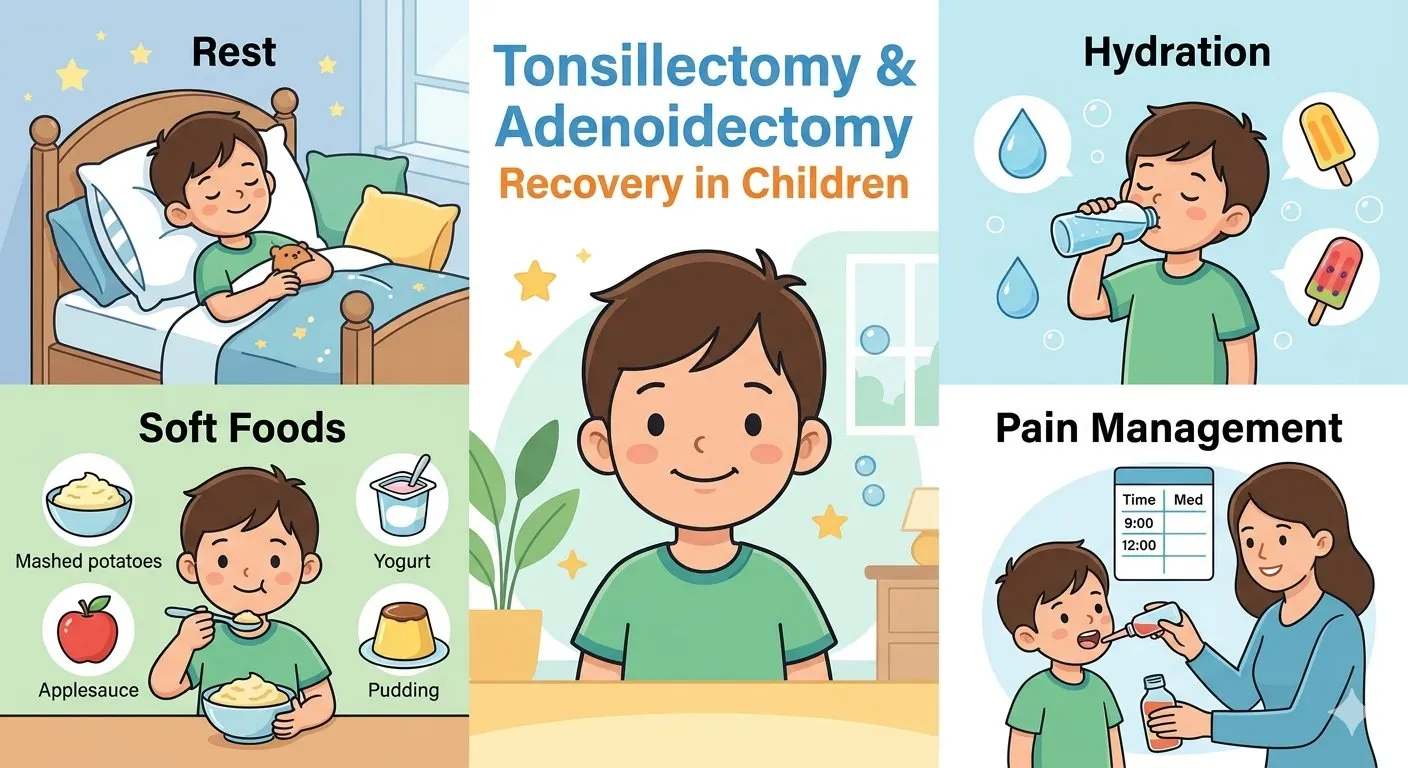
Table of Contents
- Introduction
- Day 1 — Surgery Day
- Day 2 — The Start of Soreness
- Days 3–4 — Peak Discomfort Period
- Days 5–6 — Scab Formation
- Days 7–8 — Scab Shedding (highest bleeding-risk window)
- Days 9–10 — Noticeable Improvement
- Days 11–14 — Final Healing Phase
- Normal vs Red Flag
- Tips to Make Recovery Easier
- FAQs
- Summary
- References
Introduction
A combined tonsillectomy and adenoidectomy (T&A) is the commonest major paediatric ENT surgery worldwide. Indications include recurrent streptococcal tonsillitis (SIGN 117 criteria), obstructive sleep apnoea (OSA), chronic mouth breathing, adenoid facies and recurrent otitis media with effusion. The tonsillectomy and adenoidectomy recovery timeline is typically 10–14 days, but the trajectory follows well-defined phases. Here is a short NHS explainer for parents:
Day 1 — Surgery Day
Surgery usually lasts 30–45 minutes under general anaesthesia with endotracheal intubation. The child wakes in recovery (PACU), often drowsy, nauseous, with sore throat. Discharge in most UK/Indian day-care units is 6–8 hours post-op if observations are stable and the child has taken oral fluids. On day 1 of tonsillectomy and adenoidectomy recovery, expect:
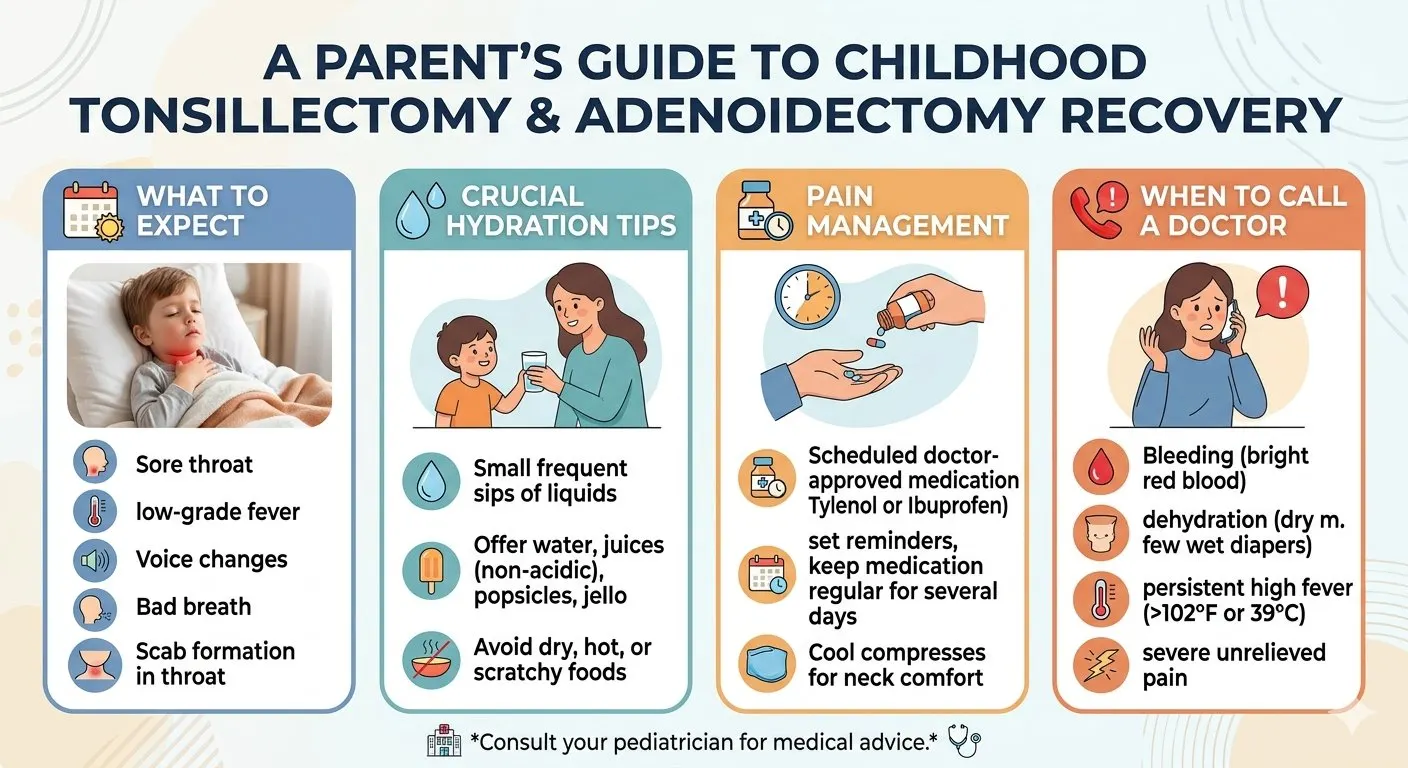
- Sore throat and odynophagia (pain on swallowing)
- Mild post-operative nausea and vomiting (PONV)
- Bad breath (halitosis) from cauterisation eschar
- Small blood-streaks in saliva for a few hours
Care protocol: Scheduled paracetamol 15 mg/kg 4-hourly + ibuprofen 10 mg/kg 6-hourly. Offer cold water, ORS, ice chips, iced lollies. No forceful coughing or throat clearing. Rest in bed, elevate head 30°.
Day 2 — The Start of Soreness
Anaesthetic residues wear off and pain rises. Classic referred otalgia (ear pain) via the glossopharyngeal nerve is common. The uvula may look oedematous. This is a normal phase of tonsillectomy and adenoidectomy recovery — do NOT stop medications.
- Encourage small, frequent sips of fluid — dehydration doubles the pain
- Soft, cool diet: yogurt, custard, mashed banana, jelly, kheer, cold rice-gruel
- Continue scheduled analgesia; do not wait for pain to worsen
- Expect irritability — comfort and distract with quiet activities
Days 3–4 — Peak Discomfort Period
This is the hardest phase of tonsillectomy and adenoidectomy recovery. White-yellow fibrin eschar forms where the tonsils were — a normal healing scab, NOT infection. Pain often radiates to both ears.
- Continuing low-grade fever up to 38 °C (100.4 °F) is normal
- Add oral morphine solution single morning dose (days 3–5) only if non-OSA child and surgeon prescribes it (NHS Lothian 2024 protocol)
- Room humidifier — moist air soothes the pharynx
- Avoid acidic, spicy or crunchy foods
- Cold treats (sugar-free lollies, ice cream) are evidence-based pain relievers
Days 5–6 — Scab Formation & Partial Improvement
Pain plateaus during the day but worsens at night due to oropharyngeal mucosal drying. Children often start talking more and moving around. This is a transitional phase of tonsillectomy and adenoidectomy recovery.
- Gradual progression to soft-solid diet: pasta, mashed potato, scrambled eggs, idli, soft upma
- Aim for clear urine as hydration marker
- Avoid vigorous activity or games that raise blood pressure — bleeding risk is still present
Days 7–8 — Scab Shedding (highest bleeding-risk window)
The fibrin scab starts to separate from healing mucosa. Temporary foul breath or a few blood-streaks in saliva is expected. This is statistically the peak window for secondary post-tonsillectomy haemorrhage (0.5–3% of all cases per Royal College of Surgeons UK audit). Tonsillectomy and adenoidectomy recovery at this stage needs the most vigilance.
Call the hospital/999 immediately if bleeding is more than a teaspoon, continuous, or bright red.
- Keep the child calm and resting
- No crunchy foods (chips, toast, biscuits)
- Gentle cold-saline mouth rinse only if advised
- Night-time pulse check if snoring; morning pallor can indicate silent overnight bleed
Days 9–10 — Noticeable Improvement
Pain, ear ache and fatigue drop sharply. Appetite returns. Scabs have mostly fallen off, exposing healthy pink mucosa. Tonsillectomy and adenoidectomy recovery is now clearly on an upward curve.
- Encourage normal eating with soft solids to exercise pharyngeal muscles
- Hydration still crucial until mucosa fully healed
- Mild morning dryness may persist
- No swimming, no contact sports until surgeon clears (usually 14 days)
Days 11–14 — Final Healing Phase
Most children are pain-free and back to normal diet and sleep. Nasal breathing is dramatically better after adenoidectomy — many parents comment that their child is snoring less within 48 hours of discharge and is completely silent by day 14.
- School/daycare return — usually safe after 10–14 days if no fever or bleeding (CDC and NHS both agree)
- Continue gentle oral hygiene
- Avoid air travel for 14 days if possible (Eustachian tube still oedematous)
- Any bleeding, high fever or persistent pain → same-day surgical review
Normal vs Red Flag
During tonsillectomy and adenoidectomy recovery, the following are NORMAL:
- Mild throat/ear pain, dull morning headache
- Low-grade fever < 38.5 °C (101.3 °F)
- White patches on the throat (fibrin eschar)
- Temporary snoring, nasal congestion, bad breath up to 10 days
- Pink-streaked saliva once or twice
Seek immediate medical help if:
- Bright-red bleeding from mouth or nose — call 999 / 112
- Continuous vomiting or inability to drink fluids > 8 h
- Fever > 38.8 °C (102 °F) not settling with paracetamol
- Severe pain not relieved by medication
- Lethargy, confusion, breathing difficulty, pale skin, cold peripheries
- Dehydration signs: dry mouth, < 3 wet nappies/24 h, sunken fontanelle
Tips to Make Recovery Easier for Children
- Hydration is king — fluids every 30–60 min while awake; aim for clear urine.
- Scheduled, not PRN, analgesia — paracetamol + ibuprofen on the clock, not just when pain is severe.
- Cool, soft, high-calorie foods — ice cream, smoothies, porridge, mashed banana, kheer, custard.
- Avoid irritants — no smoke exposure, no spicy/acidic/crunchy foods.
- Patience and reassurance — the hardest phase (days 3–6) will pass. Children may cry; stay calm.
- Keep a symptom diary — temperature, fluids in, urine out, pain score; very helpful for the post-op review.
- Prepare for the 7-day peak — plan quiet activities, favourite soft foods ready in the fridge.
Frequently Asked Questions
Q1. How many days does tonsillectomy and adenoidectomy recovery take in children?
Typically 10–14 days for mucosal healing. Children can usually return to school after day 10 if there has been no bleeding and no fever.
Q2. Which day is the worst?
Days 3–5 for pain and dehydration; days 7–8 for bleeding risk when the scab separates.
Q3. Is bad breath normal during tonsillectomy and adenoidectomy recovery?
Yes — the fibrin eschar produces a distinctive smell that can last 7–10 days. Antibiotics or mouthwash don’t change it. It resolves once the scab sheds.
Q4. When can my child eat normally?
Soft solids from day 2, gradual return to normal diet by day 10–12. Crunchy foods are the last to reintroduce.
Q5. Can my child swim or fly?
Swimming only after surgeon clearance — usually 14 days. Air travel is best avoided for 2 weeks.
Q6. What painkiller should I give?
Scheduled paracetamol + ibuprofen. Modern Cochrane evidence confirms ibuprofen does NOT increase bleeding. Avoid codeine, tramadol and aspirin in children < 12 (FDA warning, Reye’s syndrome).
Q7. When should I call 999 during tonsillectomy and adenoidectomy recovery?
Bright-red bleeding, breathing difficulty, drowsiness/confusion, seizure, severe pallor, or sudden deterioration. Secondary haemorrhage can be catastrophic if delayed.
Summary
Tonsillectomy and adenoidectomy recovery in children is a predictable 10–14 day journey with peak discomfort at days 3–6 and a bleeding-risk window at days 7–8. Scheduled paracetamol + ibuprofen, aggressive hydration, cool soft foods, humidified air and calm rest deliver the smoothest course. Parents who recognise normal fibrin eschar, know the red-flag bleeding signs and avoid stopping analgesia early will see their child back to school and to sport within two weeks — often with dramatically better sleep, fewer infections, clearer nasal breathing and improved behaviour as the long-term benefits of tonsillectomy and adenoidectomy recovery fully set in.
References
- American Academy of Otolaryngology-Head & Neck Surgery. Clinical Practice Guideline: Tonsillectomy in Children (Update). 2019, confirmed 2024.
- NHS Lothian. Pain Relief After Tonsillectomy V3.0. 2024.
- SIGN 117. Management of sore throat and indications for tonsillectomy. Updated 2023.
- Alm F et al. Postoperative pain and recovery after pediatric tonsil surgery. Eur Arch Otorhinolaryngol 2020;277:3437–3448.
- Royal College of Surgeons England. National Tonsillectomy Audit. 2024.
- FDA Safety Communication. Codeine use after tonsillectomy/adenoidectomy in children. 2012, confirmed 2024.
- Cochrane Review. NSAIDs and perioperative bleeding in paediatric tonsillectomy. 2023 update.
- NICE CG160 (updated 2024). Fever in under 5s.
- CDC. Return-to-school recommendations after routine paediatric surgery. 2024.
- Melbourne ENT Group. Discharge information: post tonsillectomy ± adenoidectomy. 2025.
ENT Consultation & Surgery
Dr. Sagar Rajkuwar (MS-ENT)
Consultant ENT Specialist & Head-Neck Surgeon
Prabha ENT Clinic, plot no 345, Saigram colony, opposite Indoline furniture, Ambad link road, Ambad, 1 km from Pathardi phata, Nashik 422010, Maharashtra, India
📱 7387590194 | 9892596635
🌐 www.entspecialistinnashik.com
Medical Disclaimer: This article is for educational purposes only and does not replace professional medical advice, diagnosis, or treatment. If your child develops bright-red bleeding, high fever, severe pain, drowsiness, or inability to drink after tonsillectomy and adenoidectomy, seek medical evaluation promptly or call 999 / 112 for emergencies.
Stay connected: Facebook — Positive Mind Healthcare | YouTube — Health Useful | WhatsApp group for health updates.
📲 For Health-Related Articles & Videos
🔹 Facebook: https://www.facebook.com/positivemind.healthcareRelated Reading on Adenoids, Tonsillectomy & ENT Care
- How to reduce Adenoids naturally
- Adenoidectomy Surgery Guide
- What age is best for Adenoidectomy?
- Cost of Adenoidectomy in India
- Coblation Adenoidectomy Cost In India
- Adenoids laser Surgery cost
- Coblation adenoidectomy side effects
- Cost Of Adenoidectomy in Hyderabad
- Cost of Adenoidectomy in Delhi
- Cost of Adenoidectomy Surgery in Mumbai
- Cost of Adenoidectomy in Kerala
- Is Adenoid Surgery expensive?
- Do Antihistamines Help Adenoids?
- How do you know if your child needs adenoids out?
- Ayurvedic Treatment For Adenoids
- Do Adenoids Affect Brain Development?
- Can Adenoids Turn Cancerous?
- How Can I Shrink My Adenoids Fast?
- When to Worry About Adenoids?
- What Does Grade 3 Adenoids Mean?
- Herbs for swollen adenoids
- Shrink Toddler Adenoids Without Surgery
- Help a Child Sleep with Enlarged Adenoids
- Enlarged Adenoids in Children: Symptoms Parents Miss
- Is Drooling Normal After Adenoidectomy?
- Adenoidectomy Infection Warning Signs
- Success Rate of Adenoid Removal
- Is Adenoid Surgery Safe?
- Is Removing Adenoids a Good Idea?
- What Happens If Adenoids Are Not Removed?
- Adenoid Cystic Carcinoma Symptoms
- Do Kids Sleep Better After Adenoid Removal?
- Can My Child Swim After Adenoidectomy?
- Can Removing Adenoids Affect Behavior?
- Adenoids and Speech Delay
- Prevent Adenoid Problems in Your Child
- Are Adenoids Linked to Allergies?
- What to Avoid After Adenoid Surgery
- Adenoids vs Allergies
- Are Adenoid Problems Genetic?
- Can Food Get Stuck in Adenoids?
- Do Adenoids Affect the Brain?
- How Long Does Adenoid Surgery Take?
- Keep Adenoids Healthy Naturally
- Severe Headache After Adenoidectomy
- How Risky Is Adenoid Removal?
- Does Removing Adenoids Improve Hearing?
- Do You Get Sick More Without Adenoids?
- Can Adenoids Cause Ear Pain?
- Adenoids Removed but Still Snoring?
- Can You Have Enlarged Adenoids Without Enlarged Tonsils?
- How Doctors Check Adenoids
- At What Age Are Adenoids Most Active?
- Do Adults Have Adenoids?
- Long-term Effects of Adenoid Removal
- Can Adenoids Grow Back in Adults?
- Time for Adenoids to Grow Back
- Adenoid X-Ray Cost
- Is Adenoid Surgery Covered by Insurance?
- Cefuroxime and Adenoid Infections
- Can Adenoids Cause Low Oxygen?
- Can Enlarged Adenoids Cause Hearing Loss?
- Does Adenoid Removal Cause Weight Gain?
- Adenoids and Asthma
- Deaths from Adenoidectomy
- Worst Days After T&A
- Foods to avoid for adenoids
- Signs of Tonsillectomy Infection
- Time to Fully Heal After Tonsillectomy
- Bleeding When Scabs Fall Off
- Why Taking So Long to Heal?
- What Adults Must Avoid After Tonsillectomy
- When Can I Sleep Flat?
- Speed Up Tonsillectomy Recovery
- Red Flags After Tonsillectomy
- How to Tell If Tonsillectomy Is Healing
- Does It Hurt When Scabs Fall Off?
- Scabs Stuck in Throat
- Is Coughing After Tonsillectomy Normal?
- When Can I Talk Normally?
- When Do Kids Start Feeling Better?
- Throat Hurts Months After Tonsillectomy
- How to Know If Something Is Wrong
- Headaches After T&A
- Adenotonsillectomy and ADHD
- When Will Uvula Shrink?
- Highest Risk Day for Bleeding
- Sleep Elevated After Tonsillectomy
- T&A and ADHD Symptoms
- Can Coughing Cause Bleeding?
- Late Complications of Tonsillectomy
- No Red Popsicles After Tonsillectomy
- Color of Tonsillectomy Scabs
- Bleeding After Tonsillectomy
- 10 Warning Signs After Tonsillectomy
- The 7-5-3 Rule
- Reactionary Hemorrhage
- Delayed Hemorrhage
- What a Healing Tonsillectomy Looks Like
- Ear Infections After Tonsillectomy
- Tinnitus with Ear Infection (Hindi)
- Bacterial Tonsil Infection
- What Kills Bacteria in the Tonsils?
- Adults Avoid After Tonsillectomy (Marathi)
- White Stuff on Tonsils (Marathi)
- Adenoids and Speech (Hindi)
- Foods to Avoid for Adenoids (Marathi)
- Tonsillitis and Swollen Lymph Nodes
- Why No Red Popsicles
- Is My Tonsillectomy Healing Properly?
- Death Rate of Tonsillectomy in Adults
- Death Rate of Tonsillectomy in Children
- Non-Dissolving Stitches Left In
- Tonsillectomy Riskier for Adults
- Why Tonsils Are Rarely Removed Today