“Do Adults Have Adenoids? Myths, Facts, Symptoms & Treatment”
Adults do have adenoids, however the tissue often disappears entirely by the late teens or early twenties, or it diminishes to a small leftover. Chronic inflammation or adult adenoid enlargement can occur, albeit infrequently, as a result of allergies or chronic infections.
Updated October 2026 with the latest ENT evidence on adult adenoid hypertrophy prevalence from MRI imaging studies, HIV-associated adenoid enlargement, red-flag symptoms suggesting nasopharyngeal cancer, coblation vs. conventional adenoidectomy outcomes in adults, and the role of nasal endoscopy in diagnosis.
Author: Dr Sagar Rajkuwar, ENT Specialist, Nashik, Maharashtra, India
🌐 www.entspecialistinnashik.com
Figure 1 — Adult adenoids: age-related changes, prevalence of residual tissue, and when to worry.
Table of contents
- Introduction
- What exactly are adenoids?
- Is it true that as people get older, their adenoids go away?
- Myths and Facts About Adult Adenoids
- Signs of Enlarged Adenoids in Adults
- What causes some adults to retain their adenoids?
- When does an adult have adenoid problems?
- Adults with enlarged adenoids have a variety of treatment choices.
- Is it possible for adult adenoids to indicate something serious?
- Key takeaways
- Modern Advances: Imaging, Coblation Surgery & HIV-Related Hypertrophy (new, Oct 2026)
- Concluding Remarks
- Summary
1)Introduction
Thinking of adenoids, you probably think of young children seeing an ENT doctor for problems with breathing, snoring, or recurrent ear infections. It is common for people to think that adenoids are a “childhood problem” that goes away as children get older. However, does this imply that adults do not have adenoids at all?
The reality is more complex. Adenoids are most active throughout childhood, but they don’t always disappear entirely in adulthood. In certain cases, even adults may still have a little adenoid tissue, which can sometimes lead to medical issues. We will dispel the myths and truths surrounding adult adenoids in this piece and try to clarify any misunderstanding.
Further context (added October 2026): The old teaching that “adults don’t have adenoids” has been firmly disproved by modern imaging studies. A midsagittal MRI study by Perry et al. (American Journal of Speech-Language Pathology, 2022) measured adenoid thickness across the lifespan and found measurable residual adenoid tissue in the majority of adults scanned, even into the sixth decade. What has changed in recent years is not whether adults have adenoids, but how we recognise and manage persistent or newly enlarged tissue in adulthood — because the differential diagnosis in an adult is wider and the stakes are higher. In children, enlarged adenoids are almost always benign lymphoid hyperplasia; in adults, the same finding can occasionally mark something more serious, including HIV-related lymphoid hypertrophy, lymphoma, or nasopharyngeal carcinoma. This article has been updated to reflect that modern, more cautious framework.
2)What exactly are adenoids?
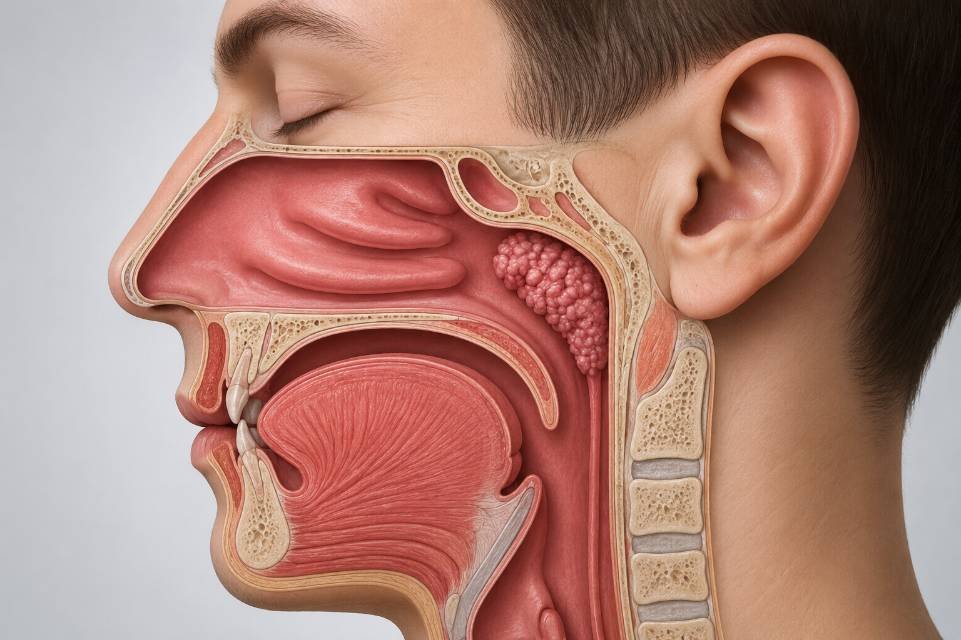
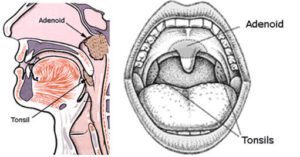
The nasopharynx, which is the area behind the nose, high up in the throat, is where the adenoids are found, a mass of lymphoid tissue. They aid in capturing bacteria and viruses that enter through the nose since they are a component of the body’s immune system.
- In youngsters, the adenoids help to safeguard the body by increasing immunity.
- In adults: Their function declines dramatically as the immune system develops and adapts through other organs such the tonsils and lymph nodes.
Further anatomical detail (added October 2026): Adenoids are formally called the pharyngeal tonsil and sit in the roof of the nasopharynx, just behind the posterior choanae and above the Eustachian-tube openings. Together with the palatine tonsils (in the throat), the lingual tonsil (at the back of the tongue) and the tubal tonsils (near the Eustachian-tube openings) they form Waldeyer’s ring — the body’s first-line immune defence against inhaled and ingested pathogens. The adenoids are covered by a specialised ciliated respiratory epithelium (unlike the stratified squamous epithelium of the palatine tonsils), which makes them particularly adapted for sampling nasal air for antigens and producing immunoglobulin A (IgA). This explains why adenoid tissue is most prominent in the first few years of life, when the child’s immune system is actively learning which antigens are harmless and which are not — and why involution begins once immune memory has matured.
3)Is it true that as people get older, their adenoids go away?
Adenoids usually attain their greatest size between the ages of three and seven. By the late adolescent years, they are frequently assumed to have “disappeared” as a result of involution, a process whereby they begin to diminish.
However, the truth is that:
- The adenoids of many adults decrease to the point that they are nearly unnoticeable or useless.
- Some adults retain minute traces of adenoid tissue.
- Adenoids occasionally stay large and continue to cause symptoms.
Therefore, although adenoids often regress, they do not always disappear entirely.
Added October 2026 — numbers from MRI and endoscopy studies: Imaging-based prevalence data have refined what “involution” actually means. Published MRI and nasal-endoscopy series from India, Turkey, Egypt and Europe suggest that roughly 55–70% of healthy adults still have endoscopically or radiologically visible adenoid tissue, albeit usually in the form of a thin pad rather than the bulky mass seen in children. The proportion with clinically significant adenoid hypertrophy — defined by symptoms plus a measurable obstruction of ≥50% of the choanal airway — is far smaller: approximately 1–3% of the general adult population in large unselected cohorts, rising to 5–10% in adults attending ENT clinics for nasal obstruction. Adenoid tissue regrows mildly during pregnancy and recedes afterwards; it may also enlarge temporarily during a viral upper-respiratory infection and then return to baseline. In HIV-positive adults, especially those with uncontrolled viral loads, the prevalence of clinically significant hypertrophy rises substantially to roughly 10–30%, reflecting lymphoid activation in response to the infection — an important point we return to in Section 11.
4)Myths and Facts About Adult Adenoids
Myth 1: Adults don’t have adenoids.
Fact: Even if it’s often considerably smaller than in youngsters, adults can still have adenoid tissue. Some adults may have adenoid hypertrophy as a result of persistent illnesses, allergies, or other factors.
Myth 2: Adenoid issues just impact youngsters.
Truth: Even though adenoid problems are more prevalent in youngsters, adults can still have issues like snoring, ear infections, or nasal congestion if the tissue stays enlarged.
Myth 3: In adults, enlarged adenoids pose no danger.
Fact: In adults, enlarged or persistent adenoids shouldn’t be disregarded. Sometimes, they may resemble or hide more severe illnesses, such as nasopharyngeal tumors. A thorough examination by an ENT doctor is necessary.
Myth 4: After being removed, adenoids can regenerate in adulthood.
The truth is that while adenoidectomy can cause regrowth, it happens much more often in children than in adults. Regrowth is uncommon in adults, but minute remnants may remain.
Myth 5 (added October 2026): Adult adenoid enlargement is always cancer.
Fact: Most adult adenoid enlargement is benign — chronic allergy, chronic viral infection, HIV-related lymphoid activation, or simple persistent childhood hypertrophy. However, the possibility of nasopharyngeal carcinoma, lymphoma or an adenoid cystic carcinoma rises with age, with unilateral or asymmetric enlargement, and with the presence of red-flag symptoms (unilateral blockage, blood-stained discharge, unilateral middle-ear effusion, cranial-nerve symptoms, cervical lymphadenopathy, weight loss). The right approach is a thorough ENT examination with nasal endoscopy — not reassurance, and not panic.
Myth 6 (added October 2026): Nasal steroids can cure adult adenoid hypertrophy.
Fact: Nasal steroid sprays (fluticasone, mometasone, budesonide) can reduce adenoid size by roughly 20–40% in series of children and have an off-label but useful role as a trial in adults with mild symptoms. However, they rarely eliminate significant obstructive hypertrophy and do not treat underlying allergy, infection, or malignancy. A failed 2–3 month trial of nasal steroids is one of the signals that formal diagnosis (endoscopy ± biopsy) is needed.
5)Signs of Enlarged Adenoids in Adults
Adults with enlarged or persistent adenoids may experience the following symptoms:
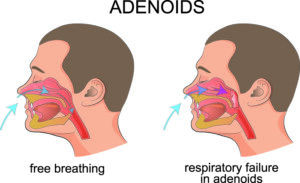
- Nasal congestion or obstruction (commonly confused with persistent sinusitis)
- Having trouble breathing through the nose
- Breathing problems while sleeping or snoring
- Having a postnasal drip (the sensation that mucus is trapped in the throat)
- recurrent ear issues like otitis media or fluid accumulation
- variations in voice (a nasal-sounding voice)
Because the symptoms of adenoids can resemble those of other ENT illnesses, most adults are unaware that adenoids may be the cause.
Added October 2026 — fuller symptom profile and red-flag combinations: Published adult-adenoid case series have expanded the symptom profile to include:
- Obstructive sleep apnea (OSA): adenoid hypertrophy is now recognised as a contributor to adult OSA, especially when combined with tonsillar enlargement, nasal septal deviation, or obesity. A polysomnography study may be needed before deciding on treatment.
- Hyponasal speech (“rhinolalia clausa”): blocked nasopharynx produces a muffled, “cold-in-the-nose” voice quality — different from the open hypernasal voice heard in velopharyngeal insufficiency.
- Chronic Eustachian-tube dysfunction: ear fullness, popping, intermittent muffled hearing, and in some cases serous otitis media with effusion in an adult.
- Chronic rhinosinusitis that fails medical treatment: because the adenoid pad obstructs mucociliary clearance from the posterior nasal cavity.
- Halitosis from stagnant postnasal secretions.
- Headache and facial pressure secondary to sinus outflow obstruction.
- Snoring that worsens over weeks or months in an adult (as opposed to lifelong snoring) deserves endoscopic evaluation.
Red-flag combinations that warrant same-week ENT review:
- Unilateral nasal obstruction + blood-stained discharge (concerning for nasopharyngeal tumor)
- Unilateral serous otitis media in an adult who has never had ear problems before (suspicious for a mass obstructing the Eustachian-tube opening)
- Painless, firm cervical lymph node in the posterior triangle, especially retroauricular or jugulodigastric
- Cranial-nerve symptoms (double vision, facial numbness, hoarseness) — rare but critical
- Unexplained weight loss or persistent new-onset headache
Any of these should prompt flexible nasal endoscopy, and often MRI with contrast.
6)What causes some adults to retain their adenoids?
Persistent adenoids in adults can be caused by a variety of factors:
- Repeated respiratory infections can lead to persistent adenoid tissue activity.
- Allergies The adenoids can remain inflamed as a result of ongoing nasal allergies.
- Environmental factors – Pollution, smoking, or exposure to irritants can all cause enlargement.
- Genetic predisposition: Some people have a larger adenoid tissue by nature.
Added October 2026 — expanded cause list from recent literature:
- HIV infection: uncontrolled HIV causes marked lymphoid activation throughout Waldeyer’s ring, with adenoid enlargement observed in roughly 10–30% of untreated or poorly controlled patients. Antiretroviral therapy usually reduces the enlargement.
- Chronic laryngopharyngeal reflux (LPR): acid-pepsin injury to the nasopharyngeal mucosa drives chronic lymphoid activation.
- Immunocompromise (post-transplant, biologics, long-term steroids): altered immune surveillance may permit chronic viral activation and adenoid hyperplasia.
- Chronic adenoiditis with biofilm: studies have demonstrated bacterial biofilms (Staphylococcus aureus, Haemophilus influenzae, Streptococcus pneumoniae) adherent to adenoid tissue, which help explain persistent and relapsing symptoms despite antibiotic courses.
- Chronic nasal irritants: occupational exposure to flour dust, chemical fumes, construction dust and tobacco smoke.
- Craniofacial anatomy: a narrow nasopharynx (seen in some patients with midface hypoplasia or syndromic features) may make even normal-sized adenoid tissue clinically significant.
- Rebound after corticosteroid withdrawal in some chronic allergy sufferers.
Understanding the specific cause matters because it changes treatment: an HIV-positive patient needs antiretroviral optimisation first, an allergic patient needs allergen avoidance and nasal steroids, and a biofilm-driven case may need a longer-than-usual antibiotic course combined with saline irrigation before surgery is considered.
7)When does an adult have adenoid problems?
It is more difficult to identify big adenoids in adults than it is in children. ENT professionals may employ:
- nasopharyngoscopy The adenoids are directly visible via a small, flexible scope that is inserted via the nose.
- Imaging may be used to determine blockage in the nasopharynx using X-rays or CT scans.
- hearing exams – To determine if adenoids are contributing to the accumulation of fluid in the middle ear.
Added October 2026 — a modern diagnostic framework:
- Flexible fibre-optic nasal endoscopy is the single most useful test. In the clinic, under topical decongestion and anesthesia, the ENT specialist can see the adenoid pad directly, grade its size (modified Clemens-Rombo or Parikh grading), check for asymmetry, look at the Eustachian-tube orifices, and biopsy anything suspicious at the same visit if needed.
- Lateral soft-tissue X-ray of the nasopharynx is cheap and widely available in India; it gives an approximate adenoid-nasopharyngeal ratio and remains a reasonable first screen in a resource-limited setting.
- CT scan defines bony landmarks, excludes antrochoanal polyp, and documents sinus involvement.
- MRI with contrast is now the preferred imaging modality when a nasopharyngeal mass is suspected on endoscopy — it distinguishes lymphoid hyperplasia from early malignancy better than CT.
- Audiogram and tympanometry for all adults with suspected adenoid-related ear symptoms, especially if the middle-ear effusion is unilateral.
- Polysomnography (sleep study) when snoring or witnessed apnea is reported.
- Allergy testing (skin prick or specific IgE) when a chronic allergic driver is suspected.
- HIV test should be considered — particularly in a patient with new-onset adenoid hypertrophy, generalised lymphadenopathy or risk factors. Many national guidelines (NACO in India, CDC in the US) recommend offering an HIV test to adults with unexplained lymphoid enlargement.
- Biopsy is indicated for any asymmetric, bleeding or atypical-looking lesion, or in any adult over 40 with new unilateral nasopharyngeal fullness, to definitively rule out carcinoma or lymphoma.
8)Treatment Options
1. Medicines
- Nasal steroid sprays and allergy drugs can help minimize swelling.
- Antibiotics are given if a bacterial infection causes acute inflammation.
- Surgery (Adenoidectomy): Done seldom in cases of severe obstructive breathing issues or chronic infections that do not respond to medical therapy.
Let me know if you or someone you know is having symptoms:
- Do you suffer from persistent snoring or nasal blockage?
- Have these symptoms been occurring for a while or have they only recently surfaced?
I can explain when it’s appropriate to consult an ENT doctor.
Treatment choices for adults with persistent symptoms caused by adenoid tissue include:
2. Adenoidectomy (Surgical Removal)
Surgery to remove the blockage may be advised if it is severe, recurrent, or if complications are suspected. Although it is less prevalent in adults, it may greatly enhance one’s quality of life.
3. Changing Your Lifestyle
- Staying away from smoking and polluted settings.
- Using saline rinses to maintain sinus health.
- Increasing immunity via food and physical activity.
Added October 2026 — modern surgical options and evidence:
- Conventional cold-steel curettage adenoidectomy remains the long-standing technique and is still safe and effective, but is less precise and causes more bleeding than modern methods.
- Suction-cautery (monopolar/bipolar) adenoidectomy gives better haemostasis with faster operating time.
- Powered-microdebrider adenoidectomy under endoscopic vision gives the most complete removal of the adenoid pad with lower regrowth rates and is increasingly the standard in adult centres.
- Coblation adenoidectomy uses a radiofrequency-generated plasma field at relatively low temperatures (around 60–70 °C) to dissolve tissue with minimal thermal injury. Clinical trial data (including randomised comparisons registered on ClinicalTrials.gov NCT02312947 and NCT07417007, and multiple published series) show that coblation adenoidectomy delivers:
- significantly less intra-operative blood loss (often less than 10 ml vs 30–50 ml for conventional surgery)
- shorter operating time once the surgeon is experienced
- less post-operative pain and faster return to normal diet
- comparable or lower rates of residual adenoid tissue when done under endoscopic vision
- Lifestyle and medical adjuncts: smoking cessation, allergy control, nasal saline irrigation, treatment of reflux, and HIV optimisation where relevant are not optional — they reduce the chance that the adenoid pad will regrow and that symptoms will relapse after any surgery.
- In HIV-positive adults, optimisation of antiretroviral therapy is usually attempted before surgery; adenoid tissue often shrinks substantially once viral control is achieved.
9)Is it possible for adult adenoids to indicate something serious?
Although persistent adenoids are often benign, they should not be overlooked. In unusual instances, the enlarged adenoid tissue may actually be:
- a tumor in the nasopharynx
- cysts or tumors
- additional lumps in the nasal passage
For this reason, it is imperative to have a thorough ENT assessment, particularly if the onset of symptoms occurs unexpectedly in adulthood.
Added October 2026 — specific diagnoses to consider:
- Nasopharyngeal carcinoma (NPC) is particularly important in adults of South-East Asian, Southern Chinese and North African origin, and is strongly linked to Epstein-Barr virus. It commonly presents with unilateral nasal obstruction, blood-stained nasal discharge, serous otitis media and a painless upper-neck lymph node. NPC is highly treatable when caught early (5-year survival >90% in stage I disease).
- Nasopharyngeal lymphoma (both Hodgkin and non-Hodgkin) can masquerade as benign adenoid hypertrophy and is sometimes diagnosed only after biopsy of what was expected to be routine adenoid tissue.
- Adenoid cystic carcinoma — a slow-growing but perineurally invasive salivary-type cancer that can arise in the nasopharynx.
- Juvenile nasopharyngeal angiofibroma (JNA) — a highly vascular benign tumor seen in adolescent and young-adult males, presenting with recurrent severe epistaxis plus nasal obstruction. Biopsy is contraindicated because of bleeding risk; CT and MRI are the diagnostic tests.
- Thornwaldt (Tornwaldt) cyst — a benign midline nasopharyngeal cyst usually discovered incidentally on imaging.
- Rathke cleft cyst extending inferiorly.
- Chordoma — rare but can present with a nasopharyngeal bulge from behind.
- HIV-related lymphoid hyperplasia — benign but a marker of underlying infection needing diagnosis and treatment.
The rule in modern ENT practice is simple: any adult with new or asymmetric nasopharyngeal fullness, especially over age 40, deserves nasal endoscopy and a low threshold for MRI and biopsy.
10)Key takeaways
- Although they are often little or dormant, adults can have adenoids.
- Adults with chronic illnesses or allergies may experience enlarged adenoids, although this is uncommon.
- An ENT expert should examine persistent symptoms such as nasal congestion, snoring, or ear issues.
- The course of treatment varies from medical management to adenoidectomy in extreme circumstances.
- Never exclude more severe reasons for nasopharyngeal blockage in adults.
- MRI studies show that 55–70% of adults have residual adenoid tissue; clinically significant hypertrophy affects 1–3% of the general adult population.
- Unilateral or asymmetric adenoid enlargement in an adult is a red flag that always deserves nasal endoscopy and often MRI.
- HIV, lymphoma, nasopharyngeal carcinoma and adenoid cystic carcinoma can all masquerade as adult adenoid hypertrophy.
- When surgery is needed, endoscope-guided coblation or powered-microdebrider adenoidectomy is now the preferred technique.
- Any adult with blood-stained nasal discharge, unilateral middle-ear effusion, or an unexplained upper-neck lymph node needs urgent evaluation.
11)Modern Advances: Imaging, Coblation Surgery & HIV-Related Hypertrophy (new section — October 2026)
Three evidence-based developments have changed the modern approach to adult adenoids:
a. MRI prevalence data
The Perry et al. (2022) midsagittal MRI study of adenoid growth and involution across the lifespan showed that adenoid tissue does not simply “vanish” in adulthood. Measurable adenoid tissue persists into the sixth decade in the majority of healthy adults — usually as a thin pad. This has shifted ENT teaching from a binary “children have adenoids, adults don’t” to a spectrum where the real clinical question is whether the tissue is symptomatic, asymmetric, or pathological.
b. Coblation adenoidectomy in adults
Clinical trial data (NCT02312947, NCT07417007 and multiple published series) have established coblation as a safe, less-bloody, less-painful alternative to conventional cold-curettage adenoidectomy in adults — a particularly welcome improvement because adult tissue tends to be more fibrotic and bleeds more than paediatric tissue. Combined with transnasal endoscopic visualisation, coblation gives a near-complete removal of the adenoid pad under direct vision, with lower residual-tissue rates.
c. HIV-related lymphoid hypertrophy
Recognition of HIV-related adenoid and tonsillar hypertrophy has grown over the last decade. In high-prevalence regions, a young or middle-aged adult presenting with new, bilateral, symmetrical adenoid hypertrophy — especially with generalised lymphadenopathy — warrants an HIV test as part of routine evaluation. Antiretroviral therapy typically reduces lymphoid-tissue bulk, and surgery is reserved for cases where airway or hearing symptoms persist despite viral control.
d. Nasal steroids as a bridging therapy
Mometasone furoate and fluticasone furoate have both been studied for adenoid-related nasal obstruction. In adult pilot studies they reduce adenoid-pad size by around 20–40% and improve nasal breathing in a subset of patients, often enough to defer surgery. A 2–3 month trial is now a reasonable first step in symptomatic adults with no red flags.
e. Role of nasal endoscopy in general ENT practice
Flexible nasal endoscopy is now routinely available in most Indian ENT clinics and is the single most important investigation in an adult with suspected adenoid problems. It takes under five minutes, needs no anesthesia, allows biopsy of anything suspicious at the same visit, and is more informative than a lateral soft-tissue X-ray.
Together these changes mean that adult adenoid disease is now diagnosed earlier, better characterised, more safely treated, and when it masks something more serious, caught at a stage where cure is still possible.
12)Concluding Remarks
“Adenoids only exist in children” is a popular myth. Even though adenoids typically decrease in size with age, adults may still have a little amount of adenoid tissue, which might occasionally lead to health problems.
An ENT expert should be consulted if you are an adult experiencing unexplained nasal congestion, recurrent ear infections, or respiratory issues related to sleep. An easy test can tell if your symptoms are caused by adenoids or something else.
Knowing the myths and facts will help you be better able to take care of your health and steer clear of needless perplexity.
Updated October 2026: Modern tools — flexible nasal endoscopy, MRI with contrast, coblation adenoidectomy under endoscopic vision, and routine HIV testing in appropriate cases — mean that an adult with suspected adenoid problems can now be diagnosed and treated more accurately and more safely than ever before. But the single most important first step remains unchanged: get the nose and nasopharynx looked at by an ENT specialist, early, especially when symptoms are new, one-sided, or combined with any of the red-flag features described above.
13)Summary
Although some may think that adenoids are only found in children, adults can still have little adenoid tissue. These remnants may occasionally grow larger and produce symptoms such as snoring, a blocked nose, or recurring ear infections. This article addresses the myths and truths surrounding adult adenoids, including their potential etiology, signs and symptoms, diagnosis, and therapy options.
Since adenoids generally decrease with age, any ongoing enlargement in adults should always be treated, as it can occasionally resemble severe disorders. For a correct diagnosis and effective treatment, it is imperative to see an ENT expert.
Medical Disclaimer
Medical Disclaimer: This article is for general educational and informational purposes only and should not be considered a substitute for professional medical advice, diagnosis, or treatment. Persistent nasal blockage, snoring, recurrent ear problems, or other symptoms in adults should be evaluated by a qualified ENT specialist. Enlarged adenoid tissue in adults may have different causes, so appropriate examination and investigation are important. Do not start, stop, or change any medication or treatment based solely on information in this article. Always consult your doctor or ENT specialist for advice based on your individual condition.
🎥 Watch Educational Videos
👉 YouTube Channel:
http://www.youtube.com/@healthuseful8539/
📞 ENT Consultation & Surgery
Dr. Sagar Rajkuwar (MS-ENT)
Prabha ENT Clinic, Ambad, Nashik
📱 7387590194 | 9892596635
🌐 www.entspecialistinnashik.com
📲 For Health-Related Articles & Videos
🔹 Facebook: https://www.facebook.com/positivemind.healthcare
🔹 YouTube: http://www.youtube.com/@healthuseful8539/
Adenoids – Categorized Internal Linking List
1. Adenoid Types, Grades & Basic Information
- What Does Grade 3 Adenoids Mean? Symptoms, Causes & Treatment Explained
https://healthuseful.com/what-does-grade-3-adenoids-mean/ - At What Age Are Adenoids Most Active? Every Parent Should Know This!
https://healthuseful.com/at-what-age-are-adenoids-most-active/ - Can You Have Enlarged Adenoids Without Enlarged Tonsils?
https://healthuseful.com/can-you-have-enlarged-adenoids-without-enlarged-tonsils/ - Enlarged Adenoids in Children: Symptoms That Look Harmless But Aren’t
https://healthuseful.com/enlarged-adenoids-in-kids-symptoms-parents-miss/ - Do Adults Really Have Enlarged Adenoids? Here’s the Expert Explanation (added Oct 2026)
https://healthuseful.com/do-adults-have-enlarged-adenoids/
2. Adenoid Symptoms & Problems
- When to Worry About Adenoids?
https://healthuseful.com/when-to-worry-about-adenoids/ - Can Adenoids Cause Ear Pain?
https://healthuseful.com/can-adenoids-cause-ear-pain/ - Can Adenoids Cause Low Oxygen Levels?
https://healthuseful.com/can-adenoids-cause-low-oxygen/ - Can Enlarged Adenoids Cause Hearing Loss?
https://healthuseful.com/can-adenoids-affect-hearing/ - Adenoids and Speech Delay
https://healthuseful.com/can-adenoids-affect-speech/ - How to Help a Child Sleep Better with Enlarged Adenoids
https://healthuseful.com/how-to-help-a-child-sleep-with-enlarged-adenoids/ - Do Adenoids Affect the Brain?
https://healthuseful.com/do-adenoids-affect-the-brain/ - Do Adenoids Affect Brain Development in Children?
https://healthuseful.com/do-adenoids-affect-brain-development/ - Can Food Get Stuck in Adenoids?
https://healthuseful.com/can-food-get-stuck-in-adenoids/
3. Causes, Allergies & Related Conditions
- Are Adenoids Linked to Allergies?
https://healthuseful.com/are-adenoids-related-to-allergies/ - Adenoids vs. Allergies
https://healthuseful.com/adenoids-vs-allergies-what-doctors-want-you-to-understand/ - Are Adenoid Problems Genetic?
https://healthuseful.com/are-adenoid-problems-genetic/ - Adenoids and Asthma
https://healthuseful.com/can-adenoids-make-asthma-worse/ - Do Antihistamines Help Adenoids?
https://healthuseful.com/do-antihistamines-help-adenoids/
4. Natural Treatment & Shrinking Adenoids
- How to Reduce Adenoids Naturally?
https://healthuseful.com/how-to-reduce-adenoids-naturally/ - How Can I Shrink My Adenoids Fast?
https://healthuseful.com/how-can-i-shrink-my-adenoids-fast/ - What Herbs Are Good for Swollen Adenoids?
https://healthuseful.com/what-herbs-are-good-for-swollen-adenoids/ - Is There Any Ayurvedic Treatment for Adenoids?
https://healthuseful.com/is-there-any-ayurvedic-treatment-for-adenoids/ - How to Keep Adenoids Healthy Naturally
https://healthuseful.com/how-to-keep-adenoids-healthy/ - How to Shrink Adenoids in Toddlers
https://healthuseful.com/how-to-shrink-adenoids-in-toddlers/ - Foods to Avoid for Adenoids
https://healthuseful.com/foods-to-avoid-for-adenoids/
5. Diagnosis & ENT Examination
- How Doctors Check Adenoids: Inside the ENT Process Explained Clearly
https://healthuseful.com/how-ent-specialists-check-adenoids/ - How Much Does an Adenoid X-Ray Cost?
https://healthuseful.com/how-much-does-an-adenoid-xray-cost/
6. Adenoidectomy – Surgery & General Information
- Adenoidectomy Surgery Guide – Expert Advice
https://healthuseful.com/adenoidectomy-surgery/ - What Age Is Best for Adenoidectomy?
https://healthuseful.com/what-age-is-best-for-adenoidectomy/ - How Do You Know If Your Child Needs Adenoids Out?
https://healthuseful.com/how-do-you-know-if-your-child-needs-adenoids-out/ - Is Adenoid Surgery Expensive?
https://healthuseful.com/is-adenoid-surgery-expensive/ - How Long Does Adenoid Surgery Take?
https://healthuseful.com/how-long-does-adenoid-surgery-take/ - Is Removing Adenoids a Good Idea?
https://healthuseful.com/is-removing-adenoids-a-good-idea/ - What Happens If Adenoids Are Not Removed?
https://healthuseful.com/what-happens-if-adenoids-are-not-removed/
7. Adenoidectomy Safety, Risks & Success
- Is Adenoid Surgery Safe?
https://healthuseful.com/is-adenoid-surgery-safe/ - Is Adenoid Removal Really Risky?
https://healthuseful.com/how-risky-is-adenoid-removal/ - What Is the Success Rate of Adenoid Removal?
https://healthuseful.com/what-is-the-success-rate-of-adenoids-removal/ - How Many People Have Died from Adenoidectomy?
https://healthuseful.com/how-many-people-have-died-from-adenoidectomy/ - Is Adenoid Removal Safe in the Long Run?
https://healthuseful.com/long-term-effects-of-adenoid-removal/ - Do You Get Sick More Without Adenoids?
https://healthuseful.com/do-you-get-sick-more-without-adenoids-the-truth-by-ent-specialist/
8. Adenoidectomy Recovery & Aftercare
- Is Drooling Normal After Adenoidectomy?
https://healthuseful.com/is-drooling-normal-after-adenoidectomy/ - Adenoidectomy Infection: Warning Signs
https://healthuseful.com/how-do-you-know-if-your-adenoidectomy-is-infected/ - What to Avoid After Adenoid Surgery
https://healthuseful.com/what-to-avoid-after-adenoid-surgery/ - Severe Headache After Adenoidectomy
https://healthuseful.com/severe-headache-after-adenoidectomy/ - Can My Child Swim After Adenoidectomy?
https://healthuseful.com/can-my-child-swim-after-adenoidectomy/ - Do Kids Sleep Better After Adenoid Removal?
https://healthuseful.com/do-kids-sleep-better-after-adenoid-removal/ - When Are the Worst Days After Tonsillectomy and Adenoidectomy?
https://healthuseful.com/what-are-the-worst-days-after-tonsillectomy-and-adenoidectomy/
9. Effects After Adenoid Removal
- Does Removing Adenoids Improve Hearing?
https://healthuseful.com/does-removing-adenoids-improve-hearing/ - Does Adenoid Removal Cause Weight Gain?
https://healthuseful.com/does-adenoid-removal-cause-weight-gain/ - Can Removing Adenoids Affect Behavior?
https://healthuseful.com/can-adenoid-removal-affect-behavior/ - Adenoids Removed but Still Snoring?
https://healthuseful.com/can-you-still-snore-without-adenoids/
10. Adenoid Regrowth
- Can Adenoids Grow Back in Adults?
https://healthuseful.com/can-adenoids-grow-back-in-adults/ - How Long Does It Take for Adenoids to Grow Back After Surgery?
https://healthuseful.com/how-long-does-it-take-for-adenoids-to-grow-back-after-surgery/
11. Adenoidectomy Cost in India
- Cost of Adenoidectomy in India
https://healthuseful.com/cost-of-adenoidectomy-in-india/ - Coblation Adenoidectomy Cost in India
https://healthuseful.com/coblation-adenoidectomy-cost-in-india/ - Adenoids Laser Surgery Cost
https://healthuseful.com/adenoids-laser-surgery-cost/ - Is Adenoid Surgery Covered by Insurance?
https://healthuseful.com/is-adenoid-surgery-covered-by-insurance/
12. Adenoidectomy Cost by City/Region
- Cost of Adenoidectomy in Hyderabad
https://healthuseful.com/cost-of-adenoidectomy-in-hyderabad/ - Cost of Adenoidectomy in Delhi
https://healthuseful.com/cost-of-adenoidectomy-in-delhi/ - Cost of Adenoidectomy Surgery in Mumbai
https://healthuseful.com/cost-of-adenoidectomy-surgery-in-mumbai/ - Cost of Adenoidectomy in Kerala
https://healthuseful.com/cost-of-adenoidectomy-in-kerala/
13. Surgical Techniques & Side Effects
- Coblation Adenoidectomy Side Effects
https://healthuseful.com/coblation-adenoidectomy-side-effects/ - Adenoids Laser Surgery Cost
https://healthuseful.com/adenoids-laser-surgery-cost/
14. Infection & Medicines
- Cefuroxime and Adenoid Infections: Effective or Not?
https://healthuseful.com/cefuroxime-and-adenoid-infections-effective-or-not/ - Adenoidectomy Infection: Warning Signs You Should Never Ignore
https://healthuseful.com/how-do-you-know-if-your-adenoidectomy-is-infected/
15. Rare Conditions / Cancer
- Can Adenoids Turn Cancerous?
https://healthuseful.com/can-adenoids-turn-cancerous/ - Adenoid Cystic Carcinoma Symptoms
https://healthuseful.com/adenoid-cystic-carcinoma-symptoms-early-warning-signs-you-shouldnt-ignore/
Medical References
- NCBI Bookshelf. Adenoiditis – StatPearls. Information on adenoid anatomy, function, hypertrophy, symptoms, and clinical evaluation.
- NCBI Bookshelf. Anatomy, Head and Neck: Adenoids. Information on adenoid structure, location, immune function, and age-related involution.
- Perry JL, et al. A Midsagittal-View Magnetic Resonance Imaging Study of the Growth and Involution of the Adenoid Mass. American Journal of Speech-Language Pathology. 2022.
- Rout MR, et al. Adenoid Hypertrophy in Adults: A Case Series. Indian Journal of Otolaryngology and Head & Neck Surgery. 2013.
- Anatomy and physiology of the palatine tonsils, adenoids, and lingual tonsils. Review of lymphoid tissue development, immune function, and clinical significance.
- Nasopharyngeal masses in adults – retrospective analysis. Research addressing benign and potentially serious causes of adult nasopharyngeal masses.
- Adenoid hypertrophy existence in adulthood – a truth revealed. National Journal of Clinical Anatomy, 2014.
- Coblation Versus Cold Adenoidectomy — Safety and Efficiency. ClinicalTrials.gov NCT02312947.
- Coblation and Traditional Adenoidectomy: A Comparative Study. ClinicalTrials.gov NCT07417007.
- Nasopharyngeal carcinoma presentation and early warning signs — World Journal of Otorhinolaryngology-Head and Neck Surgery, 2025.
- HIV-related lymphoid hypertrophy of Waldeyer’s ring — ENT literature on adult adenoid enlargement in HIV.
- WHO. Chronic rhinosinusitis and adenoid-related nasal obstruction: management guidelines.
Editorial note: For the statement that persistent/enlarged adenoid tissue in adults should be evaluated by an ENT specialist, the adult nasopharyngeal-mass literature is particularly relevant. It is better to avoid implying that adult adenoid enlargement is usually cancerous; most cases are not, but unexplained adult nasopharyngeal tissue warrants appropriate evaluation.