Can Adenoids Affect the Brain? Effects on Sleep, Memory, Behaviour and Learning-various aspects
Article author: Dr. Sagar Rajkuwar, MS-ENT, Consultant ENT Specialist.
Can adenoids affect the brain? This is one of the most anxiously searched questions parents ask in the ENT clinic. The short honest answer: adenoids do not invade the brain directly, but they can and do influence brain function indirectly through chronic nocturnal hypoxia, sleep fragmentation, recurrent hearing problems and — very rarely — contiguous infection. This complete 2026 ENT doctor’s guide answers the question can adenoids affect the brain in detail using NHS, AAO-HNS, WHO and peer-reviewed data.
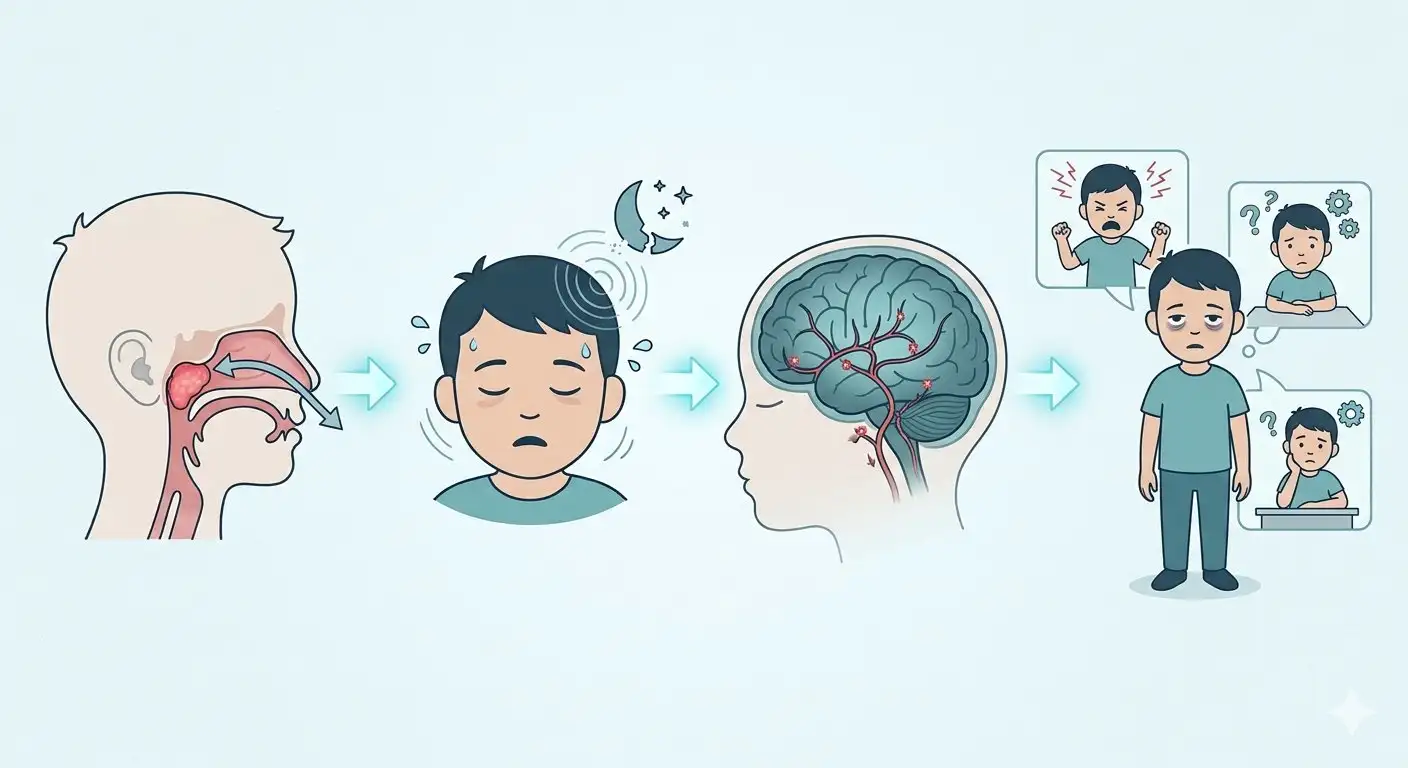
Table of Contents
- Introduction
- Anatomy and Function of the Adenoids
- Can Adenoids Directly Affect the Brain?
- Indirect Ways Adenoids Can Affect Brain Function
- Symptoms Suggesting Adenoid-Related Brain Problems
- Diagnosis
- Treatment
- 2026 Evidence: Does Adenoidectomy Improve Brain Outcomes?
- Prevention & Long-Term Outlook
- FAQs
- Conclusion
- References
1. Introduction
Adenoids are small lymphoid aggregations located high in the nasopharynx behind the soft palate. They are part of the Waldeyer’s tonsillar ring and most active between ages 3 and 7, usually involuting by adolescence. When parents ask can adenoids affect the brain, they are usually worried about either sudden danger (meningitis, brain abscess) or long-term cognitive effects (concentration, memory, behaviour). Both deserve a serious, evidence-based answer. Here is a short explainer video:
2. Anatomy and Function of the Adenoids
The adenoids (also called pharyngeal tonsil or nasopharyngeal tonsil) sit on the posterior wall of the nasopharynx, directly above the opening of the Eustachian tubes. Their job is to trap bacteria and viruses entering through the nose — central to answering can adenoids affect the brain is understanding this neighbourhood: the skull base, cavernous sinuses, middle ears and paranasal sinuses all lie within a few centimetres.
3. Can Adenoids Directly Affect the Brain?
Direct brain involvement is extremely rare. In the modern antibiotic era (2026), the rate is < 1 in 100,000. When answering can adenoids affect the brain directly, the three complications to remember are:
a. Bacterial Meningitis
Pathogens from an infected adenoid or sinus can reach the meninges — the three protective layers around the brain and spinal cord. Fever > 39 °C, severe headache, neck stiffness, photophobia, vomiting, and altered consciousness are classical features. It is a medical emergency; mortality remains 10–15% even with treatment (WHO 2024).
b. Brain Abscess
A collection of pus within the brain parenchyma. Can arise from contiguous spread via infected sinuses or middle ear. Presents with persistent headache, focal neurology, seizures, altered mental state. MRI brain with contrast is diagnostic. Very rare but devastating.
c. Cavernous Sinus Thrombosis
The cavernous sinus is a venous space at the skull base. Infection from the nose/sinuses/adenoids can trigger septic thrombosis, producing headache, periorbital swelling, proptosis, cranial nerve III/IV/VI palsies and vision loss. Requires IV antibiotics + anticoagulation.
4. Indirect Ways Adenoids Can Affect Brain Function
This is where most of the real-world answer to can adenoids affect the brain lies. The mechanisms are:
a. Obstructive Sleep Apnoea (OSA) and Intermittent Hypoxia
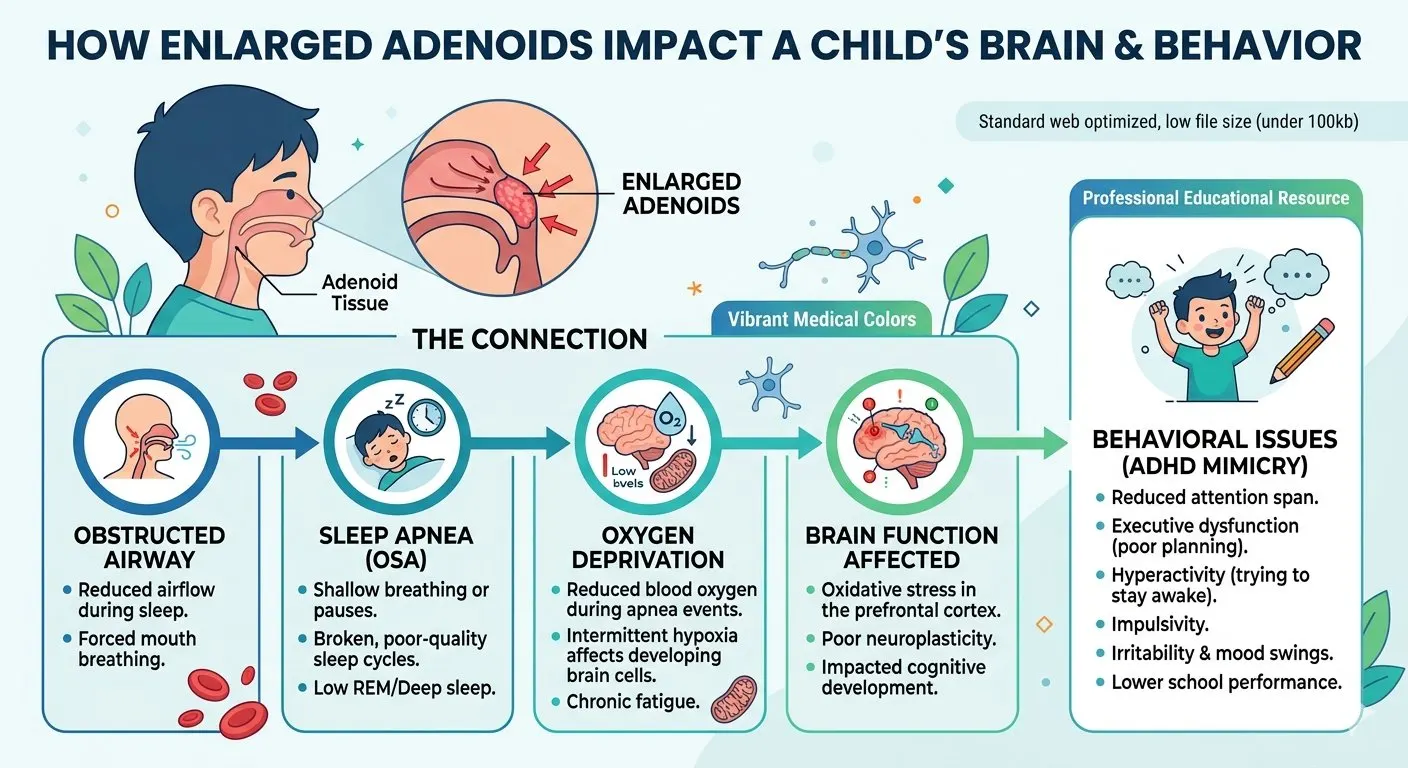
Enlarged adenoids obstruct the nasopharyngeal airway, producing paediatric OSA — apnoea-hypopnoea index > 1 event/hour in children per AASM 2024 criteria. Repeated nocturnal drops in SpO2 below 90% trigger oxidative stress, sympathetic over-activity and sleep fragmentation. Chronic hypoxia in a developing brain is associated with:
- Daytime sleepiness and poor concentration
- Short-term memory decline
- Delayed academic progress and slower verbal IQ gains
- Behavioural problems, mimicking ADHD (the “hyperactive-tired” phenotype)
b. Poor Sleep Architecture and Cognitive Effects
Even without frank OSA, mouth breathing, snoring and micro-arousals disrupt REM sleep and slow-wave sleep — the exact phases needed for memory consolidation. The 2023 UK Children’s Sleep Charity data show adenoid-related sleep disorder affects 4–11% of school children, closely linking the question can adenoids affect the brain to academic underachievement.
c. Chronic Ear Infections and Hearing Loss
Adenoids block the Eustachian tube opening, producing otitis media with effusion (OME). Persistent conductive hearing loss in early childhood directly impacts speech, language and auditory cortex development, so this is an important mechanism by which adenoids can affect the brain through indirect pathways.
d. Chronic Inflammation and the Gut-Brain Axis
Recent research (2024–2025) links chronic adenoid hypertrophy with elevated C-reactive protein and interleukin-6, potentially contributing to systemic low-grade inflammation that can affect mood and cognition. The evidence is still early.
5. Symptoms Suggesting Adenoid-Related Brain Problems
- Persistent nasal obstruction, mouth breathing, snoring, sleep apnoea
- Daytime sleepiness, poor attention, falling grades
- Hyperactivity, irritability, mood swings — a common clue when asking can adenoids affect the brain
- Recurrent ear or sinus infections
- Delayed speech or hearing difficulty
- Headache or facial pressure
- Failure to thrive in a young child
6. Diagnosis
- Nasal endoscopy — flexible fibre-optic camera, gold standard for adenoid grading
- Lateral neck X-ray — assesses adenoid-nasopharyngeal ratio (AN ratio)
- Polysomnography (sleep study) — confirms OSA, measures oxygen desaturation
- Tympanometry and pure-tone audiometry — checks middle-ear status and hearing
- MRI brain — reserved for suspected intracranial complication
7. Treatment
- Medical: intranasal corticosteroid sprays (mometasone, fluticasone), oral montelukast, allergy control, saline nasal rinses, antibiotics for acute adenoiditis
- Surgical: coblation adenoidectomy, endoscopic powered adenoidectomy — day-case under general anaesthesia, usually combined with grommet insertion for OME or tonsillectomy for combined obstruction
8. 2026 Evidence: Does Adenoidectomy Improve Brain Outcomes?
The 2013 CHAT trial (NEJM), extended follow-up through 2024, remains the landmark study on can adenoids affect the brain. Key findings:
- Adenotonsillectomy in children aged 5–9 with OSA improved attention and executive function within 7 months
- Caregiver-reported behaviour (CBCL) and quality of life improved significantly
- Formal full-scale IQ did NOT change — but polysomnographic improvement was striking
- 2024 European multicentre CHAT-E follow-up confirms sustained OSA resolution in 79% at 5 years
The honest evidence-based answer to can adenoids affect the brain: yes, through OSA-mediated sleep and attention effects which are mostly reversible after adenoidectomy.
9. Prevention & Long-Term Outlook
- Good nasal hygiene — daily saline rinses in prone children
- Treat allergies promptly (allergic rhinitis is a major adenoid-hypertrophy driver)
- Avoid tobacco smoke exposure
- Vaccinate per WHO EPI schedule (pneumococcal, Hib, influenza)
- Prompt ENT review for persistent snoring, mouth breathing or recurrent ear infections
10. Frequently Asked Questions
Q1. Can adenoids affect the brain directly?
Directly: extremely rarely (meningitis, brain abscess, cavernous sinus thrombosis), roughly 1 in 100,000 untreated cases.
Q2. Can enlarged adenoids cause learning or attention problems?
Yes, via chronic nocturnal hypoxia and sleep fragmentation of paediatric OSA. Many children are misdiagnosed with ADHD when they actually have sleep-disordered breathing.
Q3. Will my child’s IQ improve after adenoidectomy?
Formal IQ does not usually change, but attention, behaviour, mood, school performance and quality of life improve measurably. Long-term cognitive trajectory may also improve.
Q4. Can adenoid infection reach the brain?
Extremely rarely. In the pre-antibiotic era it was a recognised cause of meningitis. In 2026, with prompt antibiotic treatment, this is very uncommon.
Q5. How soon do brain-related symptoms improve after surgery?
Snoring usually stops within 48 hours. Sleep normalises in 2–4 weeks. Attention and behaviour improve within 2–3 months per CHAT trial data.
Q6. Is nasal steroid spray a safe alternative?
Yes, as first-line medical therapy for grade 1–2 adenoid hypertrophy. For grade 3–4 with proven OSA, surgery is generally more effective.
Q7. My child has chronic adenoids and poor marks. Could they be related?
Often yes. A sleep study and formal ENT assessment are the first steps to find out whether can adenoids affect the brain is true for your child.
11. Conclusion
So can adenoids affect the brain? Directly — almost never. Indirectly — yes, through obstructive sleep apnoea, chronic nocturnal hypoxia, sleep fragmentation, conductive hearing loss, recurrent ear and sinus infections, and system-wide inflammation. The great news for 2026: these effects are mostly reversible if the diagnosis is made early and treated with intranasal steroids or, where indicated, adenoidectomy. If your child snores, breathes through the mouth, is restless at night and struggles at school, a prompt ENT referral is a wise first step — because the full answer to can adenoids affect the brain is: yes, enough that it is worth acting on.
12. References
- Marcus CL et al. CHAT Trial: A Randomized Trial of Adenotonsillectomy for Childhood Sleep Apnea. N Engl J Med 2013;368:2366–2376. Extended follow-up 2024.
- American Academy of Otolaryngology-Head & Neck Surgery. Clinical Practice Guideline: Tonsillectomy in Children (Update). 2019, confirmed 2024.
- American Academy of Sleep Medicine. International Classification of Sleep Disorders, 3rd ed, Revised. 2024.
- World Health Organization. Bacterial meningitis surveillance, burden & mortality. 2024.
- NICE NG9. Otitis media with effusion in under 12s. Updated 2023.
- British Society of Paediatric Otorhinolaryngology. Paediatric OSA pathway. 2024.
- Bhattacharjee R et al. Adenotonsillectomy outcomes in treatment of OSA in children. Am J Respir Crit Care Med 2010;182:676–683.
- UK Children’s Sleep Charity. Sleep-disordered breathing data. 2023.
- CDC. Streptococcus pneumoniae and Haemophilus influenzae vaccination. 2024.
- Felix Hospital Noida. Enlarged adenoids: diagnosis & management. 2024.
ENT Consultation & Surgery
Dr. Sagar Rajkuwar (MS-ENT)
Consultant ENT Specialist & Head-Neck Surgeon
Prabha ENT Clinic, plot no 345, Saigram colony, opposite Indoline furniture, Ambad link road, Ambad, 1 km from Pathardi phata, Nashik 422010, Maharashtra, India
📱 7387590194 | 9892596635
🌐 www.entspecialistinnashik.com
Medical Disclaimer: This article is for educational purposes only and does not replace professional medical advice, diagnosis, or treatment. If your child shows symptoms of meningitis (fever + stiff neck + photophobia + vomiting), sudden severe headache, altered consciousness, or seizure, call 999 / 112 immediately. Decisions about adenoidectomy, sleep studies and audiological assessment should be made by a qualified ENT specialist, paediatrician or audiologist.
Stay connected:
Facebook — Positive Mind Healthcare |
YouTube — Health Useful |
WhatsApp group for health updates.
Related Reading on Adenoids, Tonsillectomy & ENT Care
- How to reduce Adenoids naturally
- Adenoidectomy Surgery Guide
- What age is best for Adenoidectomy?
- Cost of Adenoidectomy in India
- Coblation Adenoidectomy Cost In India
- Adenoids laser Surgery cost
- Coblation adenoidectomy side effects
- Cost Of Adenoidectomy in Hyderabad
- Cost of Adenoidectomy in Delhi
- Cost of Adenoidectomy Surgery in Mumbai
- Cost of Adenoidectomy in Kerala
- Is Adenoid Surgery expensive?
- Do Antihistamines Help Adenoids?
- How do you know if your child needs adenoids out?
- Ayurvedic Treatment For Adenoids
- Do Adenoids Affect Brain Development?
- Can Adenoids Turn Cancerous?
- How Can I Shrink My Adenoids Fast?
- When to Worry About Adenoids?
- What Does Grade 3 Adenoids Mean?
- Herbs for swollen adenoids
- Shrink Toddler Adenoids Without Surgery
- Help a Child Sleep with Enlarged Adenoids
- Enlarged Adenoids: Symptoms Parents Miss
- Is Drooling Normal After Adenoidectomy?
- Adenoidectomy Infection Warning Signs
- Success Rate of Adenoid Removal
- Is Adenoid Surgery Safe?
- Is Removing Adenoids a Good Idea?
- What Happens If Adenoids Are Not Removed?
- Adenoid Cystic Carcinoma Symptoms
- Do Kids Sleep Better After Adenoid Removal?
- Can My Child Swim After Adenoidectomy?
- Can Removing Adenoids Affect Behavior?
- Adenoids and Speech Delay
- Prevent Adenoid Problems in Your Child
- Are Adenoids Linked to Allergies?
- What to Avoid After Adenoid Surgery
- Adenoids vs Allergies
- Are Adenoid Problems Genetic?
- Can Food Get Stuck in Adenoids?
- Do Adenoids Affect the Brain?
- How Long Does Adenoid Surgery Take?
- Keep Adenoids Healthy Naturally
- Severe Headache After Adenoidectomy
- How Risky Is Adenoid Removal?
- Does Removing Adenoids Improve Hearing?
- Do You Get Sick More Without Adenoids?
- Can Adenoids Cause Ear Pain?
- Adenoids Removed but Still Snoring?
- Can You Have Enlarged Adenoids Without Enlarged Tonsils?
- How Doctors Check Adenoids
- At What Age Are Adenoids Most Active?
- Do Adults Have Adenoids?
- Long-term Effects of Adenoid Removal
- Can Adenoids Grow Back in Adults?
- Time for Adenoids to Grow Back
- Adenoid X-Ray Cost
- Is Adenoid Surgery Covered by Insurance?
- Cefuroxime and Adenoid Infections
- Can Adenoids Cause Low Oxygen?
- Can Enlarged Adenoids Cause Hearing Loss?
- Does Adenoid Removal Cause Weight Gain?
- Adenoids and Asthma
- Deaths from Adenoidectomy
- Worst Days After T&A
- Foods to avoid for adenoids
- Headaches After T&A
- T&A Recovery Day by Day
- Adenotonsillectomy and ADHD