Can a Child Have Enlarged Adenoids Without Enlarged Tonsils? Causes, Symptoms and Treatment-various aspects
Article author: Dr. Sagar Rajkuwar, MS-ENT, Consultant ENT Specialist.
Yes — it is entirely possible to have enlarged adenoids without enlarged tonsils. Although adenoids and tonsils are both part of the Waldeyer’s immune ring, they sit in different anatomical regions and respond to different triggers. Many parents (and clinicians) assume if one is swollen the other must be — but that is a myth. This complete 2026 ENT doctor’s guide explains exactly how a child can present with enlarged adenoids without enlarged tonsils, why it matters, how it is diagnosed and how it is treated, using NHS, AAO-HNS, WHO and peer-reviewed sources.
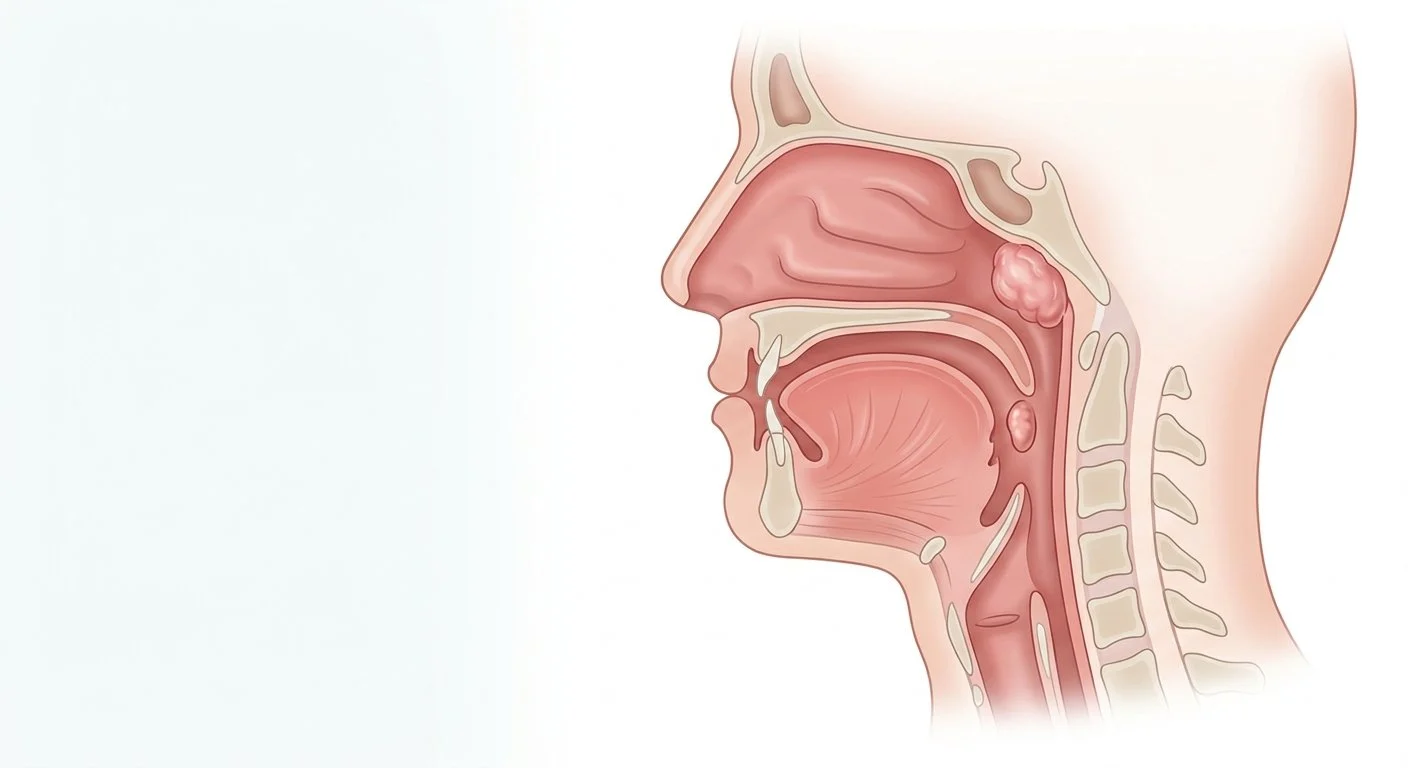
Table of Contents
- Introduction
- Anatomy and Function
- How Adenoids Enlarge Without the Tonsils
- Symptoms of Enlarged Adenoids Without Enlarged Tonsils
- Diagnosis
- Treatment Options
- Adenoidectomy — Modern 2026 Technique
- Recovery and Prognosis
- FAQs
- Conclusion
- References
1. Introduction
Adenoids and tonsils both belong to the Waldeyer’s lymphoid ring, forming a first-line immune defence of the upper aerodigestive tract. They trap bacteria, viruses, fungi and allergens that enter the body through the nose and mouth. Because of their similar lymphoepithelial structure, many people assume they always behave the same way. In reality, enlarged adenoids without enlarged tonsils is a well-recognised and common clinical scenario — especially in children with chronic nasal allergies or recurrent viral upper-respiratory infections. Here is a short NHS-style explainer:
2. Anatomy and Function
- Adenoids (pharyngeal tonsil): high in the nasopharynx, behind the soft palate, directly above the opening of the Eustachian tube. They screen airborne pathogens entering through the nose.
- Palatine tonsils: on either side of the oropharynx, visible when the mouth is wide open. They screen pathogens entering through the mouth.
- Both are made of lymphoid follicles that house B- and T-lymphocytes.
- Despite similar structure, their drainage basins and pathogen exposures differ — which is the anatomical basis for why we can have enlarged adenoids without enlarged tonsils.
3. How Adenoids Enlarge Without the Tonsils
a. Frequent Nasal or Sinus Infections
Because adenoids are on the first line of defence for the nose, they bear the brunt of chronic nasal and sinus infections. The tonsils — located further down — may not react because the pathogen is already neutralised before reaching them. This is the commonest cause of enlarged adenoids without enlarged tonsils.
b. Allergies and Environmental Irritants
Allergic rhinitis, house-dust-mite sensitisation, air pollution, wood-smoke, tobacco smoke and traffic pollutants all cause persistent nasopharyngeal inflammation and Th2-dominant hypertrophy of adenoid tissue. The tonsils face different (oral) exposures and may remain normal. In urban India, Delhi-NCR and Mumbai paediatric cohorts show allergy-driven enlarged adenoids without enlarged tonsils is strikingly common (AIIMS 2024 data).
c. Chronic Adenoiditis
Isolated infection of the adenoids — chronic adenoiditis — can persist for months with post-nasal drip, blocked nose, mouth-breathing, snoring and recurrent otitis media, yet the throat examination is clear. This is a classic cause of enlarged adenoids without enlarged tonsils.
d. Immune System Overactivity in the Nasopharynx
In some children, the nasopharyngeal immune response is simply more active — genetically or environmentally driven — while the oropharyngeal response is quieter. Biopsy studies confirm independent germinal-centre hyperplasia.
e. Age-Related Differences
Adenoids peak in size at 3–7 years and shrink by 10–12. Palatine tonsils peak a little later and shrink more slowly. Between ages 8 and 14 it is common to see a child with enlarged adenoids without enlarged tonsils because the tonsils have already involuted.
f. Reflux (Laryngopharyngeal Reflux)
Rising stomach acid can reach the nasopharynx more than the oropharynx in certain supine sleep postures, driving selective adenoid hypertrophy in a few children.
4. Symptoms of Enlarged Adenoids Without Enlarged Tonsils
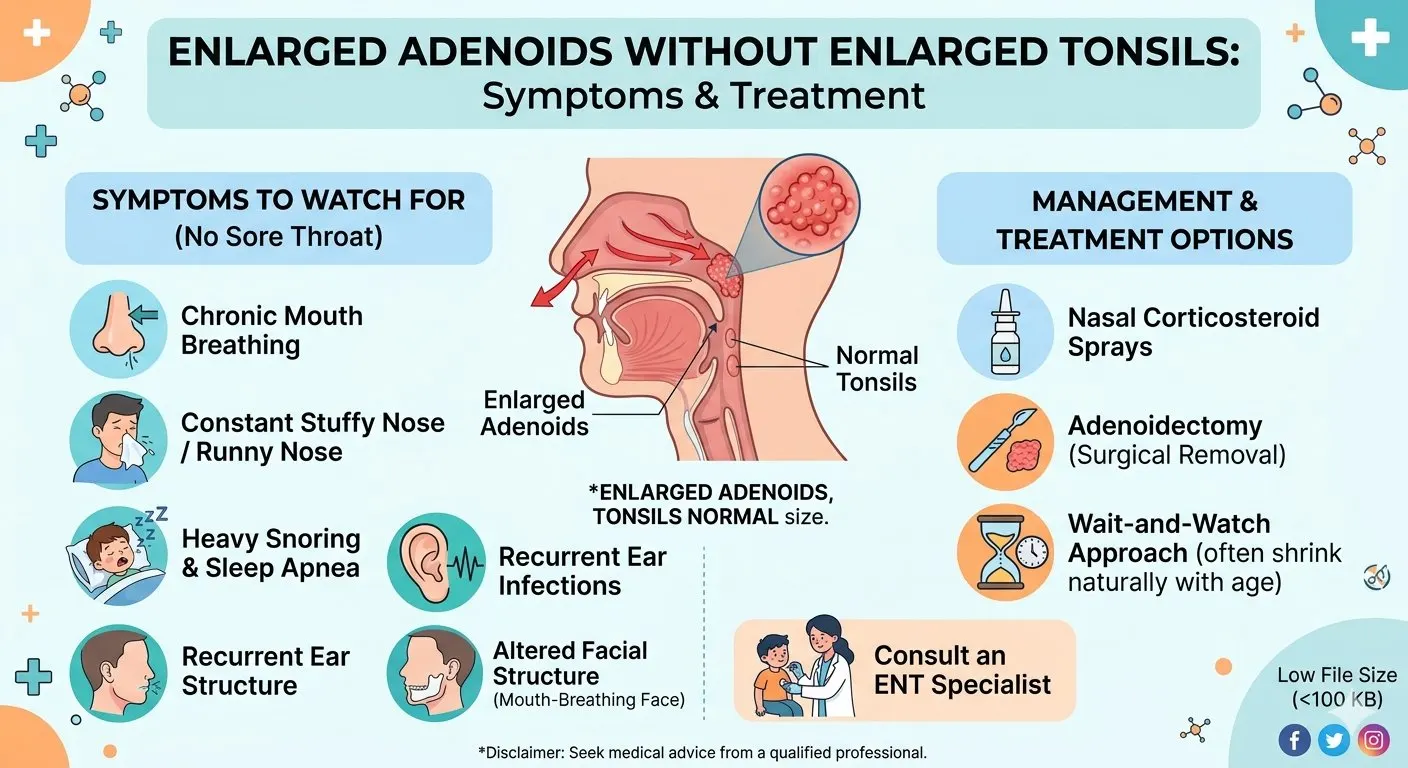
Because the adenoids sit at the back of the nose rather than the throat, enlarged adenoids without enlarged tonsils typically produce nasal and ear symptoms rather than sore throat:
- Nasal obstruction and persistent mouth breathing
- Snoring and sleep disturbance — sometimes obstructive sleep apnoea
- Post-nasal drip and chronic morning cough
- Chronic bad breath (halitosis) despite good oral hygiene
- Blocked ears, hearing loss, recurrent otitis media with effusion
- Hyponasal (rhinolalia clausa) voice — the “blocked-nose voice”
- Recurrent sinus infections
- Over time, adenoid facies — long thin face, open mouth, high arched palate, dental malocclusion
- Failure to thrive in severe cases
Notice that sore throat, odynophagia and visible tonsillar swelling — the hallmarks of tonsillitis — are ABSENT in enlarged adenoids without enlarged tonsils, which is why the diagnosis is frequently missed by GPs looking only in the mouth.
5. Diagnosis
- Nasal endoscopy — the gold standard. A thin flexible camera visualises the adenoid directly and grades its size (Clemens 1–4).
- Lateral neck X-ray (soft-tissue) — cheap, widely available, calculates the adenoid-nasopharyngeal (AN) ratio. AN ratio > 0.73 indicates significant hypertrophy.
- Sleep study (polysomnography) — if OSA is suspected.
- Tympanometry & audiometry — checks for middle-ear effusion and hearing loss.
- Allergy testing (skin prick, specific IgE) — identifies treatable triggers.
- Post-nasal swab/culture — occasionally useful in chronic refractory cases.
6. Treatment Options
a. Medical Management (first line)
- Intranasal corticosteroid spray (mometasone furoate, fluticasone propionate) — shrinks adenoid tissue in 6–12 weeks
- Nasal saline irrigation daily with isotonic or mildly hypertonic solution
- Oral montelukast 4–5 mg at night in children aged 2–14 — particularly effective when allergy is a driver
- Antihistamines (loratadine, cetirizine) for atopic patients
- Antibiotics (amoxicillin-clavulanate, cefuroxime) for acute adenoiditis
- Allergen avoidance — dust mite covers, HEPA filter, no smoking in home
Most mild-to-moderate cases of enlarged adenoids without enlarged tonsils respond well to 3 months of medical therapy.
b. Surgical Treatment — Adenoidectomy Alone
When medical therapy fails, isolated adenoidectomy (without tonsillectomy) is the correct operation for enlarged adenoids without enlarged tonsils. Indications include:
- Persistent nasal obstruction or chronic mouth breathing
- Recurrent otitis media or persistent effusion > 3 months
- Recurrent sinusitis
- Obstructive sleep apnoea confirmed on polysomnography
- Failure of medical therapy after 12 weeks
7. Adenoidectomy — Modern 2026 Technique
- Endoscopic-assisted powered adenoidectomy with a microdebrider is the current gold standard — precise, bloodless, less regrowth
- Coblation adenoidectomy — low-temperature radiofrequency plasma, minimal pain
- Traditional curettage — still used in some centres, cheap and quick
- Day-case procedure under general anaesthesia, < 30 minutes
- Combined with grommet insertion if middle-ear effusion is present
- Tonsils are left alone when examination shows them normal — so removing them unnecessarily is avoided
8. Recovery and Prognosis
Adenoidectomy alone has a much easier recovery than combined tonsillectomy — usually 5–7 days back to normal diet and activity. Children typically notice dramatic improvement in nasal breathing within 48 hours. Long-term outcome is excellent. Adenoid regrowth happens in 2–5% of children, usually those with persistent allergy or reflux.
9. Frequently Asked Questions
Q1. Can you have enlarged adenoids without enlarged tonsils in an adult?
Yes but uncommon. Persistent adenoid tissue in adults is seen in chronic rhinosinusitis, allergy, immunodeficiency and occasionally with nasopharyngeal pathology. Any adult with an adenoid mass needs careful ENT assessment to rule out nasopharyngeal carcinoma.
Q2. Why do my child’s tonsils look normal if the adenoids are enlarged?
Because they screen different pathogens, drain different lymph basins and respond to different triggers. Isolated nasal pathology (allergy, infection) drives adenoid-only hypertrophy without the tonsils reacting.
Q3. How is the diagnosis of enlarged adenoids without enlarged tonsils confirmed?
Nasal endoscopy or a lateral neck X-ray. Simply looking in the mouth is NOT enough.
Q4. Can nasal steroid sprays shrink enlarged adenoids without enlarged tonsils?
Yes. Intranasal corticosteroids (mometasone, fluticasone) reduce adenoid volume meaningfully in 60–70% of cases within 6–12 weeks and are the first-line medical therapy.
Q5. If only the adenoids are big, should the tonsils also be removed?
No. Normal tonsils should be preserved. Isolated adenoidectomy is the correct operation for isolated enlarged adenoids without enlarged tonsils. Unnecessary tonsillectomy adds risk without benefit.
Q6. Will adenoid-only surgery improve sleep and hearing?
Yes. Snoring usually resolves within 48 hours. Hearing (if blocked by Eustachian-tube obstruction or OME) improves in most children within 4–6 weeks.
Q7. Can adenoids grow back?
In 2–5% of children, residual lymphoid tissue can regrow — usually in those with persistent allergy, reflux or recurrent infections. Modern endoscopic adenoidectomy minimises this risk.
10. Conclusion
Yes — it is entirely possible to have enlarged adenoids without enlarged tonsils. The two structures sit in different anatomical zones, drain different pathogen loads and respond differently to allergy, infection and reflux. A thorough ENT evaluation with nasal endoscopy or a lateral neck X-ray accurately diagnoses the condition, and most children do well on intranasal corticosteroids, saline rinses and allergy control. When medical therapy fails, isolated adenoidectomy is a safe, quick and highly effective day-case procedure — and crucially, normal tonsils are preserved. With proper diagnosis and treatment, nearly every child with enlarged adenoids without enlarged tonsils can breathe clearly through the nose, sleep well, hear normally, grow optimally and avoid the long-term complications of chronic nasal obstruction.
11. References
- AAO-HNS. Clinical Practice Guideline: Tonsillectomy in Children (Update). 2019, confirmed 2024.
- NICE NG9. Otitis media with effusion in under 12s. Updated 2023.
- Marcus CL et al. CHAT Trial: Adenotonsillectomy for Childhood OSA. NEJM 2013;368:2366–2376. Extended follow-up 2024.
- British Society of Paediatric Otorhinolaryngology. Paediatric OSA pathway. 2024.
- Felix Hospital Noida. Enlarged adenoids: diagnosis & management. 2024.
- AIIMS Delhi Paediatric ENT Dept. Allergy-driven adenoid hypertrophy in urban Indian children. 2024.
- Goldbart AD et al. Intranasal budesonide and oral montelukast for mild-to-moderate paediatric OSA. Pediatrics 2012;130:e575–e580.
- Royal College of Surgeons England. National Tonsillectomy Audit. 2024.
- WHO. Global burden of otitis media in children. 2024.
- Clemens Classification of Adenoid Size. ENT International reference. Updated 2023.
ENT Consultation & Surgery
Dr. Sagar Rajkuwar (MS-ENT)
Consultant ENT Specialist & Head-Neck Surgeon
Prabha ENT Clinic, plot no 345, Saigram colony, opposite Indoline furniture, Ambad link road, Ambad, 1 km from Pathardi phata, Nashik 422010, Maharashtra, India
📱 7387590194 | 9892596635
🌐 www.entspecialistinnashik.com
Medical Disclaimer: This article is for educational purposes only and does not replace professional medical advice, diagnosis, or treatment. Audiogram results should be interpreted by a qualified audiologist or ENT specialist. If your child has persistent nasal obstruction, snoring, sleep apnoea, recurrent ear infections or hearing concerns, seek evaluation from a qualified ENT specialist. Decisions about adenoidectomy, allergy testing or sleep studies should be made by qualified clinicians based on individual findings.
Stay connected:
Facebook — Positive Mind Healthcare |
YouTube — Health Useful |
WhatsApp group for health updates.
Related Reading on Adenoids, Tonsillectomy & ENT Care
- How to reduce Adenoids naturally
- Adenoidectomy Surgery Guide
- What age is best for Adenoidectomy?
- Cost of Adenoidectomy in India
- Coblation Adenoidectomy Cost In India
- Adenoids laser Surgery cost
- Coblation adenoidectomy side effects
- Cost Of Adenoidectomy in Hyderabad
- Cost of Adenoidectomy in Delhi
- Cost of Adenoidectomy Surgery in Mumbai
- Cost of Adenoidectomy in Kerala
- Is Adenoid Surgery expensive?
- Do Antihistamines Help Adenoids?
- How do you know if your child needs adenoids out?
- Ayurvedic Treatment For Adenoids
- Do Adenoids Affect Brain Development?
- Can Adenoids Turn Cancerous?
- How Can I Shrink My Adenoids Fast?
- When to Worry About Adenoids?
- What Does Grade 3 Adenoids Mean?
- Herbs for swollen adenoids
- Shrink Toddler Adenoids Without Surgery
- Help a Child Sleep with Enlarged Adenoids
- Enlarged Adenoids: Symptoms Parents Miss
- Is Drooling Normal After Adenoidectomy?
- Adenoidectomy Infection Warning Signs
- Success Rate of Adenoid Removal
- Is Adenoid Surgery Safe?
- Is Removing Adenoids a Good Idea?
- What Happens If Adenoids Are Not Removed?
- Adenoid Cystic Carcinoma Symptoms
- Do Kids Sleep Better After Adenoid Removal?
- Can My Child Swim After Adenoidectomy?
- Can Removing Adenoids Affect Behavior?
- Adenoids and Speech Delay
- Prevent Adenoid Problems in Your Child
- Are Adenoids Linked to Allergies?
- What to Avoid After Adenoid Surgery
- Adenoids vs Allergies
- Are Adenoid Problems Genetic?
- Can Food Get Stuck in Adenoids?
- Can Adenoids Affect the Brain?
- How Long Does Adenoid Surgery Take?
- Keep Adenoids Healthy Naturally
- Severe Headache After Adenoidectomy
- How Risky Is Adenoid Removal?
- Does Removing Adenoids Improve Hearing?
- Do You Get Sick More Without Adenoids?
- Can Adenoids Cause Ear Pain?
- Adenoids Removed but Still Snoring?
- How Doctors Check Adenoids
- At What Age Are Adenoids Most Active?
- Do Adults Have Adenoids?
- Long-term Effects of Adenoid Removal
- Can Adenoids Grow Back in Adults?
- Time for Adenoids to Grow Back
- Adenoid X-Ray Cost
- Is Adenoid Surgery Covered by Insurance?
- Cefuroxime and Adenoid Infections
- Can Adenoids Cause Low Oxygen?
- Can Enlarged Adenoids Cause Hearing Loss?
- Does Adenoid Removal Cause Weight Gain?
- Adenoids and Asthma
- Deaths from Adenoidectomy
- Worst Days After T&A
- Foods to avoid for adenoids
- Headaches After T&A
- T&A Recovery Day by Day
- Adenotonsillectomy and ADHD