
Will Doxycycline Clear Tonsillitis? A Complete ENT-Specialist Guide
Author: Dr Sagar Rajkuwar, ENT Specialist, Nashik, Maharashtra, India
🌐 www.entspecialistinnashik.com
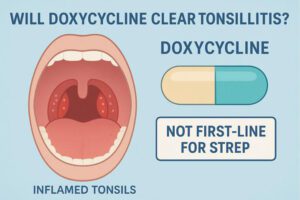
⚡ At a Glance — Will Doxycycline Clear Tonsillitis?
- Short answer: Usually no. Doxycycline is not first-line for the commonest cause of bacterial tonsillitis — Group A Streptococcus (GAS).
- First-line antibiotics: penicillin V or amoxicillin (×10 days). Alternatives for penicillin-allergic patients: azithromycin, clarithromycin, or clindamycin.
- Doxycycline may be reasonable when: penicillin-allergic patient, atypical organism suspected (Mycoplasma, Chlamydia), chronic/recurrent tonsillitis with mixed flora, or when the patient is already on doxycycline for another indication.
- Doxycycline should NOT be used in: confirmed/suspected strep throat, children under 8 years (routine), pregnancy, breastfeeding.
- Clinical scoring tool: the Centor / McIsaac criteria estimate the likelihood of strep throat and guide testing and antibiotic choice.
- Serious complications of untreated/inadequately treated strep tonsillitis: peritonsillar abscess, rheumatic fever, post-streptococcal glomerulonephritis.
- See a doctor urgently: breathing difficulty, drooling or inability to swallow saliva, muffled “hot potato” voice, one-sided neck swelling, or severe dehydration.
Centor / McIsaac Criteria — Quick Strep-Throat Score
Before choosing any antibiotic for tonsillitis, clinicians often use this bedside score. Each positive criterion scores 1 point:
| Criterion | Points |
|---|---|
| Tonsillar exudate (white pus patches on tonsils) | +1 |
| Tender anterior cervical lymphadenopathy | +1 |
| Fever history (> 38°C / 100.4°F) | +1 |
| Absence of cough | +1 |
| McIsaac age modifier: age 3–14 (+1), 15–44 (0), ≥ 45 (−1) | +1 / 0 / −1 |
Interpretation: score 0–1 → strep unlikely, no antibiotic / no test; 2–3 → consider rapid antigen test or throat swab; 4–5 → high probability of strep, test and treat with amoxicillin/penicillin. The question “will doxycycline clear tonsillitis” is relevant only in specific sub-scenarios (penicillin allergy with atypical pathogen suspicion); for a standard high Centor score, the answer is simply no — use amoxicillin instead.
🆕 FeverPAIN Score — The NICE-Recommended Alternative (2026 Update)
The UK National Institute for Health and Care Excellence (NICE) now preferentially recommends the FeverPAIN score for primary care in sore throat assessment. Each criterion scores 1 point:
- Fever in last 24 hours
- Purulence (pus on tonsils)
- Attend rapidly (within 3 days of symptom onset)
- Inflamed tonsils (severely swollen/inflamed)
- No cough or coryza
Score 0–1: 13–18% likelihood of streptococcal infection → no antibiotic. Score 2–3: 34–40% → delayed/backup prescription. Score 4–5: 62–65% → consider immediate antibiotic. This updated scoring system reduces unnecessary antibiotic prescribing by approximately 30% compared to clinical judgment alone, and once again highlights why asking will doxycycline clear tonsillitis often reflects a mismatch between the drug and the microbial target.
Table of Contents
- (1)Introduction
- (2)What is Tonsillitis?
- (3)Is Tonsillitis Treatable with Doxycycline?
- (4)When can doxycycline be used?
- (5)When Tonsillitis Should Not Be Treated With Doxycycline
- (6)For tonsillitis, which antibiotics are the most effective?
- (7)Symptoms That Doxycycline May Help Alleviate
- (8)What is the duration of doxycycline’s effect?
- (9)Why Doctors Stay Away From Using Doxycycline for Common Tonsillitis
- (10)Indicators that You Need Antibiotics for Your Tonsillitis, Not Doxycycline
- (11)Which patients should not use doxycycline to treat tonsillitis?
- (12)Home Treatments to Aid in Recovery (With or Without Antibiotics)
- (13)Consequences of Incorrect Tonsillitis Treatment
- (14)When to Seek Immediate Medical Attention from an ENT Specialist
(1)Introduction
Tonsillitis is one of the most prevalent throat infections among youngsters, adolescents, and adults. It can be caused by bacteria or viruses, with Group A Streptococcus (Strep throat) being the most frequent culprit. “Will doxycycline clear tonsillitis?” is a typical query as patients seek for quick-acting antibiotics.
It’s crucial to remember that doxycycline is not the first-line antibiotic for tonsillitis, particularly if the etiology is streptococcal, as an ENT expert. Doxycycline, though, can be beneficial in certain circumstances, depending on the kind of illness, the patient’s profile, and the antibiotic resistance.
When doxycycline works, when it doesn’t, the safest course of action, and when to seek emergency medical care are all covered in this thorough, SEO-optimized guide.
(2)What is Tonsillitis?
An inflammation of the palatine tonsils, two lymphoid tissues found at the back of the throat, is known as tonsillitis. It may be:
1. Viral Tonsillitis (Most Common – 70–80%)
Triggered by viruses such as:
- Rhinovirus
- The flu
- Adenoviruses
- The Epstein-Barr virus (EBV), which causes infectious mononucleosis
Viral tonsillitis cannot be treated with antibiotics.
2. Bacterial Tonsillitis (20–30%)
The most frequent causes are:
- Streptococcus of group A (GAS)
- Staphylococcus aureus
- Influenzae Hemophilus
- chronic tonsillitis caused by anaerobic bacteria
Bacterial tonsillitis is the only type of tonsillitis that responds to antibiotics.
Before selecting a medicine, it’s important to comprehend the underlying reason.
(3)Is Tonsillitis Treatable with Doxycycline?
Brief Response:
Although doxycycline can sometimes cure tonsillitis, it is not the most common or recommended antibiotic for strep tonsillitis.
For what reason?
The most common bacterial cause of tonsillitis is Group A Streptococcus, against which doxycycline is less effective. Antibiotics based on penicillin are still the best available option.
But doxycycline may be helpful in particular circumstances:
What are the conditions under which doxycycline is useful in treating tonsillitis?
(4)When can doxycycline be used?
1. Unusual microorganisms cause tonsillitis.
Examples:
- Pneumonia caused by Mycoplasma pneumoniae
- Chlamydia pneumonia
- Secondary infections related to sinusitis or lower respiratory infections
2. The patient has a penicillin allergy.
For those who have:
- Penicillin allergy causing anaphylaxis
- Moderate hypersensitivity to cephalosporins or penicillins
If a strep infection is improbable in these circumstances, doxycycline might be taken into consideration.
3. The Illness Is Recurrent or Chronic
Doxycycline may be effective for patients with recurrent tonsillitis caused by a combination of microorganisms (staph + anaerobes), but other antibiotics like clindamycin or azithromycin are often favored.
4. Acne Therapy-Related Tonsillitis
Doxycycline, which some patients are already using for acne treatment, may help alleviate a little bacterial tonsillitis.
(5)When Tonsillitis Should Not Be Treated With Doxycycline
1. Streptococcal tonsillitis, confirmed or suspected
Streptococcus pyogenes is not consistently killed by doxycycline.
2. High fever with severe acute tonsillitis
A more potent antibiotic that targets strep infections is necessary.
3. Children Under 8 Years Old with Tonsillitis
Bone development can be slowed, and permanent teeth might become discolored by doxycycline.
4. While breastfeeding or pregnant
Doxycycline is typically not used.
(6)For tonsillitis, which antibiotics are the most effective?
According to ENT and infectious disease guidelines:
The optimal first-line antibiotics for strep tonsillitis are:
- Penicillin V
- amoxycillin
Alternatives (Penicillin Allergy):
- Azithromycin
- Clarithromycin
- clindamycin
The preferred list for streptococcal tonsillitis does not include doxycycline.
(7)Symptoms That Doxycycline May Help Alleviate
The use of doxycycline in an appropriate situation can lead to improvements in:
- sore throat
- Swelling
- Fever
- Having trouble swallowing
- Redness of the tonsils
- Symptoms related to a chest or sinus infection
However, bacterial clearance cannot be verified only by symptom relief.
(8)What is the duration of doxycycline’s effect?
Improvement can be seen within the following range if the tonsillitis responds to doxycycline:
24 to 48 hours
- The fever goes down.
- Throat discomfort is alleviated
- Swallowing is made easier.
Full resolution: 5–7 days
An average course lasts between seven and ten days.
(9)Why Doctors Stay Away From Using Doxycycline for Common Tonsillitis
1. Insufficient measures against Streptococcus
Treatment failure can result in consequences such as:
- Peritonsillar abscess
- Rheumatic fever
- Acute glomerulonephritis
2. Problems with antibiotic resistance
Unnecessary doxycycline use contributes to broader resistance.
3. Side effects
- Stomach discomfort
- Sun Sensitivity
- Diarrhea
- If ingested without water, esophagitis might result.
It is consequently only used in a small number of instances.
(10)Indicators that You Need Antibiotics for Your Tonsillitis, Not Doxycycline
If you experience any of the following symptoms, seek antibiotic treatment:
- Temperature over 101°F (38.3°C)
- Tonsils with white pus patches
- extreme pain in the throat
- Lymph nodes in the neck that are painful
- No cough (indicating strep)
- Symptoms with an abrupt onset
This is the Centor Criteria, which is used to diagnose streptococcal tonsillitis.
(11)Which patients should not use doxycycline to treat tonsillitis?
If you are: don’t take doxycycline.
- Being pregnant
- Breastfeeding
- under the age of eight
- Experiencing severe vomiting
- Having a bad liver condition
- Having a tetracycline allergy
If you’re ever unsure, always speak with an ENT professional.
(12)Home Treatments to Aid in Recovery (With or Without Antibiotics)
✔Warm salt-water gargle
lowers inflammation and eliminates germs on the skin.
✔Hydration
Assists the body in warding off illness.
✔Inhalation of steam
Reduces congestion and relieves throat pain.
✔Honey, ginger, and turmeric water
Naturally anti-inflammatory.
✔A soft diet is acceptable.
Fried and spicy foods should be avoided.
✔Adequate rest
Boosts the immune system’s response.
These treatments help alleviate symptoms, but when a bacterial infection is verified, antibiotics should not be substituted.
(13)Consequences of Incorrect Tonsillitis Treatment
Using the wrong antibiotic, like doxycycline, when strep is present, might result in:
Local issues:
- Abscess near the tonsils
- Parapharyngeal abscess
- middle ear infection
- Sinusitis
Systemic problems:
- Rheumatic fever
- Scarlet fever
- inflammation of the kidneys (post-strep glomerulonephritis)
Choosing the right antibiotic is essential.
(14)When to Seek Immediate Medical Attention from an ENT Specialist
If you have any of the following symptoms, get immediate medical treatment:
- Breathing problems
- Inability to swallow one’s saliva
- Extreme dehydration
- Persistent high fever
- Pain in one side of the throat
- “Hot potato” voice muffled
- Tonsils are really big and in contact with one another.
An airway blockage or an abscess may be indicated by these.
(15)Conclusion: Will Doxycycline Cure Tonsillitis?
Yes, but only in a few instances when the cause is not streptococcus.
Doxycycline should not be used to treat typical, common bacterial tonsillitis (strep throat).
For the majority of patients:
- The best choice is either penicillin or amoxicillin.
- Doxycycline should only be used in rare cases of infection or if other antibiotics are not effective.
Consult an ENT specialist if you have any questions.
🆕 (16) Doxycycline Pharmacology — Why It Fails Against Streptococcus
Doxycycline is a semi-synthetic tetracycline that acts by reversibly binding the 30S ribosomal subunit, blocking the attachment of aminoacyl-tRNA and halting bacterial protein synthesis. Because it is bacteriostatic (it stops bacteria multiplying but does not actively kill them), it depends on a functional host immune system to clear the infection. For deep-tissue infections of the tonsillar crypts, where biofilm formation and relative immunoprivilege occur, a bactericidal drug such as penicillin or amoxicillin works more reliably against Group A Streptococcus. Patients asking will doxycycline clear tonsillitis often don’t realise this fundamental pharmacologic mismatch.
Additionally, the tet(M) and tet(O) resistance genes — carried on conjugative transposons such as Tn916 — have spread widely among S. pyogenes. In regional surveys (China, Spain, Portugal, South India), tetracycline resistance in GAS exceeds 25–50%. This is a key microbiological reason behind the clinical observation that will doxycycline clear tonsillitis is answered negatively in most GAS cases. By contrast, GAS has never been documented to acquire penicillin resistance in 80+ years of clinical use — a remarkable microbiological rarity.
🆕 (17) 2024 IDSA Guideline Update & Global Resistance Patterns
The 2024 Infectious Diseases Society of America (IDSA) and American Academy of Pediatrics (AAP) updates reaffirm:
- Rapid antigen detection testing (RADT) is recommended before antibiotic prescribing in all patients ≥ 3 years with Centor score ≥ 2.
- Throat culture back-up is recommended for children when RADT is negative but clinical suspicion is high.
- Routine testing is discouraged in children < 3 years (strep rare, rheumatic fever almost absent in this age group).
- A 10-day course of penicillin V or amoxicillin remains the gold standard.
- Doxycycline is explicitly NOT recommended for GAS pharyngitis.
- For true penicillin allergy, cephalexin, cefadroxil, clindamycin, or azithromycin/clarithromycin are preferred.
- Shorter courses (5–7 days) of cefuroxime axetil may be considered in selected adults.
According to WHO’s Global Antimicrobial Resistance Surveillance System (GLASS 2024), macrolide resistance in S. pyogenes has risen to 10–30% across Europe and parts of Asia, while penicillin resistance remains at essentially 0%. This continuing penicillin susceptibility is why the question “will doxycycline clear tonsillitis“ is almost universally answered with “use penicillin instead.” The 2026 global resurgence of invasive GAS (iGAS) disease and streptococcal toxic shock syndrome (STSS) cases in children makes correct antibiotic choice critical.
🆕 (18) Doxycycline Dosing for Approved Indications
| Indication | Adult Dose | Duration |
|---|---|---|
| Atypical pneumonia (Mycoplasma/Chlamydia) | 100 mg BID | 7–14 days |
| Acute rhinosinusitis (penicillin-allergic) | 100 mg BID | 5–7 days |
| Acne vulgaris | 50–100 mg daily | 3–6 months |
| Lyme disease (early) | 100 mg BID | 10–21 days |
| Malaria prophylaxis | 100 mg daily | 1 day before to 4 weeks after travel |
| Tonsillitis (atypical cause only) | 100 mg BID | 7–10 days |
🆕 (19) Frequently Asked Questions (FAQ)
Q1. Can doxycycline cure strep throat?
A: Generally no. Will doxycycline clear tonsillitis caused by Group A Streptococcus? Usually not. Penicillin V or amoxicillin remain the first-line choice; tetracycline resistance rates in GAS exceed 25% in many regions.
Q2. How fast does doxycycline work for a sore throat?
A: If the organism is sensitive (e.g. Mycoplasma pneumoniae), symptoms usually improve within 48 hours. If no improvement after 72 hours, review the diagnosis.
Q3. Can I take doxycycline for recurrent tonsillitis?
A: Only under ENT guidance. Recurrent cases often need clindamycin or amoxicillin-clavulanate because of mixed anaerobic flora; tonsillectomy may be indicated after 7 episodes in 1 year or 5/year for 2 years (Paradise criteria).
Q4. Does doxycycline treat tonsil stones?
A: No. Tonsilloliths are mineralized debris in tonsillar crypts and respond poorly to any antibiotic. Mechanical removal, saltwater gargles, or in persistent cases tonsillectomy/cryptolysis are the correct treatments.
Q5. Can I drink alcohol while taking doxycycline for tonsillitis?
A: Avoid alcohol — it accelerates hepatic metabolism via CYP3A4 induction, lowering doxycycline plasma levels, and worsens gastrointestinal side-effects.
Q6. What is the usual dose of doxycycline for throat infection?
A: 100 mg orally twice daily for 7–10 days when the organism is tetracycline-sensitive, taken with a full glass of water, upright, and not within 2 hours of dairy, calcium or iron.
Q7. Is a 3-day course of doxycycline enough for tonsillitis?
A: No. Shorter courses risk relapse and resistance development. Finish the prescribed course.
Q8. Can doxycycline cause tonsil swelling to get worse?
A: Rarely, if a Jarisch–Herxheimer reaction occurs (large bacterial die-off releasing endotoxins), transient worsening may be seen. Also, drug-induced oesophagitis can mimic sore throat.
Q9. Will doxycycline help if my tonsillitis is viral?
A: No. Will doxycycline clear tonsillitis of viral origin? Absolutely not — viruses do not have the ribosomal targets antibiotics act on.
Q10. When should I go to the hospital with tonsillitis?
A: Breathing difficulty, drooling, inability to swallow saliva, one-sided swelling, muffled voice or neck stiffness. These suggest peritonsillar abscess, parapharyngeal abscess or Lemierre’s syndrome and warrant emergency ENT review.
Medical Disclaimer
Medical Disclaimer: This article is for educational purposes only and should not be considered medical advice. Antibiotic selection depends on the cause of tonsillitis, medical history, allergies, and local resistance patterns. Always consult a qualified healthcare professional or ENT specialist before starting, stopping, or changing any medication. Seek urgent medical attention if you experience breathing difficulty, inability to swallow saliva, severe dehydration, or persistent high fever.
🎥 Watch Educational Videos
👉 YouTube Channel:
http://www.youtube.com/@healthuseful8539/
📞 ENT Consultation & Surgery
Dr. Sagar Rajkuwar (MS-ENT)
Prabha ENT Clinic, Ambad, Nashik
📱 7387590194 | 9892596635
🌐 www.entspecialistinnashik.com
📲 For Health-Related Articles & Videos
🔹 Facebook: https://www.facebook.com/positivemind.healthcare
🔹 YouTube: http://www.youtube.com/@healthuseful8539/
What to Avoid While Taking Doxycycline
https://healthuseful.com/what-to-avoid-while-taking-doxycycline/
Antibiotics & Medication Safety
Antibiotic Guidelines
Doxycycline
- https://healthuseful.com/will-doxycycline-clear-tonsillitis/
- https://healthuseful.com/how-do-i-protect-my-gut-while-taking-doxycycline/
- https://healthuseful.com/can-i-drink-milk-with-doxycycline/
- https://healthuseful.com/what-happens-if-you-dont-drink-enough-water-with-doxycycline/
- https://healthuseful.com/what-is-the-most-common-side-effect-of-doxycycline/
- https://healthuseful.com/what-foods-should-i-avoid-while-taking-doxycycline/
- https://healthuseful.com/what-to-avoid-while-taking-doxycycline/
Other Antibiotics
Medication Safety
- https://healthuseful.com/drugs-to-be-avoided-in-certain-circumstances/
- https://healthuseful.com/drugs-to-be-avoided-in-certain-circumstances-2/
Sinus Infection & Sinusitis
Treatment
Antibiotics & Contagiousness
Allergy & Drug Reactions
Allergic Reactions
Nasal Disorders
Nasal Polyps
Ear Disorders & Hearing Health
Tinnitus
Common Cold & Upper Respiratory Infections
Common Cold
Tonsillitis, Tonsillectomy & Adenoid Disorders
Disease: Tonsillitis
- https://healthuseful.com/tonsillitis-symptoms/
- https://healthuseful.com/tonsillitis-white-patches/
- https://healthuseful.com/tonsillitis-white-stones/
- https://healthuseful.com/tonsillitis-treatment/
Surgery: Tonsillectomy
- https://healthuseful.com/tonsillitis-surgery/
- https://healthuseful.com/tonsillitis-removal-surgery/
- https://healthuseful.com/what-age-is-too-late-to-remove-tonsils/
- https://healthuseful.com/does-removing-tonsils-change-your-voice/
- https://healthuseful.com/lingual-tonsillectomy/
Recovery & Post-Operative Care
- https://healthuseful.com/what-are-the-worst-days-after-tonsillectomy-and-adenoidectomy/
- https://healthuseful.com/tonsillectomy-diet-day-by-day-for-child/
- https://healthuseful.com/are-ear-infections-common-after-tonsillectomy/
Complications & Associated Conditions
References
- American Academy of Otolaryngology–Head and Neck Surgery – Clinical guidance on tonsillitis and throat infections.
- Infectious Diseases Society of America – Guidelines for diagnosis and management of streptococcal pharyngitis.
- Centers for Disease Control and Prevention – Group A Streptococcal (GAS) Pharyngitis guidance.
- CDC Strep Throat Information
- National Institute for Health and Care Excellence – Antimicrobial prescribing guidance for sore throat.
- NICE Sore Throat Guidance
- World Health Organization – Antimicrobial stewardship and antibiotic resistance recommendations.
- MedlinePlus Doxycycline Information


