What Are the Symptoms of a Sinus Mucocele?
An expansive, mucus-filled lesion that appears when the normal drainage from a paranasal sinus is impeded is known as a sinus mucocele. The afflicted sinus slowly gets larger as mucus builds up. The orbit, optic nerve, eye muscles, and skull base are among the adjacent structures that might be impacted by this expansion, which can thin or erode the surrounding bone.

Initially, some mucoceles exhibit just a few symptoms. Others may experience visual issues, double vision, eye swelling, nasal obstruction, headache, or facial pressure.
The location of the affected sinus and the degree of mucocele expansion are major determinants of the symptoms.
By Dr. Sagar Rajkuwar, ENT Specialist, Nashik, Maharashtra, India
🌐 www.entspecialistinnashik.com
Table of Contents
- What Is a Sinus Mucocele?
- Early Symptoms of a Sinus Mucocele
- Advanced Symptoms of a Sinus Mucocele
- Symptoms Based on Sinus Location
- Can a sinus mucocele impact the eyes?
- Can a Brain Be Impacted by a Sinus Mucocele?
- Signs of Infected Sinus Mucocele (Mucopyocele)
- Neurological Symptoms (Rare but Serious)
- When Do You Need to Visit an ENT?
- How Is a Sinus Mucocele Diagnosed?
- Is it possible to confuse a sinus mucocele with sinusitis?
- Is It Possible for a Sinus Mucocele to Disappear on Its Own?
- What Is the Best Way to Treat a Sinus Mucocele?
- What happens if a sinus mucocele is not treated?
- Is It Possible for a Sinus Mucocele to Recur Following Operation?
- Commonly Asked Questions
- Important Conclusions
What Is a Sinus Mucocele?
A paranasal sinus mucocele forms when its natural drainage pathway is blocked.
The sinus continues to collect mucous. The sinus may remodel or erode its bony walls as it expands over time.
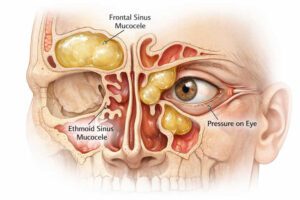
The majority of mucoceles affect the:
- Sinus frontalis
- Sinus ethmoid
- Sinus of the maxilla
- Sinus sphenoidalis
Because they are near the skull base and orbit, frontal and ethmoid mucoceles are especially significant.
What results in a sinus mucocele?
Possible reasons include:
- Prior sinus surgery
- Previous injury
- A sinus drainage channel is scarred or restricted.
- Chronic inflammatory sinus disease
- Blockage of the sinus opening
- Other, less common disorders that hinder sinus drainage may also be factors.
Prior sinus surgery is a crucial link. Years after previous sinus surgery, several mucoceles were reported in a lengthy clinical series.
Early Symptoms of a Sinus Mucocele
In the early stages, sinus mucoceles may cause subtle or vague symptoms, often mistaken for sinusitis or allergies.
1. Persistent Facial Pressure or Fullness
-
Dull, constant pressure in the forehead, cheeks, or between the eyes
-
Sensation of heaviness rather than sharp pain
-
Often worsens when bending forward
2. Chronic Nasal Blockage
-
One-sided nasal obstruction is common
-
Does not improve with usual cold or allergy medications
3. Mild Facial Pain or Headache
-
Localized headache depending on the affected sinus
-
Pain is typically gradual in onset and persistent
4. Reduced Sense of Smell
-
Partial or complete loss of smell (hyposmia or anosmia)
-
More common if the ethmoid or frontal sinuses are involved
Advanced Symptoms of a Sinus Mucocele
As the mucocele enlarges, symptoms become more pronounced and may involve ocular, neurological, and facial complications.
1. Swelling Around the Eye or Forehead
-
Visible swelling of the upper eyelid or forehead
-
Skin may appear stretched but not inflamed
-
Usually painless initially
2. Bulging of the Eye (Proptosis)
-
Eye pushed forward due to pressure from behind
-
More common in frontal and ethmoid mucoceles
-
May worsen gradually over weeks or months
3. Double Vision or Visual Disturbances
-
Blurred vision
-
Double vision (diplopia)
-
Reduced visual acuity due to optic nerve compression
⚠️ Visual symptoms are a medical emergency and require urgent ENT evaluation.
4. Reduced Vision
A mucocele can rarely affect the optic nerve or other orbital structures.
Any new loss of vision requires urgent medical assessment.
Visual outcomes can be better when vision-threatening complications are recognized and treated promptly.
Symptoms Based on Sinus Location
Frontal Sinus Mucocele Symptoms
-
Forehead swelling
-
Persistent frontal headache
-
Eye displacement downward or outward
-
Cosmetic deformity
Ethmoid Sinus Mucocele Symptoms
-
Eye bulging
-
Nasal obstruction
-
Loss of smell
-
Pain between the eyes
Maxillary Sinus Mucocele Symptoms
-
Cheek fullness
-
Facial asymmetry
-
Upper jaw or tooth pain
-
Nasal congestion
Sphenoid Sinus Mucocele Symptoms (Rare but Serious)
-
Deep, unexplained headache
-
Visual loss
-
Cranial nerve palsies
-
Dizziness or altered consciousness
Can a sinus mucocele impact the eyes?
Yes.
A growing mucocele might extend to the orbit and lead to:
- Forward eye displacement
- Diplopia
- Swelling of the eyelids
- Eye Displacement
- Diminished eyesight
- eye mobility that is limited
Mucoceles of the frontal and ethmoid bones are commonly connected with orbital involvement.
Don’t overlook new eye swelling, double vision, or loss of vision.
Can a Brain Be Impacted by a Sinus Mucocele?
A mucocele may move toward or erode the skull base in severe situations.
Possible issues include the following:
- Erosion of the skull’s base
- extension into the cranium
- Meningitis
- Abscess or infection of the brain.
Although these difficulties are uncommon, they can be severe. Imaging is crucial when a mucocele is suspected due to the paranasal sinuses’ tight connection with the skull base.
Signs of Infected Sinus Mucocele (Mucopyocele)
When a mucocele becomes infected, symptoms worsen rapidly.
1. Severe Facial Pain
-
Sharp or throbbing pain
-
Often associated with tenderness
2. Fever
-
Low-grade or high fever
-
Indicates secondary bacterial infection
3. Redness and Warmth Over the Sinus Area
-
Suggests inflammation or abscess formation
Neurological Symptoms (Rare but Serious)
Large or untreated mucoceles can extend toward the brain.
1. Severe Headache
-
Progressive and persistent
-
Different from usual sinus headaches
2. Seizures or Altered Mental Status
-
Extremely rare
-
Indicates intracranial extension
When Do You Need to Visit an ENT?
Schedule an ENT appointment if you experience:
- One-sided nasal obstruction that won’t go away
- Swelling in the face that cannot be explained
- Constant face discomfort or pressure
- Same side with recurrent symptoms
- new eye displacement
- Diplopia
- Visual loss
- Eye or facial symptoms, along with a chronic headache.
- Symptoms that persist even with standard sinus therapy
Get help from a doctor right away for:
- Vision impairment that comes on slowly or all of a sudden
- New double vision
- Eye swelling that is significant
- Intense headaches accompanied by neurological manifestations.
- Altered awareness or confusion
- Fits of convulsion
- Rapidly exacerbating orbital or face edema and a high temperature
How Is a Sinus Mucocele Diagnosed?
In most cases, diagnosis involves both an ENT exam and imaging.
1. Endoscopy of the Nose
The ENT specialist can inspect the sinus drainage regions and nasal cavity using a nasal endoscopy.
2. CT scan
A CT scan of the paranasal sinuses is especially helpful for assessing:
- the mucocele’s location
- Sinus extension
- Erosion or bony remodeling
- Engagement in orbital activities
- Involvement of the base of the skull
- Surgical Anatomy
The surrounding bony walls are frequently shown to be expanding or thinning on CT, which indicates an expansile sinus lesion.
3. MRI scan
When there is worry about one of the following, MRI may be included:
- Extension of the orbit
- Optic nerve involvement
- Extension of the brain
- A lesion that cannot be adequately characterized by CT scans
MRI gives further details about the lesion’s contents and soft tissues.
Is it possible to confuse a sinus mucocele with sinusitis?
Yes.
Some of the signs are shared with typical sinus issues.
At first, a mucocele could resemble:
- Sinusitis in the long run
- Chronic rhinosinusitis
- Polyps on the nose
- Migraine
- Other Reasons for Facial Pain
- Lesions on the orbit
Consequently, repeated therapy for suspected sinusitis may not be necessary if symptoms are odd or chronic, especially if they are unilateral or affect the eye; instead, imaging may be needed.
Is It Possible for a Sinus Mucocele to Disappear on Its Own?
A well-established sinus mucocele typically reacts differently to common medical care than uncomplicated sinusitis does.
Although medications can be used to treat related infection or inflammation, they do not reliably get rid of the underlying obstructed and enlarged mucocele.
The definitive treatment for symptomatic or expanding mucoceles is often surgical drainage and marsupialization.
What Is the Best Way to Treat a Sinus Mucocele?
Treatment is determined by:
- The sinus that is affected
- The mucocele’s size and scope
- Engagement with orbitals
- Skull-base invasion
- Previous operation
- Anatomy
- Existence of infection
- The patient’s symptoms
- Surgery with an endoscope
Endoscopic sinus surgery is frequently used to open and drain the mucocele and create a durable drainage route.
Usually, the mucocele is marsupialized, which involves making an opening for the contents to drain and the sinus to remain ventilated.
In numerous published series, endoscopic treatment has demonstrated positive long-term results.
Combined Surgery or External Surgery
Certain mucoceles have anatomy that renders an endoscopic approach difficult or insufficient.
In some circumstances, an integrated or external method may be taken into account. According to the disease’s localization and severity, the surgical method is customized.
What happens if a sinus mucocele is not treated?
A growing mucocele might keep getting bigger, altering the surrounding bone, or eroding it.
Possible issues include:
- Involvement of the orbits
- Proptosis
- Double vision
- Vision impairment
- Erosion of the skull base
- Extension to the skull
- Infection
The intensity and speed of progression, however, differ among patients. Some individuals may have massive mucoceles that cause astonishingly little discomfort.
Is It Possible for a Sinus Mucocele to Recur Following Operation?
Even if good long-term management is documented following the right surgical drainage and the creation of a long-lasting drainage route, relapse is still an option.
Especially in individuals with complicated anatomy or a history of sinus surgery, long-term follow-up is essential.
Commonly Asked Questions
Are mucoceles in the sinuses painful?
Not all mucoceles hurt, though some can. Pressure, headache, or face pain may result from the lesion’s spread.
Is it true that a mucocele is a malignant tumor?
No. A sinus mucocele is not malignant. However, it might impact surrounding structures and cause bone remodeling or erosion as it grows.
Is it possible for eye problems to be brought on by a sinus mucocele?
Yes. Mucoceles of the frontal and ethmoid bones can expand into the orbit, leading to proptosis, diplopia, eye displacement, or vision loss.
Is it possible for a sinus mucocele to cause headaches?
Yes. While headache alone is insufficient to make a diagnosis, it is a frequent initial symptom, as is facial pain.
Is it possible to go blind due to a sinus mucocele?
Yes, seldom. Advanced involvement of the optic nerve or orbit can be dangerous to vision. A sudden decrease in eyesight should be immediately evaluated.
Is surgery necessary for a sinus mucocele in all circumstances?
The individual case determines the course of treatment. Surgical treatment is frequently used for symptomatic, expanding, infected, or complex mucoceles. After a thorough examination and imaging, an ENT specialist should choose the best course of action.
Are sinus mucoceles and cysts the same thing?
They aren’t just synonyms. An expansile lesion called a mucocele is characterized by sinus drainage obstruction and has distinctive consequences on the sinus and neighboring bone.
Important Conclusions
- A sinus mucocele forms when normal sinus drainage is blocked.
- It has the ability to slowly grow, rebuild, or destroy surrounding bone.
- Headaches, pressure in the face, and a blocked nose are possible symptoms.
- Mucoceles in the frontal and ethmoid bones can have an impact on the eyes.
- Important neurological or visual symptoms might result from sphenoid mucoceles.
- CT is a crucial imaging examination for outlining the injury and its bony architecture.
- MRI could be helpful if further assessment of orbital or intracranial involvement is required.
- Surgical drainage and marsupialization are frequently used to treat mucoceles that are symptomatic or growing.
- Neurological symptoms, severe eye swelling, or changes in vision demand immediate medical attention.
Medical Disclaimer
This article is for general educational purposes only. It does not replace an examination, diagnosis, or treatment plan from a qualified ENT specialist. Persistent or one-sided sinus symptoms, eye symptoms, visual changes, severe headache, or neurological symptoms should be evaluated promptly.
📞 ENT Consultation & Surgery
Dr. Sagar Rajkuwar (MS-ENT)
Prabha ENT Clinic, Ambad, Nashik
📱 7387590194 | 9892596635
🌐 www.entspecialistinnashik.com
Related Articles (Internal Links)
🔗 Sinus Related Articles (Internal Links)
🤧 Sinus Headache & Symptoms
- https://healthuseful.com/sinus-headache-symptoms/
- https://healthuseful.com/sinus-headache-symptoms-one-side/
- https://healthuseful.com/sinus-headache-symptoms-right-side/
- https://healthuseful.com/sinus-headache-back-of-head/
- https://healthuseful.com/sinus-headache-symptoms-home-remedies/
- https://healthuseful.com/how-to-rid-of-a-sinus-infection-headache/
🦠 Sinus Infection Treatment
- https://healthuseful.com/how-to-get-rid-of-a-sinus-infection-in-24-hours/
- https://healthuseful.com/how-to-get-rid-of-sinus-infection-without-antibiotics/
- https://healthuseful.com/what-kills-a-sinus-infection-naturally/
- https://healthuseful.com/sinus-headache-tablet/
- https://healthuseful.com/how-do-doctors-drain-sinuses-without-surgery/
- https://healthuseful.com/signs-of-sinus-infection-getting-better/
- https://healthuseful.com/signs-of-sinus-infection-getting-better-with-antibiotics/
⚠️ Serious Conditions & Warning Signs
- https://healthuseful.com/end-stages-of-a-sinus-infection/
- https://healthuseful.com/how-to-tell-if-sinus-infection-has-spread-to-brain/
- https://healthuseful.com/how-to-tell-if-sinus-infection-has-spread-to-bone/
- https://healthuseful.com/what-is-a-red-flag-for-sinusitis/
- https://healthuseful.com/when-to-go-to-ae-with-sinusitis/
👁️ Related Symptoms & Complications
- https://healthuseful.com/can-a-sinus-infection-cause-eye-pain/
- https://healthuseful.com/can-sinusitis-affect-your-ears/
- https://healthuseful.com/can-sinus-infection-cause-hair-loss/
- https://healthuseful.com/symptoms-of-perforated-sinus-after-tooth-extraction/
🧠 Causes, Triggers & Misdiagnosis
- https://healthuseful.com/what-triggers-sinusitis-headaches/
- https://healthuseful.com/what-can-be-mistaken-for-a-sinus-infection/
- https://healthuseful.com/what-mimics-sinus-issues/
- https://healthuseful.com/what-can-worsen-a-sinus-infection/
🧬 Nutrition & Deficiency
- https://healthuseful.com/what-vitamin-deficiency-causes-sinus-headaches/
- https://healthuseful.com/what-vitamin-deficiency-causes-sinusitis/
- https://healthuseful.com/what-deficiency-causes-sinusitis/
📘 General Sinus Knowledge
- https://healthuseful.com/what-are-the-four-cardinal-signs-of-sinusitis/
- https://healthuseful.com/is-a-sinus-infection-contagious-with-fever/
- https://healthuseful.com/can-you-smell-a-fungal-sinus-infection/
- https://healthuseful.com/sinusitis-in-hindi/
💰 Treatment & Surgery
- https://healthuseful.com/cost-of-sinus-surgery-in-india/
- https://healthuseful.com/how-to-cure-sinus-permanently/
🧒 Special Cases
🔍 Rare Conditions
🔗 Related Articles on Nasal Polyps (ENT Expert Guides)
For detailed, evidence-based information, explore the following articles:
https://healthuseful.com/can-nasal-polyps-turn-cancerous/
https://healthuseful.com/can-nasal-polyps-affect-the-brain/
https://healthuseful.com/what-are-the-symptoms-of-cancerous-nasal-polyps/
https://healthuseful.com/when-to-worry-about-nasal-polyp/
https://healthuseful.com/what-happens-if-nasal-polyps-untreated/
https://healthuseful.com/number-one-cause-of-nasal-polyps/
https://healthuseful.com/how-to-stop-polyp-growth/
https://healthuseful.com/can-nasal-polyps-cause-heart-problems/
https://healthuseful.com/how-to-cure-nasal-polyps-permanently/
https://healthuseful.com/can-ent-see-nasal-polyps/