Tympanosclerosis Surgery Success Rate: Hearing Improvement & Recovery
Author: Dr Sagar Rajkuwar, ENT Specialist, Nashik, Maharashtra, India
🌐 www.entspecialistinnashik.com
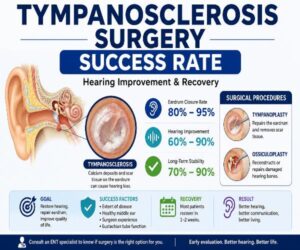
For a considerable closure of the air-bone hearing gap to 20 dB, tympanosclerosis surgery (tympanoplasty and ossicular chain reconstruction) has a success rate of 60% to 75%. Although revision procedures or two-stage operations may be necessary in situations of complicated ossicular fixation, graft uptake or eardrum repair is successful between 75% and 90% of the time.
Success rates are greatly influenced by a variety of clinical variables:
Calcification: A restricted scar has a higher surgical success rate than widespread, advanced tympanosclerosis.
Audiological Hearing Improvement: Surgeons often notice a substantial improvement in hearing, with most individuals closing their hearing gap to under 20 dB.
Anatomical Eardrum Repair: The hole in the eardrum is typically repaired with a success rate of 75% to 90%. Ossicular reconstruction for stapes fixation results in hearing threshold improvement in 60 to 65 percent of cases. To go over your specific audiogram and ear condition, you should speak with an ENT specialist or a member of the American Academy of Otolaryngology-Head and Neck Surgery for in-depth success statistics, prognostic variables, and tailored procedural options.
Table of Contents
- What is Tympanosclerosis?
- Why is surgery required?
- Categories of Tympanosclerosis Surgery
- Tympanosclerosis Surgery Success Rate
- How much may hearing improve?
- Things that impact surgical success
- Complications and Risks
- After Tympanosclerosis Surgery Recovery
- Alternatives to Surgery
- Is It Worth Having Tympanosclerosis Surgery?
- Commonly Asked Questions
- Summary
What is Tympanosclerosis?
Tympanosclerosis is a condition where scar tissue and calcium deposits grow on the eardrum (tympanic membrane) and occasionally inside the middle ear. After ear procedures, ear infections, perforations of the eardrum, or chronic otitis media, it often develops.
The eardrum may become less flexible and have chalky white areas of scar tissue. In some individuals, this illness causes conductive hearing loss by affecting the middle ear’s ability to transmit sound.
Many individuals with mild tympanosclerosis are symptomless and may only learn they have the disease during a routine ENT checkup.
Why is surgery required?
Not all tympanosclerosis patients need surgery.
Typically, therapy is suggested when:
- Severe hearing loss exists.
- The hearing bones (ossicles) are impacted.
- Eardrum motion is severely constrained by scar tissue
- Communicating on a daily basis is challenging.
- Hearing aids are not beneficial enough
Observation alone is frequently the best strategy if hearing is still regular.
Categories of Tympanosclerosis Surgery
Tympanoplasty
Scar tissue is removed and the eardrum’s damaged areas are repaired by tympanoplasty.
The eardrum can be rebuilt by the surgeon using:
- Grafts made of cartilage
- Grafts of fascia
- Graft substances made synthetically
- Reconstruction of the middle ear bones
Ossiculoplasty
may be necessary if the bones of the middle ear have been hurt or rendered immobile by calcification.
This method reconstructs:
- Malleus
- Incus
- Stapes
The purpose is to improve hearing and restore sound transmission.
Ossiculoplasty and Tympanoplasty Together
For the greatest possible hearing restoration, several patients need both treatments at once.
Tympanosclerosis Surgery Success Rate
The success rate depends on the severity and location of disease.
Published studies generally report:
| Outcome | Success Rate |
|---|---|
| Eardrum Closure | 80–95% |
| Hearing Improvement | 60–90% |
| Significant Hearing Gain | 50–80% |
| Long-Term Stability | 70–90% |
In patients with isolated eardrum tympanosclerosis, outcomes are usually excellent.
When extensive middle-ear calcification involves the ossicles, results become less predictable.
How much may hearing improve?
The amount of improvement in hearing varies among individuals.
Patients commonly have:
- Better understanding of speech
- Reduced effort in listening
- Life quality increase
- improved communication
Studies frequently demonstrate:
- Closure of the air-bone gap by 10-20 dB
- The bulk of patients experience substantial hearing restoration.
- In particular situations, complete normalization
Nevertheless, if there is a lot of ossicular damage, hearing may not return to normal.
Things that impact surgical success
Outcomes are influenced by a number of variables.
Size of Disease
Widespread calcification often yields less positive outcomes than constrained scar formation.
Participation in ossicular surgery
If the auditory bones stay moveable, success rates are higher.
Experienced Surgeon
Results improve when skilled otologic surgeons do surgery.
Role of the Eustachian Tube
The long-term success of the middle ear depends on good ventilation.
Infection in Progress
The ear is often more receptive to surgery when it is dry and free of infection.
Complications and Risks
Tympanosclerosis surgery has certain risks, even if it’s usually secure.
Possible problems include:
- Ongoing hearing impairment
- Recurring scarring
- Contamination
- Vertigo
- Disturbance in taste sensations
- Perforation of the eardrum
- Ringing in the ear.
- Uncommon sensorineural deafness
When carried out by seasoned ENT surgeons, significant problems are rare.
After Tympanosclerosis Surgery Recovery
Most patients recuperate in between one and two weeks.
Typically, recuperation entails:
The first several days
- Small pain
- Fullness of the ears
- Temporary shifts in hearing
First Two Weeks
- Healing at a slow pace
- Decreased puffiness
- Enhanced comfort
The Initial Several Months
- Ongoing hearing improvement
- Middle ear function restoration
A number of weeks after the surgery, the majority of surgeons arrange follow-up appointments and hearing checks.
Alternatives to Surgery
Not every patient requires surgery.
Alternatives may include:
Observation
Suitable for patients without hearing impairment.
Aids for hearing
When surgery is not an option, modern hearing aids can make a big difference in hearing.
Routine Monitoring
Regular hearing evaluations aid in tracking advancement.
Is It Worth Having Tympanosclerosis Surgery?
Surgery may be very helpful for individuals with severe conductive hearing loss.
Benefits include:
- Improved Hearing
- Better communication
- Lessening social isolation
- Improved quality of life
Even if the results are less consistent, patients with significant ossicular involvement may nevertheless improve.
Commonly Asked Questions
Does surgery for tympanosclerosis work?
Yes. According to most research, 60–90% of individuals who are chosen appropriately experience an improvement in their hearing.
Is it possible to completely restore hearing via surgery?
Occasionally. However, the outcome is determined by the severity of ossicular damage and scarring.
Is surgery invariably required?
Nope. Simple monitoring is sufficient for several individuals who have mild tympanosclerosis.
Is it possible for tympanosclerosis to come back following an operation?
Although it is possible, particularly in patients with chronic middle ear disease, recurrence is uncommon.
How long will it take to recover?
While hearing improvement may take a few months, the majority of patients recover in one to two weeks.
Summary
For many people with hearing loss brought on by scarring of the eardrum and middle ear, surgery for tympanosclerosis yields very good results. Many studies show that contemporary techniques like tympanoplasty and ossiculoplasty successfully repair 80–95% of eardrums and improve hearing in 60–90% of cases.
Surgical expertise, Eustachian tube function, middle-ear involvement, and illness severity all play a role in how well the procedure turns out. Patients who are experiencing hearing issues should see an ENT expert for a thorough evaluation and a customized treatment plan.
Medical Disclaimer
This content is for educational and informational purposes only and is not a substitute for professional medical advice, diagnosis, or treatment. Tympanosclerosis and hearing loss should be evaluated by a qualified ENT specialist or healthcare professional. Never ignore professional medical advice or delay seeking care because of information read online. If you experience hearing loss, ear pain, tinnitus, ear discharge, dizziness, or worsening symptoms, seek medical evaluation promptly.
Primary Topic Cluster: Otitis Media (Middle Ear Infection)
Pillar Article
Symptoms & Diagnosis
Chronic Otitis Media Cluster
- https://healthuseful.com/chronic-otitis-media/
- https://healthuseful.com/treatment-of-chronic-otitis-media/
- https://healthuseful.com/chronic-otitis-media-effusion/
Specific Types of Otitis Media
- https://healthuseful.com/otitis-media-nonsuppurative/
- https://healthuseful.com/otitis-media-paediatric/
Primary Topic Cluster: Tympanosclerosis
Pillar Article
Causes & Risk Factors
Treatment Cluster
- https://healthuseful.com/tympanosclerosis-treatment-without-surgery/
- https://healthuseful.com/tympanosclerosis-surgery-success-rate/
Symptoms & Complications
Comparison Articles
- https://healthuseful.com/tympanosclerosis-vs-otosclerosis/
- https://healthuseful.com/tympanosclerosis-vs-cholesteatoma/
References
|
Source |
Topic |
| Cleveland Clinic – Tympanosclerosis: Causes, Symptoms & Treatment |
Overview of tympanosclerosis, symptoms, diagnosis, and treatment options. |
| StatPearls – Tympanosclerosis |
Clinical review covering pathophysiology, diagnosis, and management. |
| American Academy of Otolaryngology–Head and Neck Surgery (AAO-HNS) |
ENT guidance on ear diseases, hearing disorders, and surgery. |
| National Institute on Deafness and Other Communication Disorders (NIDCD) |
Authoritative information on hearing loss and middle-ear conditions. |