Tympanosclerosis vs Cholesteatoma: Understanding the Key Differences, Symptoms, Causes, Diagnosis, and Treatment
Author: Dr Sagar Rajkuwar, ENT Specialist, Nashik, Maharashtra, India
🌐 www.entspecialistinnashik.com
Confused between cholesteatoma and tympanosclerosis? Prior to irreversible ear damage, find out about the main distinctions, symptoms, causes, diagnosis, risks of hearing loss, and available treatments.
Cholesteatoma vs. Tympanosclerosis: What’s the Difference?
The quality of life, equilibrium, and hearing can all be negatively impacted by ear issues. Tympanosclerosis and cholesteatoma are two disorders that are frequently misunderstood among the many diseases that impact the middle ear.
Despite the fact that both situations might manifest after recurrent ear infections and possibly cause hearing loss, they are fundamentally different diseases with different etiologies, appearances, consequences, and therapeutic techniques.
Because one ailment is typically benign while the other may turn destructive and possibly fatal if untreated, it’s crucial to distinguish between cholesteatoma and tympanosclerosis.
In this thorough guide, we go over all you need to know about cholesteatoma vs. tympanosclerosis, such as the signs, causes, diagnosis, treatment options, and long-term outlook.
Table of Contents
- What Is Tympanosclerosis?
- What Exactly Is a Cholesteatoma?
- Tympanosclerosis vs Cholesteatoma: Quick Comparison
- Tympanosclerosis causes
- Cholesteatoma causes
- Tympanosclerosis Symptoms
- Signs and Symptoms of Cholesteatoma
- What Causes Hearing Loss and How They Differ
- Appearance During Ear Examination
- Factors of Danger
- How These Conditions Are Diagnosed by Doctors
- Tympanosclerosis Treatment
- Treatment of Cholesteatoma
- Can Tympanosclerosis Turn Into Cholesteatoma?
- Possible Problems
- Prevention Advice
- Frequently Asked Questions (FAQs)
- Conclusion
What Is Tympanosclerosis?
Tympanosclerosis is an ailment marked by scarring and calcification of the eardrum and sometimes in the middle ear.
The problem is caused by an abnormal healing response after:
- Ear infections that keep happening
- Otitis media that persists for a long time
- insertion of ear tubes
- Eardrum injury
- History of ear operations
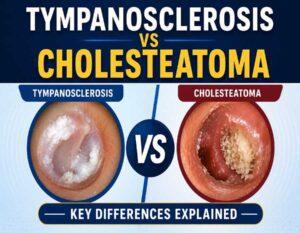
White, chalky plaques may form on the eardrum, sometimes reducing its flexibility and hindering the transmission of sound.
Often, tympanosclerosis is discovered unintentionally during a standard ENT checkup and presents without symptoms.
What Exactly Is a Cholesteatoma?
A cholesteatoma is an abnormal accumulation of skin cells that develops in the middle ear and mastoid cavity.
Even though it has the term “cholesteatoma,” it is neither cancerous nor a tumor.
It can be incredibly damaging, though.
Cholesteatoma has the potential to:
- Damage middle ear ossicles.
- Lead to long-lasting illnesses
- Hearing harm
- Balance effect
- If left untreated, it may result in major problems.
In contrast to tympanosclerosis, cholesteatoma nearly always necessitates surgery.
Tympanosclerosis vs Cholesteatoma: Quick Comparison
| Feature | Tympanosclerosis | Cholesteatoma |
|---|---|---|
| Nature | Scarring and calcium deposits | Abnormal skin growth |
| Cancerous | No | No |
| Hearing Loss | Sometimes | Common |
| Ear Discharge | Rare | Common |
| White Appearance | Chalky plaques | White debris mass |
| Infection Risk | Low | High |
| Surgery Needed | Sometimes | Usually |
| Bone Destruction | Rare | Common |
| Serious Complications | Uncommon | Possible |
Tympanosclerosis causes
Numerous circumstances raise the possibility of tympanosclerosis.
Ear Infections that Happen Again
Scar formation can be brought on by frequent inflammation.
Persistent Otitis Media
Long-term infection might result in calcium deposits in mending tissues.
Placement of Ear Tubes
Permanent scars are occasionally left by myringotomy tubes.
Perforated Eardrum
Following rupture, fibrosis and calcification may result in mending.
Prior Ear Operation
Scar tissue development can be promoted by surgical handling.
Cholesteatoma causes
Cholesteatoma typically grows in a different way.
Dysfunction of the Eustachian Tube
Negative pressure caused by inadequate middle ear ventilation pulls the eardrum inward.
Formation of Retraction Pockets
Skin cells are trapped by the retracted eardrum.
Ear Infection on a Regular Basis
Growth is accelerated by persistent infection.
Cholesteatoma, congenital
Behind the eardrum, some infants have abnormal skin tissue.
Tympanosclerosis Symptoms
Symptoms are not present in many individuals.
Among the symptoms that may occur include:
- Loss of Hearing
- Eardrum white patche
- Slight ear pain
- Fullness of the ear
- Ringing in the ear
Signs and Symptoms of Cholesteatoma
The majority of the symptoms are apparent.
Common indications include:
- Continuous ear discharge
- A loss of hearing
- Fullness in the ear
- Drainage that smells bad
- Ache in the ear
- Lightheadedness
- Problems with balance
- Tinnitus
Facial weakness may result from advanced disease.
What Causes Hearing Loss and How They Differ
Tympanosclerosis
Scarring that stiffens the eardrum or damages middle ear bones is the cause of hearing loss.
Usually, the hearing loss is conductive.
The level of severity varies from moderate to mild.
Cholesteatoma
Due to the expanding cyst’s destruction of sound-conducting components, hearing loss develops.
It might become serious if it is not addressed.
Both conductive and mixed hearing loss are possible.
Appearance During Ear Examination
Tympanosclerosis
Specialists in otolaryngology see that:
- White, shiny plaques
- chalky deposits
- Eardrum that is thicker
- regions that have calcified
Cholesteatoma
ENT experts may notice:
- White keratin debris
- Pockets for retraction
- Unpleasant discharge
- Tissue damage
To a seasoned ENT doctor, the appearance is often quite dissimilar.
Factors of Danger
Risk Factors Associated with Tympanosclerosis
- Regular childhood ear infections
- Ear surgery
- Tubes in the ear
- long-term inflammation
- Injury to the eardrum
Risk Factors for Cholesteatoma
- Recurrent ear infections
- Poor Eustachian tube function
- Palate cleft
- History of the family
- middle ear disease that is recurring
How These Conditions Are Diagnosed by Doctors
Medical history
Physicians inquire about:
- Changes in hearing
- Infections of the ear
- Surgery on the ear
- ear drainage
Examination of the ear with an otoscope
Important hints are frequently given by direct visualization.
Tests for hearing
Hearing loss severity is determined by audiology.
Tympanometry
Assesses how the eardrum moves.
CT Scan
Especially useful for cholesteatoma.
Imaging aids in determining:
- The bone’s structure is being destroyed.
- The severity of the condition
- Planning for surgery
Tympanosclerosis Treatment
Not everyone requires treatment.
Watching
Monitoring may be the only requirement for patients who have excellent hearing.
Hearing Aid
It is helpful for those who have hearing loss.
Tympanoplasty
Fixes injured eardrum tissue.
Ossiculoplasty
Restores hearing bones that have been harmed.
Treatment of Cholesteatoma
Surgical treatment is typically used.
Surgery for Cholesteatoma
Goals consist of:
- completely eliminating illness
- Preventing relapse
- Protecting one’s hearing
The following procedures may be involved:
- Tympanoplasty
- A mastoidectomy
- Reconstruction of the ossicles
Because recurrence is possible, regular follow-up is necessary.
Can Tympanosclerosis Turn Into Cholesteatoma?
No.
Cholesteatoma and tympanosclerosis are two distinct conditions.
Cholesteatoma is not automatically brought on by tympanosclerosis.
In patients with chronic ear infections, both conditions may nevertheless manifest themselves.
Possible Problems
Tympanosclerosis
Complications may include:
- Hearing loss due to conduction
- decreased eardrum movement
- Tinnitus.
Serious problems are uncommon.
Cholesteatoma
Potential issues include:
- Serious hearing loss
- Damage to the facial nerve
- Damage to the inner ear
- Meningitis
- Abscess of the brain
- Disorders of balance
Early care is crucial for this reason.
Prevention Advice
Lower Your Risk of Ear Infections
Complications may be reduced by timely treatment.
Protect the health of your ears.
Don’t put things in your ears.
Post-Ear Surgery Care
Regular monitoring aids in early issue identification.
Allergies Control
Ear ventilation may be improved by decreasing inflammation in the Eustachian tube and nose.
Prompt Evaluation by an ENT Is Recommended
Never disregard persistent ear discharge or hearing loss.
Frequently Asked Questions (FAQs)
Which is more serious?
In general, cholesteatoma is more dangerous since it has the potential to harm neighboring structures.
Can hearing loss be brought on by tympanosclerosis?
Yes. Massive scarring has the potential to impede sound transmission.
Is cholesteatoma cancerous?
No, it’s a generally harmless but perhaps hazardous tumor.
Is it possible for tympanosclerosis to go away on its own?
No. Normally, scar tissue lasts a lifetime.
Is surgery necessary for cholesteatoma at all times?
Surgery is ultimately necessary in most situations.
Conclusion
Even though cholesteatoma and tympanosclerosis may have certain characteristics, such as hearing loss and a history of ear infections, they are two quite distinct diseases. While cholesteatoma is an abnormal skin formation that can cause progressive destruction within the middle ear, tympanosclerosis is characterized by scarring and calcium deposits on the eardrum.
Tympanosclerosis is usually benign and may only need observation. However, cholesteatoma often requires surgical removal to avert severe consequences and hearing impairment.
Early detection by an ENT professional is still the most effective approach to protect hearing and avoid long-term ear damage.
Medical Disclaimer
Medical Disclaimer: This content is for educational purposes only and is not a substitute for professional medical advice, diagnosis, or treatment. Consult an ENT specialist for personalized evaluation and care.
Here are some useful YouTube resources on Tympanosclerosis vs Cholesteatoma:
▶️ Cholesteatoma | Tympanosclerosis – #46
▶️ Normal Ear vs Ear Infection, Tympanosclerosis & Cholesteatoma
Primary Topic Cluster: Otitis Media (Middle Ear Infection)
Pillar Article
Symptoms & Diagnosis
Chronic Otitis Media Cluster
- https://healthuseful.com/chronic-otitis-media/
- https://healthuseful.com/treatment-of-chronic-otitis-media/
- https://healthuseful.com/chronic-otitis-media-effusion/
Specific Types of Otitis Media
- https://healthuseful.com/otitis-media-nonsuppurative/
- https://healthuseful.com/otitis-media-paediatric/
Primary Topic Cluster: Tympanosclerosis
Pillar Article
Causes & Risk Factors
Treatment Cluster
- https://healthuseful.com/tympanosclerosis-treatment-without-surgery/
- https://healthuseful.com/tympanosclerosis-surgery-success-rate/
Symptoms & Complications
Comparison Articles
- https://healthuseful.com/tympanosclerosis-vs-otosclerosis/
- https://healthuseful.com/tympanosclerosis-vs-cholesteatoma/
References
- Cleveland Clinic – Tympanosclerosis: Causes, Symptoms & Treatment.
- Cleveland Clinic – Cholesteatoma: Symptoms, Causes & Treatment.
- National Institute on Deafness and Other Communication Disorders – Ear Infections and Hearing Disorders.
- American Academy of Otolaryngology–Head and Neck Surgery – Cholesteatoma and Chronic Ear Disease.
- NHS – Cholesteatoma.
- MSD Manual Professional Edition – Cholesteatoma.
- MedlinePlus – Middle Ear Disorders.
- StatPearls Publishing – Tympanosclerosis.
- StatPearls Publishing – Cholesteatoma.
- World Health Organization – Prevention of Hearing Loss and Ear Disease.