Tympanosclerosis Symptoms: Causes, White Spots, Hearing Loss & Treatment (2026 ENT Guide)
Chalky white spots on the eardrum (tympanic membrane) and progressive hearing loss are the most frequent symptoms of tympanosclerosis, although the condition is often entirely asymptomatic. According to peer-reviewed data, tympanosclerosis is identified in roughly 7–33% of patients with chronic otitis media and in up to 47.8% of ears examined during middle-ear surgery, making it one of the most under-recognized causes of silent hearing decline worldwide.
Author: Dr Sagar Rajkuwar, MS-ENT Specialist, Nashik, Maharashtra, India
🌐 www.entspecialistinnashik.com
📌 Table of Contents
- What Is Tympanosclerosis?
- How the Eardrum Operates
- What Causes Tympanosclerosis?
- Usual Symptoms
- Does It Always Cause Hearing Loss?
- Eardrum with White Spots
- Do White Spots Always Mean Tympanosclerosis?
- Hearing Loss in Tympanosclerosis
- Type of Hearing Loss Caused
- Ear Ringing and Tinnitus
- Risk Factors
- Diagnosis
- Tests Used
- Myringosclerosis vs Tympanosclerosis
- Tympanosclerosis vs Otosclerosis
- Is It Dangerous?
- Tympanosclerosis in Children
- Ear Infections and Scarring
- Treatment Without Surgery
- When Is Surgery Required?
- Tympanoplasty and Ossicular Reconstruction
- Hearing Aids
- Recovery
- Prevention
- Urgent Red Flags
- When to See an ENT
- FAQs
- Conclusion
1. What Is Tympanosclerosis?
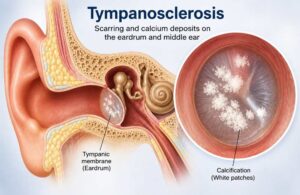
Tympanosclerosis is a condition in which hyaline degeneration and calcium deposits replace the normal elastic fibers of the eardrum and middle-ear tissues following chronic inflammation or injury. Microscopically, the lamina propria of the tympanic membrane becomes thickened by fibrous tissue that eventually mineralizes into dense white plaques. Though it can occur at any age, published series show it is most frequently diagnosed in adults aged 30–50, with a female-to-male ratio of about 1.6–1.77 : 1, likely reflecting the longer duration of untreated childhood middle-ear disease.
The condition can be limited to the eardrum (then called myringosclerosis) or extend into the middle ear and involve the ossicular chain — the malleus, incus and stapes. When ossicular involvement occurs, the sound-conducting mechanism becomes stiff, producing a measurable air-bone gap on audiometry, usually between 20 and 40 dB.
2. How the Eardrum Operates
The tympanic membrane is a three-layer cone-shaped structure (outer squamous epithelium, middle fibrous lamina propria, inner mucosal layer) that converts airborne sound into mechanical vibration. These vibrations are relayed through the ossicular chain to the oval window and the fluid-filled cochlea, where they are converted into neural impulses. Normal hearing requires both a mobile eardrum and a free-moving ossicular chain. When tympanosclerosis infiltrates the fibrous layer, stiffness increases, resonance falls, and sound transmission is damped — producing muffled, dull or distant-sounding audio perception. The healthy eardrum normally vibrates with amplitudes measured in nanometers; even a thin sclerotic plaque, if it fixes the malleus handle or stapes footplate, can double or triple the impedance of the middle ear.
3. What Causes Tympanosclerosis?
Tympanosclerosis develops when healing after middle-ear inflammation goes awry: free oxygen radicals, cytokines and macrophages trigger hyalinization of collagen, which later calcifies.
- Recurrent acute otitis media
- Chronic suppurative otitis media (CSOM)
- Otitis media with effusion (“glue ear”)
- Previous tympanic membrane perforation
- Ventilation (grommet / tympanostomy) tube insertion — a leading iatrogenic cause
- Prior tympanoplasty or mastoidectomy
- Head trauma with eardrum injury
- Long-standing Eustachian tube dysfunction
Added research insight: A 2026 publication in Genetics and Molecular Research suggests a genetic predisposition and immune-mediated component — not every child with repeated ear infections develops tympanosclerosis, and HLA phenotype plus oxidative-stress pathways appear to modulate who does.
4. Usual Symptoms of Tympanosclerosis
Many people never experience symptoms. When symptoms do appear in tympanosclerosis, they tend to progress slowly over months to years:
- Gradually diminishing hearing — conductive hearing loss
- Tinnitus (ringing, buzzing, humming or clicking)
- Feeling of fullness or blockage
- Difficulty understanding conversations in noisy rooms
- Sounds appearing muffled, as if “underwater”
- Occasional mild otalgia (ear discomfort) during infections
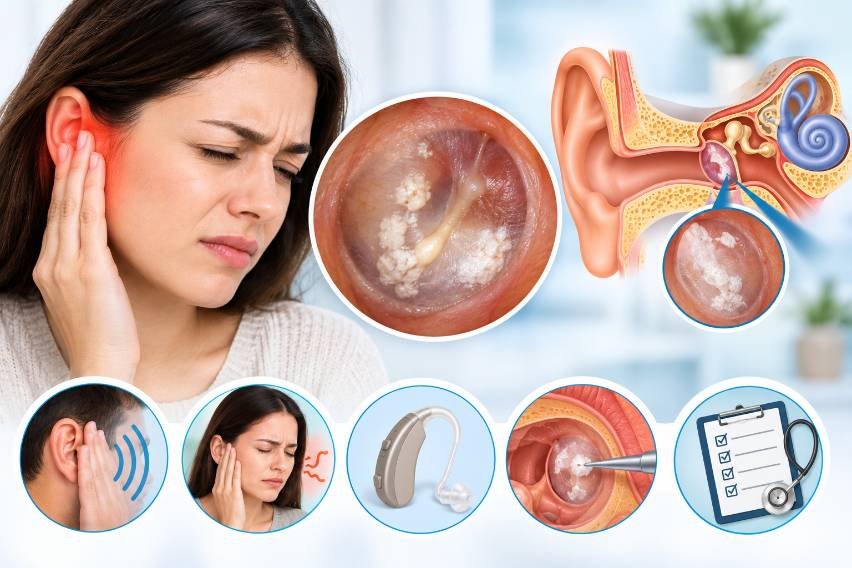
- Visible chalky white plaques on the eardrum detected by an ENT
Added value: Patient-reported outcome registries also mention associated fatigue, depressed mood and social withdrawal when hearing loss is left unaddressed — a reminder that untreated conductive hearing loss carries a measurable mental-health cost.
5. Does Tympanosclerosis Always Cause Hearing Loss?
No. Many people with visible white plaques on the eardrum have completely normal hearing. Tympanosclerosis only produces hearing loss when the sclerotic tissue fixes part of the vibrating system — typically the malleus handle, the incudomalleolar joint, or the stapes footplate. In isolated myringosclerosis of the pars tensa, hearing often remains within normal limits. Published audiometric data show that an air-bone gap (ABG) only develops once ≥30% of the eardrum is involved, or when the ossicular chain itself is affected. An audiogram is essential before any clinical conclusion is drawn.
6. Eardrum with White Spots
During otoscopy, your ENT may see shiny, chalky, horseshoe-shaped or crescentic plaques on the eardrum. These are areas where normal elastic fibers have been replaced by hyalinized collagen and calcium phosphate crystals. The plaques most commonly occupy the posteroinferior quadrant of the pars tensa — a pattern consistent across international surgical series. Under microscopy, nodular calcification resembles tiny eggshell fragments embedded in the drum.
7. Do White Spots Always Mean Tympanosclerosis?
No. Other conditions can mimic the appearance:
- Retracted or atelectatic eardrum with keratin deposits
- Attic cholesteatoma
- Healed perforation (atrophic scar)
- Lipoid or cholesterol deposits
Your ENT confirms the diagnosis with otoendoscopy, tympanometry and audiometry. Not every white patch on the eardrum is tympanosclerosis, so professional evaluation matters.
8. Hearing Loss in Tympanosclerosis
Yes — most commonly conductive hearing loss. Severity ranges from a trivial 10 dB loss up to a disabling 50–60 dB loss when the stapes footplate is fixed. The Carhart notch (a dip near 2 kHz on the bone-conduction curve) is seen in roughly one-third of symptomatic cases and is an important audiometric clue that pathology has moved beyond the drum.
9. Type of Hearing Loss Caused
Classically purely conductive, but mixed loss is possible when co-existing presbycusis (age-related hearing loss) or noise exposure is present. Not every hearing loss in a tympanosclerosis patient is caused by tympanosclerosis itself, which is why an audiogram with bone-conduction thresholds is mandatory before deciding on surgery or hearing aids. Once calcification is established it does not spontaneously resolve. Surgery can restore hearing in many cases, but when the stapes footplate is deeply involved, outcomes are less predictable.
10. Ear Ringing and Tinnitus
Tinnitus is reported by 30–50% of symptomatic patients. It may sound like steady ringing, low-frequency humming, high-pitched whistling or clicking (especially with ossicular involvement). Tinnitus loudness often parallels the degree of conductive loss. Addressing the conductive deficit — through surgery or amplification — usually reduces tinnitus perception. People with tympanosclerosis and tinnitus should still undergo a complete audiological workup, because tinnitus has many possible causes.
11. Risk Factors
- History of chronic otitis media (seen in up to 78% of surgical cases)
- Childhood grommet insertion
- Previous ear surgery
- Trauma to the eardrum
- Persistent Eustachian tube dysfunction
- Female sex (slightly increased risk)
- Chronic allergic rhinitis and biofilm-forming middle-ear bacteria
- Living in regions with poor access to early ENT care
Added value: Secondhand smoke in children is now recognized as an independent risk factor by the NIDCD and WHO, because it prolongs middle-ear effusion and inflammation.
12. Diagnosis
Medical History
Document frequency of ear infections, surgeries, trauma, tinnitus and hearing changes.
Otoscopy / Otoendoscopy
Chalky white plaques become readily visible under magnification.
Audiometry
Pure-tone and speech audiometry quantify the loss.
Tympanometry
Measures eardrum mobility; a flat or shallow (type As) tracing suggests stiffness.
High-Resolution CT of Temporal Bone
Reserved for severe disease — reveals ossicular involvement and helps plan surgery.
13. Tests Used to Evaluate Tympanosclerosis
- Otoscopy or otoendoscopy — direct visualization
- Pure-tone audiometry — defines conductive, sensorineural or mixed loss
- Tympanometry — assesses middle-ear mobility and pressure
- Tuning-fork tests (Weber, Rinne) — bedside confirmation of conductive loss
- Speech-in-noise testing — functional measure of real-world handicap
- HRCT temporal bone — in extensive or revision cases
- Acoustic reflex testing — absent reflexes suggest ossicular fixation
14. Myringosclerosis vs Tympanosclerosis
Myringosclerosis is confined to the tympanic membrane only. Usually benign and hearing is preserved. Tympanosclerosis involves the drum and middle-ear structures — mucosa, ossicles, oval window. Hearing loss is more likely with the latter.
15. Tympanosclerosis vs Otosclerosis
Though their names sound similar, these are different diseases. Tympanosclerosis involves scar-and-calcium plaques caused by inflammation or trauma, while otosclerosis is abnormal bone remodeling of the otic capsule around the stapes — often genetic, with worldwide prevalence of about 0.3–0.4%. Both can produce conductive hearing loss, but otosclerosis typically starts in the 20s–40s, is often bilateral, and may progress during pregnancy. Distinguishing them requires audiometry, imaging and sometimes exploratory tympanotomy.
16. Is Tympanosclerosis Dangerous?
Usually not life-threatening. Mortality is zero when it is isolated. However, when it coexists with chronic suppurative otitis media, intracranial complications (meningitis, brain abscess) can carry mortality of 8–18.6%, according to published series. The real danger lies in the underlying ear infection, not in the sclerosis itself.
17. Tympanosclerosis in Children
Children with recurrent ear infections or after grommet insertion are the highest-risk group. Watch for delayed speech or language, poor school performance, frequent ear complaints, or mouth breathing linked to adenoid hypertrophy. Early referral prevents secondary learning problems.
18. Can Ear Infections Cause Scarring?
Yes. Each inflammatory episode leaves microscopic fibrotic scars that may calcify over years. Prompt, adequate antibiotic treatment and management of Eustachian-tube dysfunction can reduce — though never fully eliminate — the risk of tympanosclerosis.
19. Treatment Without Surgery
- Yearly audiometry
- Hearing aids or bone-conduction devices
- Treating underlying allergic rhinitis or sinus disease
- Avoiding water contamination of the ear canal
- Smoking cessation and avoiding passive smoke
20. When Is Surgery Required?
Surgery is considered when hearing loss exceeds 30 dB and affects daily life, when the ossicular chain is fixed, when there is coexisting perforation or chronic infection, or when the patient cannot or does not want to use hearing aids. Published results show hearing improvement in 60–75% of cases when the air-bone gap is closed to 20 dB or less, though revision surgery may be needed when the stapes footplate is diseased.
21. Tympanoplasty and Ossicular Reconstruction
During tympanoplasty, scar plaques are removed and the drum is reconstructed with autologous grafts such as temporalis fascia, tragal cartilage or perichondrium. If the ossicles are fixed, ossiculoplasty is performed with Partial Ossicular Replacement Prosthesis (PORP), Total Ossicular Replacement Prosthesis (TORP), or stapedotomy with piston placement for stapes fixation. Two-stage surgery is sometimes preferred to allow middle-ear mucosa to recover before implanting a prosthesis in cases of extensive tympanosclerosis.
22. Hearing Aids
Modern digital hearing aids are highly effective for conductive hearing loss. For patients unwilling or unfit for surgery, bone-anchored hearing aids (BAHA) or contralateral routing of signals (CROS) devices offer alternatives.
23. Recovery After Surgery
Initial recovery takes 1–2 weeks; full healing and best hearing outcome take 3–6 months. During recovery, avoid lifting heavy weights (>5 kg), water contamination of the ear, air travel for 4–6 weeks, forceful nose-blowing, and scuba diving (lifelong caution advised).
24. Prevention
- Treat ear infections promptly and completely
- Breastfeed infants when possible (reduces otitis media risk)
- Pneumococcal and influenza vaccination
- Avoid smoke exposure (per WHO and CDC recommendations)
- Protect ears from loud noise and barotrauma
- Follow post-operative ENT instructions carefully
These simple measures reduce the chance of developing tympanosclerosis later in life.
25. When Hearing Loss Needs Urgent Evaluation
Sudden hearing loss is NEVER caused by tympanosclerosis. If hearing drops abruptly in one ear, this may represent sudden sensorineural hearing loss (SSNHL), which is an otological emergency — treatment within 72 hours improves prognosis. Also seek urgent care for severe dizziness, facial-nerve weakness, or ear discharge with fever.
26. When to See an ENT
- Persistent hearing decline
- Ringing in the ears
- Feeling of blockage or pressure
- Frequent infections
- Ear drainage
- Balance problems
- Any sudden change in hearing
27. Frequently Asked Questions
Does tympanosclerosis last forever?
Yes — scar tissue and calcium deposits do not resolve on their own, but they do not usually progress rapidly either.
Can tympanosclerosis heal naturally?
No, but small plaques may remain stable for decades without any treatment.
Is tympanosclerosis painful?
Generally no, unless associated with active infection.
Can hearing loss from tympanosclerosis be reversed?
Partially or fully — through surgery or hearing aids, depending on the extent and site of calcification.
Is tympanosclerosis common?
Yes. It affects 7–33% of patients with chronic middle-ear disease and up to 47% of operated ears.
Can children get tympanosclerosis?
Yes, especially after multiple middle-ear infections or ventilation-tube insertion.
Is tympanosclerosis contagious?
No. The scarring itself cannot be transmitted. The underlying infections sometimes can be.
Can tympanosclerosis cause a blocked feeling?
Yes — but earwax, Eustachian-tube dysfunction, and effusion can mimic this.
Can tympanosclerosis cause dizziness?
Usually not. If dizziness is present, another inner-ear or neurological cause should be investigated.
Can tympanosclerosis cause tinnitus?
Yes, especially when hearing loss is present. Treating the conductive loss often improves the tinnitus.
Can tympanosclerosis affect both ears?
Yes. Bilateral involvement is seen in 40–60% of cases.
Is surgery always required for tympanosclerosis?
No. Observation is sufficient when hearing is good. Surgery is offered only when hearing loss affects daily life.
Can tympanosclerosis come back after surgery?
Recurrence is possible, particularly if the underlying middle-ear environment remains inflamed. Long-term ENT follow-up is advised.
28. Conclusion
Tympanosclerosis is a slowly progressive scarring condition of the tympanic membrane and middle ear that most people never notice. When symptoms appear, they are predominantly a quiet, gradual conductive hearing loss, sometimes accompanied by tinnitus or a blocked feeling. Diagnosis combines otoscopy, audiometry and tympanometry; HRCT is reserved for complex cases. Mild disease needs only observation. When hearing loss significantly affects quality of life, hearing aids, tympanoplasty, or ossicular reconstruction can restore meaningful hearing. The most important message is this: do not ignore long-standing hearing changes, especially in children — early referral to an ENT specialist is the single most useful action you can take to protect your hearing for life.
🎥 Watch Educational Videos
👉 YouTube Channel: http://www.youtube.com/@healthuseful8539/
📞 ENT Consultation & Surgery
Dr. Sagar Rajkuwar (MS-ENT)
Prabha ENT Clinic, Ambad, Nashik
📱 7387590194 | 9892596635
🌐 www.entspecialistinnashik.com
📲 For Health-Related Articles & Videos
🔹 Facebook: https://www.facebook.com/positivemind.healthcare
🔹 YouTube: http://www.youtube.com/@healthuseful8539/
Medical Disclaimer
Medical Disclaimer: This article is for educational purposes only and does not replace professional medical advice, diagnosis, or treatment. Audiogram results should be interpreted by a qualified audiologist or ENT specialist. If you have sudden hearing loss, severe dizziness, ear discharge, or other concerning symptoms, seek medical evaluation promptly.
Medical References
- Garov EV et al. Prevalence of tympanosclerosis and effectiveness of surgical treatment. L.I. Sverzhevsky Research and Clinical Institute of Otorhinolaryngology (2017).
- Shreya K, Aishwarya S, Prasad KC. Encased in Sclerosis: Unraveling a Rare Middle Ear Enigma. Genetics and Molecular Research 25(11s), 2026.
- NIDCD — Hearing Loss Information. https://www.nidcd.nih.gov
- AAO-HNS — Clinical Practice Guidelines. https://www.entnet.org
- NHS UK — Ear Conditions and Hearing Loss. https://www.nhs.uk
- WHO World Report on Hearing (2021). https://www.who.int
- StatPearls — Tympanosclerosis Clinical Review.
- Mayo Clinic — Hearing Loss Causes and Treatments.
- CDC — Hearing Loss in Children. https://www.cdc.gov
- Cleveland Clinic — Tympanosclerosis Overview.
Tympanosclerosis — Related Reading
- Tympanosclerosis Symptoms (Pillar)
- What Causes Tympanosclerosis
- Treatment Without Surgery
- Surgery Success Rate
- Tympanosclerosis and Tinnitus
- Tympanosclerosis vs Otosclerosis
- Tympanosclerosis vs Cholesteatoma
- Otitis Media (Pillar)
- Otitis Media Symptoms & Treatment
- Chronic Otitis Media
- Treatment of Chronic Otitis Media
- Chronic Otitis Media with Effusion
- Non-Suppurative Otitis Media
- Pediatric Otitis Media