Tympanosclerosis Curable?
Author: Dr Sagar Rajkuwar, ENT Specialist, Nashik, Maharashtra, India
🌐 www.entspecialistinnashik.com
Tympanosclerosis is a condition in which calcium deposits and scar tissue develop on the eardrum or within the middle ear. Although there is no medication that can completely remove these deposits, many patients experience few or no symptoms and may not require active treatment.
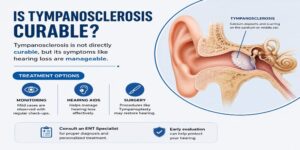
The good news is that hearing loss and other symptoms caused by tympanosclerosis can often be managed successfully. With appropriate monitoring and treatment, most patients can lead normal, active lives.
Table of Contents
- How Is Tympanosclerosis Treated?
- What Is Tympanosclerosis?
- Medical Treatments for Tympanosclerosis
- Surgical Treatment for Tympanosclerosis
- How Does an ENT Specialist Choose the Best Treatment?
- How Is Tympanosclerosis Managed?
- Results, Recovery, and Safety After Tympanosclerosis Surgery
- Key Takeaways
- Frequently Asked Questions
How Is Tympanosclerosis Treated?
Treatment depends on the severity of symptoms, the extent of scarring, and the degree of hearing loss.
Observation
If tympanosclerosis is mild and hearing remains normal, treatment may not be necessary. In such cases, regular ENT examinations and hearing tests are usually sufficient.
Hearing Aids
For patients with conductive hearing loss caused by tympanosclerosis, hearing aids can significantly improve hearing and communication. They are often an effective non-surgical treatment option.
Surgical Treatment
Surgery may be considered when hearing loss is significant or when tympanosclerosis affects the eardrum or middle-ear bones (ossicles).
Common surgical procedures include:
- Tympanoplasty (repair of the eardrum)
- Ossiculoplasty (repair or reconstruction of middle-ear bones)
The decision to proceed with surgery should be based on hearing test results, examination findings, patient expectations, and consultation with an experienced ENT specialist.
What Is Tympanosclerosis?
Tympanosclerosis refers to scarring and calcification of the eardrum or middle ear that usually develops after repeated ear infections, chronic inflammation, ear surgery, or previous ear injuries.
These calcium deposits can make the eardrum less flexible. As a result, sound transmission may become less efficient.
What Causes Tympanosclerosis?
Tympanosclerosis typically develops following persistent inflammation or damage to the middle ear or eardrum. Typical causes include:
- Recurring middle ear infections
- Otitis media that persists
- History of ear surgery
- Previous perforated eardrum
- Middle ear inflammation that has been present for a long time
- Ear trauma from the past
Scar formation and calcium accumulation might occur over time due to inflammation. Movement of the middle-ear bones may be impacted by these changes, which may make the eardrum less flexible.
Symptoms of Tympanosclerosis?
Many patients with tympanosclerosis have no symptoms and may find out they have it during a routine ear exam.
Symptoms might include:
- Conductive hearing loss, in particular, is a type of hearing loss.
- blockage or a sense of fullness in the ear
- Speech comprehension issues, particularly in noisy surroundings
- Decreased eardrum motion
- Middle-ear disease may be accompanied by recurring ear issues.
The degree of the symptoms is determined by whether the tympanosclerosis affects the middle-ear ossicles in addition to the eardrum.
How Does Tympanosclerosis Affect Hearing?
In many patients, tympanosclerosis causes no noticeable symptoms. However, when scarring becomes extensive, it can reduce the movement of the eardrum or fix the tiny middle-ear bones.
This may lead to:
- Conductive hearing loss
- Reduced sound transmission
- Difficulty hearing conversations
- A sensation of blocked ears
An ENT specialist can evaluate the condition through ear examination (otoscopy) and hearing tests such as pure-tone audiometry and tympanometry.
What is the distinction between myringosclerosis and tympanosclerosis?
Although myringosclerosis and tympanosclerosis are associated disorders, they are not precisely the same.
Myringosclerosis often refers to calcified or scar-like plaques found in the eardrum. It may have minimal or no impact on hearing.
Tympanosclerosis is a more general phrase that can refer to the eardrum as well as more internal middle ear components. Hearing can be impacted more severely when the ossicles are calcified or fixed by scar tissue.
Therefore, rather than merely the existence of noticeable white plaques, the impact on hearing is more dependent on the illness’s location and scope.
How Is Tympanosclerosis Managed?
The treatment of tympanosclerosis depends on the severity of symptoms and the degree of hearing loss.
Observation
Patients with mild tympanosclerosis and normal hearing may only require regular ENT follow-up and hearing assessments.
Hearing Aids
If tympanosclerosis causes conductive hearing loss, hearing aids can significantly improve hearing and communication without surgery.
Surgical Treatment
Surgery may be considered when hearing loss is significant or when tympanosclerosis affects the eardrum or middle-ear bones. Common procedures include:
- Tympanoplasty (eardrum repair)
- Ossiculoplasty (repair or reconstruction of middle-ear bones)
The decision for surgery should be based on hearing test results, examination findings, patient expectations, and consultation with an experienced ENT specialist.
Medical Treatments for Tympanosclerosis
It’s not always necessary to operate on every patient. A lot of people begin with a medical program intended to safeguard the ear and aid hearing.
Watching and taking care of one’s ears: Often, mild myringosclerosis that doesn’t impact hearing is monitored with frequent hearing tests.
Take care of any current infections: Your ENT Doctor may recommend targeted ear drops or oral medicine if there is pain or discharge. It’s important to maintain the ear dry while the sickness resolves.
In some circumstances, managing nasal allergies or sinus disease might improve eustachian tube function and lessen middle-ear fluid.
If scarring causes a permanent conductive loss, modern digital hearing aids can offer great clarity. Installation has to be performed by a professional audiology team.
These procedures are usually the first step in treating tympanosclerosis, particularly if the hearing impairment is minor. Evidence-based summaries show that surgery is only necessary for instances of considerable perforation or mechanical problems that can be corrected, whereas asymptomatic plaque generally does not require any intervention.
Surgical Treatment for Tympanosclerosis
Surgery may be considered when tympanosclerosis causes significant hearing loss, persistent eardrum perforation, or fixation of the middle-ear bones (ossicles). The choice of procedure depends on the location and extent of scarring.
Tympanoplasty (Eardrum Repair)
Tympanoplasty is a surgical procedure used to repair a damaged or perforated eardrum. During the procedure, the surgeon uses a graft to close the perforation and restore the normal vibratory function of the eardrum.
This procedure may help improve hearing and reduce the risk of recurrent ear infections. In many cases, tympanoplasty is performed as a day-care procedure using a microscope or endoscope.
Ossiculoplasty (Reconstruction of Middle-Ear Bones)
In some patients, tympanosclerosis affects the tiny bones of the middle ear, including the malleus, incus, or stapes. When these bones become fixed or damaged, sound transmission can be reduced.
Ossiculoplasty involves repairing, reshaping, or reconstructing the ossicular chain to improve sound conduction from the eardrum to the inner ear. This procedure may be performed alone or together with tympanoplasty.
Stapes Surgery
In rare cases, tympanosclerosis may affect the stapes bone and limit its movement. If detailed evaluation confirms stapes fixation, specialized ear surgery may be considered in selected patients.
However, stapes surgery is less commonly required in tympanosclerosis compared with other ear disorders.
Is it possible for tympanosclerosis to disappear by itself?
Calcium deposits and tympanosclerotic scar tissue do not often go away naturally.
However, not all patients require treatment. Observation might be the only treatment needed if the deposits don’t cause hearing loss or other problems.
Therefore, the primary objective of treatment is not always to eliminate all visible plaques, but to maintain or enhance hearing and, if needed, address co-occurring ear disease.
This expands on the present part that states that medications are unable to get rid of established tympanosclerotic plaques.
Is Hearing Loss Caused by Tympanosclerosis Repairable?
Tympanosclerosis-induced hearing loss can sometimes be improved, especially when the issue is due to mechanical obstruction of the eardrum or ossicles.
The potential improvement is contingent on:
- The location of the scar tissue
- if the ossicles are affected
- The kind and severity of hearing impairment
- The state of the tympanic membrane
- whether chronic middle ear disease or perforation is present.
While some patients may benefit from hearing aids, others with correctable mechanical issues may be candidates for ear surgery.
Before determining which treatment is best, a hearing test is necessary.
How Does an ENT Specialist Choose the Best Treatment?
Selecting the most appropriate treatment begins with a detailed evaluation.
Medical History and Ear Examination
Your ENT specialist will review:
- Previous ear infections
- History of ear surgery
- Hearing difficulties
- Noise exposure
- General medical history
The ear is then examined using an otoscope, microscope, or endoscope to assess the extent of scarring, calcification, and any eardrum perforation.
Hearing Tests
Hearing assessment is an important part of diagnosis and may include:
- Pure-tone audiometry
- Tympanometry
- Speech audiometry (when required)
These tests help determine the degree and type of hearing loss.
Imaging Studies
In selected cases, a CT scan of the temporal bone may be recommended to evaluate ossicular fixation or other middle-ear abnormalities.
Individualized Treatment Planning
Treatment decisions are based on:
- Severity of hearing loss
- Extent of tympanosclerosis
- Presence of eardrum perforation
- Patient symptoms
- Overall health and expectations
Many patients require only observation and periodic hearing tests. Others may benefit from hearing aids or surgery, depending on the severity of the condition.
Results, Recovery, and Safety After Tympanosclerosis Surgery
Most tympanosclerosis surgeries are performed as day-care procedures, allowing patients to return home on the same day.
Recovery After Surgery
Following surgery, your ENT specialist may advise you to:
- Keep the operated ear dry
- Avoid forceful nose blowing
- Follow postoperative instructions carefully
- Attend scheduled follow-up visits
Healing usually occurs gradually over several weeks. Many patients notice improvement in hearing after the ear packing is removed and the eardrum has healed completely.
Possible Risks and Complications
As with any surgical procedure, complications are possible but uncommon.
Potential risks include:
- Infection
- Temporary dizziness
- Temporary changes in taste sensation
- Persistent hearing loss
- Recurrent eardrum perforation
Your surgeon will discuss the expected benefits and potential risks before surgery.
Long-Term Ear Care
To protect surgical results and maintain ear health:
- Avoid water entering the ear unless approved by your doctor
- Seek treatment for ear infections promptly
- Attend regular follow-up examinations
- Follow hearing assessment recommendations
How does tympanosclerosis affect the patient?
Patients with mild tympanosclerosis who don’t experience substantial hearing loss typically have a favorable prognosis.
Periodic monitoring is all that is required for some patients who are still symptom-free. Hearing aids or well-chosen surgery may help improve communication and quality of life when hearing loss exists.
The long-term result is determined by the degree of scarring, middle-ear bone involvement, history of ear disease, and the sort of treatment needed.
What Is an ENT Specialist and When Should You See One?
An ENT evaluation may be worthwhile if you experience any of the following:
- Chronic hearing loss
- loss of hearing in one or both ears
- Frequent ear infections
- Drainage from the ear
- a nagging feeling that your ears are blocked
- Known eardrum hole
- After earlier ear surgery, hearing loss is worse.
To ascertain whether tympanosclerosis is impairing hearing, an ENT professional can inspect the ear and set up suitable hearing tests.
Key Takeaways
- Tympanosclerosis is a condition characterized by scarring and calcium deposits in the eardrum or middle ear.
- Mild cases often require only observation and periodic hearing evaluations.
- Medications can help manage infections and inflammation but cannot remove existing scar tissue or calcium deposits.
- Hearing aids are an effective non-surgical treatment for many patients with conductive hearing loss.
- Surgical procedures such as tympanoplasty and ossiculoplasty may improve hearing in selected patients.
- Treatment should be individualized based on symptoms, hearing test results, and examination findings.
Frequently Asked Questions
Does Every Case of Tympanosclerosis Require Treatment?
No. If hearing is normal and there are no recurrent ear infections or other symptoms, regular monitoring by an ENT specialist may be sufficient.
Can Medications Remove Tympanosclerosis Plaques?
No. Currently, there are no medications that can dissolve or reverse tympanosclerotic plaques. Treatment focuses on managing symptoms and improving hearing when necessary.
Are Hearing Aids a Long-Term Solution?
Yes. Hearing aids are often an effective long-term treatment option for stable conductive hearing loss caused by tympanosclerosis.
When Is Surgery Recommended?
Surgery may be considered when hearing loss significantly affects daily activities or when a persistent eardrum perforation or ossicular fixation is present.
Is Stapes Surgery Commonly Performed for Tympanosclerosis?
No. Stapes surgery is rarely required in tympanosclerosis. It is generally reserved for carefully selected patients with confirmed stapes fixation.
Will I Need a Cochlear Implant?
Most patients with tympanosclerosis do not require a cochlear implant. Tympanosclerosis typically causes conductive hearing loss rather than inner-ear damage.
Cochlear implants are generally reserved for patients with severe to profound sensorineural hearing loss who receive limited benefit from conventional hearing aids. An ENT specialist and hearing evaluation can determine whether a cochlear implant is appropriate.
Is it possible for Tympanosclerosis to lead to irreversible hearing loss?
Tympanosclerosis can result in chronic conductive hearing loss if scarring or calcification prevents the eardrum or middle-ear bones from moving properly. Patients differ in the degree to which they lose their hearing.
Is Tympanosclerosis Hazardous?
In most cases, tympanosclerosis is not harmful. Yet, medical examination and treatment could be necessary for related problems like chronic ear infections, persistent perforations of the eardrum, or substantial hearing loss.
Is it possible to avoid tympanosclerosis?
Tympanosclerosis cannot be stopped with certainty. Quick therapy for ear infections, sufficient follow-up after ear operations, and appropriate management of chronic middle-ear illnesses may all aid in minimizing persistent inflammation and difficulties.
Is hearing loss always brought on by tympanosclerosis?
No. Hearing loss is not always caused by tympanosclerosis. Some individuals have apparent plaques or calcification but have normal hearing and just need to be watched.
Medical Disclaimer
Medical Disclaimer: This content is for educational purposes only and does not replace professional medical advice, diagnosis, or treatment. Consult a qualified ENT specialist for personalized care.
Primary Topic Cluster: Tympanosclerosis
Pillar Article
Causes & Risk Factors
Treatment Cluster
- https://healthuseful.com/tympanosclerosis-treatment-without-surgery/
- https://healthuseful.com/tympanosclerosis-surgery-success-rate/
Symptoms & Complications
Comparison Articles
- https://healthuseful.com/tympanosclerosis-vs-otosclerosis/
- https://healthuseful.com/tympanosclerosis-vs-cholesteatoma/
Primary Topic Cluster: Otitis Media (Middle Ear Infection)
Pillar Article
Symptoms & Diagnosis
Chronic Otitis Media Cluster
- https://healthuseful.com/chronic-otitis-media/
- https://healthuseful.com/treatment-of-chronic-otitis-media/
- https://healthuseful.com/chronic-otitis-media-effusion/
Specific Types of Otitis Media
- https://healthuseful.com/otitis-media-nonsuppurative/
- https://healthuseful.com/otitis-media-paediatric/
Medical References
- American Academy of Otolaryngology–Head and Neck Surgery – Clinical information on ear diseases and hearing loss.
- MSD Manual Professional Edition – Tympanosclerosis and middle ear disorders.
- MedlinePlus – Hearing loss and ear health information.
- National Institute on Deafness and Other Communication Disorders – Hearing disorders and treatment guidance.
- Cleveland Clinic Ear Health Resources – Evidence-based patient education on ear conditions.