Tympanosclerosis and Tinnitus: Can Eardrum Scarring Cause Ringing in the Ears?
Author: Dr Sagar Rajkuwar, ENT Specialist, Nashik, Maharashtra, India
🌐 www.entspecialistinnashik.com
Many people with tympanosclerosis notice ringing, buzzing, or humming sounds in their ears and wonder if the two conditions are connected. Learn how eardrum scarring may contribute to tinnitus, hearing loss, symptoms, treatment options, and when to see an ENT specialist.
Tympanosclerosis and Tinnitus: Understanding the Connection Between Eardrum Scarring and Ringing in the Ears
One of the most irritating ear-related symptoms a person can suffer is tinnitus. The persistent buzzing, humming, clicking, or hissing sound might interfere with sleep, focus, employment, and general quality of life.
At the same time, a lot of patients who have been diagnosed with tympanosclerosis frequently have a crucial question:
Is tinnitus caused by tympanosclerosis?
Yes, in some instances, tympanosclerosis may be related to tinnitus, particularly if it affects hearing or interferes with sound transmission in the ear.
Despite the fact that not all people with tympanosclerosis experience tinnitus, ENT doctors are aware that eardrum scarring and middle ear damage can cause hearing changes that contribute to abnormal sound perception.
Table of Contents
- What Exactly Is Tympanosclerosis?
- What Is Tinnitus?
- Can Tinnitus Be Caused by Tympanosclerosis?
- Why Scarring of the Eardrum Can Cause Ringing in the Ears
- Tinnitus and Tympanosclerosis share the same symptoms.
- How Hearing Loss Elevates Tinnitus Risk
- What Does Tinnitus Caused by Tympanosclerosis Sound Like?
- Tympanosclerosis causes
- Who Is Most Vulnerable?
- How Is Tympanosclerosis Determined?
- Is it possible to treat tympanosclerosis?
- Is It Possible to Reduce Tinnitus with Surgery?
- Is there a possibility that hearing aids will be beneficial?
- Managing Tinnitus: A Guide to Lifestyle Tips
- When Is an ENT Specialist Necessary?
- Frequently Asked Questions
- Conclusion
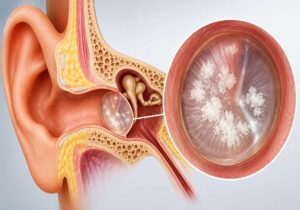
What Exactly Is Tympanosclerosis?
The eardrum and sometimes the structures of the middle ear develop calcium deposits, thicken, and scar, which is a condition known as tympanosclerosis.
After the following circumstances, the ailment often appears:
- Numerous ear infectionstympanosclerosis and tinnitus
- Long-term middle ear inflammation
- Surgery of the ear
- Placement of ear tubes
- Damage to the eardrum
During a ear check, the scar tissue frequently resembles creamy white patches.
What Is Tinnitus?
Hearing noises that aren’t coming from an outside source is referred to as tinnitus.
Patients often explain:
- The Act of Ringing
- Making a low, continuous humming sound
- Humming.
- Hissing
- Rumbling
- Auditory snapping noises
Tinnitus can be minor or severe, and it can affect one or both ears.
Can Tinnitus Be Caused by Tympanosclerosis?
Yes.
Despite the fact that hearing loss is the most frequent consequence of tympanosclerosis, some patients also experience tinnitus.
Typically, this link occurs when scarring disrupts the middle ear and eardrum’s normal sound transmission.
When there is a lack of sound input, the brain may make up for it by raising auditory activity, which can result in the experience of tinnitus.
Because of this, hearing problems are often connected to tinnitus.
Why Scarring of the Eardrum Can Cause Ringing in the Ears
When sound reaches the ear, the eardrum usually vibrates without hindrance.
Tympanosclerosis can cause the eardrum to become:
- Thicker
- Less flexible
- Stricter
Hearing may be diminished if sound transmission is hampered.
Abnormal sound processing may result from changes in hearing pathways, raising the possibility of tinnitus symptoms.
Tinnitus and Tympanosclerosis share the same symptoms.
Individuals may encounter:
Symptoms in the Ear
- Ear buzzing
- Sounds that buzz
- Noises of hum
- Clicking sensations
- Fullness in the ears
Indications of Hearing Loss
- Hearing loss that is conductive
- Hearing that is muted.
- Having trouble hearing discussions
- Lowered sound clarity
Signs that are physical
- White areas on the eardrum
- Recurring ear infections have occurred in the past.
- Prior ear surgery
How Hearing Loss Elevates Tinnitus Risk
Studies indicate that hearing loss and tinnitus frequently occur together.
The brain may become more sensitive to internal auditory impulses if hearing pathways get less sound stimulation.
Even in the absence of an outside noise, this process might create the sensation of buzzing.
What Does Tinnitus Caused by Tympanosclerosis Sound Like?
Patients describe a variety of noises, such as:
- Ringing in a high pitch
- Hollow hum
- Humming
- Roaring
- Sizzling
- Clicking that is not continuous
The degree of severity differs significantly between people.
Whereas some individuals suffer from chronic tinnitus all day long, others merely notice symptoms in silent surroundings.
Tympanosclerosis causes
A number of factors raise the risk:
Frequent Ear Infections
Chronic inflammation and scar formation can be brought on by recurrent infections.
Glue Ear
Long-term consequences might arise from fluid accumulation behind the eardrum.
Perforated Eardrum
Following a perforation, calcium deposits could remain after healing.
Location of Ear Tube
Scarring on the eardrum may sometimes occur as a result of tympanostomy tube surgeries.
Surgery on the ears.
Middle ear operations may promote the development of scar tissue.
Who Is Most Vulnerable?
Among the risk factors are:
- Ear Infections in Children
- Middle ear infection that lasts a long time
- History of Ear Surgery
- Perforations of the eardrum
- Exposure to smoking
- Dysfunction of the Eustachian tube
How Is Tympanosclerosis Determined?
ENT specialists usually do:
Examination of the Ear (Otoscopy)
The eardrum is examined by the doctor for white plaques.
Tests for Hearing
The degree of hearing impairment is assessed using audiometry.
Tympanometry
It assesses middle ear function and eardrum movement.
Studies on Imaging
In complicated circumstances, CT scans are occasionally utilized.
Is it possible to treat tympanosclerosis?
The intensity of the symptoms determines the course of treatment.
Treatment is not necessary for many patients if their hearing remains healthy.
Options include:
Observation
Monitoring is frequently all that is required in mild situations.
Aids for Hearing
When hearing loss contributes to tinnitus, it is helpful.
Surgery
Sound transmission in select patients may be improved by tympanoplasty or myringoplasty.
Is It Possible to Reduce Tinnitus with Surgery?
Occasionally.
Surgical correction might alleviate symptoms if tympanosclerosis-induced conductive hearing loss is directly linked to tinnitus.
Nevertheless, the outcomes of tinnitus differ.
While some patients feel tremendous relief, others may still have tinnitus even when their hearing improves.
Is there a possibility that hearing aids will be beneficial?
Yep.
Two advantages that hearing aids frequently offer to those who have hearing loss are:
- Better hearing
- diminished tinnitus awareness
Internal ringing might be muffled by increasing the volume of noises in the surrounding.
Managing Tinnitus: A Guide to Lifestyle Tips
Many patients benefit from:
- Stress Reduction
- Avoiding prolonged exposure to loud noise
- Obtaining enough sleep
- Anxiety management
- Utilizing white noise machines
- Addressing hearing loss early
When Is an ENT Specialist Necessary?
If you get any of the following, get medical help:
- Tinnitus that persists
- Loss of hearing
- Sensation of fullness in the ear
- Repeated ear infections
- pain in the ear
- Instantaneous hearing modifications
Early assessment may help find treatable causes.
Frequently Asked Questions
Is it possible for tinnitus to be brought on by tympanosclerosis?
Yes, it is. Changes in hearing brought on by eardrum scarring might cause tinnitus.
Does everyone with tympanosclerosis suffer from tinnitus?
No. There are no symptoms at all for a lot of individuals.
Is tinnitus the primary symptom?
Before being aware of hearing loss, patients sometimes experience a ringing sensation.
Is it possible to treat tinnitus with surgery?
Not all the time. Surgery may be useful if tinnitus is associated with conductive hearing loss.
Is tympanosclerosis a severe condition?
Hearing can be impacted by severe scarring, but typically not.
Conclusion
Tinnitus and tympanosclerosis might occasionally coexist, particularly if eardrum scarring causes conductive hearing loss. Changes in hearing caused by scar tissue may raise the risk of tinnitus, even if not all patients experience ringing in the ears.
The reassuring aspect is that a significant number of instances may be treated successfully with hearing evaluation, ENT care, hearing aids, and chosen surgical procedures. Seeking professional medical assessment is crucial for anyone experiencing persistent tinnitus, hearing loss, or other ear symptoms in order to ascertain the underlying cause and determine the best course of treatment.
Medical Disclaimer:
This article is for informational and educational purposes only and is not a substitute for professional medical advice, diagnosis, or treatment. Tympanosclerosis and tinnitus can have various causes and require proper evaluation by a qualified healthcare professional. Always consult an ENT specialist regarding any ear-related symptoms or concerns.
Primary Topic Cluster: Otitis Media (Middle Ear Infection)
Pillar Article
Symptoms & Diagnosis
Chronic Otitis Media Cluster
- https://healthuseful.com/chronic-otitis-media/
- https://healthuseful.com/treatment-of-chronic-otitis-media/
- https://healthuseful.com/chronic-otitis-media-effusion/
Specific Types of Otitis Media
- https://healthuseful.com/otitis-media-nonsuppurative/
- https://healthuseful.com/otitis-media-paediatric/
Primary Topic Cluster: Tympanosclerosis
Pillar Article
Causes & Risk Factors
Treatment Cluster
- https://healthuseful.com/tympanosclerosis-treatment-without-surgery/
- https://healthuseful.com/tympanosclerosis-surgery-success-rate/
Symptoms & Complications
Comparison Articles
- https://healthuseful.com/tympanosclerosis-vs-otosclerosis/
- https://healthuseful.com/tympanosclerosis-vs-cholesteatoma/
References
- National Institute on Deafness and Other Communication Disorders (NIDCD). Tinnitus (Ringing in the Ears).
- American Academy of Otolaryngology–Head and Neck Surgery (AAO-HNS). Clinical Practice Guidelines for Tinnitus.
- World Health Organization (WHO). Deafness and Hearing Loss.
- Merck Manual Professional Edition. Tympanosclerosis and Hearing Disorders.
- MedlinePlus. Tinnitus: Symptoms, Causes, and Treatment.
- National Health Service (NHS). Tinnitus Overview.
- Cummings Otolaryngology: Head and Neck Surgery, Elsevier.
- Scott-Brown’s Otorhinolaryngology, Head and Neck Surgery.