Tympanosclerosis Symptoms Explained: Causes, Hearing Loss & Treatment Options
Author: Dr Sagar Rajkuwar, ENT Specialist, Nashik, Maharashtra, India
🌐 www.entspecialistinnashik.com
White patches on the eardrum, ringing in the ears, and gradual hearing loss could be signs of tympanosclerosis. Learn the causes, symptoms, diagnosis, and latest treatment options for this often-overlooked ear condition.
Tympanosclerosis: What It Is, Symptoms, Causes, Hearing Loss, and Treatment Explained
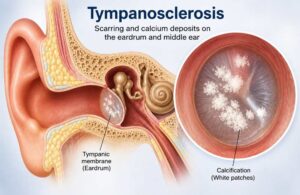
A condition known as tympanosclerosis is characterized by the accumulation of calcium and scarring on therum and Occasionally within the middle ear. While some individuals may not experience any symptoms at all, others may develop hearing issues, tinnitus, or a blocked sensation in their ear.
The illness typically occurs following multiple ear infections, ruptured eardrums, ear operations, or long-term inflammation. During a regular ENT examination, doctors frequently find tympanosclerosis since chalky white spots might appear on the eardrum.
Even though tympanosclerosis is often not harmful, substantial scarring can impair how sound passes through the ear, resulting in conductive hearing loss.
This article covers the latest medical understanding, prevention tips, treatment alternatives, diagnosis, symptoms, and causes of tympanosclerosis.
Table of Contents
- What Exactly Is Tympanosclerosis?
- How the Eardrum Operates
- What Is the Source of Tympanosclerosis?
- What are the usual signs of tympanosclerosis?
- Eardrum with white spots
- Is it possible for tympanosclerosis to lead to hearing loss?
- Ear Ringing and Tinnitus
- Tympanosclerosis Risk Factors
- How Physicians Identify Tympanosclerosis
- Myringosclerosis Versus Tympanosclerosis
- Is Tympanosclerosis a Hazard?
- In children, tympanosclerosis
- Can Scarring Result From Ear Infections?
- Tympanosclerosis Treatment Without Surgery
- When Is Surgery Required?
- Tympanoplasty Process
- Tympanosclerosis Hearing Aids
- After Ear Surgery, Recovery
- Recommendations for Prevention
- When to Visit an ENT Physician
- Commonly Asked Questions
- Commonly Asked Questions
What Exactly Is Tympanosclerosis?
Following damage or inflammation, tympanosclerosis is a hardening and scarring of the eardrum caused by the formation of calcium deposits.
By vibrating as sound waves reach the ear, the tympanic membrane—also known as the eardrum—is essential for hearing. The eardrum becomes thicker and less flexible if scar tissue grows.
The eardrum is the only thing affected by the illness in several people. In other situations, calcium deposits enter the middle ear and interfere with the ossicles, which are tiny hearing bones.
How the Eardrum Operates
The eardrum acts as a division between the middle ear and the outer ear. The eardrum vibrates and transmits sound energy to the middle ear bones as sound enters the ear canal.
Normal hearing requires a healthy movement of the eardrum. Vibrations can be decreased by scarring, which makes sounds appear obscured or muffled.
What Is the Source of Tympanosclerosis?
Tympanosclerosis is thought to develop as a result of improper healing following inflammation or damage.
Typical causes include:
- Recurrent ear infections
- persistent middle ear infection
- Glue ear
- Perforated eardrum
- Surgery for tubes in the ears
- Earlier ear surgeries
- Injury to the ear
- Long-term accumulation of fluid behind the eardrum
Since not all patients with ear infections develop tympanosclerosis, genetic predisposition and immune response may also be factors.
What are the usual signs of tympanosclerosis?
There are some people who never show any signs of the condition.
Other people might observe:
- Diminished hearing
- ears ringing
- Feeling of fullness in the ears
- having trouble understanding conversations
- Sounds that are muted
- Slight discomfort
- White patches on the eardrum
Symptoms generally appear gradually over time.
Eardrum with white spots
The presence of dazzling chalky white plaques on the eardrum is one of the telltale indicators of tympanosclerosis.
These are often found by ear nose and throat (ENT) specialists during an otoscopic examination of the ears.
Scar tissue and calcium deposits are shown by these patches.
Is it possible for tympanosclerosis to lead to hearing loss?
Yes. One of the most prevalent side effects is conductive hearing loss.
When sound cannot effectively go through the outer or middle ear, conductive hearing loss results.
Depending on the extent of scarring, the severity might range from mild to moderate.
Hearing might suffer significantly if the middle ear bones stiffen or get stuck.
Ear Ringing and Tinnitus
Tinnitus is experienced by some individuals with tympanosclerosis.
It might sound like this:
- Ringing noises
- Humming
- Whistling
- Clicking
on the picture will take you to the post office.
In serene surroundings, tinnitus may become more apparent.
Tympanosclerosis Risk Factors
Risk factors include:
- Recurrent ear infections
- Ear condition in childhood
- History of ear operations
- Damage to the eardrum
- Inflammation that persists
- Impaired Eustachian tube operation
Children who have had a lot of ear infections are more likely to get them again.
How Physicians Identify Tympanosclerosis
Commonly, diagnosis involves:
Medical records
Doctors inquire about hearing changes, operations, and infections.
Examination of the Ears
White calcified plaques may be seen using an otoscope.
Tests for Hearing
Hearing ability is measured by audiometry.
Tympanometry
It assesses the ear drum’s mobility.
It may be necessary to conduct imaging studies in serious circumstances.
Myringosclerosis Versus Tympanosclerosis
Although somewhat different, these terms are comparable.
Myringosclerosis
only impacts the eardrum.
Tympanosclerosis
Targets both middle ear structures and the eardrum.
Is Tympanosclerosis a Hazard?
Normally not.
Many people lead normal lives without ever having therapy.
However, serious situations can damage communication and hearing quality.
In uncommon circumstances, extensive calcification may need surgery.
In children, tympanosclerosis
Children often suffer from ear infections, which raise the chance of scarring.
Parents should consult a doctor if their child develops:
speech that is delayed
Having difficulty hearing
Ache in the ear
Frequent infections
Early care may aid in lowering difficulties.
Can Scarring Result From Ear Infections?
Yes.
During healing, recurring inflammation might injure sensitive ear tissues and induce calcium deposition.
Early infection treatment may minimize lasting harm.
Tympanosclerosis Treatment Without Surgery
Treatment is often not necessary for mild instances.
Non-surgical treatment may include:
- Keeping tabs on noise levels
- Assistive listening devices
- Protecting ears against infections
- Treating continuous inflammation
Observation may be enough if hearing does not change.
When Is Surgery Required?
If: Surgery may be advised.
- Hearing impairment is noticeable.
- The ossicles (middle ear bones) are impacted by scar tissue.
- Regular conversation becomes challenging.
Each case is carefully considered by an ENT specialist.
Tympanoplasty Process
The eardrum and middle ear components that have been injured are repaired by tympanoplasty.
During the operation:
- Removed scar tissue
- Middle ear bones can be fixed.
- Damaged areas are restored using tissue grafts.
Many people have better hearing following the procedure.
Tympanosclerosis Hearing Aids
Hearing aids can improve communication and quality of life even if surgery cannot completely restore hearing.
For conductive hearing loss, modern hearing aids are frequently quite effective.
After Ear Surgery, Recovery
Typically, recovery occurs in one to two weeks.
Patients should stay away from:
- Lifting heavy items
- Water getting inside the ear
- Initially, air travel
- Blowing your nose hard
Hearing tests are often scheduled for follow-up.
Recommendations for Prevention
You can lower your risk by taking the following actions:
- Early ear infection management
- Steering clear of secondhand smoke
- shielding ears against excessive noise
- Don’t put things in your ear.
- Following ENT advice post-operatively
When to Visit an ENT Physician
If you experience any of the following, get medical help:
- Unwavering deafness
- In the ears, there is a ringing.
- Fullness in the ear
- Infections that recur frequently
- Drainage from the ear
- Problems with balance
Maintaining hearing might be aided by prompt identification.
Commonly Asked Questions
Does tympanosclerosis last forever?
Typically, scar tissue does not go away on its own.
Is it possible for tympanosclerosis to heal on its own?
Although scar tissue usually remains, mild cases may continue to be constant.
Is tympanosclerosis painful?
Unless there is active inflammation, generally no.
Is it possible to reverse hearing loss?
Hearing aids or surgery can help some situations.
Is tympanosclerosis widespread?
After multiple ear infections or surgeries, it is rather typical.
Is it possible for kids to get tympanosclerosis?
Especially after repeated middle ear infections, yes.
Commonly Asked Questions
Tympanosclerosis is a fairly prevalent ear disorder that entails calcification and scarring of the eardrum and middle ear components. Some people may acquire ear fullness, tinnitus, or conductive hearing loss, even though many individuals may never experience symptoms.
Luckily, modern hearing treatments and ENT evaluation approaches may assist manage symptoms well. For the preservation of long-term ear health, early detection, infection avoidance, and good hearing care are still essential.
People who have recurring ear problems or changes in hearing should visit an ENT doctor for a thorough examination and treatment advice.
Medical Disclaimer
This article is for informational and educational purposes only and should not be considered medical advice. Always consult a qualified ENT specialist or healthcare professional regarding ear symptoms, hearing loss, or treatment decisions.
Primary Topic Cluster: Otitis Media (Middle Ear Infection)
Pillar Article
Symptoms & Diagnosis
Chronic Otitis Media Cluster
- https://healthuseful.com/chronic-otitis-media/
- https://healthuseful.com/treatment-of-chronic-otitis-media/
- https://healthuseful.com/chronic-otitis-media-effusion/
Specific Types of Otitis Media
- https://healthuseful.com/otitis-media-nonsuppurative/
- https://healthuseful.com/otitis-media-paediatric/
Primary Topic Cluster: Tympanosclerosis
Pillar Article
Causes & Risk Factors
Treatment Cluster
- https://healthuseful.com/tympanosclerosis-treatment-without-surgery/
- https://healthuseful.com/tympanosclerosis-surgery-success-rate/
Symptoms & Complications
Comparison Articles
- https://healthuseful.com/tympanosclerosis-vs-otosclerosis/
- https://healthuseful.com/tympanosclerosis-vs-cholesteatoma/