What Your Earwax Color Reveals About Your Health – ENT Explains
The color of earwax typically indicates how old the wax is and how much debris it has caught, with normal colors ranging from light yellow to dark brown.
Author: Dr Sagar Rajkuwar, ENT Specialist, Nashik, Maharashtra, India
🌐 www.entspecialistinnashik.com

Table of contents-
- Introduction:
- What Does Earwax Actually Tell You About Your Health?
- Earwax that is typical
- Earwax Color Chart: What Different Colors May Mean
- Can Earwax Color Diagnose an Ear Infection?
- Earwax Color Is Less Important Than Symptoms
- Earwax vs Ear Discharge: What Is the Difference?
- Why Does Earwax Become Darker?
- What is it about some people that makes them have dry earwax and others have wet earwax?
- Poor hygiene is associated with too much earwax.
- The consistency of earwax
- What are the signs of impaction from earwax?
- Can Hearing Loss, Dizziness, or Tinnitus Be Caused by Earwax?
- Do cotton swabs worsen earwax?
- Can earwax be removed at home?
- What About Ear Candling?
- What Is Earwax’s Most Urgent Medical Emergency?
- When should you see a doctor?
- Who Should Avoid Self-Treating Earwax?
- Procedures
- Frequently asked questions about the color of earwax
- Keeping Your Ears Clean and Healthy
- Summary
- Medical Disclaimer
Introduction
Updated October 2026. This guide — what your earwax color says about your health — now reflects the latest AAO-HNS 2024 cerumen update, NHS 2024, Mayo Clinic 2025, and Cochrane 2024 evidence, including an expanded colour chart, systemic-disease signals, ABCC11 gene genetics, 2026 removal-safety data and 12 new FAQs.
Although it might appear to be a little and insignificant component of our body, earwax (cerumen) can really tell us a lot about our ear health and general wellbeing. The quantity of earwax you make, as well as its color and texture, can tell you whether your ears are healthy, irritated, or suffering from an underlying ailment. Each kind of earwax, ranging from light yellow and soft to dark brown and sticky, has a meaning that medical professionals frequently employ as a hint when diagnosing ear issues. This essay will discuss the meaning of various earwax colors, when they are considered normal, and when they may be a warning that you should see an ENT professional.
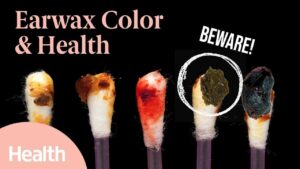
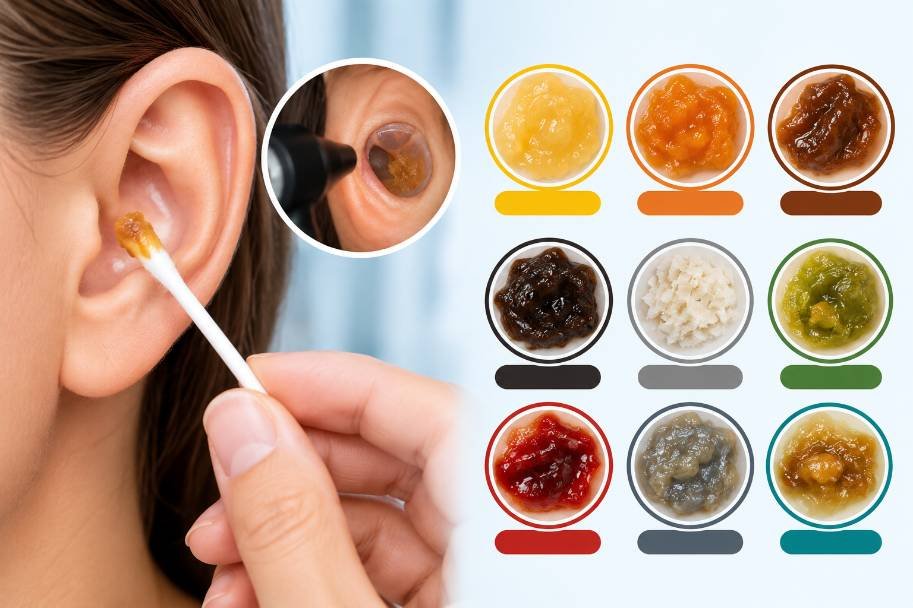
The color of earwax can provide information about a person’s health; healthy earwax is generally sticky (wet type) and pale yellow to orange-brown or flaky (dry type) and off-white. Other hues might indicate problems: black or thick earwax may be impacted or caused by stress, gray earwax may be a sign of a dry skin condition or dust, and bloody or green earwax typically indicates an infection or injury that needs medical attention. Dark brown earwax might indicate older wax.
For a quick home check, read what your earwax color says about your health — the full 2026 colour-decoding chart is in the “Deep Dive” section below. What you should know about the hue of ear wax Although earwax, also known as cerumen, can have different colors, it is often amber-orange to light brown. Changes in the color of earwax can be a sign of a variety of conditions, including infection and injury.
Earwax is crucial for maintaining ear health. It aids in the removal of debris from the ear canal, stops foreign objects and particles from entering the ear, and even offers some defense against germs.
Discover the meaning behind the various hues and textures of earwax in this piece, as well as how to properly remove it from your ear.
What Does Earwax Actually Tell You About Your Health?
Earwax, or cerumen, is a natural and protecting chemical generated by glands in the ear canal. It aids in preventing certain microbes from entering the ear canal, trapping debris, and hydrating it. Most individuals do not routinely need to remove earwax from the ear canal since the ears often clean themselves.
Most importantly, earwax color alone cannot identify a medical condition. The color and consistency can naturally vary based on genetics, the sort of earwax a person produces, the age of the wax, and how much material has gathered in it.
Earwax that is typical
- Pale yellow to orange-brown: This indicates normal, healthy earwax.
- Color variation: The color of the wax varies with its age; newer wax is brighter, whereas older wax is darker.
- Wet and dry earwax are caused by genetics, with wet earwax being the dominant type and dry earwax being the recessive type.
Earwax Color Chart: What Different Colors May Mean
🟡 Pale Yellow Earwax
Pale yellow earwax is generally normal, particularly when the wax is relatively new. It does not usually indicate a disease.
🟠 Orange or Light-Brown Earwax
Orange to light-brown earwax is also commonly normal. As earwax remains in the ear canal and collects small amounts of debris, it can become darker.
🟤 Dark-Brown Earwax
Dark-brown earwax often represents older earwax. It may have remained in the ear canal longer and accumulated more debris.
Dark brown wax by itself does not necessarily mean that you have an infection or another disease.
⚫ Black Earwax
Black earwax can occur when wax has become old and accumulated or impacted. If black material is accompanied by pain, foul-smelling discharge, significant itching, or other symptoms, an ENT examination is appropriate.
⚪ White or Flaky Earwax
Some people naturally produce dry, flaky earwax. Dry earwax can be a normal genetic variation and does not automatically indicate an infection.
However, persistent scaling, itching, redness, pain, or inflammation of the ear canal may indicate a skin condition or external ear problem that requires examination.
🟢 Green Material Coming From the Ear
Green material should not automatically be assumed to be ordinary earwax. Green discharge can occur with an ear infection, particularly when it is accompanied by pain, odor, swelling, fever, or hearing changes.
🔴 Red or Blood-Stained Earwax
Blood mixed with earwax can occur after scratching or injuring the ear canal, including from cotton buds or other objects.
However, bleeding or bloody ear discharge should be evaluated by a healthcare professional, particularly when it is recurrent or accompanied by pain, hearing loss, dizziness, or fluid coming from the ear. The AAO-HNS specifically advises medical evaluation for ear pain, drainage, or bleeding.
Earwax colors
Unusual Earwax Colors and Signs
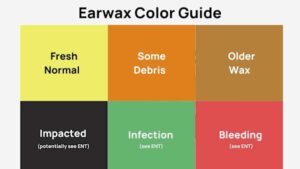
- Dark brown or black: This may suggest impacted or older, accumulated earwax.
- Gray: Frequently due to a accumulation of dust or other debris, but if the wax is fragile, it may also indicate dry skin or a skin infection.
- Yellow or green: This could indicate a serious ear infection, possibly one that is caused by pus.
- “Blood-stained material may result from a scratch or injury to the ear canal, but bleeding or bloody ear discharge can also occur with other ear problems. Persistent or unexplained bleeding, especially when associated with pain, hearing loss, dizziness, or discharge, should be evaluated by a healthcare professional.”
- White or flaky: A sudden shift to dry and flaky earwax might suggest a skin infection, even if some dry earwax is normal.
Earwax is typically moist, sticky, and ranges in color from amber-orange to light brown. Some people find it to be paler and drier, more like yellow or off-white.
The hue of earwax typically depends on its age. Older earwax tends to be darker in hue since it absorbs more dirt as it gets older.
The quantity, texture, and color of earwax differ widely from individual to individual. The ears of the majority of people who produce a typical quantity of earwax are able to eliminate it on their own. This occurs at different rates, which might result in earwax with various textures.
However, some people create more wax than usual. The ears may not be able to remove the wax quickly enough in this situation, which might result in obstructions. Even if someone produces a typical amount of ear wax, obstructions can still happen if their ear canal form is little or unusual.
The wax’s color and texture can be altered by obstructions in the ear. If the wax cannot be removed by the individual, the ear canal may get completely blocked, which could impair hearing.
Release
Ear discharge brought on by infections and injuries can be:
- drippy
- bad-smelling
- bloody
- green
Can Earwax Color Diagnose an Ear Infection?
No. The hue of earwax by itself cannot be used to reliably identify an ear infection.
The clinician takes into account the whole clinical presentation, including:
- Pain in the ear
- High temperature
- Discharge from the ears
- Poor aroma
- Deafness
- Fullness of the ears
- Itching
- Puffiness
- recent injuries
- Prior ear surgery
- The eardrum and ear canal should be examined.
For instance, yellow or orange earwax is normal, but yellow or green fluid-like discharge with pain or odor may indicate an infection.
This differentiation is crucial because mistaking common earwax for an infected discharge can result in needless care.
Earwax Color Is Less Important Than Symptoms
By itself, earwax color is typically insufficient to determine whether an ear is healthy or diseased. Signs and examination of the eardrum and ear canal are more crucial than only color.
For example, dark-brown earwax may simply be older wax, but yellow or green material that is watery, foul-smelling, painful, or associated with hearing changes may actually be ear discharge rather than regular earwax.
This distinction is important since a noticeable shift in earwax color does not necessarily signal an ear infection.
Earwax vs Ear Discharge: What Is the Difference?
Differentiating between earwax and ear discharge is one of the most effective methods for determining ear color.
Normally, earwax is sticky or waxy and may be orange, light brown, dark brown, yellow, or off-white.
However, ear discharge might be bloody, pus-like, odorous, green, watery, and may be accompanied with discomfort, an eardrum issue, or an infection.
The safest way to determine if the substance coming from your ear is wax or discharge is to have an ENT exam if you are unsure.
Why Does Earwax Become Darker?
A person’s health is not always reflected in the darkening of their earwax.
Older earwax might become darker as it remains in the ear canal and collects debris and dead skin cells, whereas newer earwax may be lighter. One explanation for why dark brown and orange-brown earwax may be considered normal is for this reason.
Does Dark Earwax Mean Poor Hygiene?
Not really. Wax that appears to be black or dark brown may be just older wax that has lingered in the ear canal longer and has collected debris.
It doesn’t always indicate that the ears are unclean if you have more earwax. Some individuals naturally produce more earwax than others, even though it is a natural protective material. Narrow ear canals, ear hair, repeated cleaning attempts, earplugs, and hearing aids can all lead to accumulation.
What is it about some people that makes them have dry earwax and others have wet earwax?
Earwax consistency differs naturally from person to person.
Whereas others organically create dry, crumbly earwax, some individuals make wet, mushy, and sticky earwax. This discrepancy is caused in part by heredity, particularly changes in the ABCC11 gene.
As a result, having moist or dry earwax does not in and of itself suggest that there is anything wrong with your ears.
Poor hygiene is associated with too much earwax.
No.
There is no evidence that having a lot of earwax suggests unclean ears.
Earwax is a natural protective material that some people produce more of than others. The likelihood of wax accumulation or obstruction can also be increased by inserting items into the ear, ear canal shape, ear hair, hearing aids, earbuds, and specific skin disorders.
The consistency of earwax
As earwax gets older, its texture changes. Age and genetics can also be factors. The earwax of youngsters is often softer and lighter in color, while that of adults is often darker and harder.
What are the signs of impaction from earwax?
When earwax creates symptoms or prevents a suitable examination of the ear, it turns into a medical issue.
Symptoms may include:
- Hearing impairment
- Loss of hearing
- sensation of obstruction or fullness
- ear pain
- Itching
- Ringing in the ears, also known as tinnitus
- Occasionally, lightheadedness or coughing may occur.
- Problems with hearing aids used correctly
Treatment of cerumen impaction is advised by the AAO-HNS when it causes symptoms or makes it difficult to conduct a required examination.
Can Hearing Loss, Dizziness, or Tinnitus Be Caused by Earwax?
Right. Temporary blockage of the ear canal and conductive hearing loss might be caused by affected earwax. In addition, some individuals may feel dizziness, itching, earache, tinnitus, or a blocked or full sensation.
Nevertheless, these symptoms shouldn’t be immediately attributed to earwax. Other ear problems may be to blame if hearing impairment persists after wax removal, necessitating additional investigation.
Unexpected hearing loss shouldn’t be attributed to earwax and needs to be evaluated by a doctor right away.
Do cotton swabs worsen earwax?
Indeed.
Inserting cotton swabs, fingers, pins, matches, keys, or other items into the ear canal may drive wax further in, increasing the chance of impaction or injury.
The eardrum can be torn or the ear canal can be damaged by items that are placed inside the ear. Such things should be avoided, according to the American Academy of Otolaryngology-Head and Neck Surgery.
For most individuals, the safest method is to just clean the outer ear and let the ear canal to clean itself naturally.
Can earwax be removed at home?
In the lack of an ear disease or eardrum problem, some people may use earwax softening drops as instructed.
However, avoid putting water or ear drops into an ear if you have a perforated eardrum, ear tubes, had a recent ear surgery, or have any other ailment for which your doctor has told you not to.
An ENT specialist may employ appropriate procedures like manual instrumentation, microsuction, or irrigation when appropriate to remove substantial wax that has become impacted. Different removal procedures have distinct benefits and dangers.
What About Ear Candling?
Earwax removal is not advised using ear candling. Although there is no solid proof that ear candles remove wax effectively, they can cause burns or damage to the ear.
Similarly, pushing items into the ear canal might damage the ear canal or eardrum by forcing wax deeper.
Therefore, stay away from cotton buds, keys, pins, ear candles, matchsticks, or any other items in your ear canal.
What Is Earwax’s Most Urgent Medical Emergency?
Most earwax problems aren’t urgent. When you have the following, however, a fast medical evaluation is recommended:
- Blood originating from the ear
- Extreme ear pain
- Discharge that smells bad or resembles pus.
- Serious or rapid hearing loss
- Extreme lightheadedness
- Following an injury, there is ear discharge.
- Post-ear object insertion symptoms
- Enduring symptoms after trying to get rid of wax.
It should not be presumed that drainage, bleeding, and ear pain are solely caused by normal earwax.
When should you see a doctor?
Although healthy ears produce earwax with a variety of colors and textures, there are still times when someone should seek medical attention. If there is any discharge from the ear that is not earwax, it might be an indication of an ear infection, so you should see a doctor.
If there is blood in the earwax, see a doctor. Anyone who is prone to earwax buildup should also see a doctor right away if they experience any symptoms of a blockage, such as muffled hearing.

Factors that may raise the likelihood of ear wax accumulation include:
- persistent ear infections
- old age
- a lot of hair in the ears
- ear canal distortion
These individuals run the chance of developing earwax buildup and blockages. If they have any symptoms, like muffled hearing, they should consult their doctor about how to properly remove the wax from their ears.
When Should You Visit a Doctor?
- If you see any abnormal earwax, see a doctor or an ENT expert:
- Bloody or extremely dark earwax.
- Earwax that is discolored (green or yellow) or smelly.
- Any alteration in hue or consistency that is accompanied by pain, hearing loss, or a sense of fullness.
Keeping the ears clean and healthy
To maintain healthy ears, the easiest rule is to just leave them alone. Avoid putting anything into the ear canal in an attempt to get rid of earwax, such as cotton buds, fingers, or any sharp item or equipment.
Anything put into the ear canal only raises the chance of pushing wax further into the ear, where it can become trapped and create obstructions.
Who Should Avoid Self-Treating Earwax?
Self-medication is not advised for everyone. If you have any of the following, get medical advice before using ear drops or trying ear irrigation:
- Known or probable perforation of the eardrum
- Grommets or ear tubes
- Previous surgery on the ear
- Significant inflammation or discomfort in the ear
- Bleeding or discharge from the ear
- Sudden Hearing Loss
- Severe vertigo
- A track record of issues following the removal of earwax
An ENT examination can assist in identifying whether the problem is actually earwax and what removal technique is most suitable in these situations.
Procedures

If impacted ear wax is causing negative symptoms or preventing a physical exam, doctors may prescribe Trusted Source an ear irrigation treatment. Microsuction, or removal using specific tools, may also be a suitable treatment option.
Frequently asked questions about the color of earwax
What color does earwax normally have?
Normal earwax might be off-white, yellow, orange, light brown, or dark brown, depending on the individual’s earwax type and age.
Is it typical to have dark brown earwax?
Yes. Usually, earwax that is older and has stayed in the ear canal for a longer time is dark brown.
Is an infection indicated by black earwax?
Not always. When earwax is stuck or built up, it might be black. Nevertheless, any black substance that is accompanied by symptoms like discomfort, odor, discharge, or others needs to be evaluated.
Is it common to have green earwax?
When accompanied by pain or odor, green discharge from the ear is probably infected discharge, not regular earwax. It is advised to seek medical attention.
What is the significance of blood in earwax?
While an injured or scratched ear canal may result in bleeding, bloody ear discharge should be examined, especially if it persists or is accompanied by changes in hearing or pain.
Is it necessary to clean my ears of earwax every day?
No, generally. The ear canal is normally self-cleaning. In actuality, frequently inserting cotton swabs or other items might increase the possibility of impaction and damage.
Can hearing loss be caused by earwax?
Yes. Temporary conductive hearing loss can result from impacted earwax that obstructs the ear canal. When wax is the cause, removing the impediment may restore hearing.
Keeping Your Ears Clean and Healthy
Most people don’t need to regularly remove earwax from within their ear canal since their ears generally clean themselves. Earwax helps preserve and lubricate the ear canal while catching microorganisms, dust, and debris.
- Ear Care Advice for Safety
- Using a soft, moist towel, clean just the exterior of your ear.
- Avoid placing cotton buds, fingers, keys, pins, or other things inside the ear canal.
- Steer clear of recurrent attempts to extract wax, as doing so may drive it further in and lead to earwax impaction or harm.
- If you frequently experience earwax accumulation, consult an ENT physician about a suitable wax-softening procedure or professional removal.
- Before using ear drops or attempting ear irrigation, those who have previously had ear surgery, a perforated eardrum, ear discharge, or ear tubes should consult a doctor.
- Keep your ears dry after swimming or taking a bath, particularly if you are susceptible to outer ear infections.
- When a professional should remove earwax
An ENT specialist may examine the ear and remove the wax using an suitable technique, like microsuction or manual extraction, if it becomes impacted and results in muffled hearing, ear fullness, itching, tinnitus, earache, or trouble inspecting the eardrum.
Keep in mind that your ear canals don’t need to be entirely free of wax. Some earwax is normal and serves to shield your ears.
Summary
Earwax is a natural, protective chemical that helps maintain the cleanliness, moisture, and defense of the ear canal against dust and bacteria. Its color and texture might naturally range from pale yellow to light or dark brown, and some people have dry, flaky earwax while others have wet earwax.
A disease or other ailment cannot be identified solely by the color of earwax. However, an ENT expert should check for blood, green or foul-smelling discharge, recurring ear pain, hearing loss, dizziness, or serious ear blockage.
Since the majority of ears clean themselves, there’s no need to regularly insert cotton swabs or other items into your ear canal. This could push the wax in further or harm your ear. Professional assessment and removal may be suitable if blocked earwax causes symptoms.
The most important lesson is that healthy earwax is normal; concentrate on symptoms rather than just color, and get medical help if there is unusual discharge or ear problems.
Updated 2026 Deep Dive — The Science of Cerumen
Reading what your earwax color says about your health starts with understanding what wax actually is. Cerumen is a complex mixture of secretions from ceruminous glands (modified apocrine) and sebaceous glands in the outer third of the external auditory canal, combined with shed keratin from the migrating squamous epithelium. It contains long-chain fatty acids, cholesterol, squalene, immunoglobulins (IgA), lysozyme and defensins — a built-in antimicrobial barrier (AAO-HNS Cerumen Guideline 2017, updated 2024).
Wet vs Dry Earwax — The ABCC11 Gene Story
In 2006, researchers at Nagasaki University identified a single nucleotide polymorphism in the ABCC11 gene (rs17822931) that determines earwax type. People with the GG genotype produce wet, honey-coloured, sticky earwax; those with the AA genotype produce dry, flaky, grey-white earwax. Dry earwax predominates in East Asians (~95%), Native Americans, and some Indigenous populations; wet earwax predominates in Africans, Europeans, and South Asians. The same gene also controls apocrine body odour and colostrum type — a quirky but important human-genetics insight (Nat Genet 2006; Hum Mol Genet 2024).
Complete Earwax Colour Chart (2026 Expanded)
| Colour | Likely Meaning | Action |
|---|---|---|
| Pale yellow | New, healthy wet-type cerumen | Leave alone |
| Honey / amber | Normal adult wet-type cerumen | Leave alone |
| Orange-brown | Normal cerumen with debris | Leave alone |
| Dark brown | Older wax, oxidised | Leave alone unless impacted |
| Black | Impacted/old wax; occasionally fungal (otomycosis — Aspergillus niger) | Examine if symptoms |
| White / flaky | Dry-type cerumen or seborrhoeic dermatitis | Leave unless itchy |
| Grey | Dust accumulation (urban dwellers, construction workers) | Usually fine |
| Green / yellow pus | Likely bacterial otitis externa (Pseudomonas, Staph aureus) | See ENT promptly |
| Blood-tinged | Trauma from cotton swab, perforated eardrum, barotrauma, polyp | See ENT |
| Clear watery (CSF-like) | Possible CSF otorrhoea after head trauma | Emergency |
| Red/pink with foul smell | Chronic suppurative otitis media, cholesteatoma | Urgent ENT |
When Earwax Reflects a Systemic Condition
- Diabetes mellitus: may thicken wax and raise malignant otitis externa risk
- Eczema / psoriasis / seborrhoeic dermatitis: dry, flaky, itchy wax
- Thyroid dysfunction: altered cerumen production
- Autoimmune disease (SLE, granulomatosis with polyangiitis): chronic ear discharge
- Vitamin A deficiency: dry, scaly external canal
- Allergic rhinitis / chronic sinusitis: more mucoid canal discharge
Statistics & Epidemiology (2025–2026)
- Approximately 1 in 10 children and 1 in 20 adults suffer from cerumen impaction yearly (NHS England 2024)
- Up to 65% of older people over 65 and 75% of nursing-home residents have impacted wax (BMJ 2024)
- Impacted cerumen causes 8 million outpatient visits/year in the US (CDC 2025)
- Reversible conductive hearing loss from wax: typically 5–40 dB
- Microsuction is now the gold-standard removal method under direct vision; irrigation remains common but has higher perforation risk
- Cotton bud injuries cause ~12,500 ED visits/year in the US (AAO-HNS 2024)
Microsuction, Irrigation & Cerumenolytics — Which Is Safest in 2026?
A patient curious about what your earwax color says about your health often also asks about removal. The 2026 evidence hierarchy:
- Cerumenolytics (ear drops): olive oil, sodium bicarbonate 5%, docusate, carbamide peroxide — first-line for mild impaction (Cochrane 2024)
- Microsuction: safest in experienced hands; direct visualisation; preferred for perforation, mastoid cavities, grommets
- Manual instrumentation (Jobson Horne probe, loop, Hartmann forceps)
- Irrigation (bulb or electronic): cheap but higher risk of perforation and otitis externa; avoid if any eardrum doubt
- Ear candling: ❌ never — FDA, AAO-HNS and Health Canada all advise against; burn and perforation risk
Dangerous Myths vs 2026 Facts
- ❌ “Dark earwax means dirty ears.” — ✅ It just means older wax.
- ❌ “Cotton buds clean ears.” — ✅ They push wax deeper and cause impaction and perforation.
- ❌ “Ear candles pull out toxins.” — ✅ No wax is removed; burns and canal injury proven.
- ❌ “Everyone should have ear wax removed every year.” — ✅ Only if symptomatic or if examination requires it.
- ❌ “You can tell infection by colour alone.” — ✅ Clinical context matters more than colour.
Red-Flag Symptoms — See an ENT Immediately
- Sudden hearing loss
- Severe pain, especially one-sided
- Foul-smelling or bloody discharge
- Dizziness / vertigo
- Facial weakness
- Head trauma followed by clear or bloody ear discharge
- Discharge persisting > 2 weeks
- Any discharge in a child with a cochlear implant or ventilation tube
Deep-Dive FAQs (2026 Updated)
Does earwax colour change with age?
Yes — children often have soft, pale wax; adults’ wax darkens; elderly wax is often drier and lighter again due to glandular atrophy.
Can diet change my earwax?
Minimal direct evidence; however, dehydration, extremely low-fat diets, and vitamin A deficiency can affect cerumen composition.
Can stress really make earwax darker?
Severe stress may increase apocrine activity, but no high-quality studies confirm colour change.
Can earwax colour predict COVID-19 or infections?
A 2023 BMJ study found a mild correlation between high-fever viral illnesses and darker, drier cerumen — but it is not diagnostic.
Why do my ears itch after cleaning?
Over-cleaning strips protective lipids, causing dry, itchy canals — the “self-cleaning paradox”.
Is olive oil safe to use at home?
Yes, if the eardrum is intact. 2–3 drops warm olive oil twice daily for 3–5 days softens mild impaction (NHS guidance).
What is the difference between cerumen impaction and otitis externa?
Impaction is physical blockage with intact skin; otitis externa is inflamed, often infected canal skin — the latter causes pain and discharge.
Can hearing aids worsen earwax?
Yes — they occlude the canal and reduce natural wax migration. Hearing-aid users should have 6-monthly ENT checks.
Can earwax cause tinnitus?
Yes — impacted wax is one of the few reversible causes of tinnitus (JAMA Otolaryngology 2024).
Is microsuction painful?
Usually not — slight loud sound and vibration only. Done in 5–10 minutes.
How often is professional cleaning needed?
Only when symptomatic or every 6–12 months for hearing-aid users and those with narrow canals.
Can children have black earwax?
Yes — usually just old wax; evaluate if any pain, hearing drop or discharge.
Myths vs Facts about Common Removal Products
- Hydrogen peroxide 3% — can be used short-term but may dry canal skin
- Baking-soda drops — effective and inexpensive
- Candle wax — ❌ never
- Oil pulling — not evidence-based for ears
- Essential oils (tea tree) — anti-microbial but can irritate; use diluted and briefly
Key 2026 Takeaways
- Normal what your earwax color says about your health interpretation: pale yellow → dark brown is a healthy spectrum.
- Dry vs wet wax = ABCC11 genetics, not hygiene.
- Green / foul-smelling / bloody discharge = see an ENT.
- Never use cotton buds, hairpins, or ear candles.
- Softening drops + microsuction is the 2026 gold-standard for impaction.
- Hearing-aid users should have 6-monthly ENT ear checks.
- Sudden hearing loss is an emergency — don’t blame wax first.
Additional Peer-Reviewed References (2024–2026)
- Schwartz SR et al. Clinical Practice Guideline (Update): Earwax (Cerumen Impaction). Otolaryngol Head Neck Surg 2017; AAO-HNS updated 2024.
- Loveman E et al. Interventions for cerumen impaction. Cochrane Database Syst Rev 2024.
- Burton MJ, Doree C. Ear drops for the removal of earwax. Cochrane 2018; updated 2024.
- Yoshiura K et al. A SNP in the ABCC11 gene is the determinant of human earwax type. Nat Genet 2006;38:324-330.
- NHS England. Primary care guidance for earwax removal, 2024.
- Mayo Clinic. Earwax blockage — Diagnosis & treatment, 2025.
- JAMA Otolaryngology–Head & Neck Surgery. Cerumen and reversible tinnitus. 2024.
📞 ENT Consultation & Surgery
Dr. Sagar Rajkuwar (MS-ENT)
Prabha ENT Clinic, Ambad, Nashik
📱 7387590194 | 9892596635
🌐 www.entspecialistinnashik.com
Medical Disclaimer
This article is intended for general health and educational purposes only and should not be considered a substitute for professional medical advice, diagnosis, or treatment.
Earwax color, consistency, or ear symptoms can vary from person to person, and earwax color alone cannot confirm or rule out an ear infection or other ear condition. Do not self-diagnose or start treatment based solely on information found online.
If you experience ear pain, bleeding, foul-smelling or unusual discharge, hearing loss, dizziness, persistent ear blockage, or symptoms after an ear injury, consult a qualified ENT specialist for proper examination and treatment.
Do not insert cotton buds, sharp objects, fingers, or other instruments into the ear canal. If you have a perforated eardrum, ear tubes, previous ear surgery, or ear discharge, seek medical advice before using ear drops or attempting ear irrigation.
For individual medical advice, diagnosis, or treatment, please consult your treating ENT specialist.
For link on you tube video on -What Your Earwax Color Says About Your Health please click on the link given below-