By Dr Sagar Rajkuwar (MS-ENT) · Reviewed: 4 November 2026
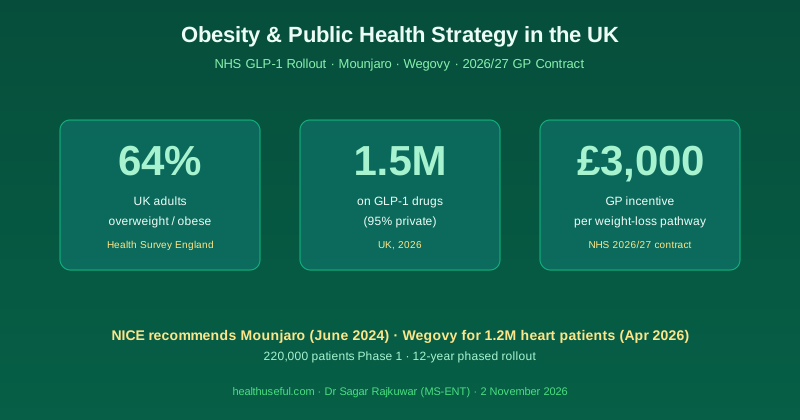
Obesity & public health strategy in the United Kingdom has entered its most transformative period in two decades. According to the Health Survey for England, approximately 64% of adults are now overweight or obese, with downstream consequences across type 2 diabetes, cardiovascular disease, osteoarthritis, obstructive sleep apnoea, several cancers and mental health. A combination of long-standing preventive policy (the Soft Drinks Industry Levy, HFSS advertising restrictions, NHS Digital Weight Management), an expanding GLP-1 pharmacotherapy offer (Wegovy and Mounjaro) and now a cardiovascular-indication expansion in April 2026 is reshaping the clinical landscape week by week.
This complete 2026 clinical guide summarises obesity & public health strategy in the United Kingdom — the five policy pillars (prevention, lifestyle, GLP-1 drugs, surgery and cardiovascular-risk reduction), the 2026/27 GP contract reforms, NICE eligibility thresholds, expected weight-loss outcomes, private-market dynamics and the practical NHS offer for eligible patients. Information is drawn from NHS England, NICE, the Nesta UK analysis, the BMJ, Pulse and sector coverage.
Table of Contents
- 1. The UK Obesity Burden in 2026
- 2. Five Pillars of the UK Obesity Strategy
- 3. Prevention Policies (SDIL, HFSS, Promotions)
- 4. GLP-1 Drugs: Mounjaro & Wegovy
- 5. The 2026/27 GP Contract Reform
- 6. NICE Eligibility & Expected Outcomes
- 7. Cardiovascular Use — Wegovy for 1.2M Heart Patients
- 8. Bariatric Surgery in the UK
- 9. The Private Market: Boots, 1.5M Users
- 10. Side Effects & Safety Considerations
- 11. Frequently Asked Questions
- 12. Summary & Conclusion
- 13. References
1. The UK Obesity Burden in 2026
The scale of the problem underlying obesity & public health strategy in the United Kingdom is substantial. The Health Survey for England shows that approximately 64% of adults were overweight (BMI 25-29.9) or obese (BMI ≥30) in 2022, the most recent published data. Obesity disproportionately affects areas of socio-economic deprivation. The NHS estimates that obesity-attributable conditions account for billions of pounds in annual healthcare costs and significant preventable premature mortality.
Here is a short explainer video from an NHS GP perspective on how GLP-1 drugs fit into the modern UK weight-management pathway — a central part of obesity & public health strategy in the United Kingdom:
2. Five Pillars of the UK Obesity Strategy
The modern framework for obesity & public health strategy in the United Kingdom rests on five complementary pillars:
- Prevention — fiscal, product-reformulation and marketing policy (Soft Drinks Industry Levy, HFSS advertising restrictions, promotion/placement rules)
- Lifestyle services — NHS Digital Weight Management programme, Tier 2/3 community clinics, dietitian referral, school meals
- GLP-1 pharmacotherapy — Mounjaro (tirzepatide) and Wegovy (semaglutide) prescribed under NICE criteria
- Bariatric surgery — gastric sleeve, gastric bypass and adjustable gastric band for eligible patients
- Cardiovascular-risk reduction — the April 2026 NHS extension of Wegovy to approximately 1.2 million high-risk heart patients
3. Prevention Policies (SDIL, HFSS, Promotions)
The Soft Drinks Industry Levy (SDIL), introduced in April 2018, has been the single most successful preventive component of obesity & public health strategy in the United Kingdom. Peer-reviewed BMJ analyses estimate the levy has removed around 46,000 tonnes of sugar from the UK diet each year through product reformulation. The HFSS (High Fat, Salt and Sugar) advertising restrictions on broadcast media, and the 2022 restrictions on volume promotions (buy-one-get-one-free deals) and in-store placement, together represent the most ambitious obesity-prevention policy package in Europe.
4. GLP-1 Drugs: Mounjaro & Wegovy
The entry of GLP-1 receptor agonists is the defining innovation in obesity & public health strategy in the United Kingdom in 2024-2026. Two drugs dominate: Wegovy (semaglutide), a once-weekly injection that mimics the GLP-1 hormone to suppress appetite and increase satiety, producing an average weight loss of approximately 15% over a year with lifestyle support; and Mounjaro (tirzepatide), a dual GLP-1 and GIP receptor agonist that produces greater weight loss of up to 21% in pivotal trials.
NICE recommended Mounjaro for obesity treatment in June 2024, with Wegovy already approved. Both are supplied as prefilled pens or Kwikpen injectors, titrated gradually to minimise gastrointestinal side effects. Obesity & public health strategy in the United Kingdom now relies on these injectables as a legitimate medical option alongside lifestyle and surgical pathways.
5. The 2026/27 GP Contract Reform
On 23 February 2026 the Department of Health & Social Care announced a major change to the GP contract that significantly expands access to weight-loss medications under obesity & public health strategy in the United Kingdom. GPs in England are now offered up to £3,000 per completed weight-management pathway as a financial incentive to move weight management from specialist clinics into local surgeries. A new £85 million programme co-funded by government and Eli Lilly launched in July 2026 to support the Mounjaro rollout.
Under the new 2026/27 framework, eligibility thresholds were widened: patients with a BMI of 35 with four weight-related conditions, or BMI of 40 with three conditions, now qualify for NHS GLP-1 prescribing. The approach aims to resolve what Pulse and the BMJ described in January 2026 as a “postcode lottery” — one in five local areas still lacked a functional Mounjaro pathway at that date.
6. NICE Eligibility & Expected Outcomes
NICE sets the operational criteria within obesity & public health strategy in the United Kingdom. Current indicative NICE criteria for NHS-funded Mounjaro or Wegovy are:
- BMI ≥ 40, or
- BMI ≥ 35 with at least one weight-related comorbidity (type 2 diabetes, hypertension, dyslipidaemia, obstructive sleep apnoea, cardiovascular disease), extended under 2026/27 contract to three or four comorbidities depending on BMI
- Commitment to a reduced-calorie diet and physical-activity programme
- Prescription within a Tier 3 or Tier 4 service, or through the new primary-care pathway
Pivotal trial data for Mounjaro (SURMOUNT) show up to 21% body-weight reduction over 72 weeks; Wegovy (STEP trials) demonstrated approximately 15% weight loss. Research published in January 2026 found weight regain within 2 years of stopping therapy — an important consideration for long-term planning.
7. Cardiovascular Use — Wegovy for 1.2M Heart Patients
In April 2026, in a landmark expansion of obesity & public health strategy in the United Kingdom, the NHS announced that Wegovy would be offered to approximately 1.2 million high-risk heart patients. This was triggered by the SELECT trial (published in NEJM 2023), which demonstrated a 20% reduction in major adverse cardiovascular events (MACE) — heart attack, stroke, cardiovascular death — in patients with established cardiovascular disease and obesity. Importantly, the cardiovascular benefit appeared before significant weight loss, suggesting a direct cardiac effect of GLP-1 signalling. This repositioning moves GLP-1 drugs from niche obesity and diabetes treatments to mainstream cardiovascular prevention.
8. Bariatric Surgery in the UK
Bariatric surgery remains an essential component of obesity & public health strategy in the United Kingdom for patients with BMI ≥ 40, or ≥ 35 with significant comorbidities, in whom medical management has failed or in whom very substantial weight loss is clinically required. The main procedures offered on the NHS are:
- Laparoscopic sleeve gastrectomy — removes approximately 75% of the stomach to create a tube-shaped remnant
- Roux-en-Y gastric bypass — creates a small stomach pouch and bypasses part of the small intestine
- Adjustable gastric banding — now less commonly performed
- Biliopancreatic diversion with duodenal switch — reserved for severe cases
Surgery typically produces 25-30% total body weight loss and significant improvement in comorbidities. Pre- and post-operative multidisciplinary care including bariatric dietitians and psychologists is standard NHS practice.
9. The Private Market: Boots, 1.5M Users
A critical reality within obesity & public health strategy in the United Kingdom is the enormous private market. Nesta UK estimates approximately 1.5 million people in the UK are currently using GLP-1 drugs, with around 95% accessing them privately through chains like Boots, Pharmacy2U, LloydsDirect and various online clinics. Private costs range from approximately £150 to £350 per month for Mounjaro and £150-200 for Wegovy. In August 2025, Eli Lilly implemented a 170% price increase on UK Mounjaro supplies.
10. Side Effects & Safety Considerations
Like all pharmacotherapies, GLP-1 drugs in obesity & public health strategy in the United Kingdom have well-characterised side effects. The most common are gastrointestinal: nausea, vomiting, diarrhoea, constipation, heartburn — all usually mild and transient, mitigated by gradual dose titration. Rare but important risks include drug-induced acute pancreatitis, cholelithiasis (gallstones), muscle mass loss (affecting lean tissue alongside fat), and theoretical thyroid C-cell tumour risk (based on rodent data, not confirmed in humans).
Patients should be screened for personal or family history of medullary thyroid carcinoma or multiple endocrine neoplasia type 2, which are absolute contraindications. Weight regain on stopping is likely (sometimes substantial) — a key point for patient counselling. For related reading on this blog, see my articles on the newest breakthrough in treating osteoarthritis (which covers GLP-1 use for OA), can asthma patients live long, and how a healthy diet helps blood pressure.
11. Frequently Asked Questions (FAQs)
Q1. Am I eligible for Mounjaro or Wegovy on the NHS?
Current NHS eligibility within obesity & public health strategy in the United Kingdom requires BMI ≥ 40, or BMI ≥ 35 with at least one weight-related condition (type 2 diabetes, hypertension, dyslipidaemia, obstructive sleep apnoea or established cardiovascular disease). Thresholds were widened in Feb 2026. Speak to your GP for individual assessment.
Q2. How much weight will I lose?
Mounjaro (tirzepatide) produces an average of up to 21% total body weight loss over 72 weeks; Wegovy (semaglutide) around 15%. Actual results vary with baseline weight, adherence, diet quality and physical activity.
Q3. Can I take GLP-1 drugs long-term?
Both drugs are designed for long-term use. However, if you stop, weight regain is likely within 1-2 years. Decisions on continuation beyond the initial 2-year period should be individualised with your prescriber.
Q4. What are the common side effects?
Nausea, vomiting, diarrhoea or constipation are most common, usually mild and transient during dose titration. Rare but serious risks include acute pancreatitis and gallstones. Report severe abdominal pain, persistent vomiting or signs of allergy to your clinician immediately.
Q5. How much do GLP-1 drugs cost privately?
In the private UK market in 2026, Mounjaro costs approximately £150-350 per month; Wegovy £150-200. Prices vary by dose and pharmacy. Buying GLP-1 drugs from unregulated online sources is strongly discouraged by the MHRA.
Q6. Can I have Wegovy for heart disease even without obesity?
As of April 2026 the NHS offers Wegovy to approximately 1.2 million patients with established cardiovascular disease and overweight (BMI > 27), based on SELECT trial data showing 20% reduction in major adverse cardiovascular events. Eligibility is assessed by cardiology and GP teams.
Q7. What role does bariatric surgery still play?
Bariatric surgery remains the most effective treatment for severe obesity (BMI ≥ 40, or ≥ 35 with serious comorbidities), typically producing 25-30% total body weight loss and significant improvement in type 2 diabetes. GLP-1 drugs do not replace surgery for this patient group; they complement it.
12. Summary and Conclusion
Obesity & public health strategy in the United Kingdom has reached a defining moment in 2026. The five-pillar framework — prevention (SDIL, HFSS), lifestyle services, GLP-1 pharmacotherapy (Mounjaro and Wegovy), bariatric surgery and cardiovascular-indication expansion — provides the most comprehensive population-health approach to obesity in Europe. The 2026/27 GP contract reform with £3,000 incentives, widened eligibility thresholds, and the April 2026 cardiovascular extension of Wegovy together mark a structural shift toward proactive, equitable NHS obesity care.
For individuals, the practical takeaway is that effective treatment of obesity is more accessible on the NHS in 2026 than ever before. For clinicians, the integrated pathway from prevention through pharmacotherapy to surgery, with cardiovascular expansion, offers a credible route to population-level improvement. The key is realistic expectations, careful selection, monitoring for side effects, and a long-term lifestyle commitment alongside medical therapy.
13. References
- Department of Health & Social Care. 2026/27 GP Contract announcement. 23 February 2026.
- NICE. Tirzepatide (Mounjaro) for managing overweight and obesity in adults — TA875. June 2024.
- NICE. Semaglutide (Wegovy) for managing overweight and obesity in adults — TA875. 2023 update.
- NHS England. Wegovy offered to 1.2 million high-risk cardiovascular patients. April 2026.
- Lincoff AM et al. Semaglutide and Cardiovascular Outcomes in Obesity Without Diabetes (SELECT Trial). NEJM 2023;389:2221-2232.
- Jastreboff AM et al. Tirzepatide Once Weekly for the Treatment of Obesity (SURMOUNT-1). NEJM 2022;387:205-216.
- Wilding JPH et al. Once-Weekly Semaglutide in Adults with Overweight or Obesity (STEP 1). NEJM 2021;384:989-1002.
- Nesta UK. Silver bullet or sticking plaster — weight-loss drugs and the UK’s obesity crisis. 2026.
- BMJ investigation. Mounjaro postcode lottery across NHS England. January 2026.
- Health Survey for England 2022 and 2024, published by NHS Digital.
ENT Consultation & Surgery
Dr. Sagar Rajkuwar (MS-ENT)
Consultant ENT Specialist & Head-Neck Surgeon
Prabha ENT Clinic, Ambad, Nashik, Maharashtra, India
📱 7387590194 | 9892596635
🌐 www.entspecialistinnashik.com
Medical Disclaimer: This article is for educational purposes only and does not replace professional medical advice. GLP-1 drugs and bariatric surgery decisions must be made in consultation with a qualified medical professional based on individual medical history. Do not purchase GLP-1 medications from unregulated online sources. For personal advice contact your NHS GP, pharmacist or a registered specialist.