By Dr Sagar Rajkuwar (MS-ENT) · Reviewed: 1 November 2026
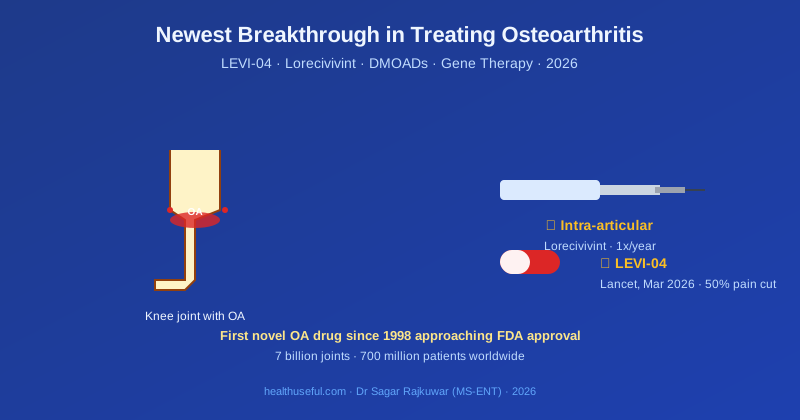
The question “what is the newest breakthrough in treating osteoarthritis?” has, in 2026, finally received an exciting answer. For nearly three decades, treatment of osteoarthritis (OA) — a degenerative joint disease now affecting approximately 25 million Americans and more than 700 million people worldwide — has consisted of lifestyle modification, paracetamol, NSAIDs, intra-articular corticosteroid or hyaluronic acid injections, and ultimately joint replacement. No drug has ever been approved by the FDA that modifies the underlying disease process. In 2026, that is finally changing.
In this 2026 clinical guide I summarise the newest breakthrough in treating osteoarthritis drawn from authoritative sources — FDA announcements, The Lancet, the American College of Rheumatology (ACR) Convergence 2025 abstracts, DelveInsight’s Osteoarthritis Pipeline Insight 2026, and company press releases from Biosplice, Levicept, 4Moving Biotech, Organogenesis, TissueGene, Enlivex, Lipogems and Novo Nordisk. The pipeline now includes more than 100 companies developing over 110 pipeline drugs, with four candidates leading the race for the first FDA-approved disease-modifying osteoarthritis drug (DMOAD).
Table of Contents
- 2. Lorecivivint (Biosplice) — NDA Submitted
- 3. LEVI-04 (Levicept) — Published in The Lancet
- 4. 4P004 (4Moving Biotech) — GLP-1 Analog DMOAD
- 5. ReNu (Organogenesis) — Amniotic Allograft BLA
- 6. TG-C — Gene Therapy for Knee OA
- 7. GLP-1 Drugs — Semaglutide and the OASIS 4 Trial
- 8. Regenerative, Cell & Exosome Therapies
- 9. Surgical & Device Innovations
- 10. Access & Availability in India
- 11. Frequently Asked Questions
- 12. Summary & Conclusion
- 13. References
1. Why 2026 Is a Breakthrough Year for Osteoarthritis
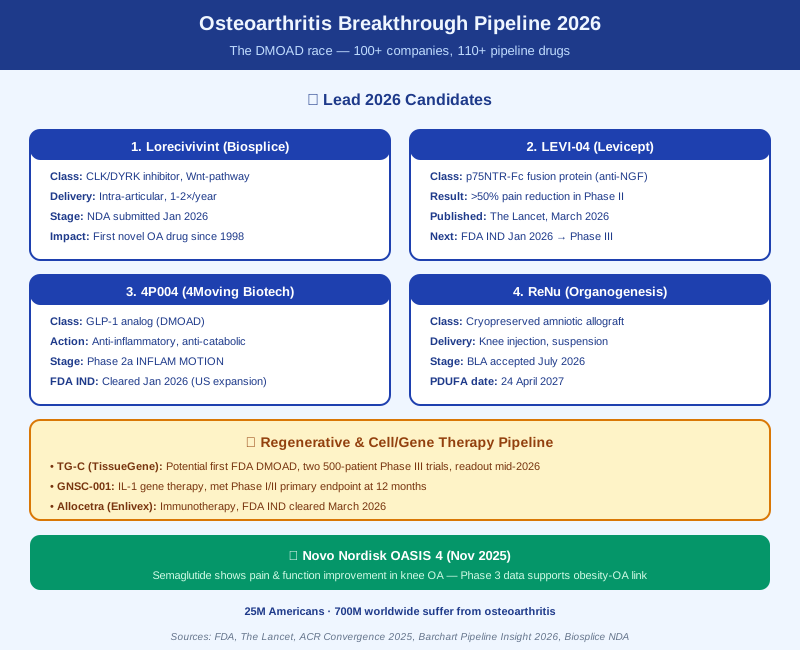
The honest answer to the question “what is the newest breakthrough in treating osteoarthritis?” is that for the first time in a generation, several candidate drugs are simultaneously approaching FDA approval that target the underlying disease — not just the pain. These are called DMOADs (Disease-Modifying Osteoarthritis Drugs). If any one of them is approved — and most industry analysts expect at least two to clear FDA by 2027–2028 — it would be the first new OA drug approved since diclofenac and hyaluronic acid products of the 1990s. Four programmes are at the front of this race.
Here is a short explainer video on the newest DMOAD pipeline and how disease-modifying therapies differ from traditional pain-relief treatments:
2. Lorecivivint (Biosplice) — NDA Submitted January 2026
Perhaps the single most important event in the newest breakthrough in treating osteoarthritis story was the submission of a New Drug Application (NDA) for lorecivivint (SM04690) by San Diego–based Biosplice Therapeutics to the U.S. FDA in January 2026. Lorecivivint is a small-molecule CLK/DYRK1A kinase inhibitor that modulates the Wnt signalling pathway, which is central to cartilage homeostasis, chondrocyte differentiation and the chronic inflammation that drives OA.
Lorecivivint is delivered by a single intra-articular injection once (or at most twice) per year directly into the affected knee joint. Across 11 clinical trials, including the pivotal 56-week Phase 3 OA-11 study (NCT03928184) in 850 patients with Kellgren-Lawrence grade 2-3 knee OA, lorecivivint has demonstrated statistically significant improvements in WOMAC Pain and WOMAC Function at 6 and 12 months post-injection, along with preservation of medial joint space width (mJSW) on X-ray — the key radiographic marker of disease modification. The three-year open-label OA-07 extension (NCT04520607), presented at ACR Convergence 2025, showed sustained benefit with annual repeat injections.
If approved — and Biosplice CEO Erich Horsley has publicly projected approval within 2026 — lorecivivint would be the first novel drug approved for the treatment of osteoarthritis since 1998. Industry analysts suggest the drug could reach $15 billion in global peak revenue, reflecting the enormous unmet need.
3. LEVI-04 (Levicept) — Published in The Lancet, March 2026
The second major entry in the newest breakthrough in treating osteoarthritis conversation is LEVI-04, developed by UK-based Levicept and published in The Lancet in March 2026. LEVI-04 is a p75NTR-Fc fusion protein that acts as a decoy receptor to neutralise excess nerve growth factor (NGF) in the osteoarthritic joint — a mechanism that previous anti-NGF monoclonal antibodies (tanezumab, fasinumab) tried, but which failed FDA approval because of rare but serious rapidly progressive osteoarthritis (RPOA) events.
What makes LEVI-04 significant is that in the Phase 2 trial (published in The Lancet March 2026) more than half of patients experienced a ≥50% reduction in pain, with a safety profile that appeared not to replicate the RPOA signal seen with the earlier anti-NGF antibodies. The FDA accepted Levicept’s Investigational New Drug (IND) application in January 2026, enabling pivotal Phase 3 trials. If replicated at scale, LEVI-04 could become not only a potent analgesic but — because NGF signalling drives both pain and some aspects of cartilage degradation — a disease-modifying agent too.
4. 4P004 (4Moving Biotech) — GLP-1 Analog DMOAD
A particularly exciting candidate in the newest breakthrough in treating osteoarthritis pipeline is 4P004, a GLP-1 receptor analog developed by Lille, France-based 4Moving Biotech. Preclinical studies show that 4P004 modulates multiple biological markers across the joint — anti-inflammatory, anti-catabolic and anabolic — potentially slowing structural damage while improving function. In January 2026 the FDA cleared the IND for 4P004, allowing the Phase 2a INFLAM MOTION trial to expand into the United States from Europe and Canada. 4P004 is designed to be a disease-modifying osteoarthritis drug (DMOAD) rather than purely a symptomatic therapy, and its GLP-1 mechanism places it in the same broad pharmacological family as the semaglutide and tirzepatide drugs currently transforming diabetes and obesity management.
5. ReNu (Organogenesis) — Cryopreserved Amniotic Allograft BLA
In July 2026 the FDA accepted Organogenesis Holdings’ Biologics License Application (BLA) for ReNu®, a cryopreserved amniotic suspension allograft designed to treat pain associated with symptomatic knee osteoarthritis. The FDA has assigned a Prescription Drug User Fee Act (PDUFA) target action date of 24 April 2027. ReNu is injected into the knee joint as a single-dose suspension of amniotic fluid cells and biologically active cytokines, growth factors and extracellular matrix proteins. The pivotal trial demonstrated clinically meaningful pain and function benefit versus saline placebo, and if approved ReNu would be the first FDA-regulated amniotic product with a specific knee OA indication.
6. TG-C (TissueGene) — Gene Therapy for Knee OA
Any 2026 account of the newest breakthrough in treating osteoarthritis must include TG-C (formerly Invossa), a cell/gene therapy developed by TissueGene/Kolon Life Science. TG-C combines allogeneic human chondrocytes with a transforming growth factor beta-1 (TGF-β1)-expressing cell line to deliver long-term anti-inflammatory and anabolic signalling to the joint. TG-C is under evaluation in two pivotal 500-patient Phase 3 trials in the United States, with study read-outs expected by mid-2026. If positive, TG-C would be the first FDA-approved DMOAD and the first gene therapy for OA.
7. GLP-1 Drugs — Semaglutide and the OASIS 4 Trial
A surprise entry in the newest breakthrough in treating osteoarthritis conversation is Novo Nordisk’s semaglutide (brand names Ozempic/Wegovy), originally developed for type-2 diabetes and obesity. In November 2025 Novo Nordisk released positive data from the OASIS 4 Phase 3 trial, showing that patients with obesity and knee OA treated with semaglutide achieved significant improvements in both pain and physical function compared with placebo. The mechanism is thought to be a combination of substantial weight loss (reducing mechanical load) and direct anti-inflammatory effects of GLP-1 signalling on cartilage and synovium. This finding has triggered broader interest in GLP-1 agonists as a potential class of OA drugs.
8. Regenerative, Cell & Exosome Therapies
Alongside pharmaceuticals, cell and tissue-based biologics represent a parallel track in the newest breakthrough in treating osteoarthritis. Key 2025-2026 developments:
- GNSC-001: An intra-articular IL-1 gene therapy; the 12-month Phase I/II data met its primary endpoint for safety and tolerability, supporting a planned Phase II.
- Allocetra (Enlivex): An immunotherapy for moderate-to-severe primary knee OA; FDA IND cleared March 2026.
- Lipogems ARISE I: Micro-fragmented adipose tissue; final study patient visit completed May 2025; PMA preparations under way.
- RION Purified Exosome Product (PEP™): Phase 1b first-patient enrolment March 2025 for knee OA.
- Platelet-rich plasma (PRP): Supported by multiple meta-analyses for moderate symptomatic knee OA; now widely used in India although still off-label.
- Autologous bone marrow aspirate concentrate (BMAC) and mesenchymal stem cell (MSC) injections — mixed evidence base, mostly observational.
9. Surgical & Device Innovations
Beyond pharmacology, the newest breakthrough in treating osteoarthritis extends to surgical innovation. Key 2025-2026 advances include:
- Robotic-assisted total knee arthroplasty — Mako and ROSA platforms now the standard of care at tertiary centres; literature shows improved alignment and faster recovery.
- Partial (unicompartmental) knee replacement — Favoured for isolated medial compartment OA; faster recovery and more natural kinematics than TKR.
- High tibial osteotomy — Still a joint-preserving option in younger active patients with varus deformity.
- Genicular nerve ablation (radiofrequency, cryoneurolysis) — A non-surgical pain intervention for patients unsuitable for arthroplasty.
- Cingal (Anika Therapeutics) — A combination hyaluronic acid + corticosteroid injection; approved internationally but still working through FDA review.
- Durolane (Bioventus) — Single-injection hyaluronic acid, FDA approved for knee OA pain.
10. Access & Availability in India
For Indian patients and clinicians, most of the agents representing the newest breakthrough in treating osteoarthritis remain confined to US and European clinical trials and are not yet available. However, several related interventions are accessible today in Indian tertiary centres — including PRP and BMAC injections, intra-articular hyaluronic acid and corticosteroids, robotic-assisted TKR at major private hospitals, and semaglutide (approved in India for diabetes/obesity, which may incidentally benefit obese patients with knee OA). Patients interested in trial access should check CTRI (Clinical Trials Registry of India) and ClinicalTrials.gov for sites recruiting in India.
For related reading on this blog, see my articles on osteoarthritis treatment, osteoarthritis symptoms, osteoarthritis causes, osteoarthritis medications, osteoarthritis self-care and knee osteoarthritis.
11. Frequently Asked Questions (FAQs)
Q1. What is the single newest breakthrough in treating osteoarthritis?
The single most consequential event in 2026 is the FDA New Drug Application for lorecivivint (SM04690) by Biosplice Therapeutics, submitted in January 2026. If approved, it would be the first novel OA drug since 1998 and the first potential disease-modifying osteoarthritis drug (DMOAD).
Q2. When will these new treatments be available?
Lorecivivint FDA decision is expected in 2026; ReNu PDUFA target action date is 24 April 2027; TG-C has Phase 3 readouts expected mid-2026 with filing to follow; LEVI-04 is entering Phase 3. India availability will typically lag US approval by 1–3 years.
Q3. Will the breakthrough treatments cure osteoarthritis?
Not yet. The newest breakthrough in treating osteoarthritis is in disease modification — slowing joint-space narrowing and reducing pain and functional loss — rather than regeneration of lost cartilage or complete cure. True regenerative treatments remain further out, likely 5-10 years.
Q4. Are stem cell injections already a breakthrough?
Short answer: the evidence is mixed. Autologous bone marrow–derived MSC and adipose-derived SVF injections have shown signal in observational studies and small RCTs, but no FDA-approved stem cell product currently exists for OA. Patients considering such therapy should be cautious about unregulated clinics and should seek treatment within clinical trials or FDA-regulated BLA products (e.g., ReNu once approved).
Q5. Will semaglutide replace knee replacement?
Unlikely to replace it, but may postpone it. The OASIS 4 Phase 3 data (Nov 2025) show meaningful pain and function improvement in obese patients with knee OA, likely combining weight-loss and direct anti-inflammatory effects. For many obese patients with symptomatic knee OA, this could delay the need for total knee replacement by years.
Q6. Are these breakthrough treatments safe?
Each candidate has its own safety profile. Lorecivivint has, across 11 trials, shown a safety profile comparable to placebo for single intra-articular injection. LEVI-04 is being watched closely for RPOA signal that previously derailed anti-NGF antibodies. GLP-1 drugs carry well-known gastrointestinal side effects. All candidates still require long-term safety data at scale after approval.
Q7. How much will these new OA drugs cost?
No firm pricing yet. Industry analyst estimates place single annual intra-articular lorecivivint injection in the USD 1,500–3,000 range in the US; gene therapies such as TG-C historically cost USD 20,000–50,000. India pricing is typically 20-40% of US pricing after launch.
12. Summary and Conclusion
Asked today, in November 2026, “what is the newest breakthrough in treating osteoarthritis?”, the honest clinical answer is that we stand on the threshold of the first truly new drug class for OA in a generation. Lorecivivint‘s NDA submission, LEVI-04‘s Lancet publication, 4P004‘s FDA IND clearance, ReNu‘s BLA acceptance with April 2027 PDUFA date, TG-C‘s imminent Phase 3 readout, and semaglutide‘s OASIS 4 result together make 2026 a genuine inflection year.
For patients, the practical takeaway is that current evidence-based therapies — weight loss, structured exercise, physical therapy, selective NSAIDs, intra-articular HA or corticosteroids, and timely surgical referral when indicated — remain the standard of care in 2026. For eligible patients, enrolment in a well-run clinical trial of these breakthrough candidates is a reasonable option to discuss with your orthopaedic surgeon or rheumatologist. Watch the FDA calendar closely over the next 12–24 months — if even one of these candidates is approved, millions of lives will change.
13. References
- Yazici Y et al. Lorecivivint for symptomatic moderate-to-severe knee OA — Phase 3 OA-11 (NCT03928184). ACR Convergence 2022/2025 abstracts.
- Levicept Ltd. LEVI-04 Phase 2 results in knee osteoarthritis. The Lancet, March 2026.
- 4Moving Biotech. FDA IND clearance for 4P004 in INFLAM MOTION Phase 2a trial. Press release, January 2026.
- Organogenesis Holdings. FDA accepts BLA for ReNu with April 24, 2027 PDUFA date. July 2026.
- TissueGene / Kolon Life Science. TG-C pivotal Phase 3 trial updates, 2025-2026.
- Novo Nordisk. OASIS 4 Phase 3 results in semaglutide for obesity-related knee osteoarthritis. November 2025.
- DelveInsight. Osteoarthritis Pipeline Insight — 2026 Report.
- Enlivex Ltd. Allocetra IND clearance for knee OA immunotherapy. March 2026.
- OrthoWorld. Opportunities in knee OA hold tremendous promise. 2025 industry review.
- American College of Rheumatology Guideline for the Management of Osteoarthritis of the Hand, Hip, and Knee. 2024 update.
ENT Consultation & Surgery
Dr. Sagar Rajkuwar (MS-ENT)
Consultant ENT Specialist & Head-Neck Surgeon
Prabha ENT Clinic, Ambad, Nashik, Maharashtra, India
📱 7387590194 | 9892596635
🌐 www.entspecialistinnashik.com
Medical Disclaimer: This article is for educational purposes only and does not replace professional medical advice. The investigational agents described (lorecivivint, LEVI-04, 4P004, ReNu, TG-C, Allocetra) are not yet FDA-approved for commercial use, except where specifically indicated. Treatment decisions for osteoarthritis must be made in consultation with a qualified orthopaedic surgeon or rheumatologist based on individual clinical findings.