By Dr Sagar Rajkuwar (MS-ENT) · Reviewed: 1 November 2026
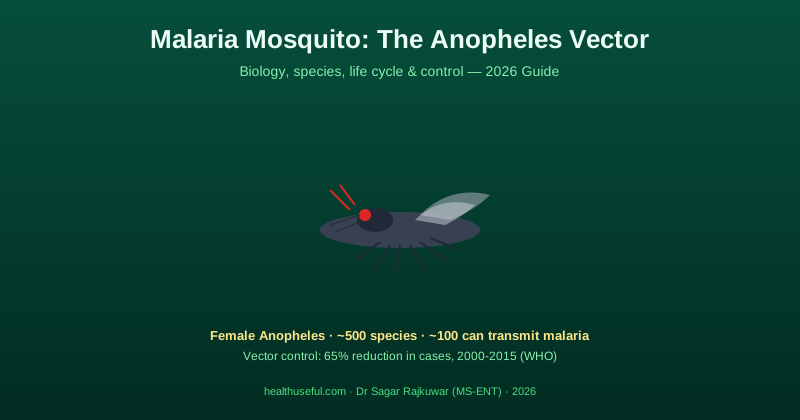
The malaria mosquito is the single most dangerous animal to humanity. Every one of the 282 million cases and 610,000 deaths from malaria recorded globally in 2024 (WHO World Malaria Report 2025) ultimately traces back to a bite from a female Anopheles mosquito carrying one of five human-infecting Plasmodium species. The Anopheles genus contains approximately 500 described species worldwide, of which about 100 can transmit human malaria and 30 to 40 are of major public-health importance.
In this 2026 complete clinical guide I walk through everything an informed reader, a medical student, a public-health worker and a traveller needs to know about the malaria mosquito — its biology and life cycle, why only females bite, the major vector species on each continent (including the Indian primary vectors), the extrinsic sporogonic cycle inside the mosquito, WHO vector-control strategies (LLINs, IRS, larval source management, newer dual-active-ingredient nets, monoclonal antibodies and gene drives), the rising problem of pyrethroid insecticide resistance, and practical personal-protection advice. The references draw on the WHO Global Malaria Programme, CDC, peer-reviewed Malaria Journal, Frontiers in Malaria, and the Liverpool School of Tropical Medicine.
Table of Contents
- 1. What Is the Malaria Mosquito?
- 2. Life Cycle of the Malaria Mosquito
- 3. Why Only Female Anopheles Bite
- 4. Major Malaria Mosquito Species Worldwide
- 5. The Malaria Mosquito in India
- 6. What Happens Inside the Mosquito (Sporogonic Cycle)
- 7. Biting Behaviour, Host Preference & Resting Habits
- 8. WHO Vector Control & Modern Innovations
- 9. Insecticide Resistance in the Malaria Mosquito
- 10. Personal Protection for Travellers & Residents
- 11. Frequently Asked Questions
- 12. Summary & Conclusion
- 13. References
1. What Is the Malaria Mosquito?
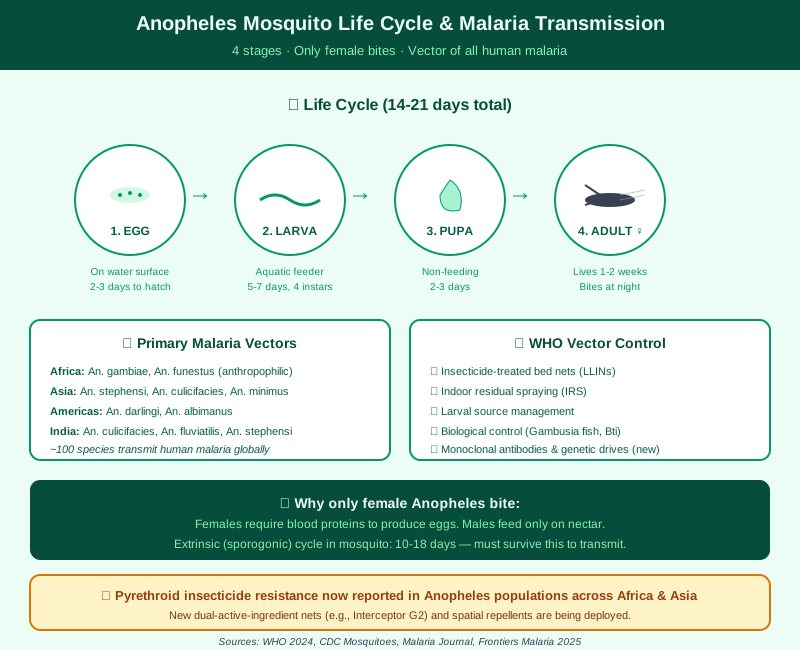
The malaria mosquito is any mosquito of the genus Anopheles capable of transmitting human malaria. Taxonomically, Anopheles belongs to the family Culicidae, order Diptera. The genus was first described in 1818 by Johann Wilhelm Meigen, and the critical discovery that it transmits malaria was made by Sir Ronald Ross in 1897 in Secunderabad, India — work that won him the 1902 Nobel Prize in Physiology or Medicine. Visually, an adult Anopheles can be distinguished from other mosquitoes by its characteristic resting posture — body held at an angle to the surface — and by palps that are nearly as long as the proboscis.
Here is a short visual overview of the malaria mosquito life cycle and vector biology from a WHO/CDC educational video:
2. Life Cycle of the Malaria Mosquito
Like all mosquitoes, the malaria mosquito undergoes complete metamorphosis through four distinct stages — egg, larva, pupa and adult. The first three stages are aquatic and together take 5 to 14 days depending on temperature and species. The adult female can live 1 to 2 weeks in nature (occasionally up to one month in captivity), which is just enough time to complete the sporogonic cycle of the Plasmodium parasite and transmit malaria to a human host.
2.1 Egg
A single female Anopheles lays 50 to 200 eggs after each blood meal, directly on the surface of standing water. Anopheles eggs are characteristically boat-shaped and have lateral floats that keep them on the water surface — unlike Culex eggs which are laid in rafts, or Aedes eggs which are laid above the water line. Eggs hatch within 2 to 3 days under tropical conditions.
2.2 Larva
Anopheles larvae are aquatic filter feeders that lie parallel to the water surface (another distinguishing feature from Culex larvae, which hang head-down). They breathe through spiracles on the eighth abdominal segment and consume algae, bacteria and organic debris. The larval stage lasts 5 to 7 days through four instars under optimal temperatures (25–30 °C). Breeding sites prefer clean, slow-moving or stagnant water — rice paddies, irrigation ditches, puddles, forest streams, rock pools and household water storage containers.
2.3 Pupa
The non-feeding, comma-shaped pupa floats at the surface and breathes through respiratory trumpets. It is mobile but does not feed. The pupal stage lasts 2 to 3 days, after which the adult mosquito emerges.
2.4 Adult
The emerging adult malaria mosquito rests on vegetation for a few hours while its exoskeleton hardens, then begins its adult life. Males feed only on nectar and plant sugars and live 1 to 2 weeks. Females feed on both sugar and blood — a blood meal is required for egg development — and in nature live only about 1 to 2 weeks (though up to a month is possible in cooler, more humid conditions). Importantly, less than 10% of female Anopheles gambiae survive beyond the 14-day extrinsic incubation period of P. falciparum, which is why vector longevity is such a critical determinant of transmission intensity.
3. Why Only Female Anopheles Bite
A frequently asked question — and a crucial one — is why only female malaria mosquito bite humans. The answer is reproductive: female Anopheles require the iron and amino acids in blood to synthesise the yolk protein vitellogenin for her developing eggs. Male mosquitoes have no need for blood protein and feed exclusively on nectar and plant sugars. Male Anopheles are easily identified under a dissecting microscope by their heavily feathered plumose antennae, used for detecting female wing-beat frequencies during mating.
After mating (which typically occurs in male swarms at dusk shortly after adult emergence), a female Anopheles embarks on a gonotrophic cycle every 2–3 days — blood meal → egg development → oviposition → next blood meal. Each cycle gives her another opportunity to acquire or transmit the Plasmodium parasite.
4. Major Malaria Mosquito Species Worldwide
4.1 Sub-Saharan Africa
The two dominant African vectors — Anopheles gambiae sensu stricto and Anopheles funestus — are the most efficient malaria mosquito species on Earth because they are highly anthropophilic (preferring human blood), endophilic (resting indoors) and endophagic (biting indoors). This combination of behaviours makes them exceptionally dangerous and also, importantly, makes them vulnerable to indoor interventions such as insecticide-treated nets and indoor residual spraying. Secondary African vectors include Anopheles arabiensis, Anopheles squamosus and Anopheles coluzzii.
4.2 Southeast Asia & Western Pacific
Major Asian vectors include Anopheles stephensi (an increasingly urban-adapted species of major current concern), Anopheles minimus, Anopheles dirus (a forest-fringe species driving residual transmission in Southeast Asia), and in Indonesia and the Pacific, Anopheles koliensis and Anopheles farauti. Indonesia alone reports at least 31 Anopheles species that are known malaria vectors.
4.3 Americas
The dominant Latin American vectors are Anopheles darlingi (the primary vector in the Amazon basin) and Anopheles albimanus (coastal Central America and Caribbean), with additional roles for Anopheles pseudopunctipennis and Anopheles aquasalis.
4.4 Europe
Although Europe eliminated indigenous malaria transmission decades ago, two historically important vectors — Anopheles atroparvus (southern Europe) and Anopheles sacharovi (Mediterranean basin) — remain present. Occasional “airport malaria” and travel-related cases keep European surveillance networks on alert.
5. The Malaria Mosquito in India
India has 58 recorded Anopheles species, of which 9 are proven malaria vectors. The three primary vectors are:
- Anopheles culicifacies — The main rural vector across most of plains India; transmits predominantly P. vivax and P. falciparum. Breeds in rice fields, canal seepage and irrigation water.
- Anopheles fluviatilis — Important in forested hilly areas of central and eastern India, including Odisha, Chhattisgarh, Jharkhand and northeastern states; prefers flowing streams and highly anthropophilic.
- Anopheles stephensi — The main urban malaria mosquito in India, breeding in rooftop tanks, wells, cement cisterns and construction-site water containers in cities including Mumbai, Delhi, Chennai and Bengaluru.
Secondary Indian vectors of regional importance include Anopheles minimus, Anopheles dirus, Anopheles sundaicus, Anopheles annularis and Anopheles philippinensis. The National Vector Borne Disease Control Programme (NVBDCP) conducts entomological surveillance in 500+ districts and leads the national Integrated Vector Management (IVM) response.
For other related reading on this blog see my articles on malaria transmission, causes of malaria, types of malaria, malaria testing, malaria treatment and malaria vaccine.
6. What Happens Inside the Mosquito — the Sporogonic Cycle
When a female malaria mosquito takes a blood meal from an infected human, she ingests male and female gametocytes of Plasmodium. These fuse in the mosquito midgut to form a motile ookinete, which penetrates the midgut wall to become an oocyst. Over the next 10 to 18 days, the oocyst undergoes sporogony and produces thousands of sporozoites, which migrate to the mosquito’s salivary glands. Only now is the mosquito infectious — when she next bites, she injects sporozoite-laden saliva into a new human host.
The length of the extrinsic incubation period depends on species and ambient temperature. P. falciparum takes 10–14 days at 28 °C, longer at cooler temperatures; below 16 °C, the parasite fails to complete sporogony at all. This is a key reason why high-altitude areas, cooler latitudes and seasonal cold periods have little or no malaria transmission.
7. Biting Behaviour, Host Preference and Resting Habits
Three behavioural traits determine the vectorial capacity of any malaria mosquito population. First is host preference — anthropophilic species that prefer human blood are far more efficient malaria vectors than zoophilic species that primarily feed on cattle. Second is biting location — endophagic species that bite indoors are susceptible to insecticide-treated nets, while exophagic species that bite outdoors evade this intervention. Third is resting location — endophilic species resting on indoor walls are susceptible to indoor residual spraying, while exophilic species resting outdoors are not.
Most Anopheles species, including the key African and Indian vectors, are crepuscular to nocturnal biters, with peak activity between dusk and dawn (roughly 10 PM to 4 AM). This is one of the biological facts that makes a long-lasting insecticidal net (LLIN) such a powerful intervention — people are already in bed during the mosquito’s peak biting window.
8. WHO Vector Control & Modern Innovations
Vector control is the single most effective intervention against malaria — the WHO estimates that 65% of the global reduction in malaria cases between 2000 and 2015 was due to vector control, principally LLINs and indoor residual spraying. The WHO 2024 Guidelines for Malaria define the current pillars:
- Long-lasting insecticidal nets (LLINs): Pyrethroid-treated bed nets lasting 3+ years; approximately 2.5 billion delivered since 2004.
- Indoor residual spraying (IRS): Spraying walls with a long-acting insecticide (DDT historically, now pyrethroids, carbamates, organophosphates and newer formulations).
- Larval source management (LSM): Removal, modification or treatment of breeding sites with Bti (Bacillus thuringiensis israelensis), temephos or environmental drainage.
- Biological control: Gambusia affinis and Poecilia reticulata larvivorous fish; copepods; Bti bacterial sprays.
- Space spraying: Thermal fogging and ULV spraying in epidemic situations.
- Chemoprevention: Perennial malaria chemoprevention for children (PMC); IPTp for pregnant women; MDA in elimination contexts.
8.1 Newer 2024-2026 Innovations
- Dual-active-ingredient nets (e.g., Interceptor G2 combining chlorfenapyr and alpha-cypermethrin) — a response to pyrethroid resistance.
- Spatial repellents for outdoor and residual transmission.
- Attractive toxic sugar baits (ATSB) — exploit sugar-feeding by both male and female Anopheles.
- Monoclonal antibodies against sporozoites in human hosts (CIS43LS and L9LS Phase 2 trials, 2024-2025).
- Genetic approaches — Target Malaria is testing self-limiting and gene-drive constructs in Burkina Faso and Mali under contained conditions.
9. Insecticide Resistance in the Malaria Mosquito
The spread of pyrethroid insecticide resistance in major Anopheles vector populations is one of the most serious threats to malaria control in the 2020s. Resistance mechanisms include knock-down resistance (kdr) gene mutations at the sodium channel target site, up-regulation of detoxifying cytochrome P450 enzymes, and cuticular thickening. The WHO’s Global Insecticide Resistance Database now reports pyrethroid resistance in 73 malaria-endemic countries, including most of sub-Saharan Africa, India, Pakistan and parts of Southeast Asia.
The programmatic response includes the roll-out of dual-active-ingredient nets, rotation of insecticide classes in IRS campaigns, and ongoing monitoring through entomological sentinel sites. In India, kdr mutations are now documented in Anopheles culicifacies and Anopheles stephensi in multiple states, and the NVBDCP has initiated a formal Insecticide Resistance Management Plan.
10. Personal Protection Against the Malaria Mosquito
For travellers, pregnant women, children and anyone living in a transmission zone, personal protection against the malaria mosquito rests on a layered A-B-C-D approach adapted from CDC and NHS guidance:
- A — Awareness of the local risk and seasonality before travel
- B — Bite prevention: sleep under a long-lasting insecticidal net; use DEET 20–50%, picaridin 20% or oil of lemon eucalyptus repellents on exposed skin; wear long sleeves and trousers at dusk; use permethrin-treated clothing
- C — Chemoprophylaxis where recommended (atovaquone-proguanil, doxycycline, mefloquine or tafenoquine depending on region and age)
- D — Diagnosis promptly — any fever within 3 months of travel should trigger an immediate malaria test
In urban Indian settings, additional practical measures include emptying standing water (water storage containers, flower pots, cooler trays), screening windows and doors, using household aerosols at dusk, and installing mosquito nets on infant cradles.
11. Frequently Asked Questions (FAQs)
Q1. How can I identify a malaria mosquito?
At rest, an Anopheles mosquito holds its body at a 30–45° angle to the surface (unlike Culex and Aedes which rest parallel). Its palps are nearly as long as the proboscis — in females, this is a reliable field-level identification clue. Many Anopheles species also have characteristic dark and pale spots on their wings. Definitive species identification requires microscopy or molecular PCR.
Q2. Can every mosquito spread malaria?
No. Only female Anopheles mosquitoes can transmit human malaria, and even among the ~500 Anopheles species, only about 100 are known vectors. Culex and Aedes mosquitoes transmit other diseases (filariasis, dengue, chikungunya, Zika, Japanese encephalitis) but not malaria.
Q3. At what time of day does the malaria mosquito bite?
Most Anopheles species are crepuscular to nocturnal biters with peak activity between dusk and dawn, roughly 10 PM to 4 AM. Sleeping under a long-lasting insecticidal net remains the single most effective evidence-based protection.
Q4. How far does the malaria mosquito fly?
Typical flight range of a female Anopheles is 1 to 3 km from the breeding site, but longer dispersal (up to 10 km) is possible with wind assistance. Rare long-distance travel in aircraft gives rise to “airport malaria” — occasional cases diagnosed in people living near international airports in non-endemic countries.
Q5. Does climate change affect the malaria mosquito range?
Yes. Warming temperatures are extending the altitudinal and geographical range of Anopheles vectors. A 2024 Lancet Planetary Health analysis documents highland malaria resurgence in East Africa, and Anopheles stephensi — originally an Indian subcontinent vector — has now invaded the Horn of Africa (Djibouti, Ethiopia, Sudan, Somalia) and is driving urban falciparum outbreaks.
Q6. Can the malaria mosquito survive winter?
Adult Anopheles typically die off in cold winters, but eggs and some larvae can survive, and in temperate zones females may enter a reproductive diapause and overwinter in sheltered locations. In tropical India transmission continues year-round, with seasonal peaks after the monsoon rains.
Q7. Is there a vaccine against the malaria mosquito?
The WHO-recommended RTS,S/AS01 (Mosquirix) and R21/Matrix-M vaccines protect humans against the Plasmodium parasite, not against the mosquito itself. However, transmission-blocking vaccines (TBVs) that would prevent the parasite from completing its cycle inside the mosquito are in early human trials. See my dedicated article on the malaria vaccine.
12. Summary and Conclusion
The malaria mosquito — the female Anopheles — is the critical link in the chain of malaria transmission. Understanding its biology (four-stage life cycle, sporogonic cycle, host preference, biting rhythm), its principal vector species in each region (An. gambiae and An. funestus in Africa; An. culicifacies, An. fluviatilis and An. stephensi in India; An. darlingi in Latin America; An. dirus and An. minimus in Southeast Asia), and the modern vector-control toolbox (LLINs, IRS, LSM, dual-active-ingredient nets, monoclonal antibodies, gene drives) is foundational for every clinician, public-health worker and traveller.
The two biggest challenges in 2026 — accelerating pyrethroid resistance and the urban invasion of Anopheles stephensi — require renewed investment in surveillance and innovation. For individuals, the simplest layered protection against the malaria mosquito (nets, repellents, chemoprophylaxis where appropriate, prompt testing of any fever) remains highly effective. For public-health systems, continuing WHO-aligned Integrated Vector Management remains the backbone of malaria control.
13. References
- World Health Organization. World Malaria Report 2025. Geneva, 2025.
- WHO Global Malaria Programme. Guidelines for Malaria. 2024 updated edition.
- CDC. Anopheles Mosquitoes. CDC Malaria pages, updated 2026.
- Frontiers in Malaria. Mosquito vector diversity and malaria transmission. 2025;3:1600850.
- Research LSTM. Know your enemy: understanding mosquito biology to advance malaria elimination in Africa. 2024.
- Malaria Journal. The behaviour of adult Anopheles gambiae and its relevance to malaria control: a review. May 2024.
- Nguyen et al. Species composition and blood feeding patterns of understudied Anopheles mosquitoes in southern Zambia. Malaria Journal 2026;25:107.
- IFAS Entomology. Anopheles squamosus (EDIS IN1465), 2026.
- National Vector Borne Disease Control Programme (NVBDCP), India. Operational Manual on Malaria Elimination 2024.
- MDPI Insects. Anopheles squamosus — a cryptic understudied vector. 2025;16(2):110.
ENT Consultation & Surgery
Dr. Sagar Rajkuwar (MS-ENT)
Consultant ENT Specialist & Head-Neck Surgeon
Prabha ENT Clinic, Ambad, Nashik, Maharashtra, India
📱 7387590194 | 9892596635
🌐 www.entspecialistinnashik.com
Medical Disclaimer: This article is for educational purposes only and does not replace professional medical advice. Travel-related malaria prevention and chemoprophylaxis should be prescribed by a qualified medical professional based on destination, duration, individual risk factors and current drug-resistance data. If you develop fever within three months of travel to a malaria-endemic area, seek urgent medical care.