By Dr Sagar Rajkuwar (MS-ENT) · Reviewed: 31 October 2026
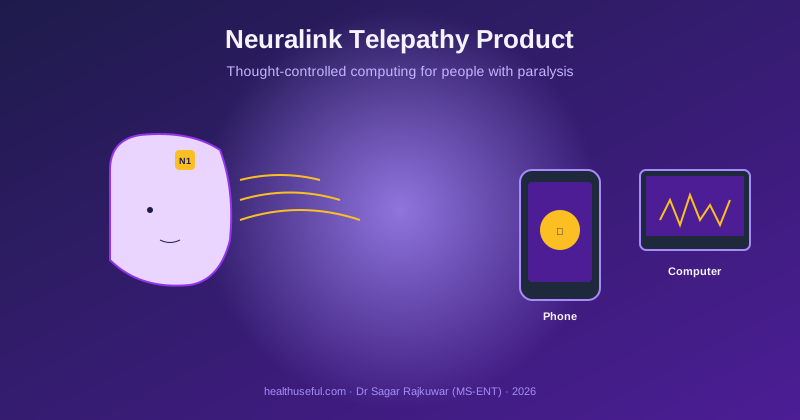
The neuralink telepathy product is the first commercial device being developed by Neuralink, the neurotechnology company co-founded by Elon Musk. Officially announced on 29 January 2024 after the first-in-human implant of the N1 chip, the Telepathy product is designed to allow a person with severe paralysis to control a phone, computer or robotic arm using only their thoughts. By October 2026, 26 or more participants have received the neuralink telepathy product implant through the PRIME, CAN-PRIME and GB-PRIME clinical trials, and the device is approaching FDA Premarket Approval with a projected commercial launch window of late 2026 to 2027.
In this article I provide a careful 2026 clinical guide to the neuralink telepathy product — what it is, who qualifies, what patients can and cannot do with it, and what the real-world outcomes have been. The information is drawn from the U.S. Food and Drug Administration, the ClinicalTrials.gov registration for the PRIME study (NCT06429735), Neuralink’s own 2024–2026 disclosures, peer-reviewed BCI literature and independent reporting by Reuters, The Week, Fierce Biotech and MIT Technology Review.
Table of Contents
- 1. What is the Neuralink Telepathy Product?
- 2. How the Telepathy Product Works
- 3. Who Qualifies for the Telepathy Product
- 4. Capabilities: What Patients Can Actually Do
- 5. First Patient Experience — Noland Arbaugh
- 6. Timeline & FDA Pathway
- 7. Risks and Limitations
- 8. How Telepathy Compares to Rivals
- 9. Beyond Telepathy — Blindsight, Deep & Speech
- 10. Frequently Asked Questions
- 11. Summary & Conclusion
- 12. References
1. What is the Neuralink Telepathy Product?
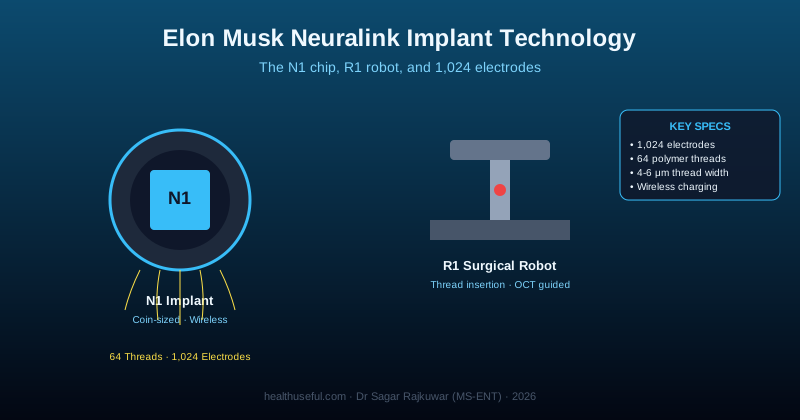
The neuralink telepathy product is a complete brain-computer interface (BCI) system consisting of the implanted N1 chip, 64 flexible polymer threads carrying 1,024 recording electrodes, the R1 Surgical Robot that places the threads into the motor cortex, and the external decoder software that converts neural signals into cursor coordinates and device commands. Musk announced the product name on X on 29 January 2024, writing that it would “enable control of your phone or computer, and through them almost any device, just by thinking.”
It is important to understand what the neuralink telepathy product is not. It does not read thoughts in the broad everyday sense — it reads action potentials from a small region of the motor cortex that encodes intended hand and arm movement. It does not grant telepathic communication between two people. It does not currently cure paralysis — it compensates for it by allowing thought-based control of external devices while the patient remains physically paralysed.
Here is a Neuralink production video giving an overview of the neuralink telepathy product and the first patients’ experience:
2. How the Neuralink Telepathy Product Works
The neuralink telepathy product works through a four-step signal path. Step one — the user forms an intention to move. The motor cortex fires characteristic action potentials. Step two — the 1,024 electrodes record those spikes, and the N1 chip‘s on-device application-specific integrated circuit performs spike detection. Step three — the compressed neural data is transmitted by Bluetooth to a nearby phone, tablet or computer. Step four — the decoder software maps the pattern to cursor coordinates or a device command, and the target device responds.
The patient does not need to perform a particular mental gymnastic to use the neuralink telepathy product. Noland Arbaugh has publicly described two approaches that work for him. In the early days he used attempted movement — mentally rehearsing the arm or hand motion that would have produced the cursor movement. Over time he transitioned to imagined movement: he simply thinks about where he wants the cursor to go, and it moves. He described the transition as “something flipped in my brain.”
3. Who Qualifies for the Neuralink Telepathy Product?
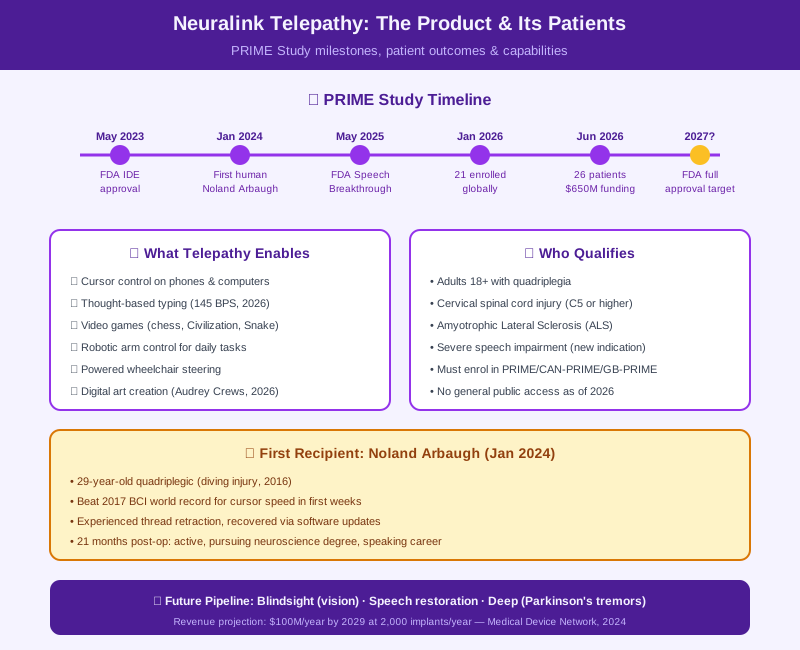
In 2026, the eligibility criteria for the neuralink telepathy product clinical trials are narrow:
- Adults aged 18 years or above
- Limited or no ability to use both hands due to cervical spinal cord injury (typically C5 or higher) or amyotrophic lateral sclerosis (ALS)
- Documented stability of neurological condition
- Able to attend regular in-person and at-home research sessions
- No contraindications to craniotomy or general anaesthesia
- Living within reasonable travel distance of a trial site
Patients with other causes of paralysis — brainstem stroke, severe cerebral palsy, or brachial plexus injury — may qualify for the parallel GB-PRIME study (NCT07127172) in the United Kingdom, which has slightly broader inclusion criteria. Separate trials for severe speech impairment are expected to open recruitment in late 2026 following the May 2025 FDA Breakthrough Device Designation.
Importantly, the neuralink telepathy product is not available to the general public as of October 2026. Patients cannot “buy” the device, cannot have it implanted outside a clinical trial, and cannot access it in India at the time of writing. Interested patients and families should register their interest through Neuralink’s United States Patient Registry at neuralink.com, which forwards eligible candidates to the nearest trial site.
4. What the Neuralink Telepathy Product Can Actually Do
Published and demonstrated capabilities of the neuralink telepathy product as of October 2026 include:
- Cursor control on a phone, tablet or computer at conversational speed
- Thought-based typing — Phase 3 interim data reports an average of 145 bits per second
- Playing video games — Civilization VI, chess and the Mario Kart series have all been demonstrated
- Controlling a robotic arm for self-feeding, pouring liquids and grasping fragile objects
- Steering a powered wheelchair via thought-controlled cursor and camera interface
- Creating digital artwork — Audrey Crews, the ninth recipient, published original art created with the Telepathy product in June 2026
- Returning to study — Noland Arbaugh is completing university coursework in neuroscience
- Resuming paid work — Arbaugh now holds speaking engagements including the World Governments Summit (Dubai, Feb 2026)
The device cannot currently restore physical movement (that would require stimulating muscles rather than reading from motor cortex), cannot read speech directly (a separate speech-restoration device is in development), and cannot restore vision (a separate Blindsight device is being developed for that indication).
5. First Patient Experience — Noland Arbaugh
Noland Arbaugh, implanted on 28 January 2024 at the age of 29, is the most publicly documented recipient of the neuralink telepathy product. Arbaugh had been paralysed from the shoulders down after a 2016 diving accident. He was recruited through a friend who had read Neuralink’s recruitment call, and he received the implant eight years after his original injury.
In the first three weeks the neuralink telepathy product worked precisely as advertised — Arbaugh broke a 2017 BCI world record for cursor speed and precision, playing Civilization VI “for hours” and feeling, in his own words, “very, very cool.” Then in the fourth week a serious complication developed — most of the polymer threads retracted from brain tissue and performance degraded. Arbaugh said he feared the device would have to be removed. Neuralink engineers initially proposed a revision surgery, but the clinical team held back and worked on software updates that re-weighted the surviving channels. Within weeks, performance was substantially recovered.
By October 2025 — 21 months post-implant — Arbaugh was pursuing a full-semester university program (chemistry, biology, calculus prep) that he says would have been “impossible without Neuralink.” He had also launched a professional speaking career; he spoke at the Fortune Brainstorm Tech conference in Park City, Utah in September 2025 as a paid speaker, and plans one to two similar engagements per month going forward. He affectionately calls his implant “Eve.”
6. Timeline and FDA Pathway
- May 2023 — FDA grants Investigational Device Exemption (IDE)
- January 2024 — First human implant (Noland Arbaugh)
- August 2024 — Second recipient Alex implanted; first robotic-arm control
- November 2024 — Health Canada approves CAN-PRIME study
- May 2025 — FDA Breakthrough Device Designation for speech restoration
- September 2024 — FDA Breakthrough Device Designation for Blindsight
- October 2025 — First UK patient implanted (Newcastle)
- January 2026 — 21 participants enrolled globally
- March 2026 — Phase 3 interim data released (145 BPS, 85 patients across 12 centres)
- June 2026 — 26 participants globally; $650 million funding round
- Projected late 2026 / 2027 — Full FDA PMA submission and potential commercial clearance
7. Risks and Limitations of the Neuralink Telepathy Product
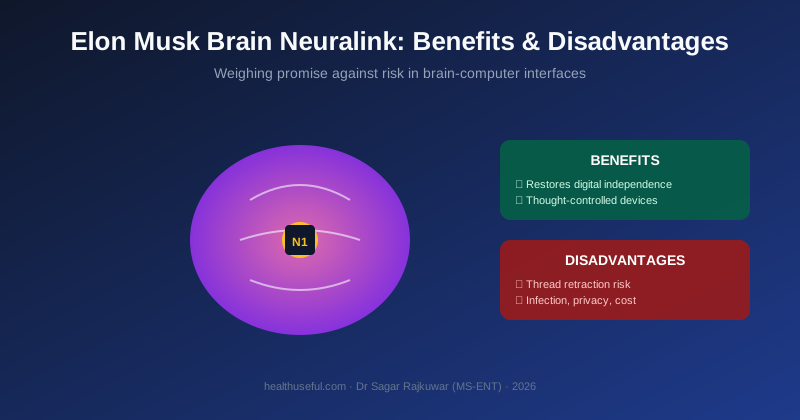
No invasive medical device is risk-free, and the neuralink telepathy product is no exception. Documented and anticipated risks include thread retraction (observed in the first patient at approximately 85%), surgical complications of craniotomy including infection (comparable DBS infection rates are 3.79–4.57%), hemorrhage, long-term biocompatibility questions about chronic polymer electrode implantation, cybersecurity vulnerabilities inherent to any wireless implanted device, and unresolved neural data privacy frameworks.
In addition, the neuralink telepathy product currently places the N1 at a single cortical site. Patients requiring both-hand control at full dexterity, or two-site stimulation, would need additional implants. For a more detailed discussion of the trade-offs between promise and risk, see my parallel article on the elon musk brain neuralink benefits and disadvantages, and for a hardware deep-dive see elon musk neuralink implant technology.
8. How Telepathy Compares to Rival BCIs
The neuralink telepathy product is not the only brain-computer interface in human trials. The main competitors in 2026 are:
- Synchron Stentrode — Endovascular BCI that is threaded through the jugular vein to sit against the motor cortex from inside a vein. Lower channel count but no craniotomy. First human implant in 2022.
- BrainGate / Utah array — Academic standard with 96 or 128 rigid silicon electrodes. Decades of chronic implantation data.
- Blackrock Neurotech MoveAgain — Granted FDA Breakthrough Device Designation; based on Utah array hardware.
- Paradromics Connexus — High-channel-count intracortical device with FDA Breakthrough Designation in 2023.
- Precision Neuroscience Layer 7 Cortical Interface — Minimally invasive surface array; received FDA clearance in April 2025 for temporary use.
Among these, the neuralink telepathy product stands out for its combination of channel count, wireless operation, cosmetic invisibility and robotic insertion precision. It is also the device with the loudest marketing voice and the most public patient demonstrations, which is both a strength and a weakness — the clinical community continues to ask for peer-reviewed independent publication.
9. Beyond Telepathy — Blindsight, Deep and Speech Restoration
Neuralink has publicly disclosed three additional products beyond the neuralink telepathy product:
- Blindsight — A device that bypasses damaged optic nerves and directly stimulates the visual cortex. FDA Breakthrough Device Designation granted September 2024; early clinical trials underway in 2026.
- Deep — A device aimed at treating Parkinson’s disease tremors and essential tremor via targeted stimulation. Still in pre-clinical phase.
- Speech-restoration device — Targeting severe speech impairment in ALS, stroke, spinal cord injury, cerebral palsy and multiple sclerosis. FDA Breakthrough Designation granted May 2025.
According to industry projections cited by Medical Device Network, Neuralink expects FDA approval for the neuralink telepathy product by 2029 (with 2,000 implantation procedures per year generating $100 M in annual revenue) and $1 B total annual revenue by 2031 across the full product line.
10. Frequently Asked Questions (FAQs)
Q1. Is the Neuralink Telepathy product available in India?
No. The neuralink telepathy product is in clinical trials only, and the trial sites in 2026 are in the United States, Canada, the United Kingdom and the UAE. There are no Indian trial sites and no commercial availability. Indian patients cannot currently access the device.
Q2. How much will the Telepathy product cost after approval?
Industry forecasts cite per-implant pricing in the USD 20,000–50,000 range, excluding specialised surgical facility and software support. Clinical trial participants pay nothing.
Q3. Does Telepathy allow mind-to-mind communication?
No. The device is called “Telepathy” because it enables thought-to-device control, not thought-to-thought communication. It reads from one person’s motor cortex. True brain-to-brain communication is not what the product does.
Q4. Can the Telepathy product restore walking?
Not directly. The neuralink telepathy product reads neural signals and converts them into device commands; it does not stimulate muscles. However, with the implant plus a brain-controlled exoskeleton or electrical muscle stimulation system, there is a plausible path to restored functional movement, which some competitor systems are exploring.
Q5. Who performs the surgery?
Qualified neurosurgeons at each trial site perform the craniotomy and manage the patient; the R1 Surgical Robot performs the thread insertion. In the United States, Dr Allan Levi at the University of Miami and the team at the Barrow Neurological Institute have been publicly named co-investigators.
Q6. How long does the battery last?
Neuralink has not published exact battery life figures, but has reported a ~30% improvement in battery performance and wireless-charging efficiency between the 2024 unit and the 2026 unit. Patients report charging the device daily via an external induction coil placed near the scalp.
Q7. Can the Telepathy device be upgraded?
Software updates can be delivered wirelessly — this is how Noland Arbaugh’s performance was recovered after his thread retraction. Hardware upgrades would require revision surgery. Neuralink has not announced a formal upgrade pathway for current patients.
11. Summary and Conclusion
The neuralink telepathy product is a genuinely important first-generation brain-computer interface that in 2026 is demonstrating the real-world possibility of restoring digital independence for people with severe paralysis. Twenty-six patients, four countries, Phase 3 interim data at 145 bits per second decoding, and documented returns to study, speaking careers and digital artwork collectively make the product more than a demonstration — it is credible, early-stage, assistive medicine.
At the same time, the neuralink telepathy product is still investigational. The device is not approved for sale, not available in India, and the long-term mechanical and biological durability questions have not been fully answered in peer-reviewed form. Patients and families should treat the product with careful optimism, use authoritative sources, and insist on the usual safeguards — informed consent, independent oversight and transparent follow-up — for anyone considering trial enrolment over the next 12 to 24 months.
12. References
- Neuralink Corporation. PRIME Study (NCT06429735). ClinicalTrials.gov, 2024–2026.
- Neuralink Corporation. GB-PRIME Study (NCT07127172). ClinicalTrials.gov, 2025.
- Neuralink Corporation. Two Years of Telepathy blog update, March 2026.
- U.S. FDA. Breakthrough Device Designation — Neuralink speech restoration device. May 2025.
- U.S. FDA. Breakthrough Device Designation — Blindsight. September 2024.
- Reardon S. Neuralink’s first human trial — Noland Arbaugh’s journey with the N1 implant. The Week, May 2026.
- Fierce Biotech / Reuters coverage of first-in-human implant and follow-up, 2024–2026.
- Medical Device Network. Neuralink targets $1 Bn revenue by 2031. 2024.
- Musk E, Neuralink. An Integrated Brain-Machine Interface Platform With Thousands of Channels. JMIR 2019;21(10):e16194.
- MIT Technology Review — ongoing coverage of Neuralink and BCI competitors, 2024–2026.
ENT Consultation & Surgery
Dr. Sagar Rajkuwar (MS-ENT)
Consultant ENT Specialist & Head-Neck Surgeon
Prabha ENT Clinic, Ambad, Nashik, Maharashtra, India
📱 7387590194 | 9892596635
🌐 www.entspecialistinnashik.com
Medical Disclaimer: This article is for educational purposes only and does not replace professional medical advice. The Neuralink Telepathy product is investigational and not yet FDA-approved for commercial use. Clinical trial enrolment and surgical decisions must be made in consultation with qualified neurosurgeons and neurologists based on an individual patient’s condition.