By Dr Sagar Rajkuwar (MS-ENT) · Reviewed: 31 October 2026
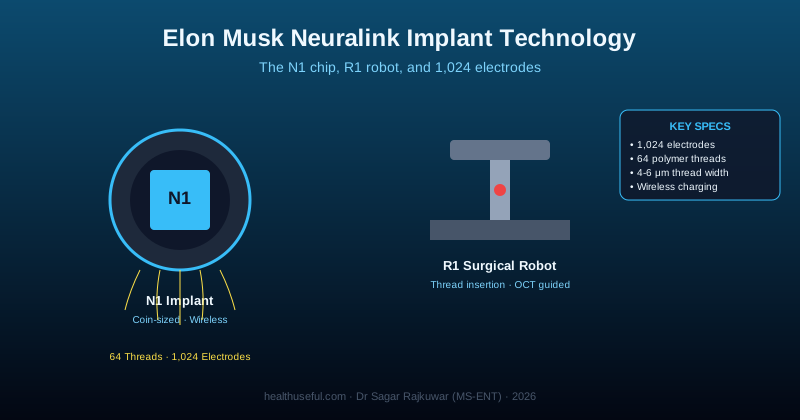
The elon musk neuralink implant technology is the most technically ambitious attempt yet to connect a human brain to a computer. Where earlier brain-computer interface (BCI) systems like the Utah array relied on 96 to 256 rigid silicon electrodes connected by a transcutaneous pedestal, the Neuralink N1 packs 1,024 electrodes onto 64 flexible polymer threads each only 4–6 micrometres wide — thinner than a red blood cell — and streams the data wirelessly. The company’s purpose-built R1 Surgical Robot inserts those threads with sub-millimetre precision, using five camera systems and optical coherence tomography (OCT) to avoid surface vasculature.
In this article I walk through the elon musk neuralink implant technology at a level that is useful to patients, caregivers, medical students and curious readers. The information is drawn from Neuralink’s 2019 white paper in the Journal of Medical Internet Research, the PRIME Study registration (NCT06429735), peer-reviewed BCI literature, and Neuralink’s own 2024–2026 progress disclosures. I will cover the three main hardware components — the N1 Implant, the R1 Surgical Robot, and the external decoder software — the surgical procedure itself, the current patient cohort, and known limitations.
Table of Contents
- 1. Overview of the Neuralink System
- 2. The N1 Implant: Hardware Specifications
- 3. The 64 Polymer Threads & 1,024 Electrodes
- 4. The R1 Surgical Robot
- 5. The Implantation Procedure
- 6. Signal Decoding and the Telepathy App
- 7. Clinical Trial Status (October 2026)
- 8. Technical Limitations
- 9. Frequently Asked Questions
- 10. Summary & Conclusion
- 11. References
1. Overview of the Neuralink System
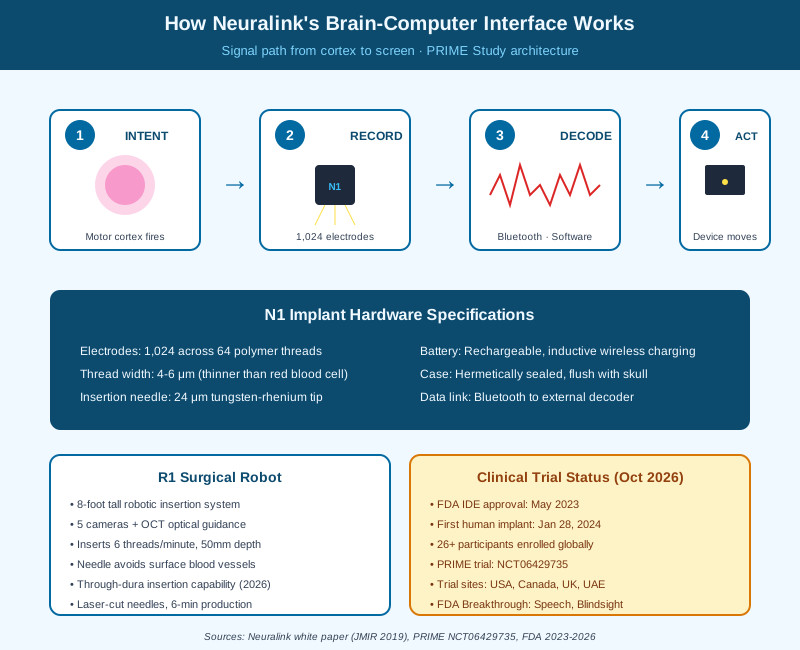
The complete elon musk neuralink implant technology stack has four components working together: the implanted N1 chip, the polymer electrode threads that extend from it into the cerebral cortex, the R1 Surgical Robot that places the threads, and the external decoder running on a phone, tablet or computer. Each component is custom-built — Neuralink has publicly argued that a fully full-stack approach is necessary because no off-the-shelf parts meet the requirements of this scale.
Operationally, the elon musk neuralink implant technology works in four steps. First, when a user forms the intention to move, neurons in the motor cortex fire characteristic action potentials. Second, the 1,024 electrodes on the implanted threads record those spikes at broadband fidelity. Third, the N1 chip performs on-device spike detection, compresses the data, and transmits it by Bluetooth to a nearby device, where the decoder software translates it into cursor coordinates, keystrokes, robotic arm commands or wheelchair steering. Fourth, the device acts — the cursor moves, the robot arm reaches, the chair turns. The round-trip latency is low enough to feel natural for the user.
Here is a Neuralink video showing the elon musk neuralink implant technology from the inside, including footage of the R1 robot inserting threads and the Telepathy decoder in use:
2. The N1 Implant: Hardware Specifications
At the centre of the elon musk neuralink implant technology is the N1 itself — a coin-sized, hermetically sealed device roughly 23 mm in diameter and 8 mm thick. The N1 is implanted flush with the skull, replacing a circle of bone that the surgeon removes to make space; after healing, the device is invisible under the hair. The hermetic case protects a lithium-ion battery, a custom low-power application-specific integrated circuit (ASIC) that performs analog-to-digital conversion and spike detection, a Bluetooth radio for data transfer, and an induction coil that charges the battery wirelessly from an external device placed over the scalp.
2.1 Key Specifications of the N1
- Channel count: 1,024 electrodes across 64 polymer threads
- Thread dimensions: approximately 4–6 µm thick, 20 mm long
- Electrode material: PEDOT:PSS or iridium oxide (IrOx) sites
- Impedance: ~37 kΩ (PEDOT:PSS) and ~56 kΩ (IrOx) in benchtop testing
- Sampling: full broadband electrophysiology from all channels
- Communication: Bluetooth to external receiver
- Power: wirelessly rechargeable lithium-ion battery
- Case: hermetically sealed, flush with skull
The on-chip ASIC is important because the elon musk neuralink implant technology cannot afford the thermal budget of streaming raw broadband data from 1,024 electrodes continuously. The chip performs lossy compression — mostly spike detection and threshold crossings — so the Bluetooth link carries a much smaller, more clinically meaningful payload. By 2026, Neuralink has reported a ~30% optimisation in battery life and wireless charging efficiency compared with the original 2024 unit.
3. The 64 Polymer Threads and 1,024 Electrodes
The visible genius of the elon musk neuralink implant technology is the ultra-fine polymer thread. Each of the 64 threads carries 16 recording sites, which together give the device 1,024 electrodes. The threads are manufactured from biocompatible polyimide with gold interconnects and parylene-C insulation, and they end in a 16 × 50 µm2 loop that the robot’s needle grasps during insertion. Thread cross-section is kept small — nominally 4–6 µm thick — specifically to minimise tissue displacement in the brain.
Compared with the Utah array — which uses 96 rigid silicon electrodes in a 4×4 mm pad — the elon musk neuralink implant technology provides roughly a ten-fold increase in channel count and distributes those channels over a wider cortical area. The flexibility of the polymer threads is also meant to accommodate micromotion of the brain within the skull, which is a known cause of chronic signal loss in rigid-array systems. Early data suggest this works: Neuralink’s benchtop and animal recordings have reported chronic spiking yields of up to 85.5% of the implanted channels.
4. The R1 Surgical Robot
Because the polymer threads are too flexible for a human surgeon to insert, the elon musk neuralink implant technology cannot work without the R1 Surgical Robot. The R1 is an eight-foot-tall robotic platform with a head containing five camera systems, an optical coherence tomography (OCT) module for sub-surface imaging, and a 24-micrometre tungsten-rhenium needle that is used to grasp, insert and release threads one at a time.
4.1 How the R1 Avoids Blood Vessels
The R1’s cameras image the exposed cortical surface in real time and build a vascular map; the OCT module can image a few hundred micrometres below the surface to catch sub-surface vessels. A software planner then selects insertion points that avoid every vessel the imaging system can see. This is the single clearest safety advantage of the elon musk neuralink implant technology over a hand-placed Utah array, where even a skilled neurosurgeon cannot reliably see every pial vessel through a microscope.
4.2 Insertion Speed and Depth
In its 2019 technical demonstration, the R1 inserted six threads per minute (192 electrodes per minute); by 2026, Neuralink reports further speed improvements and insertion depths exceeding 50 mm from the brain surface. The R1 can also now insert threads through the dura mater — the tough outer protective membrane — without the surgeon needing to open and resect it; this reduces operating time and the risk of exposing brain tissue.
4.3 Needle Manufacturing
The R1 needle itself is a small marvel of manufacturing. It is laser-cut from 40-micrometre tungsten-rhenium wire down to a 24-micrometre tip. Neuralink has reduced production time per needle from 22 minutes to roughly 6 minutes and improved yield from 58% to 91%, which keeps surgical throughput high.
5. The Implantation Procedure
A full implantation session with the elon musk neuralink implant technology currently takes a few hours under general anaesthesia. Broadly, the surgical steps are: (1) scalp incision and reflection; (2) craniotomy — the neurosurgeon removes a roughly 25 mm circle of skull; (3) exposure of the dura; (4) handover to the R1 for the needlework — the robot inserts the 64 threads into the pre-planned motor-cortex coordinates; (5) placement of the N1 body flush with the skull, where its underside sits on the dura; (6) scalp closure. The patient typically goes home within one to two days.
A detailed Western neurosurgical team — the University of Miami Miller School of Medicine — was selected as the second U.S. trial site in 2024 and continues to recruit. In 2025, UK neurosurgeons at Newcastle performed the first British implant on a man with motor neuron disease, who was reportedly able to control a computer within hours of surgery. By 2026, the elon musk neuralink implant technology has been performed in the United States, Canada, the United Kingdom and the UAE.
6. Signal Decoding and the Telepathy App
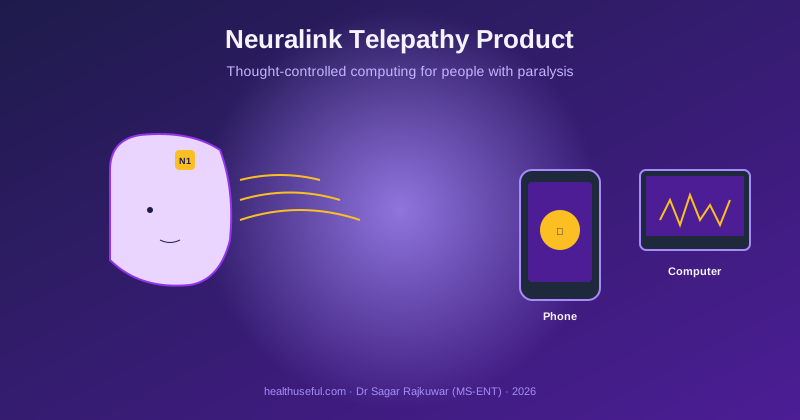
Once the elon musk neuralink implant technology is in place, the real work begins in software. The external decoder runs machine-learning models that map neural spike patterns to intended cursor coordinates. In the first weeks after surgery, the patient and the Neuralink team run calibration sessions — the patient attempts a specific movement, the model learns which neurons fire for that intention, and the mapping is refined. By three to six weeks post-op, most participants reliably control a two-dimensional cursor; some, like Noland Arbaugh, broke a 2017 BCI world record for cursor speed and precision within weeks of surgery.
By 2026, decoding software for the elon musk neuralink implant technology has advanced from 2D cursor control to 6D robotic arm control, with 15 Phase 3 participants using the implant to feed themselves, pour liquids and grasp fragile objects. The published Phase 3 interim data report an average decoding throughput of 145 bits per second, fast enough for real-time conversational typing. The product name — Telepathy — refers specifically to this cursor-and-device-control application; the dedicated speech-restoration device, which Neuralink has publicly indicated will go into trial in late 2026, is being developed separately.
7. Clinical Trial Status (October 2026)
- FDA IDE approval: 25 May 2023
- First human implant: 28 January 2024 (Noland Arbaugh, Barrow Neurological Institute)
- Enrolment, January 2026: 21 participants globally
- Enrolment, June 2026: 26 participants globally
- Trial sites: USA (Barrow, University of Miami), Canada (CAN-PRIME), UK (GB-PRIME, Newcastle), UAE
- FDA Breakthrough Device Designation: Speech restoration (May 2025), Blindsight (Sept 2024)
- Funding: $650 M round closed in H1 2026; pre-money valuation reported at $8.5 B
- Commercial approval target: late 2026 to 2027 pending FDA PMA
8. Technical Limitations
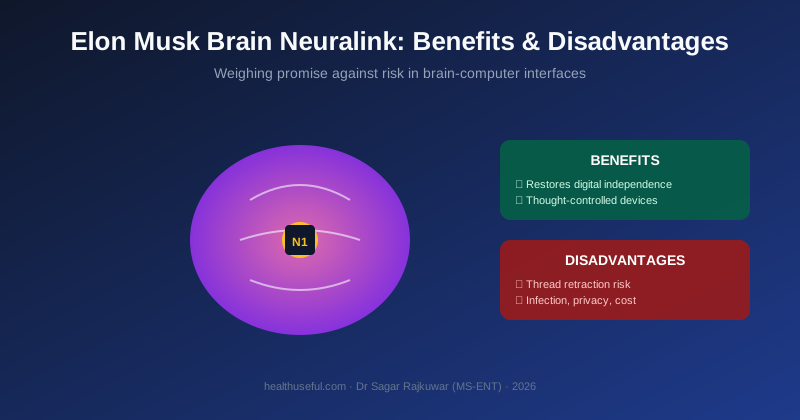
Honesty about the elon musk neuralink implant technology requires honesty about what it still cannot do. In the first patient, Noland Arbaugh, an estimated 85% of the polymer threads retracted from brain tissue in the weeks after surgery. Neuralink attributed this partly to larger-than-expected brain micromotion. Software updates recovered most of the lost performance by re-weighting the surviving channels, and in later patients the surgical plan places threads deeper, but the mechanical durability question is not fully closed.
Other current limitations of the elon musk neuralink implant technology include: unknown long-term biocompatibility of polymer threads over decades of implantation; chronic microglial activation around indwelling electrodes which can slowly degrade signal; cybersecurity vulnerabilities inherent to any wireless implanted device; and the fact that the device still reads only from a single small region of motor cortex, so applications beyond cursor and limb control require either additional implants or different cortical targets. Related interlink: for a broader clinical primer on how neural function is assessed in general practice, see my article on how a neurologist checks the nerves.
9. Frequently Asked Questions (FAQs)
Q1. How many electrodes does the N1 chip have?
The current N1 implant contains 1,024 electrodes arranged on 64 flexible polymer threads, with 16 recording sites per thread. Neuralink has prototyped higher-channel-count variants with up to 3,072 electrodes but these are not the current clinical configuration.
Q2. How thin are the threads?
Each thread is approximately 4–6 micrometres thick and 20 mm long — thinner than a single human red blood cell (about 7 µm) and far thinner than a human hair (approximately 70 µm).
Q3. Why does Neuralink need its own surgical robot?
Because the threads are too fine and too flexible to be inserted by hand. Neuralink co-founder DJ Seo has explained that even a skilled neurosurgeon cannot reliably place dozens of micrometre-scale threads through the dura while avoiding every surface vessel. The R1 uses computer vision and OCT imaging to plan safe insertion paths.
Q4. Does the chip need external cables?
No. The elon musk neuralink implant technology is fully wireless. Data streams over Bluetooth, and the battery recharges by induction from an external coil placed near the scalp.
Q5. What region of the brain is targeted?
The current Telepathy product targets a small area of the motor cortex that encodes hand and arm movement intention. The forthcoming Blindsight product targets the visual cortex, and the speech-restoration device targets speech-motor regions.
Q6. How long is the surgery?
Current operating-room time for the full procedure is reportedly a few hours under general anaesthesia, with the R1 performing the needlework and the neurosurgeon handling the craniotomy and closure. Patients typically go home within one to two days.
Q7. Is the Neuralink technology published in peer review?
The original 2019 white paper is published in JMIR (Journal of Medical Internet Research, 2019;21:e16194), and a related preprint is on bioRxiv. Several independent reviewers have noted that detailed PRIME study clinical outcomes have not yet appeared in a formal peer-reviewed journal, which remains an open ask from the scientific community.
10. Summary and Conclusion
The elon musk neuralink implant technology represents a credible step-change in brain-computer interface engineering. The combination of 1,024 flexible electrodes, a bespoke surgical robot, a wireless hermetically sealed implant and a sophisticated external decoder has demonstrably moved patients with quadriplegia from zero digital autonomy to real-time cursor control, typing, and in some cases 6-dimensional robotic arm manipulation. The core engineering is sound, the R1 robot is a genuine advance in safe thread placement, and the Phase 3 interim data are promising.
What is still missing from a complete clinical case for the elon musk neuralink implant technology is long-term mechanical and biological durability data, peer-reviewed independent safety reports, and a FDA Premarket Approval decision. For patients considering enrolment or for clinicians who may be referring them, 2026 is a reasonable year to engage with the technology, but with eyes open to the fact that it remains investigational and will likely remain so for a further 12–24 months.
11. References
- Musk E, Neuralink. An Integrated Brain-Machine Interface Platform With Thousands of Channels. J Med Internet Res 2019;21(10):e16194.
- Neuralink Corporation. PRIME Study (NCT06429735). ClinicalTrials.gov, 2024–2026.
- Neuralink Corporation. GB-PRIME Study (NCT07127172). ClinicalTrials.gov, 2025.
- Neuralink Corporation. Two Years of Telepathy blog update, March 2026.
- U.S. FDA. Breakthrough Device Designation — Neuralink speech restoration device. May 2025.
- Reuters / Fierce Biotech / The Week — coverage of first-in-human implant and 21-month follow-up, 2024–2026.
- Oxley T et al. Endovascular brain-computer interface — Stentrode first-in-human. J NeuroInterv Surg 2021.
- Fiani B et al. Hardware complications in DBS and intracortical arrays — Systematic Review. Neuromodulation 2020.
- Satam IA, Szabolcsi R. Ethical and Safety Challenges of Implantable BCI. Indecs 2025;23(2):82-94.
- MIT Technology Review — ongoing coverage of Neuralink and BCI competitors, 2024–2026.
ENT Consultation & Surgery
Dr. Sagar Rajkuwar (MS-ENT)
Consultant ENT Specialist & Head-Neck Surgeon
Prabha ENT Clinic, Ambad, Nashik, Maharashtra, India
📱 7387590194 | 9892596635
🌐 www.entspecialistinnashik.com
Medical Disclaimer: This article is for educational purposes only and does not replace professional medical advice. Neuralink’s N1 implant is investigational and not yet FDA-approved for commercial use. All surgical decisions must be made in consultation with qualified neurosurgeons and neurologists based on an individual patient’s condition.