By Dr Sagar Rajkuwar (MS-ENT) · Reviewed: 1 November 2026
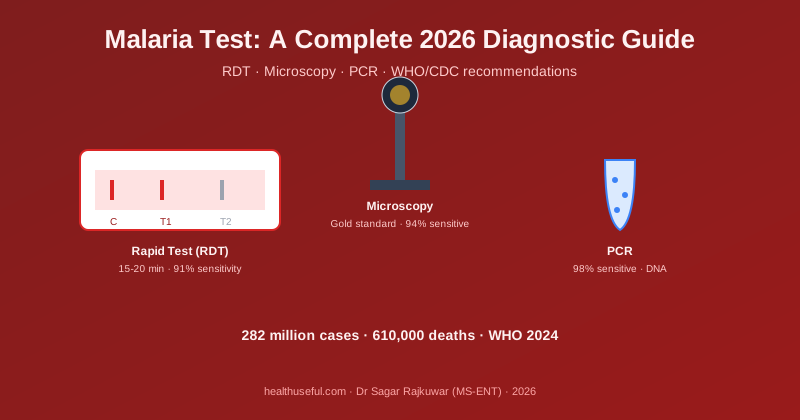
A prompt and accurate malaria test is the single most important step in the management of any patient with fever and possible exposure to a malaria-endemic area. The World Health Organization (WHO) explicitly recommends that every patient with suspected malaria should receive a parasitological confirmation — either by light microscopy or by a rapid diagnostic test (RDT) — before antimalarial treatment is started. With 282 million cases and 610,000 deaths from malaria reported globally in 2024 (WHO World Malaria Report 2025), the right malaria test literally saves lives.
In this 2026 complete clinical guide I walk through every type of malaria test currently in use — the rapid diagnostic test (RDT), Giemsa-stained blood smear microscopy, molecular polymerase chain reaction (PCR), isothermal loop-mediated amplification (LAMP) and serology — their respective sensitivity, specificity, turnaround time, cost, and the clinical settings where each belongs. I also cover the WHO April 2026 prequalification of three new pf-LDH-based RDTs that address the growing problem of HRP2 gene deletions, as well as practical advice for patients travelling to endemic areas and for Indian clinicians working in the national malaria programme.
Table of Contents
- 1. Why a Malaria Test Is Essential
- 2. Rapid Diagnostic Test (RDT)
- 3. Blood Smear Microscopy — the Gold Standard
- 4. PCR & Molecular Diagnostics
- 5. LAMP & Isothermal Amplification
- 6. Serology and Antigen ELISA
- 7. WHO 2024-2026 Diagnostic Algorithm
- 8. HRP2 Deletions — the 2026 Threat
- 9. Malaria Testing in India
- 10. How to Interpret Your Malaria Test Result
- 11. Frequently Asked Questions
- 12. Summary and Conclusion
- 13. References
1. Why a Malaria Test Is Essential
Fever alone cannot confirm malaria. Many tropical and non-tropical illnesses — dengue, typhoid, influenza, leptospirosis, chikungunya, bacterial sepsis and now even COVID-19 — present with high-grade fever, chills and body aches that overlap heavily with the malaria paroxysm. Giving empirical antimalarial drugs without a confirmed malaria test leads to drug wastage, masks the real cause of fever, and accelerates drug resistance. Since 2010, the WHO has moved firmly away from clinical-only diagnosis and recommends laboratory confirmation of every suspected case before treatment.
A good malaria test achieves five things. First, it confirms or excludes the presence of Plasmodium parasites. Second, in the case of microscopy and PCR, it identifies the species (P. falciparum, P. vivax, P. ovale, P. malariae or P. knowlesi), which drives treatment selection. Third, it quantifies the parasitaemia, which guides severity classification and monitoring. Fourth, it detects mixed infections, which are commoner than widely appreciated. Fifth, it supports public-health surveillance for drug resistance and HRP2 deletions.
Here is a short, authoritative WHO explainer video on malaria diagnosis and the parasitological confirmation algorithm:
2. Rapid Diagnostic Test (RDT) for Malaria
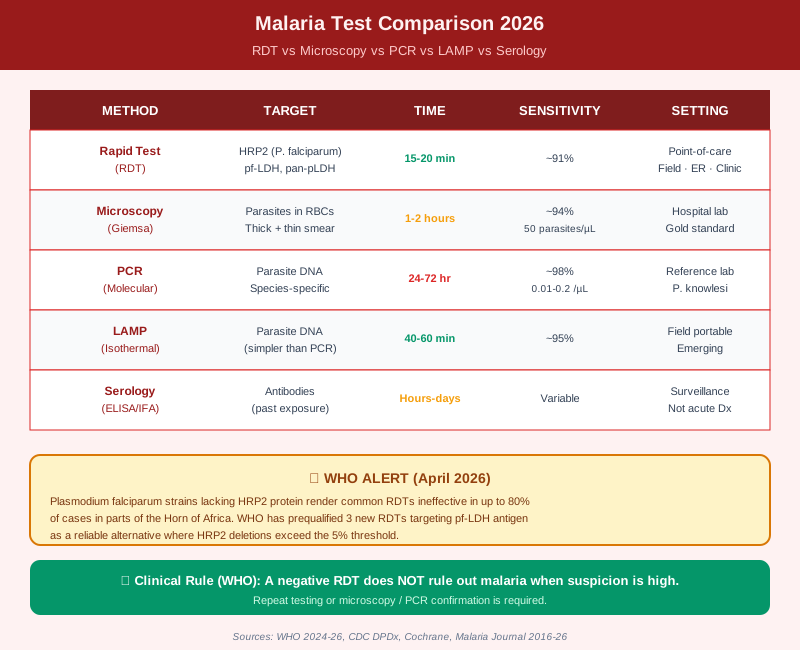
The rapid diagnostic test is now the backbone of point-of-care malaria test coverage in Africa, Southeast Asia and the Americas. An RDT is a disposable immunochromatographic strip that detects specific parasite antigens in whole blood from a finger-prick. The test takes 15 to 20 minutes, requires no microscope, no electricity and no trained technician, and reads out as simple visible lines on the strip — a control line (C) plus one or two test lines (T1, T2).
2.1 Target Antigens Used by RDTs
Three target antigens are used in a typical modern malaria test strip:
- HRP2 (histidine-rich protein 2) — specific to P. falciparum only
- pf-LDH (Plasmodium falciparum lactate dehydrogenase) — specific to P. falciparum
- pan-pLDH or aldolase — detects all five human-infecting Plasmodium species
Most combination RDTs on the market in 2026 — such as the FDA-cleared Abbott BinaxNOW Malaria, CareStart Malaria HRP2/pLDH (Pf/pan) Combo Test, SD Bioline Malaria Ag Pf/Pan — pair HRP2 (for P. falciparum) with pan-pLDH (for other species). A single visible test line therefore tells the clinician both whether malaria is present and which main species is likely responsible.
2.2 RDT Sensitivity and Specificity
In the right hands and against microscopy, a quality-assured malaria test RDT achieves sensitivity and specificity of >90% for P. falciparum. A Tanzanian field evaluation (Mahende et al., Malaria Journal 2016) reported sensitivity of 88.9% and positive predictive value of 75.3% for HRP2 RDT against microscopy. The 2019 UK DFID-funded Cochrane systematic review concluded that RDTs can effectively replace microscopy for P. falciparum diagnosis in resource-limited settings when quality assurance is maintained.
2.3 Known Limitations
Every clinician using a malaria test RDT must remember five limitations. First, HRP2-based RDTs are relatively insensitive for P. malariae and P. ovale. Second, HRP2 antigen can persist in the blood for weeks after successful treatment, so a positive RDT does not always mean an active infection. Third, false positives can occur with rheumatoid factor, autoimmune disease and some chronic infections. Fourth, false negatives occur with prozone effect in very high parasitaemias and with HRP2 gene deletions (see section 8). Fifth, heat stability of the strip degrades in uncontrolled tropical storage.
3. Blood Smear Microscopy — the Gold Standard
Despite the rise of RDTs, Giemsa-stained blood film microscopy remains the gold-standard malaria test and is specifically preferred by the WHO for severe malaria, suspected mixed infections, and in settings where microscopy expertise exists. The classical examination has two parts — a thick smear (concentrates parasites and increases sensitivity) and a thin smear (preserves parasite morphology for species identification).
3.1 Procedure
A finger-prick or venous blood sample is placed on a clean glass slide, a thick drop and a thin streak are prepared, and both are stained with Giemsa solution at pH 7.2. An expert microscopist then counts parasites per 200 or 500 white blood cells (thick smear) and reviews morphology, size of infected red blood cells, parasite stages (rings, trophozoites, schizonts, gametocytes) and the presence of pigment or Schüffner’s dots on the thin smear to identify the species.
3.2 Sensitivity
Expert microscopy can detect parasitaemias as low as 50 parasites per µL, with reported sensitivity around 94% and essentially 100% specificity in the hands of trained experts. The main limitations are the need for a trained technician, 1–2 hour turnaround time, and declining quality in high-volume labs with low malaria prevalence — exactly the situation now developing in many parts of urban India.
4. PCR & Molecular Diagnostics
Polymerase chain reaction (PCR) is the most sensitive malaria test available and is now considered the reference standard for drug-resistance studies, epidemiological surveys and the detection of extremely low parasitaemias in asymptomatic carriers. PCR amplifies species-specific DNA sequences (commonly the 18S rRNA gene) and can detect as few as 0.01 to 0.2 parasites per µL of blood — approximately 100 times more sensitive than microscopy.
Because PCR requires a thermal cycler, trained molecular biology staff and 24 to 72 hours of turnaround, it is not used for routine clinical management except in specific situations. The WHO specifically endorses PCR for the detection of P. knowlesi (which is morphologically indistinguishable from P. malariae on microscopy), for confirming mixed infections, and for monitoring sub-microscopic parasitaemia in elimination settings. Modern nested PCR and real-time qPCR can also quantify parasitaemia with high precision.
5. LAMP & Isothermal Amplification
Loop-mediated isothermal amplification (LAMP) is a molecular malaria test that works at a single temperature (around 60–65 °C) without the need for a thermal cycler. A result is available in 40 to 60 minutes with sensitivity close to PCR (~95%), making it a promising field-portable alternative. WHO-endorsed commercial LAMP kits (such as Illumigene Malaria from Meridian Bioscience) are increasingly used by regional reference labs in India and sub-Saharan Africa for near-patient confirmatory testing.
6. Serology and Antigen ELISA
Serology detects IgG and IgM antibodies against Plasmodium antigens using indirect fluorescent antibody (IFA) or ELISA. Because antibodies persist for months to years after infection, this type of malaria test is not used for acute diagnosis — a positive serology does not distinguish current from past infection. Its real role is in epidemiological surveys, in screening blood donors in non-endemic countries (such as the UK and USA blood services), and in investigating cases of chronic infection or relapse.
7. WHO 2024-2026 Diagnostic Algorithm
The WHO Global Malaria Programme has crystallised the preferred testing pathway for every type of patient:
- Uncomplicated suspected malaria at community level: RDT first; microscopy if available
- Severe malaria (hospital): microscopy preferred (also quantifies parasitaemia)
- Recurrent malaria: microscopy or LDH-based RDT (because HRP2 may persist)
- P. vivax, P. ovale, P. malariae or mixed infection: microscopy
- Suspected P. knowlesi: PCR (microscopy misreads it as P. malariae)
- Pregnancy / neonatal malaria: microscopy plus RDT if available
- Negative test with high clinical suspicion: repeat testing every 12–24 h for up to 72 h
In April 2026, the WHO took the additional step of prequalifying three new pf-LDH-based rapid diagnostic tests (manufactured by Access Bio, SD Biosensor and Zephyr Biomedicals) as a resilient alternative to HRP2-based RDTs in areas where HRP2 deletions are documented.
8. HRP2 Deletions — the 2026 Threat
One of the most important recent findings in malaria diagnostics is the spread of P. falciparum strains that have deleted the pfhrp2 and pfhrp3 genes. In such parasites, the HRP2 antigen is simply not produced — and a conventional HRP2-only malaria test will read negative even in a patient with full-blown falciparum malaria. The WHO reported in 2026 that HRP2 deletions now render common RDTs ineffective in up to 80% of cases in parts of the Horn of Africa (Eritrea, northern Ethiopia and parts of Sudan). The threshold at which WHO recommends switching away from HRP2-only tests is 5% HRP2 deletion prevalence; several African countries have crossed that line.
In practice, this means that in 2026 any patient with a strongly suggestive clinical picture of falciparum malaria but a negative HRP2 RDT should have microscopy, a pf-LDH-based RDT, or PCR performed before malaria is excluded. The problem is not yet widespread in India but is increasingly reported in travel-related cases from the Horn of Africa.
9. Malaria Testing in India
Under the National Vector Borne Disease Control Programme (NVBDCP), India distributes approximately 100 million bivalent malaria test RDTs annually through government health facilities and ASHA workers. Testing is free of cost at government centres, and the result decides whether the patient receives an ACT (artemisinin-based combination therapy) for falciparum malaria, chloroquine plus primaquine for vivax, or further investigation if the test is negative. Indian clinicians still rely heavily on microscopy at district hospitals, with PCR available at National Institute of Malaria Research (NIMR), ICMR regional labs and larger private laboratories.
In my ENT practice in Nashik, Maharashtra, I routinely refer any patient with persistent fever, chills, and a travel or exposure history to the nearest government fever clinic or a private pathology lab for a malaria test. If you are curious about related infection-control topics on this blog, I recommend my articles on malaria symptoms, malaria transmission, types of malaria, causes of malaria, malaria treatment and the malaria vaccine.
10. How to Interpret Your Malaria Test Result
Reading a malaria test result correctly matters as much as choosing the right test. For an RDT: a visible control line (C) plus a positive test line (T1) for HRP2 means P. falciparum. A positive pan-pLDH or aldolase line (T2) alone (with HRP2 negative) suggests P. vivax, P. ovale, P. malariae or P. knowlesi — species confirmation then needs microscopy or PCR. If only the test line is visible without a control line, the test is invalid and must be repeated. A completely negative RDT in a febrile patient does not rule out malaria — repeat testing or microscopy is mandatory.
For microscopy, the laboratory report should include species identification, parasite stages present, parasitaemia (parasites per µL or percentage of infected red cells), and comments on gametocytes (which indicate transmission potential). A parasitaemia of >100,000/µL (>2%) is one WHO criterion for severe falciparum malaria.
11. Frequently Asked Questions (FAQs)
Q1. Which malaria test is most accurate?
PCR is the most sensitive malaria test (~98%, detecting 0.01–0.2 parasites/µL), followed by expert microscopy (~94%) and quality-assured RDT (~91%). However, “best” depends on setting — RDT is best for rapid field diagnosis; microscopy is best for severe hospital cases; PCR is best for research, mixed infections and P. knowlesi.
Q2. How soon after a mosquito bite does a malaria test turn positive?
Parasites appear in the blood after the liver-stage incubation period — typically 7 to 30 days after the infective bite depending on the Plasmodium species. A malaria test performed within the first few days of a bite can be falsely negative. If you have fever within six weeks of returning from an endemic area and a negative test, repeat it every 12–24 hours for 72 hours.
Q3. Can I buy a malaria test for home use?
Over-the-counter self-test malaria RDTs are available in some countries (the UK, Germany, France, parts of India through pharmacies) but WHO does not recommend home self-testing as a substitute for medical evaluation. A positive test must be confirmed and treated at a healthcare facility; a negative home test does not safely rule out severe malaria.
Q4. How much does a malaria test cost?
In Indian government facilities under NVBDCP: free. In private pathology labs in India (2026): RDT costs ₹200–500; microscopy ₹300–800; PCR ₹1,500–3,500. In the US and UK: USD 30–150 for RDT, USD 150–400 for microscopy, USD 250–600 for PCR.
Q5. Why did my RDT turn positive but microscopy was negative?
Three common reasons: (1) HRP2 persistence after recently treated infection — HRP2 can stay detectable for 4–6 weeks after cure; (2) very low parasitaemia below the microscopy threshold; (3) rarely, a false-positive RDT due to rheumatoid factor or heterophile antibodies. Treating clinicians weigh symptoms, exposure history and repeat testing to decide.
Q6. Does the malaria test detect all species?
Combination RDTs with HRP2 and pan-pLDH detect P. falciparum and most non-falciparum species but are relatively insensitive for P. malariae and P. ovale. P. knowlesi is reliably detected only by PCR. Microscopy with trained personnel detects all five species.
Q7. Is a malaria test needed in pregnancy?
Yes, and promptly — pregnant women in endemic areas with fever should receive both an RDT and a peripheral blood smear. Placental infection can occur without peripheral parasitaemia (placental sequestration) in some cases, so if clinical suspicion remains high after a negative blood test, placental histopathology after delivery may be considered.
12. Summary and Conclusion
A rapid, accurate malaria test is the single most important early step in managing any patient with suspected malaria. In 2026 the three mainstream options — RDT, microscopy and PCR — each have well-defined roles: RDT for immediate point-of-care decisions, microscopy as the gold standard for species identification and severity grading, and PCR for the most sensitive detection and for identifying P. knowlesi or mixed infections. The emerging threat of HRP2 gene deletions is reshaping diagnostic policy in Africa; the April 2026 WHO prequalification of pf-LDH-based RDTs is a timely response.
For patients, the clinical take-home is simple — never accept antimalarial treatment without a confirmed malaria test, and never dismiss persistent fever simply because one RDT came back negative. For clinicians, the WHO 2024-2026 testing algorithm is the gold-standard reference. For public-health systems, continuing surveillance of HRP2 deletions, maintaining microscopy skills, and ensuring supply-chain integrity of quality-assured RDTs remain the top priorities.
13. References
- World Health Organization. World Malaria Report 2025. Geneva, 2025.
- WHO Global Malaria Programme. Guidelines for the Treatment of Malaria — 3rd and updated editions. 2015, 2023 revisions.
- WHO Prequalification of In Vitro Diagnostics. Prequalification of pf-LDH based RDTs. April 2026.
- Mahende C et al. Performance of RDT, microscopy and PCR for diagnosis of malaria among febrile children in Korogwe, Tanzania. Malaria Journal 2016;15:391.
- Abba K et al. Rapid diagnostic tests for diagnosing uncomplicated P. falciparum malaria (Cochrane Review). 2019 update.
- Maltha J et al. Rapid diagnostic tests in travel medicine. Clin Microbiol Infect 2013;19(5):408-15.
- Watson OJ et al. False-negative malaria RDT results and their impact on community surveys in sub-Saharan Africa. BMJ Glob Health 2019;4:e001582.
- CDC DPDx — Malaria Laboratory Diagnosis. Updated 2026.
- National Vector Borne Disease Control Programme (NVBDCP), India. Operational Manual on Malaria Elimination. 2024.
- Medmastery Clinical Guide: Rapid diagnostic tests & PCR for malaria, 2024 edition.
ENT Consultation & Surgery
Dr. Sagar Rajkuwar (MS-ENT)
Consultant ENT Specialist & Head-Neck Surgeon
Prabha ENT Clinic, Ambad, Nashik, Maharashtra, India
📱 7387590194 | 9892596635
🌐 www.entspecialistinnashik.com
Medical Disclaimer: This article is for educational purposes only and does not replace professional medical advice. The choice and interpretation of any malaria test must be made in consultation with a qualified medical professional based on an individual patient’s clinical condition and exposure history. In the event of persistent fever following possible malaria exposure, seek urgent medical care.