What Are the Stages of Stitches Healing? A Complete Recovery Timeline Explained
By Dr. Sagar Rajkuwar
ENT Specialist, Nashik, Maharashtra, India
🌐 www.entspecialistinnashik.com
Table of Contents
-
Introduction
-
What Are Stitches (Sutures)?
-
Why Understanding Stitches Healing Stages Is Important
-
Overview of the Wound Healing Process
-
Stage 1: Hemostasis – The Immediate Response (Day 0)
-
Stage 2: Inflammatory Phase – Cleaning and Protection (Days 1–5)
-
Stage 3: Proliferative Phase – New Tissue Formation (Days 4–21)
-
Stage 4: Maturation (Remodeling) Phase – Strengthening the Skin (Weeks to Months)
-
How Different Types of Stitches Heal
-
Normal Signs of Healing vs Warning Signs
-
Factors That Affect Stitches Healing
-
How to Care for Stitches at Each Healing Stage
-
When Should Stitches Be Removed?
-
Frequently Asked Questions
-
Final Thoughts
1. Introduction
Stitches, also known as sutures, are commonly used to close wounds after surgery or injury. While most patients focus on stitch removal, understanding the stages of stitches healing helps ensure faster recovery, fewer complications, and minimal scarring.
Whether you have stitches on your face, scalp, nose, throat, or any other body part, the healing process follows predictable biological stages.
2. What Are Stitches (Sutures)?
Stitches are medical threads used to hold tissues together while the body heals. They may be:
-
Dissolvable (absorbable)
-
Non-dissolvable (non-absorbable)
Each type heals slightly differently, but the stages of healing remain the same.
3. Why Understanding Stitches Healing Stages Is Important
Knowing what happens at each stage helps you:
-
Avoid unnecessary worry
-
Recognize early signs of infection
-
Take proper wound care measures
-
Prevent scars and wound reopening
Patients often mistake normal healing symptoms for complications.
4. Overview of the Wound Healing Process
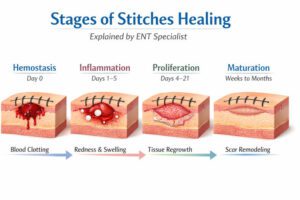
Stitches healing occurs in four main stages:
-
Hemostasis
-
Inflammation
-
Proliferation
-
Maturation (Remodeling)
These stages overlap and vary depending on age, health, and wound type.
5. Stage 1: Hemostasis – The Immediate Response (Day 0)
Timeline: Immediately after stitches are placed
What Happens?
-
Blood vessels constrict to stop bleeding
-
Blood clots form around the wound
-
Platelets release growth factors
What You May Notice:
-
Mild bleeding or oozing
-
Tightness around stitches
-
Slight swelling
Is This Normal?
✅ Yes. This stage prevents blood loss and initiates healing.
6. Stage 2: Inflammatory Phase – Cleaning and Protection (Days 1–5)
Timeline: 24 hours to 5 days
What Happens?
-
White blood cells fight bacteria
-
Damaged tissue is removed
-
Swelling and redness peak
Normal Symptoms:
-
Redness around stitches
-
Mild warmth
-
Tenderness
-
Clear or light yellow discharge
Warning Signs 🚨:
-
Increasing pain
-
Thick pus
-
Fever
-
Spreading redness
This stage is essential for preventing infection.
7. Stage 3: Proliferative Phase – New Tissue Formation (Days 4–21)
Timeline: From day 4 to 3 weeks
What Happens?
-
New skin cells form
-
Collagen is produced
-
Blood vessels regenerate
-
Wound edges pull together
What You May Feel:
-
Itching around stitches
-
Tight or pulling sensation
-
Reduced redness
🟢 Itching is a good sign—it means healing is progressing.
8. Stage 4: Maturation (Remodeling) Phase – Strengthening the Skin (Weeks to Months)
Timeline: 3 weeks to 6–12 months
What Happens?
-
Collagen reorganizes
-
Scar becomes flatter and paler
-
Skin regains strength
Important Fact:
Even after stitches are removed, internal healing continues for months.
At this stage, the skin regains up to 80–90% of its original strength.
9. How Different Types of Stitches Heal
Dissolvable Stitches
-
Break down naturally
-
Absorbed within 7 days to 8 weeks
-
Common in ENT surgeries
Non-Dissolvable Stitches
-
Need removal
-
Usually removed in 5–14 days
Staples
-
Used for scalp or large wounds
-
Removed in 7–14 days
Healing stages remain the same, but timelines vary.
10. Normal Signs of Healing vs Warning Signs
Normal Healing Signs ✅
-
Mild redness
-
Itching
-
Slight swelling
-
Scab formation
Warning Signs 🚨
-
Increasing pain after day 3
-
Pus discharge
-
Bad smell
-
Fever
-
Wound reopening
If warning signs appear, consult your doctor immediately.
11. Factors That Affect Stitches Healing
Several factors influence healing speed:
-
Age
-
Diabetes
-
Smoking
-
Poor nutrition
-
Infection
-
Excessive movement
-
Location of stitches (face heals faster than legs)
ENT surgical wounds usually heal faster due to rich blood supply.
12. How to Care for Stitches at Each Healing Stage
Early Stage (Days 1–5)
-
Keep wound clean and dry
-
Avoid touching stitches
-
Follow antibiotic instructions
Middle Stage (Days 6–14)
-
Gentle cleaning allowed
-
Avoid stretching wound
-
Protect from sun
Late Stage (After Removal)
-
Use silicone gel or scar cream
-
Massage scar gently
-
Apply sunscreen
Proper care improves cosmetic results.
13. When Should Stitches Be Removed?
| Body Area | Removal Time |
|---|---|
| Face | 5–7 days |
| Scalp | 7–10 days |
| Neck | 7–10 days |
| Trunk | 10–14 days |
| Limbs | 10–14 days |
⚠️ Never remove stitches at home without medical advice.
14. Frequently Asked Questions
Do stitches heal from inside or outside first?
Healing starts inside first, then surface skin closes.
Is itching normal during stitches healing?
Yes, itching indicates tissue repair.
Can stitches reopen after removal?
Yes, if healing is incomplete or strain is applied early.
How long does complete healing take?
Surface healing: 1–3 weeks
Internal healing: up to 6 months
For important health related topics please click on our facebook page link given below or copy paste this link into google search –
https://www.facebook.com/positivemind.healthcare
For important health related videos please click on the link of our youtube channel given below or copy paste this link into google search-
http://www.youtube.com/@healthuseful8539
15. Final Thoughts
Understanding the stages of stitches healing helps patients recover confidently and safely. Most stitch-related concerns are normal parts of healing, but recognizing warning signs is equally important.
If you experience unusual pain, discharge, or delayed healing, always consult a qualified ENT or surgeon.
Medical Disclaimer
This article is for educational purposes only and does not replace professional medical advice. Always consult your doctor for personalized treatment.
Clinic address of ENT SPECIALIST doctor Dr Sagar Rajkuwar-
Prabha ENT clinic, plot no 345,Saigram colony, opposite Indoline furniture Ambad link road ,Ambad ,1 km from Pathardi phata Nashik ,422010 ,Maharashtra, India-Dr Sagar Rajkuwar (MS-ENT), Cell no- 7387590194 , 98925966