Sensorineural Hearing Loss Audiogram: How to Read and Interpret Hearing Test Results
Damage to the auditory nerve or the inner ear causes sensorineural hearing loss (SNHL). Both air and bone conduction thresholds decreasing below normal limits (worse than 20 dB) at the same level—that is, there is no “air-bone gap”—uniquely identifies it on an Audiogram Interpretation.
Author: Dr Sagar Rajkuwar, ENT Specialist, Nashik, Maharashtra, India
🌐 www.entspecialistinnashik.com
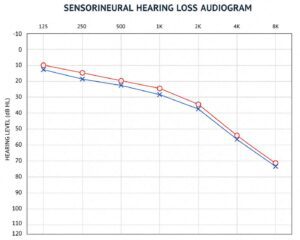
What an SNHL Audiogram Appears Like
A graph that quantifies the hearing threshold levels in decibels (dB) along the vertical y-axis and the sound frequency (pitch) in Hertz (Hz) along the horizontal x-axis is called an audiogram.
SNHL: What to Look For
- AC (air conduction): verified by using earphones or earbuds. Red circles (O) indicate results for the right ear, and blue X’s (X) indicate results for the left ear.
- Bone Conduction (BC): Conducted using a vibrating device positioned on the mastoid bone behind the ear, bypassing the outer and middle ear. Triangles or (<>) generally indicate results.
- Important Indicators: Bone Conduction and Air Conduction indicators overlap on the graph in cases of pure SNHL. They are both abnormal and equally impaired. There is no space separating them.
Audiogram Configurations for SNHL That Are Frequent
The particular pattern of hearing loss shown on the graph can reveal its underlying cause:
- Inclined The most frequent pattern is high-frequency loss. Lower frequencies (low pitches) are heard normally or almost normally, but higher frequencies (high pitches) decrease dramatically. Aging (presbycusis) and noise exposure are frequent causes.
- Flat loss: Every frequency (high and low pitches) is impacted to about the same extent.
- Cookie-Bite / U-Shape Hearing is enhanced at extremely high and extremely low frequencies, however it decreases in the middle pitch ranges.
- Loss of low-frequency sound (increasing): Hearing is poorer at lower frequencies and better at higher frequencies.
Why the pattern counts
Since SNHL impacts the inner ear, sounds are heard as less distinct as well as less loud. The frequencies plotted between 250 Hz and 8,000 Hz are critical for understanding human speech. A drop in this “speech banana” (particularly in the high frequencies) frequently explains why people can hear others speak but have difficulty comprehending the actual words, especially in loud or reverberant settings.
You may read the thorough Geeky Medics Audiogram Interpretation Guide to understand how an audiologist assesses and analyzes these distinctive hearing patterns.
Table of Contents
- Sensorineural Hearing Loss: Diagnosis, Treatment, Symptoms, and Causes
- Sensorineural Hearing Loss: Hearing Tests, Treatment, and Diagnosis
- Prognosis, Prevention, Causes, and Types of Sensorineural Hearing Loss
- SNHL (Sensorineural Hearing Loss): FAQ, Medical Disclaimer, and Conclusion
Sensorineural Hearing Loss: Diagnosis, Treatment, Symptoms, and Causes
Introduction
A prevalent health issue that impacts individuals of all ages is hearing loss. If left untreated, it can make it difficult to communicate and lower the quality of life.
Hearing loss is broadly categorized into two groups:
Hearing loss that is conductive and caused by issues in the outer or middle ear.
Injury to the inner ear, hearing nerve, or brain networks associated with hearing causes sensorineural hearing loss (SNHL).
The most prevalent form of irreversible hearing loss is sensorineural hearing loss. It happens when the auditory nerve or the fragile hair cells in the cochlea (inner ear) are damaged.
Since hearing loss can affect speech comprehension, social engagement, professional achievement, and mental health, early identification and care are crucial.
What Is Sensorineural Hearing Loss?
Hearing loss caused by issues with: is referred to as SNHL or sensorineural hearing loss.
- Cochlea (inner ear)
- the auditory nerve
- The brain’s auditory regions
In contrast to conductive hearing loss, SNHL cannot typically be resolved just by taking out earwax or addressing a problem with the middle ear.
People who have SNHL frequently lament that:
- The sound of speech is muddled or indistinct.
- Even though they can hear sounds, they are unable to understand words clearly.
- It’s hard to talk because of the background noise.
- The television’s volume must be increased.
Common Causes of Sensorineural Hearing Loss
The most common causes include:
|
Cause |
Description |
|---|---|
|
Age-related hearing loss (Presbycusis) |
Gradual hearing loss with aging. |
|
Noise-induced hearing loss |
Long-term exposure to loud sounds. |
|
Congenital hearing loss |
Present from birth. |
|
Meniere’s disease |
Inner-ear disorder causing hearing loss and vertigo. |
|
Head injury |
Trauma affecting the inner ear or nerve. |
|
Ototoxic medications |
Drugs such as aminoglycoside antibiotics. |
|
Diabetes and other systemic diseases |
Can damage inner-ear structures. |
|
Vestibular schwannoma |
Benign tumor of the hearing nerve. |
|
Autoimmune inner-ear disease |
Immune system attacks the inner ear. |
|
Barotrauma |
Pressure-related ear injury. |
How prevalent is it?
With advancing age, sensorineural hearing impairment becomes increasingly prevalent.
According to research:
- Following middle age, the risk of hearing loss rises gradually.
- Many individuals experience some level of high-frequency hearing loss as they age.
- Noise-induced hearing loss is also a significant global cause, particularly among those who are exposed to noisy environments, machinery, music, or firearms.
What causes sensorineural hearing loss?
Thousands of microscopic hair cells found in the inner ear turn sound vibrations into electrical signals.
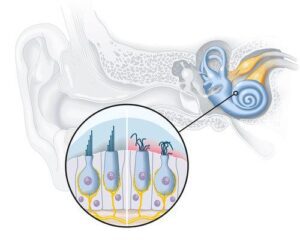
The auditory nerve carries these messages to the brain.
SNHL occurs when the auditory nerve or these hair cells are damaged.
Key mechanisms of destruction
- Gradual loss of hair cells as people get older.
- Damages the delicate hair-cell structures – Loud noise.
- Reduced oxygen supply to the cochlea is caused by inadequate blood supply.
- Drugs that damage inner-ear cells can cause lasting damage.
- The cochlea or auditory nerve may get damaged due to infections.
- Inflammation inside the inner ear is caused by an autoimmune illness.
Signs of Sensorineural Hearing Loss
Typical symptoms are:
- Sudden or gradual loss of hearing.
- Challenges in comprehending speech.
- Having difficulty hearing in loud environments.
- Often request that individuals repeat themselves.
- increasing the volume on the television.
- Ringing in the ears (tinnitus).
- Thinking that noises are muted.
- Sometimes feeling dizzy or having issues with balance.
When Should You Visit an ENT Specialist?
If you have any of the following, seek immediate medical attention:
- sudden deafness that develops in a few hours or days.
- Hearing loss that only affects one ear.
- Significant dizziness and hearing impairment.
- Following a head injury, hearing loss.
- Facial weakness accompanied by hearing impairment.
Sensorineural Hearing Loss: Hearing Tests, Treatment, and Diagnosis
How Is Sensorineural Hearing Loss Identified?
A thorough medical history and physical examination performed by an ENT expert are the first steps in identifying sensorineural hearing loss (SNHL). Understanding the source of hearing loss facilitates selecting the most effective therapy and raises the likelihood of maintaining hearing.
Your doctor might inquire about:
- When the hearing loss began
- Whether one or both ears are afflicted
- Start gradually or abruptly.
- Exposure to loud sounds
- Previous ear infections or ear surgery
- Barotrauma or head injury
- Hearing loss in the family’s past
- Existing medications, particularly those that are ototoxic
- Symptoms that may accompany this include vertigo, ear fullness, dizziness, or tinnitus
A thorough assessment of the ears, head, neck, and cranial nerves is also carried out to rule out alternative diagnoses.
Hearing Examinations Used to Identify Sensorineural Hearing Loss
The severity and sort of hearing loss may be determined with the aid of many hearing tests.
Audiometry with Pure Tones (PTA)
The gold standard for determining hearing loss is pure tone audiometry.
At this time, we’re taking a test.
- You put on headphones while inside a soundproof room.
- Several tones and frequencies are used.
- The softest sound you can hear at any given frequency is recorded.
For sensorineural hearing loss:
- Reduced thresholds are seen for both air and bone conduction.
- There isn’t a noticeable air-bone gap, setting it apart from conductive hearing loss.
Additionally, an audiogram helps determine whether the hearing loss is primarily low, middle, or high frequency.
Rinne Test
Air conduction is compared to bone conduction using a 512 Hz tuning fork in the Rinne test.
Typically:
- Bone conduction is inferior to air conduction (positive Rinne).
With sensorineural hearing loss:
- Because both air and bone conduction decline equally, the Rinne test often stays positive.
This quick bedside examination aids in distinguishing between conductive and SNHL hearing loss.
Weber Test
Additionally, a tuning fork placed in the middle of the forehead is used in the Weber test.
Included outcomes are:
- In one-sided sensorineural hearing loss, the healthy ear hears the sound more loudly.
- Sound is louder in the damaged ear when there is conductive hearing loss.
The Weber test is a rapid technique to detect unilateral hearing loss.
Tympanometry
The movement of the eardrum and middle ear is assessed through tympanometry.
This test helps diagnose:
- Fluid in the middle ear
- Dysfunction of the Eustachian tube
- Abnormalities of the tympanic membrane
- Middle ear pressure problems
Patients who just have sensorineural hearing loss often have unremarkable tympanometry findings.
Otoacoustic Emissions (OAE)
Sounds produced by the cochlea’s outer hair cells are measured by otoacoustic emissions.
This non-invasive test is frequently used for:
- Hearing examination for newborns
- Cochlear hair cell damage detection
- Assessing hearing loss caused by noise exposure
OAEs are typically absent when there is damage to the cochlear outer hair cells.
Auditory Brainstem Response (ABR)
How sound signals travel from the inner ear to the brain is assessed via auditory brainstem response testing.
ABR is especially helpful for:
- Babies
- Patients who are unable to complete hearing tests
- Suspected auditory nerve disorders
- Assessment of vestibular schwannoma
Audiometry of speech
Speaking words are assessed using speech audiometry.
Many people who have sensorineural hearing impairment state that they can hear noises but are unable to comprehend speech clearly, particularly in noisy situations.
This test aids in identifying hearing aid advantages and communication challenges.
Studies on Imaging
In a chosen group of patients, imaging may be advised.
MRI Scan
Magnetic Resonance Imaging (MRI) aids in the detection of:
- Vestibular. Acoustic neuroma (schwannoma)
- multiple sclerosis
- Cancers of the brain
- Inner ear deformities
- Disorders of the auditory nerve
MRI is especially suggested for:
- Hearing loss that happens quickly
- Hearing loss on one side
- Hearing impairment coupled with neurological symptoms
CT scan
Temporal bone CT scans can help identify:
- Fractures of the temporal bone
- Birth abnormalities
- Ossification of the cochlea
- Chronic otitis media
Laboratory Testing
Normally, blood tests are not necessary.
However, they could be advised if systemic or autoimmune disorders are thought to be present.
Possible probes include:
- Erythrocyte sedimentation rate (ESR)
- Antinuclear antibody (ANA)
- RF (Rheumatoid factor)
- Antibodies to the thyroid gland
- Blood sugar monitoring
- Screening for autoimmune disorders
- How to Treat Sensorineural Hearing Loss
The severity, length, and underlying reason of hearing loss all influence the kind of treatment that is used.
Treatment for abruptly acquired sensorineural hearing impairment
An ENT emergency is sudden sensorineural hearing loss (SSNHL).
It’s ideal to start treatment within the first two weeks, as soon as feasible.
Among the most frequent treatments are:
- Corticosteroids taken orally
- Steroid injections into the tympanic cavity
- Checking audibility using repeated audiograms
- MRI to determine the underlying reasons
Hearing may be recovered most effectively with early treatment.
Aids to hearing
For the majority of individuals suffering from chronic sensorineural hearing loss, hearing aids are the main course of therapy.
Modern hearing aids can:
- Enhance conversation
- Lower the background noise.
- Improve communication
- improve the quality of life
They are offered in a number of designs, such as:
- behind-the-ear (BTE)
- Receiver-in-canal (RIC)
- CIC stands for “completely in canal.”
- In-the-ear (ITE)
Hearing aids are very effective for most patients who have mild to moderate SNHL.
Hearing Aids with CROS and BiCROS
People with hearing loss in one ear may be able to hear better with the use of these special hearing aids.
By transmitting noises from the inferior ear to the better-hearing ear, they enhance communication and sound awareness.
Hearing Aids Using Bone Conduction
By sending sound vibrations to the cochlea through the skull, bone conduction systems skip the outer and middle ear.
These gadgets are helpful for:
- Hearing loss caused by conduction
- mixed hearing impairment
- One-sided hearing loss
Implant that is placed in the ear.
Cochlear implants may be an option for patients who have extreme or complete sensorineural hearing loss and whose hearing aids provide little benefit.
Cochlear implants stimulate the auditory nerve directly, skipping damaged cochlear hair cells, in contrast to hearing aids.
Among the advantages are:
- Enhanced speech comprehension
- Communication that is improved
- improved quality of life
- More independence
Imaging, speech evaluation, and extensive hearing examinations are all part of the assessment.
Rehabilitation in the Auditory Field
Beyond regaining hearing, effective therapy entails more.
Rehabilitation may entail:
- Therapy for speaking
- training in communication
- Techniques for lip-reading
- Listening support gadgets
- Advice and instruction for the family
Daily activities are improved and social isolation is reduced by early rehabilitation.
Prognosis, Prevention, Causes, and Types of Sensorineural Hearing Loss
Presbycusis, or age-related hearing loss
The most frequent cause of sensorineural hearing loss in seniors is presbycusis. As the auditory nerve and inner ear age naturally, it gradually manifests.
Most people notice difficulty hearing high-pitched noises or grasping talks in noisy surroundings first. Before the impacted person, family members may identify the issue.
Typical Indications
- Progressive hearing loss in both ears
- Difficulty comprehending speech
- Asking people to say something again over and over
- Raising the volume on the phone or TV
- Difficulty hearing in crowded environments
- Tinnitus (ringing in the ears)
Diagnosis
High-frequency hearing loss, which worsens with time, is often seen in an audiogram.
Treatment
Even though age-related hearing loss cannot be cured, treatment may significantly increase one’s ability to communicate.
Options for treatment include:
- Electronic Hearing aids
- Aid in hearing devices
- Strategies for Communication
- Routine hearing tests
- For severe hearing loss, cochlear implants
Social isolation is less likely with early treatment, which also keeps people independent.
Hearing loss caused by loud noises
After repeated exposure to loud sounds or following a sudden, extremely loud noise, noise-induced hearing loss (NIHL) develops.
One of the leading causes of permanent hearing loss that may be avoided is this.
Popular Causes of Loud Noise
- Equipment used in industry
- Work in construction
- Weapons
- Music that is loud
- Nightclubs
- Loud headphones
- power tools
- Farm machinery
Symptoms
- Hearing loss that gradually worsens
- Ear buzzing
- Difficulty hearing conversations
- Low speech clarity
- Increased sound sensitivity
Diagnosis
A typical 4,000 Hz hearing loss notch, frequently linked to prolonged noise exposure, is frequently shown by audiometry.
Avoiding problems or issues.
Preventive actions include the following:
- Donning hearing protection
- Lowering the volume on headphones
- making listening breaks
- Reducing exposure to loud surroundings
- obeying hearing conservation guidelines at work
Preventing long-term harm is aided by early hearing preservation.
Ménière’s Syndrome
A disorder of the inner ear that impacts both hearing and balance is called Ménière’s disease.
Over time, it may affect both ears, although it often affects just one.
- Typical Signs and Symptoms
- Repeated episodes of dizziness
- loss of fluctuating hearing
- Tinnitus
- Pressure or fullness in the ears
Symptoms frequently manifest themselves in episodes that can last anywhere from a few minutes to several hours.
Diagnosis
Evaluation may include:
- Tests on hearing
- Vestibular function evaluation
- If necessary, an MRI
Treatment of Illnesses
The goal of treatment is to enhance quality of life and lessen symptoms.
Typical choices are:
- Low-salt diet.
- Sufficient water
- Medicines that treat vertigo
- hearing aids
- Rehabilitation of the vestibule
- In certain cases, surgical therapy
Inner Ear Autoimmune Disorder
When the immune system accidentally assaults inner ear structures, autoimmune inner ear disease results.
Though rare, it might result in hearing loss that rapidly worsens.
Signs
- earing loss that worsens over time
- Hearing loss in both ears
- Tinnitus
- Feeling Lightheaded
- Issues with balance
Identification
Doctors could recommend:
- Testing for Hearing
- Autoimmune Illness Blood Tests
- MRI when necessary
Therapy
Treatment may entail:
- Corticosteroids
- Medicines that reduce immunity
- Steroid injections that go inside the eardrum
- rehabilitation of long-term hearing
The likelihood of preserving hearing is increased by early diagnosis.
Sensorineural Congenital Hearing Loss
Genetic or environmental factors might contribute to congenital hearing loss, which is present at birth.
Early detection is crucial because language and speech development can be impacted by hearing loss that goes untreated.
Common Causes
- Genetic mutations
- Infections that occur at birth
- early delivery
- Problems during birth
- Some medications taken during pregnancy
Diagnosis
Often, a diagnosis includes:
- Hearing screening for neonates
- Otoacoustic Emissions (OAE)
- Response of the brainstem to sound (ABR)
- Testing on genes
- If necessary, imaging studies
Treatment
Depending on severity, treatment might include:
- Aids to hearing
- implants in the ear
- Therapy that focuses on speech
- Counseling for families
- Early intervention initiatives
Additional Reasons for Sensorineural Hearing Loss
Additional circumstances that can harm the auditory nerve or the inner ear include:
- Infections caused by viruses
- Meningitis caused by bacteria
- Trauma to the head
- Fractures of the temporal bone
- Medicines that cause ototoxicity
- Diabetes mellitus
- numerous sclerosises
- Vestibular schwannoma (acoustic neuroma)
- Barotrauma
- Perilymphatic fistula
Since treatment varies according on the diagnosis, it’s critical to determine the root cause.
Difficulties of sensorineural hearing impairment
Physical, psychological, and social well-being can all be severely impacted by unaddressed hearing loss.
Potential side effects include:
- Social seclusion
- melancholy
- Worry
- Communication challenges
- decreased work performance
- poor academic results
- A deterioration in cognitive abilities
- Issues with memory
- Increased likelihood of falls
- Life quality is lower.
Many of these consequences can be avoided with early care.
Is Sensorineural Hearing Loss Avoidable?
While not all cases may be avoided, leading a healthy lifestyle may help lower the risk.
Advice for Prevention
- Keep your ears safe from loud noises.
- Utilize hearing protection at work.
- Maintain headphone volume below 60%.
- Loud noises should not be exposed for an excessive amount of time.
- Control excessive blood pressure and diabetes.
- Stop smoking.
- Maintain a regular exercise schedule.
- Eat a well-balanced meal.
- Only take ototoxic medications with a doctor’s prescription.
- If you are in danger, get routine hearing exams.
When Should You Get Help Right Away?
If you have any of the following symptoms, get help right away:
- Loss of Hearing Suddenly
- one-sided hearing loss
- extreme dizziness and loss of hearing
- Head trauma might result in hearing loss.
- Weakness in the face
- Hearing loss and chronic earache
- Loss of hearing followed by symptoms of nerve damage
Prompt treatment is required since unexpected sensorineural hearing loss is considered a medical emergency.
Outlook
The forecast is determined by the underlying cause and how quickly therapy is initiated.
Typically:
- Hearing impairment associated with age progresses gradually.
- Hearing loss due to noise is incurable but avoidable.
- Early therapy is linked to improved results in cases of unexpected hearing loss.
- In the majority of people, listening aids considerably increase communication.
- For many people with severe hearing loss, cochlear implants provide excellent hearing restoration.
Periodic visits to an audiologist and ENT expert help maximize long-term hearing results.
Living with Sensorineural Hearing Loss
With suitable therapy and support, a large number of individuals with SNHL continue to lead busy and satisfying lives.
Useful strategies include:
- Using hearing aids frequently
- Learning effective communication methods
- conversing while lowering background noise
- Speaking in front of the speaker.
- Get frequent hearing checkups.
- When necessary, participate in hearing support groups.
Early identification, rehabilitation, and persistent treatment can significantly raise quality of life.
SNHL (Sensorineural Hearing Loss): FAQ, Medical Disclaimer, and Conclusion
Summary
The most prevalent kind of permanent hearing loss, sensorineural hearing loss (SNHL), may severely impair communication, education, employment, and general quality of life. Aging, prolonged noise exposure, infections, genetic predispositions, specific medications, or underlying medical diseases can all cause damage to the fragile hair cells of the inner ear or the auditory nerve.
Prompt therapy can increase the possibility of recovery, thus an early diagnosis is important, particularly in situations of rapid hearing loss. Appropriate therapy and the root cause may be determined via thorough hearing evaluation employing audiometry and other diagnostic testing.
Modern treatment alternatives like digital hearing aids, cochlear implants, auditory rehabilitation, and speech therapy can significantly enhance hearing ability and day-to-day functioning, even though permanent sensorineural hearing loss is typically irreversible. The greatest ways to maintain hearing health for the duration of life continue to be preventative measures like safeguarding your ears from loud noise, managing chronic illnesses, and getting frequent hearing check-ups.
See an ENT expert or audiologist right away for an early diagnosis and effective treatment if you suddenly lose your hearing, experience constant tinnitus, dizziness, or increasing hearing issues.
FAQs (Frequently Asked Questions)
1. What is sensorineural hearing loss?
Sensorineural hearing loss is an incurable kind of hearing loss that occurs when the brain’s auditory nerves, inner ear (cochlea), or hearing pathways are damaged.
2. Is sensorineural deafness permanent?
In most circumstances, the answer is yes. However, some kinds of sudden sensorineural hearing loss may get better with prompt treatment.
3. How do you lose your sensorineural hearing?
Common causes include:
- Presbycusis, or age-related hearing loss.
- Exposure to loud noise
- Genetically inherited conditions
- Infections caused by viruses
- Meniere’s illness
- Medicines with ototoxic effects
- Wound to the head
- Autoimmune illnesses
- Neuroma, Acoustic
4. What symptoms does sensorineural hearing loss manifest?
The following are some of the symptoms:
- Having trouble comprehending communication
- Hearing that has been muffled
- Tinnitus (ringing in the ears)
- Difficulty hearing in loud situations
- Balance issues or feeling faint
- Either abrupt or gradual hearing loss
5. Is it possible for sensorineural hearing loss to be reversed?
The source will determine the recovery. Chronic hearing loss is often irreversible, whereas early treatment might partially or completely reverse sudden sensorineural hearing loss.
6. How is sensorineural hearing loss found?
Doctors could suggest:
- Audiometry using pure tones
- Audiometry of speech
- Tympanometry
- Otoacoustic emissions (OAEs)
- Auditory brainstem response (ABR)
- MRI or CT scan as needed
7. What is the most effective treatment for sensorineural hearing loss?
Depending on the cause, treatment may involve:
- Corticosteroids
- Assistive hearing equipment
- Implants in the cochlea
- rehabilitation for hearing
- Treatment for the underlying sickness
8. Can sensorineural hearing loss be aided by hearing aids?
Yes. Communication is greatly improved by hearing aids, which are the main treatment for sensorineural hearing loss that is moderate to mild.
9. What circumstances call for a cochlear implant?
Cochlear implants may be recommended for those who have severe or profound hearing loss and do not get much help from hearing aids.
10. Is it possible for loud music to lead to irreversible hearing damage?
Absolutely. Noise-induced sensorineural hearing loss and lasting harm to the inner ear can result from regular exposure to loud music or occupational noise.
11. Can tinnitus coexist with sensorineural hearing impairment?
Yes. Tinnitus, which is frequently defined as a humming, buzzing, or ringing sound in the ears, affects a large number of people who have SNHL.
12. Is an emergency sudden hearing loss?
Of course. A medical emergency known as abrupt sensorineural hearing loss requires immediate assessment by an ENT professional.
13. Is it possible for diabetes to raise the likelihood of hearing loss?
Indeed. Diabetes raises the risk of hearing loss by potentially harming the inner ear’s little nerves and blood vessels.
14. What steps can I take to avoid sensorineural hearing loss?
By doing the following, you can lower your risk:
- Putting on hearing protection
- avoiding continuous loud noise
- Maintaining a headphone volume below 60%
- Managing chronic diseases
- stay away from ototoxic drugs you don’t need
- Regular hearing tests should be conducted.
15. Which of the following is most likely to acquire sensorineural hearing loss?
Higher-risk populations include:
- Senior citizens
- Workers in factories
- Musicians and songwriters
- Troops
- Workers in construction
- Diabetics
- People who have a history of hearing loss in their families
Disclaimer for Medical Information
The material in this article is for educational purposes only and should not be used as a substitute for professional medical counsel, diagnosis, or treatment. Sensorineural hearing loss can result from a number of factors, some of which need quick medical attention. Always get guidance from an experienced ENT, audiologist, or medical expert about hearing loss, tinnitus, dizziness, or any other ear-related issues. Never postpone getting treatment because of what you’ve read online.
Summery
Damage to the auditory nerve or inner ear causes sensorineural hearing loss (SNHL), the most frequent type of permanent hearing loss. Learn about the causes, symptoms, diagnosis, hearing exams, treatment options, hearing aids, cochlear implants, prevention measures, and commonly asked questions.
References
- National Institute on Deafness and Other Communication Disorders (NIDCD). Age-Related Hearing Loss. https://www.nidcd.nih.gov/
- American Academy of Otolaryngology–Head and Neck Surgery (AAO-HNS). Clinical Practice Guidelines for Sudden Hearing Loss.
- World Health Organization (WHO). World Report on Hearing. https://www.who.int/
- Centers for Disease Control and Prevention (CDC). Noise-Induced Hearing Loss. https://www.cdc.gov/
- National Institute for Health and Care Excellence (NICE). Hearing Loss in Adults: Assessment and Management. https://www.nice.org.uk/
- StatPearls Publishing. Sensorineural Hearing Loss. National Center for Biotechnology Information (NCBI Bookshelf).
- Merck Manual Professional Edition. Sensorineural Hearing Loss. https://www.merckmanuals.com/
- American Speech-Language-Hearing Association (ASHA). Sensorineural Hearing Loss. https://www.asha.org/