Conductive Hearing Loss Audiogram: How to Read and Interpret Hearing Test Results
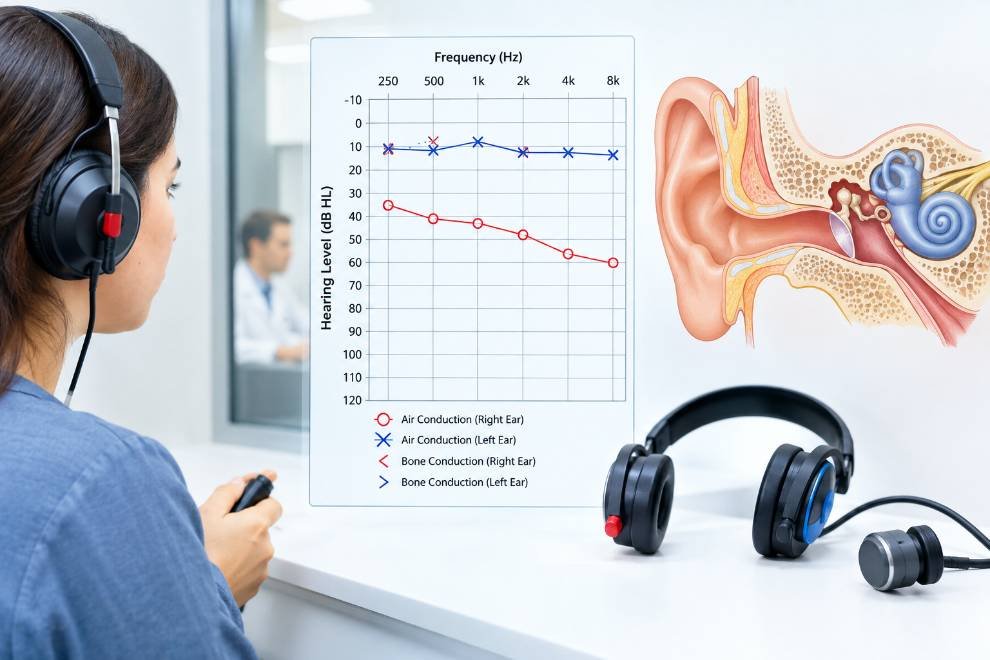
An audiogram for conductive hearing loss reveals that the outer or middle ear’s sound transmission is damaged, but the inner ear is functioning normally. It is characterized by impaired air conduction thresholds in conjunction with normal bone conduction thresholds (0–20 dB), resulting in a noticeable “air-bone gap” of more than 15 dB.
Author: Dr Sagar Rajkuwar, ENT Specialist, Nashik, Maharashtra, India
🌐 www.entspecialistinnashik.com
The Audiogram’s Salient Characteristics
- Bone Conduction (BC): The bone conduction thresholds (typically indicated by (langle ) or (rangle )) will be within the normal hearing range (usually 0 – 20 dB). This shows that the cochlea (inner ear) is in good working order.
- AC (air conduction): The air conduction thresholds (represented by O for the right ear and X for the left ear) will be lower than the normal range (e.g., more than 25 dB), indicating some degree of hearing loss.
- This is the hallmark of conductive hearing loss: the Air-Bone Gap. It signifies the difference in decibels between the bone conduction threshold and the air conduction threshold for any particular
- frequency. A air-bone gap of more than 15 dB suggests that sound isn’t getting to the inner ear as it should.
Why is this taking place?
Conductive hearing loss results when the outer or middle ear’s ability to transmit sound waves to the inner ear is obstructed in some way.
Typical causes are:
- Overaccumulation of earwax (cerumen impaction), a foreign item, or swimmer’s ear (otitis externa).
- Middle Ear: A ruptured eardrum, fluid in the middle ear (otitis media), or stiffening of the middle ear bones (otosclerosis).
Steps to take next
It is strongly recommended to see an ENT (ear, nose, and throat) professional (otolaryngologist) if your audiogram reveals conductive hearing loss. Contrary to sensorineural hearing loss, conductive loss can frequently be treated.
An ENT will do a physical examination of the ear and may recommend: to determine the cause of your hearing loss and the most effective course of treatment.
- Medical Treatment: Antbiotics/medications for infections or fluid, or earwax removal.
- Surgical Choices: Operations such as mending middle-ear bone problems or inserting ear tubes.
- Amplification, using bone-anchored hearing devices or traditional hearing aids.
You may utilize materials like the ENT Health Specialist Finder or read more thorough interpretations on Geeky Medics to better understand your unique results or locate a local expert.
Table of Contents
- Introduction
- What is an audiogram?
- How Is Audiometry Done?
- Average of Pure Tones (PTA)
- Bone Conduction vs Air Conduction
- What is masking?
- Audiometric speech
- When Is an Audiogram Advised?
- Types of Hearing Loss on an Audiogram
- Audiogram Patterns in General
- Factors Affecting Accuracy of Audiograms
- Significance of an Audiogram in Medicine
- Conductive Hearing Loss: Frequently Asked Questions Audiogram
- Summary
Understanding and Interpreting Audiograms
Introduction
The official hearing test that evaluates a person’s ability to hear sounds at various frequencies and volumes is called an audiogram. This helps healthcare professionals detect diseases like sensorineural hearing loss, mixed hearing loss, and conductive hearing loss by identifying the kind, amount, and pattern of hearing loss.
One of the most important diagnostic instruments in audiology and otolaryngology (ENT) is audiometry. An audiogram determines whether hearing loss is due to the outer, middle, or inner ear, or to the auditory nerve, by evaluating air conduction and bone conduction hearing thresholds.
Certain audiogram patterns can point to conditions like age-related hearing loss (presbycusis), noise-induced hearing loss, Ménière’s disease, otosclerosis, vestibular schwannoma (acoustic neuroma), and hearing loss brought on by ototoxic medications, in addition to assessing hearing capacity.
What is an audiogram?
A graph that shows the softest sounds a person can hear over various sound frequencies is called an audiogram.
The hearing test:
- Through headphones, air conduction is utilized to play pure tones.
- Extra sounds can be sent via a bone vibrator positioned behind the ear (bone conduction).
- A sound is indicated by the patient.
- For interpretation, the findings are plotted on an audiogram.
This test assists in identifying:
- Hearing sensitivity
- Hearing impairment type
- How bad is the hearing loss?
- Hearing loss pattern
- The need for additional testing or treatment
How Is Audiometry Done?
To remove background noise, audiometry is typically done in a sound-treated booth.
Testing for air conduction
The whole hearing channel is assessed by air conduction:
- External ear
- Canal of the ear
- Eardrum
- Middle ear
- Cochlea (inner ear)
- Nerve responsible for hearing
- Brain
The patient wears headphones as sounds of varying frequencies and intensities are played.
Testing Using Bone Conduction
The outer and middle ears are circumvented during bone conduction testing.
The cochlea is immediately stimulated by a little vibrating device placed on the mastoid bone behind the ear.
This aids in identifying the cause of hearing loss as one of the following:
- Conductive hearing loss (disorder of the outer or middle ear)
- Auditory nerve or inner ear injury (sensorineural hearing loss)
Understanding the Audiogram
An audiogram has two main axes:
Horizontal Axis (X-axis)
Indicates the frequency (pitch) in Hertz (Hz).
The following frequencies are often evaluated:
- 250 hertz
- 500 hertz
- 1000 Hz
- 2 kHz
- 3000 hertz
- 4000 Hz
- 6000 Hertz
- 8 kHz
The majority of audible speech sounds occur between 500 Hz and 4000 Hz.
Y-axis, or vertical axis
Demonstrates the level of hearing measured in decibels (dB HL).
Normal hearing threshold is 0 dB HL.
Larger figures signify that louder noises are necessary before they can be heard.
In general:
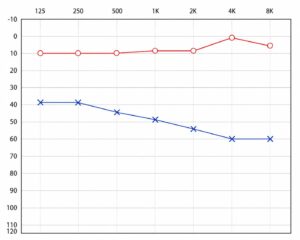
- Normal hearing ranges from 0 to 25 dB HL.
- 26–40 dB Mild hearing loss according to HL.
- 41 to 55 dB HL: Moderate hearing loss
- 70-56 dB HL: Hearing loss of moderate severity
- 71-90 decibels HL: Serious loss of hearing
- More than 90 dB Profound hearing loss (HL)
Average of Pure Tones (PTA)
Hearing thresholds are used to compute the Pure Tone Average (PTA) at:
- 500 Hz
- 1000 Hz
- 2 kilohertz
PTA is frequently employed to evaluate the degree of hearing loss and to determine a person’s eligibility for a hearing aid. It provides a general assessment of a person’s hearing ability for speech comprehension.
Bone Conduction vs Air Conduction
Audiograms contrast two auditory pathways:
Conduction of Air
Evaluates hearing throughout the auditory system.
Conduction through Bone
Skips the outer and middle ear and activates the inner ear right away.
The sort of hearing loss may be determined by comparing these results.
What is masking?
The superior ear may identify sounds delivered to the poorer ear if one ear hears much better than the other.
Audiologists use masking, which involves introducing noise into the ear with better hearing while evaluating the other ear, in order to avoid getting results that are incorrect.
Particularly in individuals with asymmetrical hearing loss, masking enhances the accuracy of audiogram interpretation.
Audiometric speech
Pure-tone audiometry is supplemented by speech testing.
It analyzes:
- Speech Threshold (SDT)
- SRT (Speech Reception Threshold)
- WRS stands for Word Recognition Score.
How effectively a patient comprehends spoken words is assessed via these examinations, which also aid in evaluating communication skills.
Retrocochlear or auditory nerve problems might be indicated by relatively decent hearing thresholds combined with poor speech recognition.
When Is an Audiogram Advised?
An audiogram may be recommended by your doctor if you:
- Loss of hearing
- Tinnitus (ringing in the ears)
- Dizziness or lightheadedness
- Fullness of the ears
- Exposure to noise
- Damage to the skull
- Exposure to ototoxic drugs
- Sudden loss of hearing
- Deafness in the family’s past
For the following people, routine hearing screening is also advised:
- Senior people
- Children’s activities
- Workers in industry
- Members of the armed forces
- musicians
- Pilots
Types of Hearing Loss on an Audiogram
SNHL (Sensorineural Hearing Loss)
Damage to the cochlea, auditory nerve, or central auditory pathways causes sensorineural hearing loss.
Common causes include:
- Presbycusis, or aging
- Exposure to noise
- Ménière disease
- Medications that are ototoxic
- Infections with viruses
- Schwannoma of the vestibule
Audiogram results:
- The thresholds for bone conduction and air conduction drop simultaneously.
- There is no noticeable air-bone difference.
Hearing loss that is conductive in nature.
When sound cannot pass through the outer or middle ear efficiently, conductive hearing loss results.
Among the frequent causes are:
- Earwax obstruction
- Otitis media
- Tympanic membrane perforation
- Otosclerosis
- Fluid in the middle ear
Audiogram results:
- Regular bone conduction
- less air conduction
- 15 dB or more air-bone gap
A mixed hearing loss
Mixed hearing loss is characterized by both conductive and sensorineural components.
Audiogram results are as follows:
- Higher bone conduction threshold values
- High air conduction thresholds
- A large air-bone gap
Audiogram Patterns in General
Presbycusis
- Two-sided
- symmetrical
- Progressive hearing loss in the high frequency range
- Audiogram that slopes downward
Loss of Hearing Due to Noise
usually exhibits a noise notch at 4,000 Hz.
Common among:
- Manufacturing staff
- Music performers
- Military personnel
- Building workers
Meniere’s Disease
Common causes:
- One-sided low-frequency hearing loss
- Upsloping audiogram
- Hearing levels that are inconsistent
Vestibular Schwannoma
May yield:
- High-frequency hearing loss on one side
- Speech comprehension that is inadequate
- Asymmetrical audiogram
MRI is typically advised for confirmation.
Hearing Loss Due to Ototoxicity
Usually starts with high frequencies.
Related drugs are:
- Antibiotics in the Aminoglycoside Class
- Cisplatin
- Diuretics that are loop-like
- Salicylates in high doses
Otosclerosis
Can yield:
- Mixed or conductive hearing loss
- Bone-air gap
- At 2,000 Hz, a distinctive Carhart notch may be seen.
Hearing Loss at Birth
Some inherited hearing disorders show a “cookie-bite” audiogram with more severe hearing loss in the mid frequencies.
Factors Affecting Accuracy of Audiograms
There are a number of things that might affect audiogram results, including:
- Poorly placed headphones
- Inadequate coverage
- Noise in the background
- Patient weariness
- Lack of Collaboration
- Hearing loss that is functional (non-organic)
- Errors in equipment calibration
For trustworthy findings, a competent audiologist must conduct precise testing.
Significance of an Audiogram in Medicine
With the aid of an audiogram, doctors may:
- Diagnose auditory impairments.
- Find out how bad and what kind of hearing loss it is.
- Observe hearing modifications throughout time
- Give me some advice on hearing aids.
- Cochlear implants are considered.
- Find situations that need MRI or additional testing
- Inform rehabilitation and treatment
Because hearing loss may have a major impact on communication, education, employment, and quality of life, early diagnosis using audiometry is essential for enhancing long-term results.
Conductive Hearing Loss: Frequently Asked Questions Audiogram
1. What is an audiogram with conductive hearing loss?
The audiogram for conductive hearing loss is a graph of a hearing test that indicates reduced air conduction hearing with comparatively normal bone conduction. The inner ear is not the issue, according to this pattern, but rather the middle or outer ear.
2. What role does an audiogram play in identifying conductive hearing loss?
The air and bone conduction hearing thresholds are compared in an audiogram. A conductive hearing loss is often caused by defective sound transfer through the outer or middle ear, which is indicated by an air-bone gap of more than 10–15 dB.
3. What are the frequent causes of conductive hearing loss?
The following are typical causes:
- Blocked earwax (cerumen)
- Infection of the middle ear (otitis media)
- fluid behind the eardrum.
- Eardrum (tympanic membrane) perforation
- Otosclerosis
- The ear contains a foreign substance.
- Ear abnormalities present from birth
4. Is it possible to treat conductive hearing loss?
Yeah. In many cases, conductive hearing loss may be cured. Treatment may involve earwax removal, medications, antibiotics, hearing aids, or operations like stapedectomy or tympanoplasty, depending on the cause.
5. What is an audiogram’s air-bone gap?
The difference between air conduction and bone conduction hearing thresholds is known as an air-bone gap. It’s the defining symptom of conductive hearing loss and distinguishes it from sensorineural hearing loss.
6. Is hearing loss that is conductive irreversible?
Not always. Many situations are short-lived and improve with the treatment of the core cause. However, surgery or long-term hearing rehabilitation may be necessary for some diseases, such as congenital abnormalities or severe otosclerosis.
7. On an audiogram, how do conductive and sensorineural hearing loss differ?
Bone conduction is normal in conductive hearing loss, but air conduction is decreased, resulting in an air-bone gap. Both bone and air conduction fall simultaneously with no appreciable air-bone gap in sensorineural hearing loss.
8. When ought I get an audiogram?
If you have any of the following symptoms—hearing loss, tinnitus, ear fullness, recurring ear infections, dizziness, ear discharge, or trouble understanding speech, particularly in loud settings—you should have an audiogram.
9. Is it possible for children to have conductive hearing loss?
Yes, I do. Due to ear infections, enlarged adenoids, middle ear fluid, or congenital ear abnormalities, conductive hearing loss is frequent in youngsters. Speech and language delays can be avoided by early diagnosis.
10. Who interprets an audiogram?
A skilled audiologist or ENT expert should analyze audiograms, combining the results of the hearing test with your symptoms, medical history, and physical examination to identify the underlying cause.
Summary
An audiogram for conductive hearing loss aids in the detection of hearing problems brought on by disorders of the middle or outside ear. An air-bone difference, with air conduction thresholds being worse than bone conduction thresholds, is the telltale sign. Some of the causes of otosclerosis include earwax buildup, middle ear fluid, tympanic membrane perforation, and otosclerosis. Conductive hearing loss, unlike sensorineural hearing loss, may frequently be reversed with proper medical or surgical care.
Accurate diagnosis, timely treatment, and enhanced hearing results are ensured through early audiometric evaluation performed by an audiologist or ENT specialist.
📞 ENT Consultation & Surgery
Dr. Sagar Rajkuwar (MS-ENT)
Prabha ENT Clinic, Ambad, Nashik
📱 7387590194 | 9892596635
🌐 www.entspecialistinnashik.com
What Does an Air-Bone Gap Really Mean?
At the same frequency, air conduction hearing is poorer than bone conduction hearing, which is referred to as an air-bone gap (ABG). This pattern indicates that sound transmission through the middle or outer ear is inefficient.
However, an air-bone gap shouldn’t be interpreted on its own. The audiologist evaluates its size, frequency pattern, whether it is present in one or both ears, the bone-conduction thresholds, masking findings, and the patient’s ear assessment.
Although the specific interpretation relies on the testing circumstances and the whole audiogram, a 15 dB or higher air-bone gap is often utilized as a clinical sign of a conductive component.
Key Point: Conductive hearing loss is not always indicated by a little air-bone gap.
According to new audiology studies, erroneous air-bone gaps might appear, especially at specific frequencies. A 2026 study of 1,000 ears showed that fake gaps were most prevalent at 250 Hz and might occasionally happen at 4,000 Hz in certain circumstances. Therefore, clinicians should diagnose conductive hearing loss from the full audiogram, not from a single gap.
This is a crucial explanation for why an audiogram should be interpreted in conjunction with a patient’s medical history, other audiological tests, and otoscopy.
Why Tympanometry May Be Recommended With a Conductive Hearing Loss Audiogram
Tympanometry offers details about middle-ear performance, while an audiogram displays how effectively someone can hear.
Tympanometry can assist in identifying issues related to:
- Liquid inside the middle ear
- Dysfunction of the Eustachian tube
- Abnormalities of the eardrum
- Middle ear mobility that is either lowered or increased
- Problems with the ossicular chain
- Patterns associated with otosclerosis
As a result, a person who has an air-bone gap may have both tympanometry and pure-tone audiometry.
When read together, the two assessments are frequently more insightful since they address different concerns.
What Other Tests May Be Needed?
Although there is a conductive pattern on the audiogram, the precise etiology is not always apparent. The following specialists may be consulted by an audiologist or ENT depending on the clinical results:
- Examination of the ear canal and eardrum with an otoscope
- A tympanometry examination of the middle ear’s function
- Selected cases undergo acoustic reflex testing.
- Word recognition and speech detection testing through audiometry.
- Weber and Rinne tests are examples of tuning-fork tests.
- When there is a structural issue with the temporal bone or middle ear, a CT scan of the temporal bone is necessary.
- MRI when a condition affecting the surrounding structures, auditory nerve, or inner ear is suspected
Imaging isn’t necessary for everyone who has conductive hearing loss. The decision is based on the patient’s medical history, otoscopic exam, audiogram, and likely cause.
Can Conductive Hearing Loss Be Reversed?
Occasionally, yes.
When the underlying cause of conductive hearing loss can be treated, it may improve. After appropriate management of, for example, hearing may get better:
- Cerumen impaction
- Fluid in the middle ear
- Certain ear infections
- Perforation of the eardrum
- Issues with the ossicular chain
- Otosclerosis
The course of therapy is determined by the cause. Observation, medication, earwax removal, hearing rehabilitation, tympanoplasty, ossicular reconstruction, tympanostomy tubes, or other surgical treatments may be included when necessary.
Not all conductive hearing loss may be reversed, though. Long-term hearing rehabilitation may be necessary for some chronic disorders, significant structural damage, long-standing ear disease, and congenital abnormalities.
Does a Conductive Hearing Loss Audiogram Always Mean the Inner Ear Is Normal?
Not always.
Pure conductive hearing loss is often defined by air-conduction thresholds that are worse than bone-conduction thresholds, which are relatively unaffected. However, a patient might have both conductive and sensorineural components.
Mixed hearing loss is what this is called.
For instance, in addition to middle-ear disease, a person may also have sensorineural hearing loss that is either noise- or age-related. Additionally, the bone-conduction thresholds are elevated and there is an air-bone gap in that scenario.
Therefore, the assertion “bone conduction looks better, thus the inner ear is totally normal” should not be made without taking the entire audiogram into account.
Why Masking Matters When Reading an Audiogram
Some individuals may hear sounds delivered to one ear through their other cochlea. This might cause an unmasked test to seem superior to the actual hearing of the ear being examined.
Hence, audiologists apply masking noise in the non-test ear as needed. This assists in determining whether the measured response truly reflects the intended ear.
Masking is extremely crucial when there is a significant discrepancy between the two ears or when the air and bone conduction results may be wrongly linked to the wrong cochlea.
A Conductive Audiogram Is a Pattern, Not a Final Diagnosis
Although an audiogram may strongly indicate conductive hearing loss, it typically does not identify the precise condition on its own.
For instance, a comparable conductive pattern might emerge in the presence of:
- Obstruction from earwax
- Fluid in the middle ear
- Perforation of the tympanic membrane
- Abnormalities of the ossicular chain
- Otosclerosis
- persistent middle ear illness
- Defects Present at Birth
Correlation with the patient’s symptoms, otoscopic examination, and, if required, tympanometry or imaging is necessary for the definitive diagnosis.
Quick Takeaway
Bone conduction that is superior to air conduction + a suitable air-bone gap = conductive component.
However, just the air-bone gap cannot identify the source of that conductive component.
When Should You Seek Prompt Medical Assessment?
An audiogram’s typical findings should be interpreted in light of the situation. When hearing loss is accompanied by the following symptoms, though, a more pressing evaluation is merited:
- Suddenly begins to grow
- deteriorates swiftly
- Is related to new facial weak spot or altered sensation
- It happens along with major neurological symptoms.
- Has persistent ear discharge or severe ear pain.
- Is highly asymmetrical and unexplained?
- recurrent or persistent vertigo is present.
When there is no obvious external or middle ear reason, NICE advises an immediate or urgent specialist evaluation for sudden or quickly declining hearing loss.
Sudden hearing loss should not be attributed to earwax or middle-ear fluid as a cause of conductive hearing loss. Prompt assessment is advised by NIDCD to distinguish between conductive reasons and sudden sensorineural hearing loss, which necessitates rapid medical evaluation.
Conductive Hearing Loss Audiogram: Key Points at a Glance
Audiogram finding |
What it may suggest |
|---|---|
Normal or relatively preserved BC + poorer AC |
Conductive component |
Elevated AC and BC without significant ABG |
Sensorineural component |
Elevated AC and BC + significant ABG |
Mixed hearing loss |
Unilateral/asymmetric findings |
Requires interpretation with history and examination |
Isolated small ABG |
May not necessarily indicate true conductive disease |
Conductive pattern + abnormal tympanometry |
Supports a middle-ear component |
Conductive pattern + abnormal otoscopy |
Helps identify the underlying ear disorder |
The table describes common audiometric patterns; it is not a substitute for professional interpretation of an individual audiogram.
Conductive Hearing Loss Audiogram – Frequently Asked Questions
Which audiogram finding is most indicative of conductive hearing loss?
The classic finding is an air-bone gap at relevant frequencies, with lower air-conduction thresholds than bone-conduction thresholds.
Is conductive hearing loss inevitable with a 15 dB air-bone gap?
No, no. A conductive component is usually indicated by an air-bone gap of 15 dB or more, although testing or measuring elements can sometimes result in isolated gaps. The entire audiogram needs to be taken into account.
What examination validates the involvement of the middle ear?
Tympanometry can offer more information on how well the eardrum and middle ear function. It is frequently translated along with otoscopy and audiometry.
Is it possible for earwax to result in a conductive hearing loss pattern?
Yes. A conductive pattern and decreased air-conduction hearing might result from ear-canal obstruction like impacted cerumen.
Can mixed hearing loss develop from conductive hearing loss?
Yes. An already present conductive issue might be accompanied by the development of a sensorineural component. High bone-conduction thresholds and an air-bone gap are then visible in the audiogram.
Does everyone with conductive hearing loss need an operation?
No. Treatment varies depending on the cause. Structural problems may necessitate surgery or hearing rehabilitation, but some circumstances improve with treatment for wax, infection, or middle ear fluid.
Medical Disclaimer
This article is intended for general educational purposes and should not be used to diagnose or treat an individual hearing problem. Audiograms can be difficult to interpret without the patient’s medical history, ear examination and complete audiological assessment. If you have new, sudden, worsening, asymmetric or unexplained hearing loss, seek evaluation from a qualified ENT specialist or audiologist.
Hearing Loss & Audiogram – Organized Internal Link Categories
1. Hearing Loss – Types & Audiogram Comparison
-
Sensorineural vs Conductive Hearing Loss – Audiogram
2. Conductive Hearing Loss – Audiogram
-
Conductive Hearing Loss Audiogram
3. Sensorineural Hearing Loss – Audiogram
-
Sensorineural Hearing Loss Audiogram
4. Hearing Loss Types – Audiogram
-
Hearing Loss Types Audiogram
5. Ménière’s Disease – Audiogram
-
Ménière’s Disease Audiogram
Medical References
- American Speech-Language-Hearing Association (ASHA) – Hearing Loss in Adults and pure-tone audiometry guidance.
- NICE Guideline NG98 – Hearing loss in adults: assessment and management.
- Merck Manual Professional Edition – Hearing Loss.
- Cleveland Clinic – Conductive Hearing Loss and Tympanometry.
- National Institute on Deafness and Other Communication Disorders (NIDCD) – Sudden Deafness.
- Chordekar S, Kariv L, Fink N. Clinical Prevalence and Impact of False Air–Bone Gaps in Clinical Audiometry: A Study of 1,000 Ears. American Journal of Audiology. 2026.