Losing Voice: Causes, Treatment, Recovery Time & When to See a Doctor
Losing your voice — called dysphonia when the voice is hoarse or weak, and aphonia when it is gone completely — is one of the most common complaints seen by ENT specialists worldwide. In most cases, voice loss follows a cold, a long day of talking, cheering at a match, or singing. It usually recovers within a week. However, voice loss that lasts more than three weeks can occasionally be the first sign of something more serious, including laryngeal cancer, vocal fold paralysis, or an acid reflux problem that is quietly damaging your voice box.
Author: Dr Sagar Rajkuwar, ENT Specialist, Nashik, Maharashtra, India
🌐 www.entspecialistinnashik.com

Losing voice: Causes, treatment and expert ENT guidance
Table of Contents
- (1) Introduction
- (2) What Does “Losing Your Voice” Actually Mean?
- (3) How Your Voice Is Produced (Simple Anatomy)
- (4) Top 15 Causes of Losing Your Voice
- (5) Acute Laryngitis: The #1 Cause
- (6) Chronic Laryngitis
- (7) Voice Overuse & Misuse
- (8) Acid Reflux (GERD & LPR / Silent Reflux)
- (9) Vocal Cord Nodules, Polyps & Cysts
- (10) Vocal Fold Paralysis
- (11) Vocal Fold Hemorrhage
- (12) Neurological Causes
- (13) Allergies, Smoking & Air Pollution
- (14) Thyroid Problems
- (15) Laryngeal Cancer (Red Flag)
- (16) Red Flags: When Voice Loss Is NOT Normal
- (17) How Doctors Diagnose Voice Loss
- (18) Home Remedies & Self-Care
- (19) Medical Treatments & Voice Therapy
- (20) How Long Does Voice Loss Last? (Recovery Timeline)
- (21) Prevention & Voice Hygiene
- (22) Losing Voice in Children
- (23) Losing Voice in Singers, Teachers & Public Speakers
- (24) Expert Opinion
- (25) Summary
- (26) Conclusion
- (27) FAQs
- (28) References
(1) Introduction
At any given moment, nearly 1 in 13 adults in the general population is experiencing a voice problem, according to voice-disorder epidemiology data from the National Institute on Deafness and Other Communication Disorders (NIDCD). Teachers, singers, call-centre agents, parents of young children, and anyone recovering from a viral cold can tell you how frustrating losing your voice can be — you suddenly cannot be heard across a room, cannot answer the phone normally, and cannot do your job.
The good news is that most episodes of voice loss are temporary and self-limiting. The important news is that persistent voice loss is one of the clearest early-warning signs of several ENT and systemic conditions. This comprehensive 2026 guide — written by an ENT specialist and reviewed against WHO, CDC, NHS, NIDCD, and peer-reviewed medical sources — walks you through every important reason you might be losing your voice, how to recover faster, and the signs that mean “see a doctor today.”
(2) What Does “Losing Your Voice” Actually Mean?
“Losing voice” is an umbrella term covering a range of experiences:
- Hoarseness (dysphonia): Your voice sounds breathy, raspy, strained, softer, or lower in pitch than normal. Per the NIDCD, your throat may feel scratchy.
- Complete voice loss (aphonia): You can only whisper or produce no sound at all.
- Vocal fatigue: Your voice is normal first thing in the morning but weakens with use.
- Pitch and range loss: You can speak but can’t hit high or low notes you normally reach.
Any of these can be referred to in casual language as “losing my voice.” Clinicians divide them by cause, duration (acute < 3 weeks; chronic ≥ 3 weeks), and anatomical origin (vocal folds, nerves, surrounding structures).
(3) How Your Voice Is Produced (Simple Anatomy)
Understanding why you lose your voice is easier once you know how it is made.
The three systems of voice production
- Power source — the lungs: Air pushed up from the lungs provides the energy for sound.
- Vibrator — the vocal folds (vocal cords): Two small ribbon-like muscles inside the larynx (voice box) vibrate as air passes between them. They vibrate up to several hundred times per second to produce pitch.
- Resonator / articulator — the throat, mouth, nose, lips & tongue: Shape the sound into speech.
What goes wrong when you lose your voice
Almost all voice loss happens because the vocal folds cannot vibrate properly. This can be due to:
- Swelling (inflammation) of the fold surface — classic laryngitis.
- A mass sitting on the fold — a nodule, polyp or cyst.
- The fold not moving correctly — paralysis or neurological disease.
- The fold being injured — bleeding, scarring, or burn from acid reflux.
(4) Top 15 Causes of Losing Your Voice
Sorted roughly from most to least common:
- Acute laryngitis (viral upper respiratory infection)
- Voice overuse or misuse (shouting, cheering, long talking)
- Allergies and post-nasal drip
- Acid reflux (GERD / LPR — “silent reflux”)
- Smoking and vaping
- Dehydration
- Chronic laryngitis
- Vocal fold nodules
- Vocal fold polyps
- Vocal fold cysts
- Vocal fold hemorrhage
- Vocal fold paralysis (after surgery, trauma, or viral neuropathy)
- Thyroid disorders
- Neurological disease (Parkinson’s, stroke, spasmodic dysphonia)
- Laryngeal cancer
We cover each of the main ones below.
(5) Acute Laryngitis: The #1 Cause
Acute laryngitis is inflammation of the voice box, usually triggered by a viral infection (common cold, influenza) or by sudden vocal strain. According to nidirect.gov.uk (NHS-aligned guidance), acute laryngitis typically clears within one to two weeks on its own and often needs no specific treatment.
Typical symptoms
- Hoarseness or complete voice loss
- Sore throat
- Mild fever
- Dry, irritating cough and constant throat-clearing
- Sometimes headache, swollen glands, runny nose, pain on swallowing
Course
Symptoms often start suddenly and worsen over 2–3 days. Hoarseness can linger for up to a week after other cold symptoms are gone, as the vocal folds take extra time to settle.
(6) Chronic Laryngitis
When hoarseness persists beyond three weeks, it is classified as chronic laryngitis. Causes include:
- Smoking (the single biggest cause)
- Chronic acid reflux (LPR)
- Occupational irritants: dust, fumes, chemicals
- Alcohol abuse
- Chronic sinusitis with post-nasal drip
- Autoimmune disease (less commonly)
Chronic laryngitis always deserves ENT evaluation, because it shares warning signs with precancerous and cancerous laryngeal lesions.
(7) Voice Overuse & Misuse
Shouting at a sports event, singing without warm-up, talking all day in a noisy classroom, or crying for hours (in a baby or an adult) can all overload the vocal folds. The NIDCD explicitly lists voice overuse as a leading cause of hoarseness.
Who’s most at risk
- Teachers (studies cited by the NIDCD use “voice dosimeters” to measure teacher voice loads)
- Singers and actors
- Call-centre workers
- Fitness trainers and coaches
- Clergy, lawyers, public speakers
Treatment
Voice rest, hydration, and — for persistent cases — voice therapy with a speech-language pathologist (SLP).
(8) Acid Reflux (GERD & LPR / Silent Reflux)
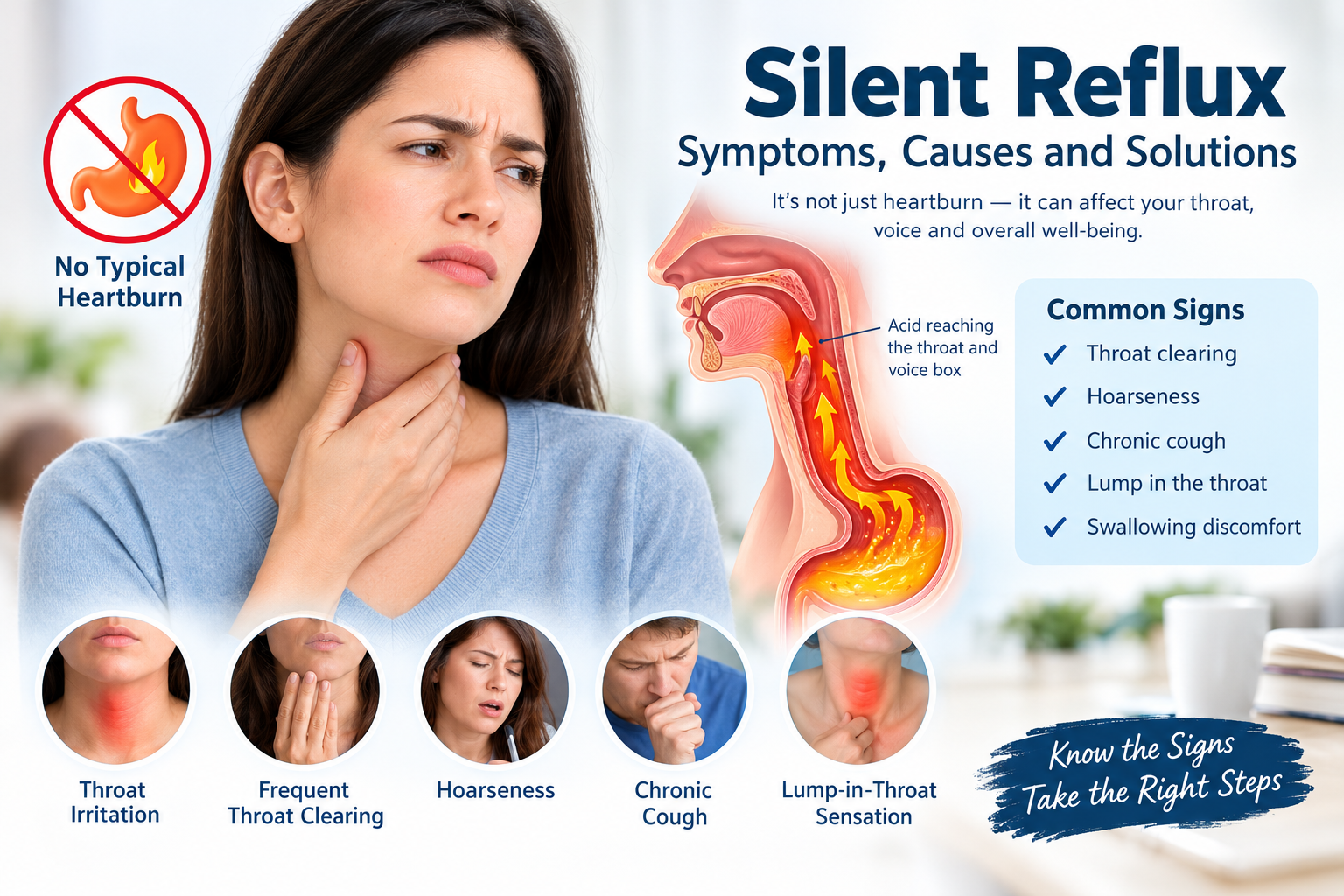
Laryngopharyngeal reflux (LPR), also called silent reflux, is a very common and often missed cause of chronic voice loss. Unlike classic GERD, LPR frequently has no heartburn — stomach acid simply refluxes up to the throat and burns the vocal folds, especially at night.
Classic LPR symptoms
- Hoarseness, worse in the morning
- Chronic throat clearing
- Lump-in-throat feeling (globus)
- Chronic cough
- Post-nasal drip sensation
- Difficulty swallowing
See our detailed guide: Silent Reflux (LPR): Symptoms, Causes, Diagnosis & Treatment.
(9) Vocal Cord Nodules, Polyps & Cysts
These are three closely related benign vocal fold lesions.
Nodules (“singer’s nodules”)
Callus-like bumps on both vocal folds from repetitive voice overuse. Common in teachers, singers, and children who scream a lot.
Polyps
Usually a single, blister-like swelling, often from a one-off strain (one episode of hard yelling) or from chronic smoking.
Cysts
Fluid- or mucus-filled sacs inside the vocal fold. May require microsurgery.
Treatment
Voice therapy is first-line for nodules. Polyps and cysts often need microlaryngeal surgery followed by voice therapy.
(10) Vocal Fold Paralysis
A paralyzed vocal fold cannot move to meet its partner, so your voice becomes breathy and weak. Causes include:
- Injury to the recurrent laryngeal nerve during thyroid, neck, chest, or heart surgery
- Viral neuropathy (sometimes following upper respiratory infection or COVID-19)
- Tumors in the neck or chest
- Stroke or brainstem lesions
- Idiopathic (no identifiable cause)
Treatment ranges from voice therapy to vocal fold injection (“medialization”) or framework surgery (thyroplasty).
(11) Vocal Fold Hemorrhage
A small blood vessel bursts on the surface of the vocal fold — usually during an episode of yelling, singing a high note, or heavy coughing. The affected fold stiffens and the voice suddenly becomes hoarse or breathy.
Treatment is urgent and absolute voice rest, plus prompt ENT evaluation. Continuing to speak can convert a reversible hemorrhage into a permanent scar.
(12) Neurological Causes
Several neurological disorders can present with voice loss:
- Parkinson’s disease — soft, monotone voice (hypophonia)
- Stroke — sudden breathy voice if a cranial nerve is affected
- Spasmodic dysphonia — strained, strangled voice from involuntary spasms of the vocal folds
- Essential vocal tremor — shaky voice
- Myasthenia gravis, ALS, multiple sclerosis
(13) Allergies, Smoking & Air Pollution
Allergies
Hay fever and other allergies cause post-nasal drip, which drips over the vocal folds and triggers constant throat clearing — itself an injury to the folds. Antihistamines can also dry the mucosa.
Smoking (including vaping)
Repeated heat and chemical injury thickens the vocal fold mucosa (Reinke’s edema), lowers pitch, and dramatically increases the risk of laryngeal cancer. The WHO lists tobacco use as the leading preventable cause of laryngeal cancer worldwide.
Air pollution and occupational exposure
Dust, welding fumes, cleaning chemicals, and wildfire smoke all irritate the larynx.
(14) Thyroid Problems
Hypothyroidism can cause voice swelling and a deep, hoarse voice. A large goitre or a thyroid tumour can also press on the recurrent laryngeal nerve, paralyzing a vocal fold. Any unexplained chronic hoarseness, especially with a neck lump, needs thyroid and laryngeal evaluation.
(15) Laryngeal Cancer (Red Flag)
This is the most important diagnosis not to miss. Cancer of the voice box most often presents simply as hoarseness lasting more than three weeks. Early-stage glottic (vocal fold) cancer is highly curable with voice-preserving treatment, which is why the 3-week rule matters.
Who is at highest risk
- Current or former smokers (especially combined with heavy alcohol use)
- Age over 40
- Male sex (though incidence in women is rising)
- History of HPV infection
- Occupational exposure to asbestos or wood dust
See our in-depth guide: What Are the Red Flags for Hoarse Voice? 10 Warning Signs You Must Not Ignore.
(16) Red Flags: When Voice Loss Is NOT Normal
Go to an ENT or your GP promptly if any of these apply:
- Hoarseness lasting more than 3 weeks
- Complete voice loss lasting more than a few days
- Difficulty breathing or noisy breathing (stridor)
- Difficulty swallowing (dysphagia) or pain on swallowing (odynophagia)
- Coughing up blood
- A lump in the neck
- Severe pain in the ear referred from the throat
- Unexplained weight loss, loss of appetite, or night sweats
- Smoker over 40 with any new hoarseness
- Hoarseness after recent neck, chest, or thyroid surgery
For a complete explanation of each red flag, read How to Tell If Hoarseness Is Serious: 12 Warning Signs & Expert Guide.
(17) How Doctors Diagnose Voice Loss
Step 1 — History and physical examination
Duration, triggers, smoking and alcohol use, occupation, reflux symptoms, recent surgeries, medications (especially inhaled steroids and ACE inhibitors), and allergy history.
Step 2 — Laryngoscopy
A thin flexible endoscope passed through the nose provides a direct view of the vocal folds. This is the single most important test — many diagnoses are made within minutes in the ENT clinic.
Step 3 — Stroboscopy
A high-speed strobe light shows the vibration pattern of the folds, essential for diagnosing subtle nodules, cysts, scars, or sulci.
Step 4 — Additional tests (as needed)
- CT or MRI scan — for suspected cancer, nerve injury or tumour
- Blood tests (thyroid function, inflammatory markers)
- 24-hour pH monitoring for reflux
- Voice analysis in a voice lab (jitter, shimmer, maximum phonation time)
- Biopsy if a suspicious lesion is seen
(18) Home Remedies & Self-Care
For a typical cold-related voice loss, the following strategies have good evidence or long-standing clinical use:
Rest your voice
This is the single most effective remedy. Try to avoid speaking for 24–72 hours. Do not whisper — whispering strains the vocal folds more than normal speech.
Hydrate
Drink 2–3 litres of water a day (unless your doctor restricts fluids). Vocal folds vibrate best when systemically well-hydrated.
Humidify the air
Use a cool-mist humidifier at night, or inhale steam from a bowl of hot water for 5–10 minutes 2–3 times a day. The NHS and multiple ENT societies endorse steam inhalation for laryngitis.
Warm fluids and honey
Warm (not hot) water, herbal teas, and 1 teaspoon of honey can soothe the throat. (Do not give honey to babies under 1 year.)
Avoid irritants
No smoking, no vaping, no second-hand smoke, limit alcohol and caffeine.
Over-the-counter options
Paracetamol or ibuprofen for pain; throat lozenges (though they do not reach the vocal folds themselves).
What NOT to do
- Do not whisper.
- Do not clear your throat repeatedly — swallow instead.
- Do not take non-prescribed antibiotics; most laryngitis is viral.
- Do not rely on decongestants that dry the throat if you need your voice soon.
(19) Medical Treatments & Voice Therapy
Medications
- Proton pump inhibitors (PPIs) for reflux-related voice loss
- Antihistamines or nasal steroids for allergic post-nasal drip
- Antibiotics only when a bacterial infection is confirmed
- Inhaled corticosteroids for asthma may paradoxically cause hoarseness — speak to your doctor before stopping any inhaler
Voice therapy
Delivered by a certified speech-language pathologist. Highly effective for nodules, muscle tension dysphonia, vocal fatigue, and after vocal fold surgery.
Procedures
- Microlaryngeal surgery (phonomicrosurgery) for polyps, cysts, severe nodules
- Vocal fold injection (hyaluronic acid, calcium hydroxylapatite, or fat) for paralysis or atrophy
- Thyroplasty (type I) for permanent vocal fold paralysis
- Botox injection for spasmodic dysphonia
- Laser or radiation for early laryngeal cancer
(20) How Long Does Voice Loss Last? (Recovery Timeline)
| Cause | Typical recovery time |
|---|---|
| Viral laryngitis | 7–14 days |
| Overuse (one episode) | 2–7 days with voice rest |
| LPR / silent reflux | Weeks to months with PPI & diet change |
| Vocal nodules | 6–12 weeks of voice therapy |
| Vocal polyp / cyst | Days to weeks post-surgery |
| Vocal fold hemorrhage | 1–2 weeks strict voice rest |
| Vocal fold paralysis | Up to 12 months (for recovery); permanent if no return |
| Chronic laryngitis | Depends on removing the cause |
| Laryngeal cancer (early) | Voice typically improves after treatment |
(21) Prevention & Voice Hygiene
Known collectively as “vocal hygiene,” these habits protect your voice for a lifetime:
- Stay well hydrated.
- Do not smoke; avoid second-hand smoke.
- Limit alcohol and caffeine (both are drying).
- Warm up your voice before heavy use (sing scales for 5 minutes, like athletes warm up muscles).
- Avoid screaming, shouting, and prolonged loud talking.
- Use a microphone in large rooms instead of straining.
- Treat reflux: eat 3 hours before bed, raise the head of the bed, lose extra weight.
- Treat allergies and sinus disease.
- Get vaccinated against flu and consider annual check-ups if you are a professional voice user.
- Rest your voice as soon as it feels tired.
(22) Losing Voice in Children
Children lose their voice most often from:
- Viral colds and croup
- Vocal nodules from screaming and loud play
- Juvenile recurrent respiratory papillomatosis (RRP) — a rare but important HPV-related growth
⚠️ Any noisy breathing (stridor) in a child with voice loss is an emergency. Croup can obstruct the airway rapidly. Seek immediate care.
(23) Losing Voice in Singers, Teachers & Public Speakers
For professional voice users, voice loss can be career-threatening. Key additional tips:
- Learn breath support and resonance technique from a qualified voice coach or SLP.
- Schedule vocal rest days.
- Request classroom amplification systems — studies show they reduce teacher voice injuries.
- Treat even mild LPR aggressively.
- Have a baseline laryngoscopy if you make your living with your voice.
Related reading: Voice Disorders in Adults: Causes, Symptoms, Diagnosis & Treatment.
(24) Expert Opinion
“Most episodes of losing your voice last a few days and settle on their own with voice rest and hydration. But patients should never ignore hoarseness that persists beyond three weeks — in my clinic, this is one of the commonest situations in which we pick up early, highly treatable laryngeal cancer. A simple flexible laryngoscopy takes less than 5 minutes and can be lifesaving.”
— Dr. Sagar Rajkuwar, MS-ENT
(25) Summary
- Losing your voice usually means acute viral laryngitis — it resolves in 1–2 weeks with voice rest and hydration.
- Voice overuse, acid reflux, allergies, smoking, and vocal nodules are the next most common causes.
- Red flags: hoarseness > 3 weeks, complete voice loss > a few days, breathing/swallowing difficulty, neck lump, blood in sputum, unexplained weight loss.
- Diagnosis is quick in an ENT clinic — laryngoscopy and stroboscopy give an immediate answer.
- Treatments are highly effective, ranging from voice rest and PPIs to voice therapy, phonomicrosurgery, injections, and (for cancer) voice-preserving radiation or laser.
- Prevention is almost entirely about voice hygiene: hydrate, don’t smoke, control reflux and allergies, don’t shout, warm up before heavy use, rest when tired.
(26) Conclusion
Your voice is a precious, highly specialised tool powered by a pair of vibrating folds the size of a fingernail. Treat it the way an athlete treats their muscles — warm up, hydrate, rest, and seek specialist help early if it does not return to normal. If you are losing your voice right now and it has lasted less than three weeks with no red flags, trust the body’s healing — rest, drink, steam, and avoid irritants. If it has lasted three weeks or more, or you tick any red-flag box, book an ENT appointment this week. Early diagnosis almost always means easier, voice-preserving treatment.
🎥 Watch Educational Video: HealthUseful YouTube Channel – Voice & Throat Playlist
(27) FAQs
1. How long does losing your voice last?
Usually 7–14 days when caused by a viral infection (acute laryngitis). Overuse clears in 2–7 days. If voice loss lasts more than 3 weeks, see an ENT specialist.
2. Is losing your voice contagious?
Voice loss itself is not contagious, but the underlying viral infection (cold, flu, COVID-19) that causes most laryngitis certainly is. Use normal hand-hygiene and respiratory etiquette.
3. Why can I only whisper when I lose my voice?
Because inflammation or swelling prevents the vocal folds from closing and vibrating properly. However, whispering actually strains your voice more. Prefer gentle, low-volume speech or complete voice rest.
4. Can anxiety cause voice loss?
Yes. Psychogenic (“functional”) voice loss and muscle tension dysphonia can occur after stress or trauma. Voice therapy is usually highly effective and the voice often returns dramatically within one or two sessions.
5. Can COVID-19 cause losing voice?
Yes. COVID-19 can cause acute laryngitis, post-viral vocal fold paralysis, and chronic cough that further irritates the voice box. Persistent hoarseness after COVID-19 should be evaluated.
6. Is honey good for voice loss?
Honey has mild antimicrobial and soothing properties for the pharynx. It will not reach the vocal folds themselves (that is anatomically impossible), but it does ease throat discomfort. Avoid honey in infants under 1 year.
7. Can acid reflux cause losing voice without heartburn?
Yes — this is called laryngopharyngeal reflux (LPR) or “silent reflux.” It is one of the most under-diagnosed causes of chronic voice loss. See our Silent Reflux guide.
8. Should I take antibiotics for losing my voice?
Usually no. Most laryngitis is viral and does not respond to antibiotics. They are prescribed only when there is clear evidence of bacterial infection (high fever, severe pain, visible pus).
9. Can stress make you lose your voice?
Yes. Stress tightens the muscles around the larynx, causing muscle-tension dysphonia. Severe emotional events can occasionally trigger complete psychogenic voice loss, which is reversible.
10. When is losing your voice a medical emergency?
When accompanied by difficulty breathing, noisy breathing (stridor), high fever with severe sore throat, drooling, coughing up blood, or a sudden swelling of the neck. Seek emergency care immediately.
11. Can singing cause permanent voice loss?
Repeated poor-technique singing can cause nodules, polyps, hemorrhage, or scarring — some of which can leave permanent changes. Good technique, warm-ups, and rest prevent this.
12. Is it OK to work out when I’ve lost my voice?
Light exercise is fine. Avoid heavy weightlifting and breath-holding (the Valsalva manoeuvre strains the larynx) if you have a vocal fold hemorrhage or recent surgery.
13. What is the fastest way to get your voice back?
Absolute voice rest + hydration + steam inhalation + treating the underlying cause. Avoid whispering, throat clearing, smoking, and alcohol. Most mild cases return in 48–72 hours.
14. Can thyroid problems cause losing voice?
Yes. Hypothyroidism causes vocal fold swelling and a lower, hoarser voice. A thyroid tumour or goitre can also compress the recurrent laryngeal nerve, causing vocal fold paralysis.
15. Does age cause voice loss?
Yes — this is called presbyphonia. Vocal folds atrophy with age, producing a thin, breathy, higher-pitched voice. Voice therapy and sometimes vocal fold injections can significantly improve the voice. Read: Causes of Raspy Voice in Elderly.
Medical Disclaimer
Medical Disclaimer: The information provided in this article is intended for general educational and informational purposes only. It should not be considered a substitute for professional medical advice, diagnosis, or treatment.
If you have voice loss lasting more than 3 weeks, difficulty breathing or swallowing, a lump in the neck, coughing up blood, or any of the red flags described in this article, seek prompt evaluation by a qualified ENT specialist. Treatment of voice disorders depends on the underlying cause, which only a laryngoscopy and clinical assessment can confirm.
HealthUseful.com and the author do not accept responsibility for complications resulting from self-treatment or from relying solely on the information provided in this article. Always follow the specific advice given to you by your own healthcare professional.
(28) References
- National Institute on Deafness and Other Communication Disorders (NIDCD, NIH) – Hoarseness (NIH Publication No. 11-4375). Definition, causes (laryngitis, voice overuse, GERD/LPR, nodules, polyps, cysts, hemorrhage, paralysis, neurological conditions, cancer), evaluation and treatment.
- NHS / nidirect.gov.uk – Laryngitis. Symptoms, duration, self-care, prevention and when to see a doctor.
- MedlinePlus (U.S. National Library of Medicine) – Hoarseness (article 003054). Patient-level guidance on causes and self-care.
- Centers for Disease Control and Prevention (CDC) – General infectious-respiratory disease prevention guidance (hand hygiene, flu vaccination).
- World Health Organization (WHO) – Guidance on tobacco use and laryngeal cancer prevention.
- Mayo Clinic – Laryngitis patient information: symptoms, causes, when to see a doctor, home care.
- American Academy of Otolaryngology – Head and Neck Surgery (AAO-HNS) – Clinical Practice Guideline: Hoarseness (Dysphonia), updated versions.
- Harvard Health – Vocal Cord Disorders A to Z.
- NCBI / PubMed PMC – Peer-reviewed literature on vocal fold nodules, polyps, hemorrhage, laryngopharyngeal reflux, and voice therapy outcomes.
- University of Alabama at Birmingham (UAB) Otolaryngology – Patient education on voice loss and vocal health.
- British Voice Association – Vocal hygiene recommendations for professional voice users.
Last updated: October 2026 — reviewed by Dr. Sagar Rajkuwar, MS-ENT.