Elon Musk Says Don’t Go to Medical School: Can AI and Robots Really Replace Doctors?-various aspects-
Medically reviewed By ENT and respiratory health specialist — Dr. Sagar Rajkuwar, MS-ENT. Clinic Website: www.entspecialistinnashik.com
Health education article | HealthUseful.com
Elon Musk Says Don’t Go to Medical School: What Did He Mean?
Elon Musk says don’t go to medical school is a statement that attracted widespread attention after a conversation about artificial intelligence (AI), humanoid robots and the future of healthcare. Musk suggested that advanced AI and robots could eventually provide medical care at a level beyond what human professionals can deliver today. When podcast host Peter Diamandis asked whether that meant people should not enter medical school, Musk replied that it was “pointless” in the imagined future he was describing.
However, the remark should not be treated as a proven prediction or professional advice. It was a speculative view about how quickly technology might advance. Current medical practice still depends on trained clinicians, and the capabilities of today’s surgical robots are much narrower than the idea of a fully independent robot doctor.
Elon Musk says don’t go to medical school is therefore best understood as the starting point for a more important question: what parts of a doctor’s work can machines perform safely, and which responsibilities will continue to require human clinical judgement?
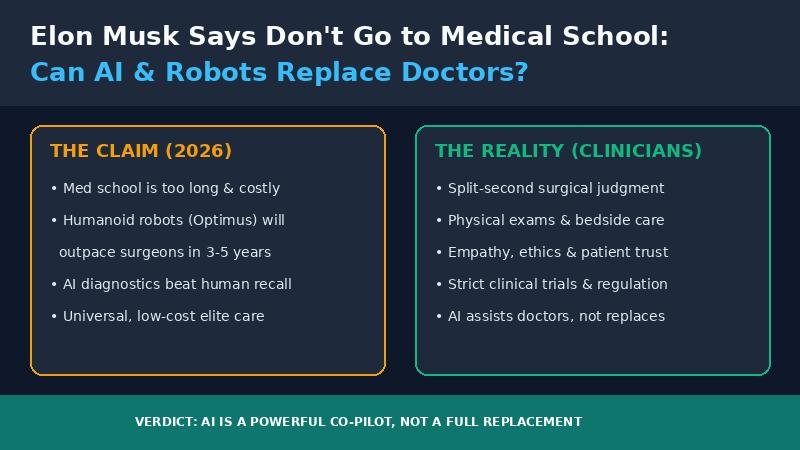
Table of Contents
What Exactly Did Elon Musk Say?
The discussion took place in episode 220 of Moonshots with Peter Diamandis, published on 6 January 2026. The episode was recorded on 22 December 2025. During a conversation about abundant, technology-enabled healthcare, Musk predicted that AI and humanoid robots could make high-quality medical care widely available. Diamandis then asked whether people should avoid medical school. Musk agreed and described it as pointless in that future scenario.
The surrounding conversation matters. Musk was not announcing a change to medical licensing rules, presenting clinical trial results, or issuing guidance to students. He was expressing a technology forecast. He also discussed a future in which robots could perform highly precise operations and healthcare might become dramatically less expensive.
His prediction about robots outperforming the best human surgeons within a few years is a claim about the future. It should not be confused with a result already demonstrated across routine clinical surgery, different specialties, hospitals and patient populations.
Readers can watch the full conversation rather than relying only on a short viral clip: Moonshots episode 220: Elon Musk on AGI, jobs, healthcare and humanoid robots.
Why Does Musk Think Medical School May Become Unnecessary?
His argument rests on several assumptions about the pace and scale of technological progress.
1. AI can process large amounts of medical information
Medical knowledge grows continuously. AI tools can search, summarize and compare large volumes of information quickly. In selected settings, software can help interpret medical images, flag abnormal results, organize records and support clinical decisions. This may reduce time spent on some information-heavy tasks.
But producing a plausible answer is not the same as making a safe diagnosis. An AI system can miss context, generate inaccurate information or perform differently in patients and hospitals that were poorly represented in its training data. A clinician must assess whether an output fits the individual patient.
2. Robots can repeat precise movements
Robotic systems can help surgeons control instruments with precision, view the operating field and perform complex movements through small incisions. In the future, improved sensors, imaging, software and mechanical control may expand what these systems can do.
3. Technology could increase access to specialist care
AI-supported services may help clinicians in areas where specialists are scarce. Remote review of scans, decision-support systems and digital consultations could make some expertise more accessible. However, access also depends on infrastructure, affordability, connectivity, trained staff and reliable referral pathways.
What Can Surgical Robots Actually Do Today?
One of the most important facts missing from many viral discussions is the difference between robot-assisted surgery and autonomous surgery.
Robot-assisted surgery is not the same as a robot surgeon
The US Food and Drug Administration (FDA) explains that robotically assisted surgical devices allow a trained surgeon to control instruments using a computer-assisted system. The surgeon generally operates from a console and directs the movements of the instruments. The device is not an independent surgeon and does not perform an operation without direct human control.
These systems can be useful for selected procedures, including some urological, gynaecological, cardiac, colorectal, thoracic, head and neck and general surgical operations. Their suitability depends on the procedure, the patient’s condition, the equipment, the team’s training and the surgeon’s experience.
| Technology | What it does | Does it replace the doctor? |
|---|---|---|
| AI image analysis | Can flag or classify patterns in selected scans, images or tests. | No. A clinician must interpret results in context. |
| Clinical decision support | Can organize information and suggest possible diagnoses or next steps. | No. It supports, rather than owns, the clinical decision. |
| Robot-assisted surgery | Allows a surgeon to control instruments with computer-assisted precision. | No. Common systems require direct surgeon control. |
| Autonomous surgical research | Investigates whether a machine can complete defined surgical tasks with less direct control. | Not equivalent to a routinely approved, independent robot surgeon for all operations. |
Why surgery is more than moving an instrument
An operation involves much more than a sequence of hand movements. The team must confirm the diagnosis and indication, assess anaesthetic risk, position the patient, maintain sterility, identify anatomy, respond to bleeding, recognize unexpected findings and decide when the planned procedure should change. A surgeon must also manage complications and coordinate postoperative care.
A robot that performs a narrow, pre-programmed task under controlled conditions has not thereby demonstrated that it can safely manage every variation encountered in real patients.
What about LASIK and other automated procedures?
Some procedures use highly automated devices to deliver energy or perform tightly defined steps. This does not mean that the entire episode of care is autonomous. Patient selection, measurements, planning, supervision, recognition of complications and follow-up remain important. A laser performing a programmed action is not the same as an independent ophthalmologist.
Can Artificial Intelligence Replace Doctors Completely?
At present, there is no sound basis for claiming that AI can replace all doctors. AI may perform well on a defined task, but healthcare involves a chain of decisions across diagnosis, treatment, communication, procedures, monitoring and follow-up.
Tasks where AI may assist
- Radiology and pathology support: highlighting suspicious areas for a trained professional to review.
- Clinical documentation: helping prepare summaries, notes and discharge information, subject to verification.
- Risk prediction: identifying patterns that may indicate a higher risk of deterioration or complications.
- Patient communication: explaining general health information in accessible language, while directing patients to professional care when needed.
- Research: helping search literature, organize evidence and identify potential research questions.
- Workflow support: assisting with appointment systems, triage processes and administrative tasks.
Tasks that still require clinical responsibility
- Taking a history and examining a patient when physical findings matter.
- Reconciling conflicting symptoms, examination findings and test results.
- Explaining uncertainty, risks, benefits and alternatives to patients.
- Obtaining informed consent and respecting patient preferences.
- Making decisions when a patient does not fit a standard pattern.
- Responding to unexpected complications and emergencies.
- Taking responsibility for treatment decisions and continuity of care.
The World Health Organization (WHO) has emphasized that AI in health needs safety evaluation, transparency, accountability, privacy protection and appropriate human oversight. Its guidance does not treat technological capability alone as sufficient proof that a system is safe for every clinical use.
Why Human Doctors Will Still Matter
Clinical judgement is not simply memorizing medical facts
A doctor does not diagnose a patient only by matching a symptom to a disease in a database. The clinician weighs the history, examination, probability of different conditions, test limitations, comorbidities and the patient’s circumstances. Two patients with the same scan finding may need different management.
Communication and trust affect care
Patients often need a professional to explain a serious diagnosis, discuss uncertainty, understand their concerns and support difficult decisions. Empathy is not an optional decoration in medicine. Communication helps clinicians understand symptoms, obtain informed consent and build a treatment plan that a patient can realistically follow.
Real patients do not always follow textbook patterns
Patients may have multiple diseases, unusual anatomy, incomplete medical records, language barriers or rapidly changing symptoms. An emergency may require decisions before all investigations are available. Safe care needs a team capable of adapting when circumstances change.
Accountability and ethics cannot be ignored
If an AI recommendation causes harm, important questions arise: Was the system validated for this patient group? Was the output checked? Who was responsible for acting on it? How was patient information protected? These are clinical, legal and ethical questions, not just engineering problems.
Should Students Still Study MBBS in India?
Elon Musk says don’t go to medical school may worry students preparing for NEET-UG or families considering the cost and length of medical education. But a career decision should not be based on one entrepreneur’s forecast. Students should consider their own motivation, aptitude, financial circumstances, willingness to undertake long training and interest in patient care.
In India, the National Medical Commission’s competency-based medical education curriculum describes 4½ academic years of MBBS study followed by one year of compulsory rotating medical internship. The curriculum includes clinical experience, practical learning, communication and problem-oriented approaches. This reflects the fact that medical education is not limited to memorizing information.
Questions students should ask before choosing medicine
- Do I genuinely want to care for patients? Medicine involves responsibility, uncertainty, teamwork and communication, not only academic achievement.
- Can my family and I manage the training pathway? Consider tuition, living expenses, time away from earning and the cost of postgraduate preparation where relevant.
- Am I ready to keep learning? Medical knowledge and clinical tools change throughout a doctor’s career.
- Will I learn to use AI responsibly? Future doctors should understand how AI systems work, where they fail and when not to trust an output.
- Have I explored the daily reality of the profession? Speaking with doctors, observing clinical work where permitted and understanding duty hours can help set realistic expectations.
What should medical students learn in the AI era?
- Strong foundations in anatomy, physiology, pathology, pharmacology and clinical reasoning.
- Evidence-based medicine and the ability to evaluate research quality.
- Digital health and basic AI literacy, including bias, privacy and model limitations.
- Communication, teamwork, leadership and shared decision-making.
- Practical clinical skills and the ability to recognize emergencies.
The practical message is not to ignore AI. It is to become a doctor who can use technology critically while retaining the knowledge and skills needed to protect patients.
Which Medical Skills May Become More Important?
It is difficult to predict which specialties will grow or shrink over decades. It is more useful to identify capabilities likely to remain valuable across many areas of medicine.
| Skill area | Why it may matter |
|---|---|
| Complex clinical reasoning | Patients often have several interacting problems and incomplete information. |
| Procedural and emergency skills | Unexpected events require assessment, adaptation and coordinated action. |
| Patient communication | Trust, consent, shared decisions and clear explanations are central to care. |
| AI and data literacy | Doctors need to evaluate accuracy, bias, limitations and appropriate use. |
| Quality improvement and safety | Healthcare teams must monitor outcomes and detect system failures. |
| Interdisciplinary collaboration | Modern care involves doctors, nurses, pharmacists, therapists, engineers and data specialists. |
Will some routine medical tasks change?
Yes. Repetitive documentation, image pre-screening, scheduling, basic information retrieval and some protocol-driven tasks may become more automated. The extent and pace will vary by country, specialty, regulation, cost and local health-system capacity. Automation of a task does not necessarily mean elimination of the profession that includes it.
Risks and Limitations of AI in Healthcare
AI can improve efficiency, but using it without proper safeguards can create harm.
1. Incorrect or fabricated outputs
Generative AI may produce confident but inaccurate statements. A clinician should independently verify clinically important claims, medication details, calculations and references.
2. Bias and unequal performance
A model developed using data from one population may not work equally well in another. Differences in age, sex, ethnicity, disease prevalence, equipment and local practice can affect performance. Systems need appropriate external validation.
3. Privacy and cybersecurity
Medical records contain sensitive personal information. Healthcare organizations must consider consent, data minimization, access controls, secure storage and applicable privacy laws before using AI tools with patient data.
4. Over-reliance and automation bias
Clinicians may give excessive weight to a computer recommendation, even when it conflicts with the patient’s condition. Training should encourage users to question outputs and recognize when a tool is outside its intended use.
5. Unclear responsibility
Hospitals, clinicians, developers and regulators need clear responsibilities for testing, monitoring and responding to failures. A system should not be deployed merely because it is impressive in a demonstration.
Key Takeaways: What Does the Future of Medicine Look Like?
Symptoms, history, examination and preferences
Verifies findings, explains options and makes accountable decisions
Human oversight, outcome monitoring and adjustment of care
- Musk’s remark was a prediction about future technology, not established evidence that medical education is useless.
- Current robot-assisted surgical systems commonly remain under direct surgeon control.
- AI can support selected medical tasks but can also make errors and show bias.
- Doctors need clinical knowledge, communication skills, judgement and the ability to use technology responsibly.
- Students should make education decisions based on evidence, personal suitability and realistic career planning—not a viral quotation alone.
Frequently Asked Questions
1. Did Elon Musk really say not to go to medical school?
Yes. In a January 2026 episode of the Moonshots podcast with Peter Diamandis, Musk agreed when asked whether people should avoid medical school, describing it as pointless in the future he was predicting. The comment was part of a speculative discussion about AI, robots and abundant healthcare.
2. Did Elon Musk say robots will become better surgeons than humans?
He predicted that advanced humanoid robots could outperform the best human surgeons within a few years. This is his forecast, not proof that such performance has been achieved across real-world surgery or approved for independent use.
3. Can a robotic surgical system operate without a surgeon?
Common robotically assisted surgical systems are controlled directly by trained surgeons. The FDA states that these systems do not perform surgery without direct human control. Research into more autonomous surgical tasks is a separate area.
4. Will AI replace MBBS doctors?
There is no reliable evidence that AI will replace MBBS doctors completely. AI may automate or support some tasks, but doctors remain responsible for integrating findings, communicating with patients, managing uncertainty and providing clinical care.
5. Is it still worth studying medicine in 2026?
It can be a worthwhile path for students who are interested in patient care and understand the demands of medical training. They should also prepare for a profession in which digital tools and AI are likely to become increasingly important.
6. Will AI reduce the number of doctors needed?
The long-term effect is uncertain. AI may increase efficiency in some tasks, but it may also expand access to services and create new needs for oversight, complex care and technology governance. The effect will differ across health systems and specialties.
7. What is the difference between AI diagnosis and robotic surgery?
AI diagnosis refers to software analyzing information such as symptoms, records or medical images to support assessment. Robotic surgery involves mechanical instruments and computer systems used during an operation. One is not the same as the other, and both require careful clinical oversight.
8. What should future doctors do to remain relevant?
They should build strong clinical foundations, learn evidence appraisal and AI literacy, maintain practical skills, communicate well and understand patient safety, privacy and professional accountability.
Conclusion
Elon Musk says don’t go to medical school is a headline that captures attention, but the evidence needs a more measured interpretation. AI and robotics are advancing and will likely change how doctors diagnose, operate, document and monitor care. Yet today’s robot-assisted surgical systems are not independent replacements for surgeons, and AI tools have limitations that require professional oversight.
For students, the sensible response is neither to dismiss technology nor to abandon medicine because of a prediction. Understand the realities of medical education, choose the profession for sound personal reasons and prepare to work alongside increasingly capable tools. The future may involve more machines in healthcare—but safe, compassionate and accountable patient care remains the central goal.
Disclaimer
This article is for general educational and informational purposes. It discusses public statements and developments in medical technology; it is not personal career, medical, legal or investment advice. Predictions about future AI capabilities are uncertain and should not be treated as established facts. Students should consult recognized education authorities, medical colleges and qualified career counsellors before making education decisions. Clinical AI and robotic systems should be used only within their authorized indications and under appropriate professional oversight.
References and Further Reading
- Peter Diamandis, Moonshots episode 220: Elon Musk on AGI, jobs, clean energy and humanoid robots (published 6 January 2026; recorded 22 December 2025). Primary video source for the quotation and its context.
- US Food and Drug Administration (FDA): Computer-Assisted Surgical Systems. Explains robotically assisted surgical devices and the role of direct surgeon control.
- World Health Organization: Ethics and Governance of Artificial Intelligence for Health (2021). Guidance on human autonomy, safety, transparency, accountability and equity.
- World Health Organization: Ethics and Governance of Artificial Intelligence for Health—Guidance on Large Multi-Modal Models (2025 publication page). Discusses opportunities and risks of generative and multimodal AI in health.
- World Health Organization: Regulatory Considerations on Artificial Intelligence for Health (2023). Covers safety, effectiveness, validation, transparency and regulation.
- National Medical Commission (India): Competency-Based Medical Education Curriculum. Describes the MBBS training period, internship and competency-based learning.
- World Health Organization: New report calls for stronger ethics oversight of AI-related health research (21 September 2026).