By Dr Sagar Rajkuwar (MS-ENT) · Reviewed: 4 November 2026
Each autumn the burden of winter respiratory viruses & surveillance in the United Kingdom rises to the top of the NHS workload. The UK Health Security Agency (UKHSA) publishes a weekly surveillance bulletin on influenza, SARS-CoV-2, respiratory syncytial virus (RSV), norovirus and other seasonal pathogens between weeks 40 and 20 of each calendar year. In October 2026 the agency re-started that bulletin for the 2026-27 season. Understanding exactly what UKHSA is tracking — and the NHS vaccines, antivirals and public-health measures that match — is one of the most practical reads for anyone in the UK or planning to travel there.
In this complete 2026-27 clinical guide I summarise the full picture of winter respiratory viruses & surveillance in the United Kingdom — the four main viruses the UKHSA tracks, the current 2025-26 season data, the opening 2026-27 season trends (weeks 40-44), the NHS vaccination offer (flu, COVID-19 autumn booster, RSV Abrysvo, infant nirsevimab), prevention advice, and when to call NHS 111 or 999. Information is drawn from UKHSA, NHS England and gov.uk, with supporting peer-reviewed evidence.
Table of Contents
- 1. What UKHSA Surveillance Covers
- 2. Seasonal Influenza — Strains & A(H3N2)
- 3. COVID-19 — SARS-CoV-2 Lineages in 2026
- 4. Respiratory Syncytial Virus (RSV)
- 5. Norovirus & Other Winter Pathogens
- 6. The 2025-26 Season — Key Findings
- 7. The Opening 2026-27 Season (Weeks 40-44)
- 8. NHS Vaccination Offer 2026
- 9. Personal & Household Prevention
- 10. When to Call NHS 111 or 999
- 11. Frequently Asked Questions
- 12. Summary & Conclusion
- 13. References
1. What UKHSA Surveillance Covers
The UKHSA brings together five complementary surveillance systems to describe winter respiratory viruses & surveillance in the United Kingdom. These are Respiratory DataMart (a sentinel laboratory network reporting PCR-positive results from hospital samples), the Second Generation Surveillance System (SGSS) (national laboratory reporting), the Unified Sample Dataset (USD) (a merged SARS-CoV-2 dataset), ED syndromic surveillance (emergency department attendance patterns), and the UKHSA’s Respiratory Virus Unit for genomic sub-typing. Together these give the agency a near-real-time read on activity levels, hospitalisations and circulating strains.
The agency reports every indicator with a trend (increasing, stable, decreasing) and a level (baseline, low, medium, high). The weekly surveillance report is the single best public window into winter respiratory viruses & surveillance in the United Kingdom. Here is a short NHS explainer video on seasonal respiratory viruses and how surveillance supports public-health decisions:
2. Seasonal Influenza — Strains & A(H3N2)
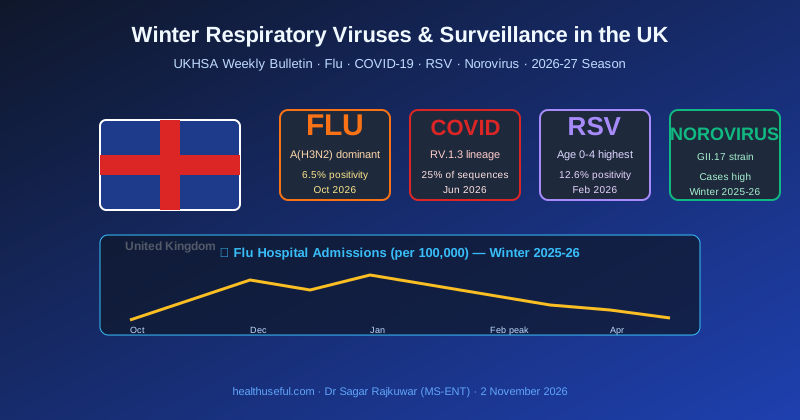
Seasonal influenza is the dominant signal in each autumn’s UKHSA bulletin. The circulating subtypes vary each year but the 2025-26 season was dominated by influenza A(H3N2), which the UKHSA’s Respiratory Virus Unit confirmed on sub-typing of samples throughout winter. A(H3N2) tends to cause more severe illness in older adults than other A strains. Hospital admissions for flu in England ranged from a peak around 1.23 per 100,000 in early January to 0.74 per 100,000 by week 8 (February) of 2026 as the wave receded.
Flu activity in winter respiratory viruses & surveillance in the United Kingdom is tracked by Respiratory DataMart positivity, ED attendances for influenza-like-illness (ILI), and the GP sentinel scheme. In week 6 of 2026 flu positivity fell to 3.9% from 5.5% a week earlier — a typical late-winter decline. Importantly, UKHSA noted that flu levels remained “stubbornly stable” in those aged 85 and over into the New Year, reinforcing the message that the NHS flu vaccine should be taken up by all eligible older adults.
3. COVID-19 — SARS-CoV-2 Lineages in 2026
COVID-19 is now embedded within the routine framework of winter respiratory viruses & surveillance in the United Kingdom. The UKHSA runs weekly genomic surveillance of SARS-CoV-2 lineages on sequenced PCR-positive samples from SGSS. In the sequencing window of 8-21 June 2026 the dominant lineage was RV.1.3, accounting for approximately 25% of sequenced cases. Lineage composition shifts every few months; the full list of currently circulating lineages is published in Figure 4 of the UKHSA national surveillance report.
COVID-19 community activity in 2026 has remained at baseline to low levels for most weeks, with mixed trends through summer and gradual increases from week 35 (late August 2026). Hospital admission rates for COVID-19 rose modestly to around 0.25 per 100,000 by week 33. The NHS autumn booster is prioritised to adults 75 and over and clinical risk groups to protect against hospitalisation from current and emerging lineages.
4. Respiratory Syncytial Virus (RSV)
Respiratory syncytial virus (RSV) is the single most important paediatric respiratory pathogen in winter respiratory viruses & surveillance in the United Kingdom and increasingly matters for older adults too. In the 2025-26 season RSV positivity was highest in children aged 0 to 4 years — a rolling 7-day positivity rate of 12.6% was recorded up to 1 February 2026 in that age band. Hospital admissions peaked around 1.11 per 100,000 in early February then fell to 0.79 per 100,000 by week 8.
From 2023 the NHS has operated two major RSV protection programmes that have transformed prevention — maternal vaccination with Abrysvo (bivalent RSVpreF vaccine, offered to pregnant women from 28 weeks’ gestation) and passive immunisation of infants with nirsevimab (long-acting monoclonal antibody) in an increasing number of regions. From age 75, the NHS RSV vaccine is also offered to older adults. These three programmes combined are expected to meaningfully reduce the peak paediatric admission rates visible in winter respiratory viruses & surveillance in the United Kingdom.
5. Norovirus & Other Winter Pathogens
Although not strictly respiratory, norovirus is reported in the same UKHSA weekly bulletin because it drives the same winter pressure on NHS hospitals. The 2025-26 season saw particularly high norovirus activity that began stabilising in weeks 5-6 (late January and early February 2026). Norovirus transmission is faecal-oral, with care-home and hospital outbreaks common. The agency also reports on rhinovirus, adenovirus, parainfluenza viruses 1-4, human metapneumovirus (hMPV) and seasonal coronaviruses (NL63, OC43, 229E, HKU1) which collectively drive the “common cold” burden every winter.
6. The 2025-26 Season — Key Findings
Several headlines characterise the 2025-26 season of winter respiratory viruses & surveillance in the United Kingdom:
- Early flu start in mid-December 2025 followed by a sharp rise, then a sustained decline from the New Year
- A(H3N2) dominance on sub-typing, with early UKHSA vaccine-effectiveness data confirming the flu vaccine worked well against the dominant strain
- Flu levels “stubbornly stable” in adults aged 85+ even as overall levels fell — the single biggest clinical message for the elderly
- RSV peak in early February in children 0-4 years with positivity 12.6%
- High norovirus activity stabilising by weeks 5-6, with many care-home and hospital outbreaks
- COVID-19 at baseline throughout the season — a very quiet COVID winter in UK terms
- Weekly flu hospital admissions declined to 0.74/100,000 by week 8 of 2026
7. The Opening 2026-27 Season (Weeks 40-44)
The 2026-27 winter has now begun. UKHSA weekly surveillance restarted in week 40 (28 September-4 October 2026). As of the most recent bulletin, influenza activity is increasing and circulating at baseline levels, with flu positivity rising to 6.5% from 5% the previous week. Overall flu hospitalisations were 1.97 per 100,000 in week 40. COVID-19 activity is increasing and circulating at low levels; RSV activity remains low at baseline levels, with hospital admission rate 0.11 per 100,000. This pattern is typical of early autumn in winter respiratory viruses & surveillance in the United Kingdom and the peak is expected in January 2027 if the previous season’s curve repeats.
8. NHS Vaccination Offer 2026
The autumn 2026 NHS vaccination offer in support of winter respiratory viruses & surveillance in the United Kingdom includes:
- Seasonal flu vaccine: adults aged 65 and over, pregnant women, those in clinical risk groups, frontline NHS and social-care workers, children in school years Reception to Year 11 (nasal spray), and all two- and three-year-olds
- COVID-19 autumn booster: adults aged 75 and over, residents of adult care homes, and those aged 6 months to 74 years in clinical risk groups
- RSV vaccine (Abrysvo): pregnant women from 28 weeks’ gestation, adults aged 75 to 79
- Infant nirsevimab: long-acting monoclonal antibody for RSV protection, offered in a growing number of regions
- Pneumococcal vaccine: adults aged 65 and over, those in at-risk groups
9. Personal & Household Prevention
Alongside NHS vaccines, individuals can take several simple evidence-based steps that support winter respiratory viruses & surveillance in the United Kingdom by cutting onward transmission. First, perform a thorough 20-second hand wash with soap and water, especially after public transport, shopping or caring for someone unwell. Second, catch coughs and sneezes in a tissue (then “bin it, kill it”). Third, stay home if you have fever, severe cough or vomiting. Fourth, ventilate rooms where possible — open a window for 10 minutes several times a day. Fifth, consider a well-fitting face mask in healthcare settings or on busy public transport, particularly if you are at clinical risk. Sixth, take up every NHS vaccine you are offered.
For elderly or clinically vulnerable relatives, add two more practical steps: ensure they have a prompt GP appointment or NHS 111 contact within 24 hours of any new fever or breathlessness, and keep a pulse oximeter at home for at-risk patients (sustained oxygen saturation below 94% is a red flag). These simple actions make a measurable difference in the household-level data captured by winter respiratory viruses & surveillance in the United Kingdom.
10. When to Call NHS 111 or 999
Most winter respiratory infections resolve with rest, fluids and paracetamol. However, the NHS urges urgent contact when:
- Severe breathlessness — unable to complete a sentence, lips turning blue
- Chest pain or sudden confusion
- Persistent high fever above 39°C that does not respond to paracetamol
- A baby is limp, floppy, feeding poorly or has a very high or very low temperature
- An elderly person suddenly deteriorates — sudden drowsiness, new confusion or a fall
- Pulse oximeter reading persistently below 94% on room air (if available at home)
- Symptoms that improve, then suddenly worsen (biphasic deterioration) — a classic flu complication pattern
For urgent but not life-threatening symptoms call NHS 111; for life-threatening symptoms always call 999 immediately.
11. Frequently Asked Questions (FAQs)
Q1. Where can I read the UKHSA weekly surveillance bulletin?
The weekly “National flu and COVID-19 surveillance report” is published every Thursday on gov.uk during the surveillance season (weeks 40 to 20). It contains the trend, level, and comments for each virus plus hospital admission rates and vaccine uptake. This bulletin is the authoritative single source on winter respiratory viruses & surveillance in the United Kingdom.
Q2. Which flu strain is circulating this winter?
The dominant sub-typed strain in the 2025-26 UK season was A(H3N2). Sub-typing for 2026-27 is still in progress at the time of writing (week 40-44). UKHSA will confirm the dominant strain within the first 6-8 weeks of the season.
Q3. How effective is the 2026-27 NHS flu vaccine?
Early UKHSA vaccine effectiveness data from last winter (2025-26) showed the flu vaccine worked well against the dominant A(H3N2) strain. Effectiveness varies 20-60% across seasons depending on antigenic match; it is still strongly recommended for all eligible groups.
Q4. Can I have the flu, COVID-19 and RSV vaccines at the same visit?
Yes. Co-administration of the flu, COVID-19 autumn booster and RSV vaccines at the same appointment is NHS-recommended and safe. Many pharmacies and GP surgeries offer combined appointments to improve uptake.
Q5. What is nirsevimab and how does it differ from the RSV vaccine?
Nirsevimab is a long-acting monoclonal antibody given to infants (not the mother) as a single injection to provide passive immunity against RSV for up to 5 months. Abrysvo is a maternal vaccine given from 28 weeks’ gestation that passes antibodies to the baby transplacentally. Both are protective strategies against RSV in infants.
Q6. What is “flu-like illness (ILI)” in NHS data?
Influenza-like-illness (ILI) is a clinical syndrome of fever ≥38°C plus cough or sore throat of acute onset, in the absence of another diagnosis. It is a surveillance term, not a laboratory diagnosis — a patient with ILI could have flu, COVID-19, RSV or another respiratory pathogen. ILI rates are a core input into winter respiratory viruses & surveillance in the United Kingdom.
Q7. Should I wear a face mask in public during winter?
A well-fitting FFP2/N95 or surgical mask provides measurable protection in crowded indoor settings and in healthcare contexts. The NHS recommends mask-wearing for all healthcare visitors with any respiratory symptoms, and clinically vulnerable individuals may wish to wear one in busy environments throughout the peak winter weeks.
12. Summary and Conclusion
Winter respiratory viruses & surveillance in the United Kingdom is one of the most rigorous public-health monitoring programmes in the world. The UKHSA weekly bulletin combines laboratory, hospital and syndromic data to give a near-real-time picture of flu, COVID-19, RSV, norovirus and other seasonal pathogens. The 2025-26 season was dominated by influenza A(H3N2) with an early start, a large RSV peak in young children and high norovirus activity; the opening 2026-27 season (week 40) shows increasing flu and COVID at baseline levels. The NHS autumn vaccination offer — flu, COVID-19 boosters, maternal Abrysvo, infant nirsevimab and the 75-79 RSV adult programme — is the single most effective population intervention.
For individuals, the practical take-home is clear: take up every NHS vaccine you are offered, follow the five prevention steps (hand hygiene, catch coughs/sneezes, stay home when unwell, ventilate, mask where sensible), know the NHS 111 and 999 red flags, and consult the weekly UKHSA bulletin if you want to follow winter respiratory viruses & surveillance in the United Kingdom at national scale. Combined, these actions protect you, your family and the NHS through the peak winter weeks.
13. References
- UK Health Security Agency. National flu and COVID-19 surveillance report, weeks 40-44, 2026-27 season. gov.uk, October 2026.
- UKHSA. Weekly winter surveillance bulletin, 2025-26 season. Published weeks 40-20.
- UKHSA. Respiratory syncytial virus in the UK — annual epidemiological reports. Updated 13 August 2026.
- UKHSA. Flu levels ‘stubbornly stable’ in older age groups despite overall decline. 9 January 2026.
- UKHSA. Norovirus cases stabilising but remain high. 13 February 2026.
- NHS England. Autumn 2026 flu, COVID-19 and RSV vaccination programme. 2026.
- NHS England. Nirsevimab passive immunisation of infants against RSV. 2024 update.
- Department of Health & Social Care. UK winter resilience plan 2026-27. 2026.
- Royal College of Paediatrics and Child Health. Bronchiolitis pathway. 2024.
- Journal of Infection and peer-reviewed UK influenza vaccine effectiveness studies, 2024-26.
ENT Consultation & Surgery
Dr. Sagar Rajkuwar (MS-ENT)
Consultant ENT Specialist & Head-Neck Surgeon
Prabha ENT Clinic, Ambad, Nashik, Maharashtra, India
📱 7387590194 | 9892596635
🌐 www.entspecialistinnashik.com
Medical Disclaimer: This article is for educational purposes only and does not replace professional medical advice. UKHSA surveillance data are provisional and interpreted by qualified public-health physicians. For personal clinical concerns, contact your GP, NHS 111, or your local emergency department. In the UK, call 999 for life-threatening symptoms including severe breathlessness, blue lips, chest pain or collapse.