By Dr Sagar Rajkuwar (MS-ENT) · Reviewed: 31 October 2026
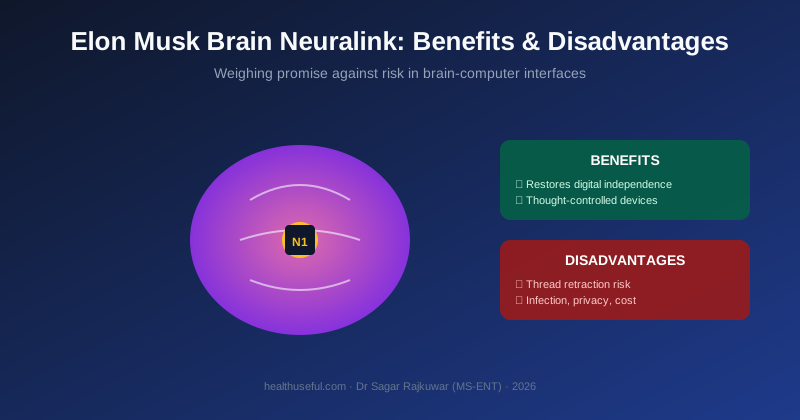
The debate around the elon musk brain neuralink benefits and disadvantages has moved from science fiction to the operating theatre. Since Neuralink performed its first-in-human implant on 28 January 2024, the N1 Implant has been placed into more than 26 patients worldwide, generating real clinical outcomes that physicians, patients and families now have to weigh carefully. The company’s PRIME Study (Precise Robotically Implanted Brain-Computer Interface, NCT06429735) has reported both striking successes — paralysed patients controlling computers, typing at conversational speed, and even creating digital art with their thoughts — and real complications such as thread retraction and ongoing debate about neural data privacy.
As an ENT Specialist who works closely with patients facing neurological and sensory challenges, I find the honest discussion of the elon musk brain neuralink benefits and disadvantages critically important. Patients and their relatives frequently read sensational headlines and arrive in clinic expecting either a miracle or a disaster. The truth, as always in medicine, lies somewhere in between. This article presents a balanced 2026 clinical review of the brain-computer interface (BCI) technology, drawing from the U.S. Food and Drug Administration (FDA), peer-reviewed neuroscience, independent ethicists and Neuralink’s own clinical disclosures.
Table of Contents
- 1. What is Neuralink and the Telepathy Device?
- 2. Benefits of the Neuralink Brain Implant
- 3. Disadvantages and Risks
- 4. Real Patient Outcomes: Noland Arbaugh & Beyond
- 5. Ethical, Privacy & Equity Issues
- 6. Who Should Consider the Implant?
- 7. Frequently Asked Questions
- 8. Summary and Conclusion
- 9. References
1. What is Neuralink and the Telepathy Device?
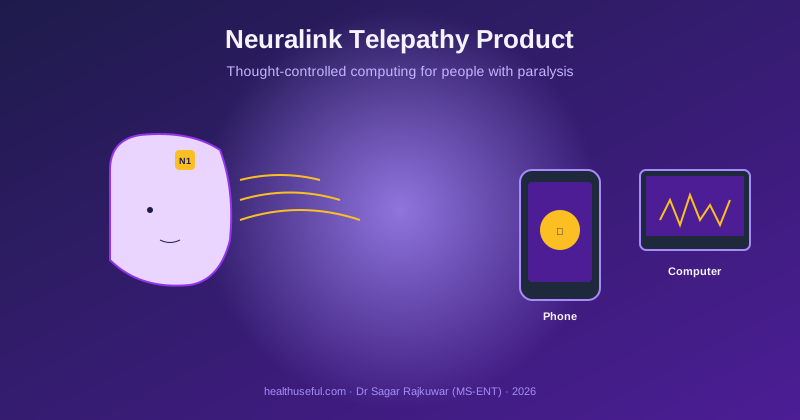
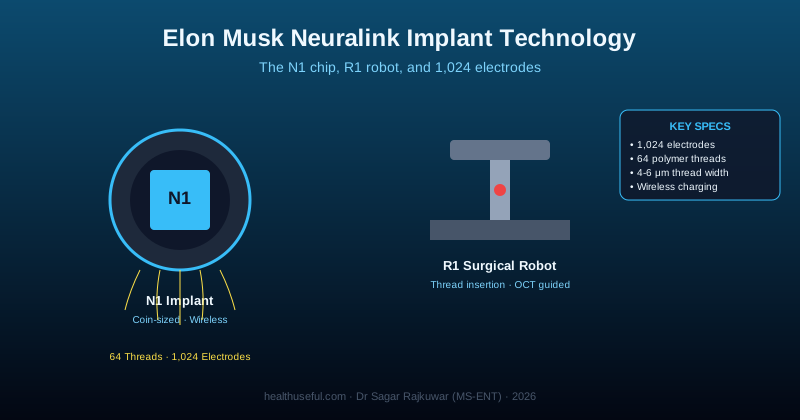
Neuralink is a neurotechnology company co-founded by Elon Musk in 2016 with the mission of building a safe, high-bandwidth brain-computer interface. Its first product, officially named Telepathy, consists of a coin-sized sealed implant (the N1) placed flush with the skull and a surgical robot (the R1) that threads 64 ultra-fine polymer electrode arrays into the brain’s motor cortex. The device reads neural signals associated with movement intention and converts them, by Bluetooth, into cursor and device commands on a phone or computer.
When discussing the elon musk brain neuralink benefits and disadvantages, it is important to understand that the technology is still investigational. The FDA granted an Investigational Device Exemption (IDE) on 25 May 2023, and the first implant followed in January 2024. The device also holds FDA Breakthrough Device Designation for severe speech impairment, and a separate Neuralink device called Blindsight is being developed to restore vision. As of October 2026, 26 or more patients have received implants across trial sites in the United States, Canada, the United Kingdom and the United Arab Emirates. The system is not yet available to the general public.
Here is a brief visual walkthrough from Neuralink’s own clinical team that explains how the N1 implant and the Telepathy product work in a real patient:
2. Benefits of the Neuralink Brain Implant
When patients and relatives ask me to summarise the elon musk brain neuralink benefits and disadvantages, I always start with the genuine, documented benefits — because for a small group of severely disabled people, this device is already life-changing. The published outcomes from the PRIME Study and parallel trials provide a credible picture of what the device can and cannot do today.
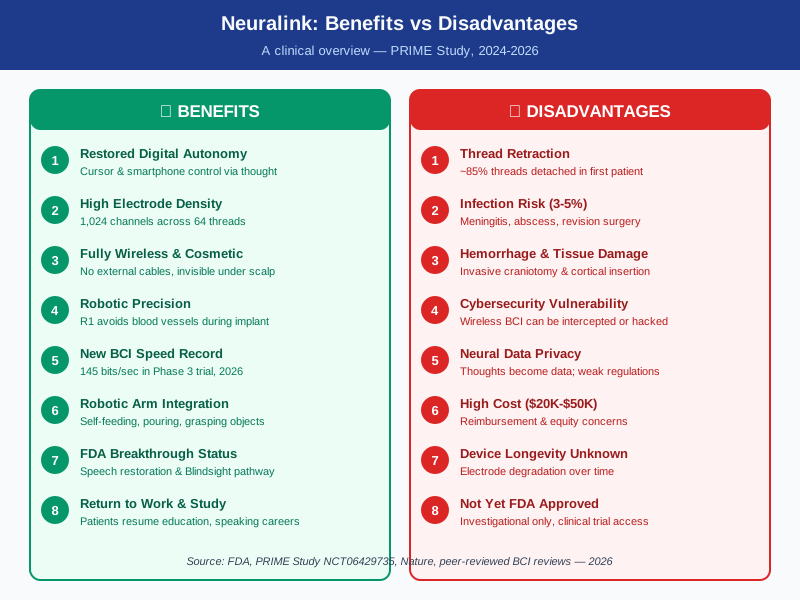
2.1 Restored Digital Independence
The single clearest benefit is the restoration of digital autonomy for people with quadriplegia or amyotrophic lateral sclerosis (ALS). In the PRIME Study, participants who could no longer move their limbs are now able to control a cursor, open emails, send messages, browse the internet and operate smart-home devices using only their thoughts. The first recipient, Noland Arbaugh, publicly stated that the N1 implant allows him to “control a computer just like anyone else can, which is not something I was able to do beforehand.” For a 29-year-old paralysed from the shoulders down after a 2016 diving accident, this is a non-trivial improvement in quality of life.
2.2 High Electrode Density and Speed
Compared with earlier brain-computer interface systems, the elon musk brain neuralink benefits and disadvantages discussion must acknowledge the device’s technical leap in electrode density. The N1 implant uses 1,024 electrodes distributed across 64 ultra-fine polymer threads, each thread only 4–6 micrometres wide — thinner than a red blood cell. This is roughly an order of magnitude more channels than the Utah array that has been the research gold standard for two decades. The practical consequence is bandwidth: Phase 3 interim data released in March 2026 reported an average decoding speed of 145 bits per second, fast enough for conversational-speed typing and real-time robotic arm control.
2.3 Fully Wireless and Cosmetically Invisible
Earlier BCI systems typically required a cable protruding through the scalp (the pedestal connector of a Utah array), which is both a cosmetic issue and a chronic infection risk. The N1 is fully wireless: data streams by Bluetooth and the battery recharges by induction through an external coil placed over the scalp. The device sits flush with the skull, which means it is invisible under the hair after healing. This is a tangible benefit for day-to-day life.
2.4 Robotic Precision During Implantation
Any serious review of the elon musk brain neuralink benefits and disadvantages must mention the R1 Surgical Robot. Because the electrode threads are too thin and flexible for a human surgeon to insert by hand, the R1 uses an eight-foot gantry with five cameras and an optical coherence tomography (OCT) system to see brain surface vasculature, then uses a 24-micrometre tungsten-rhenium needle to insert threads at pre-planned coordinates while actively avoiding blood vessels. The robot can insert approximately six threads per minute to depths exceeding 50 mm. In theory, this reduces procedural hemorrhage risk compared with manual placement.
2.5 Expanding Clinical Indications
Among the elon musk brain neuralink benefits and disadvantages, the pipeline matters for patients looking ahead. In May 2025 the FDA granted Breakthrough Device Designation for a Neuralink device aimed at restoring communication in people with severe speech impairment — including conditions such as ALS, stroke, spinal cord injury, cerebral palsy and multiple sclerosis. In parallel, Blindsight (vision restoration via direct visual cortex stimulation) and Deep (a device targeted at Parkinson’s tremors) received or are seeking similar designations. Each new indication multiplies the potential clinical benefit, provided safety is established.
3. Disadvantages and Risks of Neuralink
No clinical conversation about the elon musk brain neuralink benefits and disadvantages is complete without a frank account of the risks. These are not hypothetical: several have already been observed in the first handful of implanted patients, and others are drawn from decades of peer-reviewed evidence on invasive BCI and deep brain stimulation (DBS).
3.1 Thread Retraction
The best-documented problem is thread retraction — the fine polymer electrode threads physically pulling back from the brain tissue in the weeks after surgery. In Neuralink’s first patient, Noland Arbaugh, approximately 85% of the implanted threads are reported to have retracted or lost signal. His brain moved more during normal activity than the engineering team had anticipated, which produced mechanical stress on the threads. Neuralink recovered most of the lost performance through software updates that re-weighted the surviving channels, and the surgical plan for subsequent patients has been revised to insert threads deeper, but the episode shows that long-term mechanical reliability is still an open question.
3.2 Infection Risk
Any craniotomy that opens the skull carries a baseline infection risk. Systematic reviews of deep brain stimulation (DBS) — the closest commercially approved comparator — report an infection incidence of approximately 3.79–4.57%, and infection associated with the chronically implanted NeuroPace RNS system has been reported at 4.1% procedurally with cumulative infection rates up to 12.1% over long follow-up. Infections can lead to meningitis, brain abscess, septic emboli, and in nearly all cases, device explantation plus prolonged antibiotic therapy. This is a core element of the elon musk brain neuralink benefits and disadvantages that patients must understand before signing a consent form.
3.3 Hemorrhage and Tissue Damage
Even with robotic guidance, placing dozens of threads into the cerebral cortex involves penetrating thousands of neurons and microvessels. Independent ethicists have specifically flagged neurosurgical complications — bleeding, swelling and tissue damage — as central concerns because, unlike a pedestal electrode, the N1 device cannot be easily removed and replaced if something goes wrong. Published analyses in Nature and bioethics journals note that long-term biocompatibility of the fine polymer threads remains unknown and that chronic microglial activation around indwelling electrodes can slowly degrade signal quality.
3.4 Cybersecurity Vulnerability
Because the N1 communicates wirelessly over Bluetooth, independent researchers and the FDA itself have raised cybersecurity concerns typical of any wireless implanted device. An intercepted or manipulated BCI signal could, in principle, inject false commands, exfiltrate neural data or disable the device. Ethicists writing in Live Science and peer-reviewed BCI reviews have specifically warned about unauthorised access, wireless interception and tamper resistance as unresolved issues requiring encryption and secure authentication.
3.5 Neural Data Privacy
Perhaps the most philosophically unsettling item on the elon musk brain neuralink benefits and disadvantages list is neural data privacy. The N1 implant records action potentials from the motor cortex — not thoughts in the broad sense, but the raw electrical activity underlying intended movement. Current data-protection laws (HIPAA in the United States, GDPR in Europe, India’s DPDPA 2023) were written for conventional electronic health records and arguably do not adequately address bulk recordings of cortical activity. Independent reviewers have urged clear ethical and legal guidelines before this technology scales.
3.6 High Cost and Equity Concerns
Industry analyses project a per-implant cost in the USD 20,000–50,000 range, excluding the specialised surgical infrastructure and lifelong software support. Even in high-income countries, that figure raises hard questions about insurance reimbursement and equitable access. In lower- and middle-income countries, including India, the practical availability of such a device for the average patient with spinal cord injury is likely to remain remote for the foreseeable future.
3.7 Device Longevity and Not Yet FDA-Approved
Long-term electrode degradation has been observed in other BCI platforms, and Neuralink has not disclosed a specific service-life figure for the N1. The device also remains investigational — it is not FDA-cleared for commercial sale, and access outside the clinical trials is not possible as of October 2026. These are important realities that balance the enthusiasm around the elon musk brain neuralink benefits and disadvantages.
4. Real Patient Outcomes: Noland Arbaugh and Beyond
The clearest window into the practical elon musk brain neuralink benefits and disadvantages is the lived experience of the first trial participants. Noland Arbaugh, implanted on 28 January 2024, broke a 2017 world record for BCI cursor control within weeks of surgery, used the device to play chess and video games, and in October 2025 — 21 months post-implant — publicly described his implant (which he nicknames “Eve”) as having allowed him to resume full-semester university coursework in neuroscience and to begin a paid speaking career. He described his experience in a 2026 World Governments Summit talk, saying the brain chip helped him “reclaim independence.”
In August 2024, the second recipient, Alex, became the first participant to control a robotic arm. By January 2026 enrolment had reached 21 participants globally, and by June 2026 the total had risen to 26 patients across trial sites in the United States, Canada, the United Kingdom and the UAE. Audrey Crews, the ninth recipient and first woman to receive the N1, used the device to create original digital artwork, which Neuralink published in June 2026. The first UK patient — a man with motor neuron disease — was implanted in October 2025 and reportedly controlled a computer within hours of surgery. Neuralink has publicly stated that no serious device-related adverse events have occurred across participants to date, although this claim is self-reported and awaits independent peer-reviewed confirmation.
5. Ethical, Privacy and Equity Issues
A rigorous consideration of the elon musk brain neuralink benefits and disadvantages cannot stop at the operating theatre. Several ethical questions remain unresolved. First, Neuralink chose not to register the first PRIME study at ClinicalTrials.gov on its initial launch — an unusual practice that drew specific criticism from The Conversation and independent commentators, since trial registration is required by most academic journals and improves transparency. Second, the company’s early animal-testing record was criticised by the Physicians Committee for Responsible Medicine, although the U.S. Department of Agriculture found no breaches on inspection. Third, in January 2026, STAT News reported that Neuralink hired a senior FDA official from the office that regulates the company, which raised conflict-of-interest concerns.
From an informed-consent standpoint, the elon musk brain neuralink benefits and disadvantages present a classic ethical dilemma — patients enrolling in the trial have very few alternative options for restoring digital autonomy, which can place them in a position of therapeutic desperation that is difficult to reconcile with truly voluntary consent. These are not reasons to abandon the technology, but they are reasons to insist on peer-reviewed publication, independent oversight and transparent reporting of every adverse event.
6. Who Should Consider the Neuralink Implant?
In 2026, the practical answer to who should consider the elon musk brain neuralink benefits and disadvantages is narrow. The PRIME Study inclusion criteria are adults aged 18 or above with limited or no ability to use both hands due to cervical spinal cord injury (C5 or higher) or amyotrophic lateral sclerosis (ALS). Patients with other conditions — stroke, cerebral palsy, severe speech impairment — may qualify for related trials such as CONVOY or the newer speech-restoration study. Interested patients can join Neuralink’s United States Patient Registry; the CAN-PRIME and GB-PRIME trials provide access in Canada and the United Kingdom respectively.
For the vast majority of patients I see in my ENT practice in Nashik — including those with sensorineural hearing loss, chronic rhinosinusitis or recurrent tonsillitis — the elon musk brain neuralink benefits and disadvantages are, at present, mostly academic. The device is not an option, and conventional evidence-based treatments remain the right choice. That said, patients with profound hearing loss may still be eligible for the cochlear implant, which is a mature, FDA-approved, insurance-covered BCI relative that has transformed lives for four decades. If you are curious about related work on hearing, you may wish to read my article on sensorineural hearing loss reconstruction, as well as my overview of how a neurologist checks the nerves.
7. Frequently Asked Questions (FAQs)
Q1. Is the Neuralink implant available to buy in 2026?
No. The device is investigational. Access is restricted to approved clinical trials (PRIME, CAN-PRIME, GB-PRIME, CONVOY and the speech-restoration study). As of October 2026, Neuralink has not yet received a full Premarket Approval (PMA), and the earliest realistic FDA commercial clearance window is late 2026 to 2027.
Q2. Can a Neuralink implant be removed?
In principle, yes — the implant is designed to be removable, and Neuralink has stated that explantation would not cause irreversible harm. However, removal is a second craniotomy and carries its own surgical risk. The electrode threads are fine and flexible; some may remain in the cortex after device removal.
Q3. What happens if the implant malfunctions?
The first patient’s experience illustrates one answer. When the majority of Noland Arbaugh’s threads retracted, Neuralink used software updates to re-weight the remaining working channels. Where software alone cannot recover function, revision surgery is possible but has not yet been performed on a trial participant.
Q4. Does the Neuralink device read thoughts?
No, not in the broad everyday sense. The N1 records neural action potentials from a small region of the motor cortex that encodes movement intention. It cannot decode abstract thoughts, memories or emotions. The marketing name “Telepathy” is therefore a simplification; the device enables thought-to-cursor control, not mind reading.
Q5. How much does the Neuralink implant cost?
Participants in the clinical trials pay nothing — Neuralink funds the surgery and follow-up. Industry projections estimate a future per-implant cost in the USD 20,000–50,000 range, with CMS reimbursement discussions ongoing.
Q6. What are the alternatives?
Competing brain-computer interface platforms include Synchron‘s endovascular Stentrode (less invasive, implanted via the jugular vein), BrainGate and the Utah array family (academic standard), and Blackrock Neurotech‘s MoveAgain system. For profound hearing loss, mature FDA-approved BCI relatives — the cochlear implant and the auditory brainstem implant — remain the standard of care.
Q7. Is it safe for children?
No. The PRIME Study and related trials are restricted to adults aged 18 or above. Paediatric use is not being studied in 2026 and would require separate FDA review.
8. Summary and Conclusion
Any honest 2026 account of the elon musk brain neuralink benefits and disadvantages has to hold two truths at once. For a small, carefully selected group of adults with quadriplegia or ALS, the device has produced genuine, independently verifiable improvements in daily function — restored cursor control, communication, assistive-robot operation, and in several cases a return to study and work. These are not minor gains. For the same patients, the device is still experimental: thread retraction has occurred, long-term biocompatibility is unproven, infection and hemorrhage remain real surgical risks, cybersecurity and neural data privacy frameworks are incomplete, and the device is not yet FDA-approved for commercial use.
My clinical conclusion is that patients and families reading about the elon musk brain neuralink benefits and disadvantages should treat this technology with the same careful optimism we extend to any first-generation implanted device. For patients outside the narrow trial inclusion criteria, conventional evidence-based rehabilitation remains the right choice today. For eligible patients and their families, enrolment in a well-run trial — with full informed consent, transparent follow-up and realistic expectations — is a reasonable path to consider. Watch for peer-reviewed publication, independent safety data and FDA PMA decisions over the next 12–24 months.
9. References
- U.S. Food and Drug Administration. Breakthrough Device Designation — Neuralink speech restoration device. May 2025.
- Neuralink Corporation. PRIME Study: Precise Robotically Implanted Brain-Computer Interface (NCT06429735). ClinicalTrials.gov, 2024–2026.
- Neuralink Corporation. GB-PRIME Study (NCT07127172). ClinicalTrials.gov, 2025.
- Musk E, Neuralink. An Integrated Brain-Machine Interface Platform With Thousands of Channels. JMIR 2019;21(10):e16194.
- Satam IA, Szabolcsi R. Ethical and Safety Challenges of Implantable Brain-Computer Interface. Interdisciplinary Description of Complex Systems 2025;23(2):82-94.
- Fiani B et al. Hardware Complications in Clinical Deep Brain Stimulation and Human Intracortical Arrays — a Systematic Review. Neuromodulation 2020.
- Reardon S. Neuralink’s first human trial — Noland Arbaugh’s journey. The Week, May 2026.
- Oxley T et al. Endovascular brain-computer interface — Stentrode first-in-human. J NeuroInterv Surg 2021; cited in BCI complications reviews, Springer 2023.
- Centers for Medicare & Medicaid Services / BCC Research. Projected reimbursement pathways for intracortical BCI. 2024.
- Reuters / STAT News investigative coverage of Neuralink animal welfare and regulatory interaction, 2022–2026.
ENT Consultation & Surgery
Dr. Sagar Rajkuwar (MS-ENT)
Consultant ENT Specialist & Head-Neck Surgeon
Prabha ENT Clinic, Ambad, Nashik, Maharashtra, India
📱 7387590194 | 9892596635
🌐 www.entspecialistinnashik.com
Medical Disclaimer: This article is for educational purposes only and does not replace professional medical advice. Neuralink’s N1 implant is investigational and not yet FDA-approved for commercial use. Clinical trial enrolment and surgical decisions must be made in consultation with qualified neurosurgeons and neurologists based on an individual patient’s condition.