Normal Audiogram: Understanding Normal Hearing Test Results Explained
According to a normal audiogram, an individual’s hearing sensitivity is within acceptable range across all frequencies that were evaluated. A result is deemed normal in a conventional hearing assessment if all thresholds for both air conduction and bone conduction are 20 decibels (dB) or less (some clinical standards specify 25 dB or less) throughout the standard frequency spectrum.
Author: Dr Sagar Rajkuwar, ENT Specialist, Nashik, Maharashtra, India
🌐 www.entspecialistinnashik.com

Table of Contents
- 1. Introduction
- 2. What Is an Audiogram?
- 3. What Does a Typical Audiogram Look Like?
- 4. How to Read a Normal Audiogram
- 5. What Do O and X Mean on an Audiogram?
- 6. What is the Speech Banana on an Audiogram?
- 7. Normal Hearing at Different Frequencies
- 8. Air Conduction vs Bone Conduction
- 9. Normal Audiogram but Difficulty Hearing
- 10. Normal Audiogram but Tinnitus
- 11. Normal Audiogram but Poor Speech Understanding
- 12. What Other Tests May Be Done With an Audiogram?
- 13. Is a Normal Audiogram the Same as Perfect Hearing?
- 14. When Should You See an ENT Specialist?
- 15. Important Difference Between Screening and Diagnostic Hearing Tests
- 16. Factors That Can Affect Audiogram Results
- 17. How Often Should Hearing Be Tested?
- 18. FAQ
- 19. Examples of Audiograms and Levels of Hearing Loss
- 20. Conclusion
- 📞 ENT Consultation & Surgery
- Medical Disclaimer
- 🎥 Watch Educational Videos
- 📲 For Health-Related Articles & Videos
1. Introduction
Your hearing is within the healthy range across various sound frequencies and volumes, as shown by a normal audiogram. It is one of the most critical tools employed by audiologists and ENT doctors to assess hearing capacity and identify initial hearing loss. If you’ve recently completed a hearing test and are curious about the meaning of your audiogram, comprehending the graph, symbols, and normal hearing levels can assist you in analyzing your findings with assurance.
You’ll find out what a typical audiogram looks like, how hearing is measured, and when to visit an audiologist or ENT doctor in this guide.
A normal audiogram is reassuring, but it does not always mean that every aspect of hearing is normal. Pure-tone audiometry mainly measures the softest sounds a person can detect at different frequencies. A person may still report difficulty understanding speech in background noise, tinnitus, sound sensitivity, or other hearing-related symptoms despite having thresholds within the normal range.
2. What Is an Audiogram?
A pure-tone hearing exam generates an audiogram, a graph that shows the quietest noises a person can hear at various frequencies. Hertz (Hz) is used to measure frequency horizontally, while decibels hearing level (dB HL) is used to measure hearing level vertically.
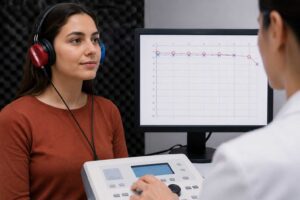
Higher-pitched sounds are represented by higher frequencies, whereas deeper sounds are represented by lower frequencies. The frequencies from about 250 to 8000 Hz are typically examined by conventional audiometry, although the precise frequencies examined may differ.
An audiologist or ENT professional can use the audiogram to determine if hearing thresholds are within the anticipated range and if there is a pattern of hearing loss.
3. What Does a Typical Audiogram Look Like?
In general, a normal audiogram shows hearing thresholds that are within the normal range across all frequencies tested.
The precise definition of normal hearing may differ based on the classification system employed. While the WHO’s current classification considers normal hearing to be thresholds of 20 dB or greater in the better-hearing ear, ASHA identifies typical hearing as being between -10 and 15 dB HL. As a result, rather than relying on a single figure, the audiologist’s or ENT expert’s report should serve as the basis for the interpretation.
An audiogram typically has:
- The red O symbols are frequently used to display the results of air conduction in the right ear.
- Blue X symbols are frequently used to depict the outcomes of air conduction tests performed on the left ear.
- Bone-conduction findings are represented by various standard symbols.
- In general, results in the anticipated hearing range are placed toward the top of the audiogram.
- It’s crucial to consider the pattern across frequencies, not only one individual value.
In order to clearly separate the air and bone conduction results, as well as the left and right ears, ASHA advises using standardized audiometric symbols.
4. How to Read a Normal Audiogram
Horizontal Axis – Frequency
In Hz, the frequency is shown on the horizontal axis.
Common frequencies are:
- 250 Hertz
- 500 Hz.
- 1000 Hz
- 2000 Hz
- 4000 Hz
- 8,000 Hz
High-pitched noises are represented by high frequencies, whereas low-pitched sounds are associated with lower frequencies.
Hearing Level – Vertical Axis
In dB HL, the vertical axis indicates the hearing level.
The fact that the audiogram scale may seem counterintuitive is a crucial consideration. The higher the graph, the lower the hearing levels are, and the lower the graph, the higher the hearing levels are.
Therefore, it’s not enough to just see if a mark appears “high” or “low.” The actual dB HL value should be taken into account.
5. What Do O and X Mean on an Audiogram?
Numerous conventional audiograms show that:
- right-ear air-conduction threshold = O
- Left ear air-conduction threshold = X
Standardized audiometric notation includes these symbols. Bone-conduction testing employs different symbols according on the testing circumstances.
Important: The exact symbols may vary depending on the test technique and audiogram format; thus, the legend on each audiogram should always be examined.
6. What is the Speech Banana on an Audiogram?
On an audiogram, the speech banana is a often utilized visual area that displays around where many speech sounds occur in terms of their intensity and frequency.
Various parts of this region are occupied by different speech sounds. For instance, certain high-frequency consonants, such as /s/ and /f/, occur at relatively higher frequencies, whereas vowel sounds tend to occur at lower frequencies.
Therefore, even if lower-frequency hearing is relatively good, someone with high-frequency hearing loss may struggle to differentiate between certain consonant sounds.
The speech banana is effective for clarifying hearing patterns, but it cannot take the place of speech testing or clinical interpretation.
7. Normal Hearing at Different Frequencies
Yes.
Hearing impairment does not necessarily affect all frequencies equally. An audiogram might reveal:
- All frequencies tested have normal hearing.
- Hearing loss at high frequency
- Low-frequency hearing impairment
- A low-frequency hearing loss pattern
- An asymmetrical pattern in the two ears
For instance, someone can have great hearing at lower frequencies but less sensitivity at higher frequencies.
Therefore, in addition to the overall hearing level, the audiogram’s form or arrangement provides crucial information.
8. Air Conduction vs Bone Conduction
The normal route, which includes the inner, middle, and outer ear, is used for air conduction to assess hearing.
To aid the doctor in determining whether a conductive component exists, bone conduction employs a vibrator put on the skull to communicate sound vibrations toward the inner ear.
Clinicians can differentiate between air- and bone-conduction thresholds by comparing their relationship:
- Hearing loss that is conductive
- Sensorineural hearing loss
- Combined hearing loss
Together with a thorough clinical assessment, the existence and magnitude of an air-bone gap are crucial for identifying the kind of hearing loss.
9. Normal Audiogram but Difficulty Hearing
Absolutely.
Even if they have a healthy pure-tone audiogram, some people may still struggle to hear in specific situations.
For instance, someone might struggle with:
- Understanding what’s said in a loud restaurant
- Following chats when numerous individuals are talking
- From afar, hearing soft speech
- Even with normal hearing for separate noises, it is still difficult to comprehend speech.
- Identifying the source of a sound
- Putting up with some noises
In a peaceful testing environment, a pure-tone audiogram mostly measures the identification of tones. WHO points out that pure-tone thresholds alone do not completely explain a person’s communication issues, especially in background noise.
An ENT doctor or audiologist could recommend additional tests, based on the symptoms.
10. Normal Audiogram but Tinnitus
Yeah.
Standard pure-tone hearing thresholds may be normal, yet tinnitus may still be present.
Further medical assessment may be required if tinnitus is persistent, one-sided, pulsatile, accompanied by dizziness, or accompanied by an unexpected hearing loss.
Therefore, a normal audiogram should not be immediately considered to rule out every potential auditory or ear issue.
11. Normal Audiogram but Poor Speech Understanding
Even if my audiological examination is normal, I struggle to hear speech properly. Why?
Normal pure-tone thresholds might make it difficult to grasp speech for a number of reasons.
In loud settings where the brain must distinguish speech from rival sounds, the issue might become especially obvious.
An audiologist may take the following factors into account based on their medical history and evaluation:
- Speech audiometry
- Speech in Noise Test
- tympanometry
- Otoacoustic discharges
- Testing the auditory brainstem response
- Other unique auditory evaluations
The proper tests are determined by the clinical findings and the symptoms of the patient.
12. What Other Tests May Be Done With an Audiogram?
A comprehensive hearing evaluation includes a pure-tone audiogram.
An audiologist or ENT specialist may suggest one of the following based on the patient’s symptoms:
Audiometry of Speech
Evaluates a person’s ability to hear or comprehend language.
Tympanometry
helps identify issues involving the middle ear system and eardrum by assessing middle-ear function.
(OAE) Otoacoustic Emissions
Can offer details on how cochlear outer hair cells operate.
ABR (Auditory Brainstem Response)
It measures electrical reactions along the auditory route and might be beneficial in certain circumstances.
ENT Inspection
An ear checkup may detect eardrum abnormalities, infection, earwax, or other disorders that an audiogram alone cannot diagnose.
13. Is a Normal Audiogram the Same as Perfect Hearing?
Not always.
According to the classification used for the test, a normal audiogram shows that hearing thresholds are within the anticipated range.
However, hearing entails more than merely sensing pure sounds. Other important aspects of daily hearing include comprehending speech, particularly in noisy environments, processing complex sounds, and pinpointing the direction of noises.
As a result, a “normal audiogram” does not always imply “perfect hearing in all listening environments.”
14. When Should You See an ENT Specialist?
Even with a normal audiogram, when is it appropriate to consult an ENT specialist?
If you experience any of the following, think about getting a medical checkup:
- Sudden loss of hearing
- Hearing loss that is gradual
- Loss of hearing in just one ear
- Enduring one-sided tinnitus
- Tinnitus that pulsates
- Frequent ear discharge
- Pain in the ear
- Vertigo or frequent dizziness
- A sensation of having full or blocked ears
- Despite a passing hearing exam, speech is difficult to comprehend.
Don’t wait for evaluation just because a patient’s audiogram is normal, especially if they’re exhibiting new or significant symptoms.
15. Important Difference Between Screening and Diagnostic Hearing Tests
Is a full audiology the same as a hearing exam?
No.
Generally, a hearing screening is made to find those who might need more testing.
When necessary, a diagnostic hearing evaluation provides additional information regarding hearing thresholds and other facets of auditory function.
A thorough assessment may be suggested if a screening test reveals a potential hearing issue.
16. Factors That Can Affect Audiogram Results
Various factors can affect audiometric results, such as:
- background noise
- Improper location of headphones or earbuds
- Obstruction from earwax
- Disease of the Middle Ear
- Tiredness of the patient
- Challenges in understanding the test directions
- Inconsistent feedback
- Calibrating Equipment
Clinical audiometry adheres to standardized procedures and paperwork requirements in order to enhance its dependability.
17. How Often Should Hearing Be Tested?
No one testing period is ideal for all.
The variables listed below influence how often hearing testing is performed:
- Age
- Results of the preceding hearing
- Exposure to loud noises at work or during play
- Disorder of the ear
- History of the family
- Ringing in the ear.
- Hearing issues
- The usage of ototoxic drugs
You shouldn’t wait for a regular screening appointment if you observe a new change in hearing.
18. FAQ
1. What does a typical audiogram look like?
A normal audiogram reveals hearing thresholds in the range of -10 dB to 20 dB HL across the tested frequencies, suggesting good hearing.
2. On an audiogram, what do the symbols O and X mean?
Right ear air conduction is represented by O (Red).
X (Blue): Air conduction left ear
3. What frequencies are measured in a hearing test?
The range of frequencies from 250 Hz to 8000 Hz, which is crucial for comprehending speech, is typically covered by hearing tests.
4. What is regarded as standard hearing?
A person with normal hearing can hear sounds between -10 dB and 20 dB HL at all frequencies that have been tested.
5. Is it possible to have normal audiograms but still have hearing issues?
Indeed. Despite a normal audiogram, some individuals may have trouble hearing in noisy surroundings. Further hearing tests could be suggested.
6. What exactly is air conduction testing?
Testing with air conduction gauges hearing through the whole hearing route using headphones or earbuds.
7. What does it mean to undergo bone conduction testing?
Bone conduction testing bypasses the middle and outer ear to examine the auditory nerve and inner ear function.
8. Why is an audiogram necessary?
It assists in determining the type and severity of hearing loss, making early diagnosis possible, and directing the best course of action.
9. How frequently should grown-ups get their hearing checked?
Healthcare providers should advise adults to get a baseline hearing test and repeat it if their hearing changes.
10. When should I consult an ENT specialist?
Seek medical attention if you suffer from hearing loss, tinnitus, dizziness, ear discomfort, ear discharge, or abrupt changes in your hearing.
11. Is it normal to have hearing with 10 dB?
Yeah. Around 10 dB HL, a hearing threshold is typically considered normal. However, the audiogram’s classification system and its entire audiogram should be considered.
12. Is normal hearing 20 dB?
In numerous clinical environments, a 20 dB HL threshold is typically regarded as being within the normal range. The WHO now considers normal hearing to be thresholds of 20 dB or less in the better-hearing ear.
13. Is a hearing loss of 25 dB typical?
Depending on the categorization system, the interpretation may differ. Normal thresholds are considered to be 25 dB HL by some systems, while a smaller normal range is utilized by others. The whole audiogram and the clinical setting must be taken into account.
14. Can you have hearing loss if your audiogram is typical?
Even with normal pure-tone thresholds, a person may still struggle to comprehend speech, especially in noisy environments. Depending on the symptoms, more evaluation may be required.
15. What does a flat audiogram indicate?
The hearing thresholds are fairly consistent throughout the examined frequencies if the pattern is flat. Normal hearing or different degrees of hearing loss can result in a flat pattern, thus the real dB HL values must be taken into account.
16. What does an audiogram’s slant signify?
Depending on the direction of the slope, a sloping audiogram indicates that hearing thresholds worsen as frequency rises or falls. For instance, a steep drop at high frequencies may point to more difficulty hearing sounds with high pitches.
17. What is an air-bone gap?
An air-bone gap is defined as air-conduction thresholds that are worse than bone-conduction thresholds at the frequencies that are important. When clinically relevant, it can suggest a conductive component to hearing loss.
18. Can a normal audiogram be followed by a hearing improvement?
Between testing sessions, hearing thresholds might change. Temporary issues with the middle ear, earwax, test circumstances, or other variables might cause changes. Major alterations should be evaluated by an ENT or audiologist.
19. Is an ear problem ruled out by a normal audiogram?
No. Not every ear problem is excluded by a routine pure-tone audiogram. Extra assessment may be necessary for other problems, such as earwax, eardrum problems, middle-ear disease, tinnitus, balance disorders, and more.
20. Is it possible for me to have tinnitus even if my hearing test results are normal?
Yes. People who have normal pure-tone thresholds may experience tinnitus.
19. Examples of Audiograms and Levels of Hearing Loss
The terminology and numerical ranges can vary between classification systems. One commonly used ASHA classification lists:
Hearing level |
dB HL |
|---|---|
Normal |
−10 to 15 |
Slight |
16–25 |
Mild |
26–40 |
Moderate |
41–55 |
Moderately severe |
56–70 |
Severe |
71–90 |
Profound |
91+ |
Important: Do not use this table as the sole basis for diagnosing an individual patient’s hearing disability. Clinical interpretation should consider the complete audiogram, speech understanding, symptoms, history, and other findings.
20. Conclusion
A normal audiogram often indicates that hearing thresholds are within the expected range throughout the frequencies evaluated. The audiogram provides vital details regarding hearing sensitivity and may aid in identifying several forms of hearing loss.
However, a typical pure-tone audiogram does not ensure that a person will have no trouble hearing in all real-world situations. Further evaluation may be required if you have issues like tinnitus, ear fullness, dizziness, trouble understanding speech in background noise, or other ear symptoms.
An ENT specialist or audiologist can ascertain whether further tests are required if you continue to have problems hearing despite having a normal audiogram.
📞 ENT Consultation & Surgery
Dr. Sagar Rajkuwar (MS-ENT)
Prabha ENT Clinic, Ambad, Nashik
📱 7387590194 | 9892596635
🌐 www.entspecialistinnashik.com
Medical Disclaimer
Medical Disclaimer: This article is for educational purposes only and does not replace professional medical advice, diagnosis, or treatment. Audiogram results should be interpreted by a qualified audiologist or ENT specialist. If you have sudden hearing loss, severe dizziness, ear discharge, or other concerning symptoms, seek medical evaluation promptly.
Hearing Loss & Audiogram – Organized Internal Link Categories
1. Hearing Loss – Types & Audiogram Comparison
-
Sensorineural vs Conductive Hearing Loss – Audiogram
2. Conductive Hearing Loss – Audiogram
-
Conductive Hearing Loss Audiogram
3. Sensorineural Hearing Loss – Audiogram
-
Sensorineural Hearing Loss Audiogram
4. Hearing Loss Types – Audiogram
-
Hearing Loss Types Audiogram
5. Ménière’s Disease – Audiogram
-
Ménière’s Disease Audiogram
Medical References
- World Health Organization (WHO). World Report on Hearing.
- American Speech-Language-Hearing Association (ASHA). Understanding Audiograms.
- National Institute on Deafness and Other Communication Disorders (NIDCD). Hearing Tests.
- American Academy of Otolaryngology–Head and Neck Surgery (AAO-HNS). Hearing Loss Evaluation.
- Centers for Disease Control and Prevention (CDC). Hearing Loss and Prevention.
- British Society of Audiology (BSA). Recommended Procedure for Pure Tone Audiometry.
- National Health Service (NHS). Hearing Tests and Hearing Loss.