American Startup Invents Food Printers That Create Nutritious Meals From Air
By Dr. Sagar Rajkuwar, ENT Specialist, Nashik, Maharashtra, India
🌐 www.entspecialistinnashik.com
Introduction: Food From Thin Air
Imagine producing a fresh, nutritious meal using only air, water, and electricity—no farms, no animals, no soil, and no sunlight. What once sounded like science fiction is now becoming reality.
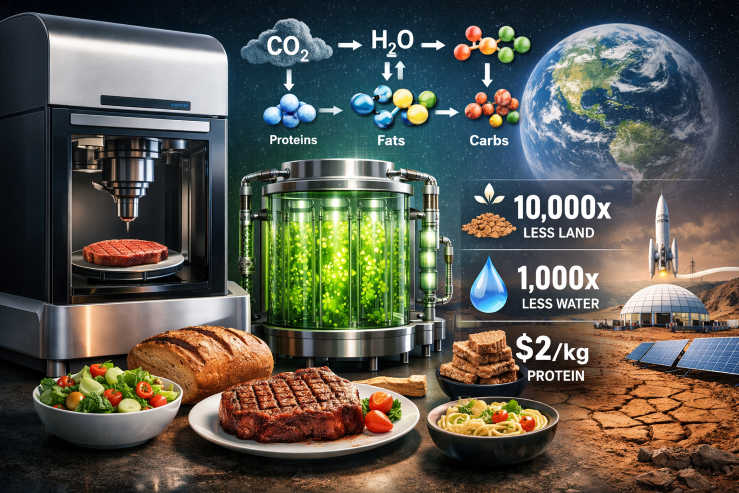
An American startup, Air Company, has developed revolutionary food printers capable of synthesizing complete meals from captured carbon dioxide (CO₂) using artificial photosynthesis and advanced 3D printing. This breakthrough could redefine food security, sustainability, and nutrition worldwide.
According to Nature Food (2025), this technology uses 10,000 times less land and 1,000 times less water than traditional agriculture while producing food that is molecularly identical to conventional ingredients.
What Is Artificial Photosynthesis Food Technology?
Artificial photosynthesis mimics the natural process plants use to create food—but does it faster, cleaner, and without sunlight.
Instead of relying on crops, soil, or climate conditions, Air Company’s system uses:
-
Captured carbon dioxide
-
Water
-
Renewable electricity
These inputs are converted into organic food molecules, the same building blocks found in meat, grains, and vegetables.
How Air Company’s Food Printers Work (Step-by-Step)
The system follows a precise, science-driven process:
Step 1: Splitting Water
Renewable electricity splits water (H₂O) into:
-
Hydrogen
-
Oxygen
Step 2: Carbon Capture
Carbon dioxide is captured directly from:
-
Industrial emissions
-
Or ambient air
Step 3: Microbial Conversion
Hydrogen and CO₂ enter catalytic reactors containing engineered microorganisms. These microbes:
-
Convert CO₂ into ethanol and organic compounds
-
Operate without sunlight
-
Work continuously, day and night
Step 4: Molecular Food Synthesis
The organic compounds are refined into:
-
Amino acids (proteins)
-
Fatty acids (oils)
-
Sugars (carbohydrates)
These are the fundamental components of all food.
Turning CO₂ Into Proteins, Fats, and Carbohydrates
The resulting molecules are:
-
Structurally identical to conventional food molecules
-
Free from antibiotics, hormones, or pesticides
-
Highly pure and controllable
Vitamins and minerals are added to create nutritionally complete ingredients, customized for:
-
Children
-
Elderly populations
-
Athletes
-
Patients with medical dietary needs
3D Printing Complete Meals in Minutes
Once ingredients are prepared, a food 3D printer assembles them layer by layer.
It can create:
-
Steaks
-
Bread
-
Vegetables
-
Pasta
-
Customized medical diets
Texture, taste, shape, and nutrition can all be precisely controlled—something impossible with traditional farming.
A single machine can produce 10 complete meals per day, anywhere on Earth.
How Is This Food Different From Lab-Grown or Plant-Based Foods?
| Technology | Key Difference |
|---|---|
| Lab-grown meat | Requires animal cells |
| Plant-based meat | Depends on crops and agriculture |
| Air-based food | Requires no plants, animals, or farmland |
Air Company’s food is created directly from molecules, eliminating the inefficiencies of biological farming.
Environmental Impact: Land, Water, and Climate Benefits
This technology could drastically reduce environmental damage:
-
🌱 10,000× less land use
-
💧 1,000× less water use
-
🚫 No deforestation
-
🚫 No methane emissions from livestock
-
🚫 No pesticides or fertilizers
-
🚫 No food transportation (“food miles”)
Food production becomes carbon-negative, consuming CO₂ instead of emitting it.
Food Security Revolution: Feeding the World Anywhere
Air-based food printers can operate in places where farming is impossible:
-
Deserts
-
Arctic research stations
-
Spacecraft and space colonies
-
Submarines
-
Disaster-hit regions
-
War zones
With only solar power, these machines can provide unlimited fresh food, independent of climate or seasons.
Cost, Efficiency, and Commercial Viability
-
Machine cost: $25,000
-
Lifespan: Decades
-
Maintenance: Minimal
-
Protein cost: $2 per kilogram
-
Cheaper than chicken
-
Far cheaper than beef
-
This makes it one of the most cost-efficient protein sources ever created.
Safety, Nutrition, and Allergen Control
Air-based food offers major health advantages:
-
No bacteria, parasites, or food-borne pathogens
-
No antibiotics or growth hormones
-
Allergens can be completely eliminated
-
Nutrition precisely optimized
This makes it ideal for:
-
Hospitals
-
Space missions
-
Military use
-
Immunocompromised patients
When Will This Technology Be Available?
-
2026: Commercial launch for
-
Restaurants
-
Institutions
-
Research facilities
-
-
2027: Consumer home versions
-
Expected price: $5,000
-
Home kitchens may soon include food printers alongside refrigerators and microwaves.
Potential Challenges and Ethical Considerations
Despite its promise, challenges remain:
-
Public acceptance of “synthetic” food
-
Regulatory approvals
-
Taste and cultural preferences
-
Energy infrastructure requirements
However, history shows similar resistance to:
-
Pasteurization
-
GM crops
-
Refrigeration
Over time, adoption is likely to grow.
The Future of Food Production
Air-based food printing could:
-
End hunger
-
Decouple food from climate change
-
Restore forests and ecosystems
-
Enable sustainable space colonization
It represents a fundamental shift from agriculture to molecular food manufacturing.
Conclusion
Food printers that create meals from air may be one of the most important innovations of the 21st century. By combining carbon capture, artificial photosynthesis, and 3D printing, Air Company has demonstrated a future where food is:
-
Sustainable
-
Affordable
-
Safe
-
Universally accessible
If scaled globally, this technology could transform how humanity eats forever.
Written by
Dr. Sagar Rajkuwar
ENT Specialist, Nashik, Maharashtra
📞 ENT Consultation & Surgery
Dr. Sagar Rajkuwar (MS-ENT)
Prabha ENT Clinic, Ambad, Nashik
📱 7387590194 | 9892596635
🌐 www.entspecialistinnashik.com
Disclaimer
The information provided in this article is for general informational and educational purposes only. While every effort has been made to ensure accuracy, advancements in food technology and sustainability science are evolving rapidly. The content is based on publicly available sources, including company disclosures and peer-reviewed publications, and does not constitute professional, medical, nutritional, legal, or investment advice.
Readers should not rely solely on this information when making dietary, health, or purchasing decisions. Always consult qualified professionals or official sources before adopting new food technologies or products. The author and website are not affiliated with or endorsed by any company mentioned unless explicitly stated.