
What’s the Longest Dissolvable Stitch Last? A Complete 2026 Guide for Patients
Causes, Normal Healing Sensations & When to Worry — Updated with Maxon, V-Loc & Stratafix (NEW 2026 Barbed Sutures)
By: Dr. Sagar Rajkuwar, ENT Specialist, Nashik, Maharashtra www.entspecialistinnashik.com
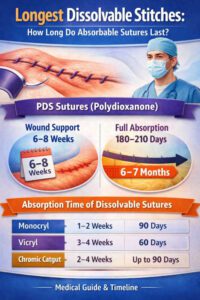
Quick Answer: What’s the longest dissolvable stitch last? Among traditional sutures, Polydioxanone (PDS II) is the longest-lasting absorbable monofilament routinely used in surgery — retaining meaningful tensile strength for up to 6–8 weeks and taking 180–210 days (6–7 months) for complete absorption. However, newer barbed sutures like V-Loc 180 and Stratafix PDS and alternatives like Maxon (polyglyconate) can also offer comparable long-term support with specific advantages.
Table of contents-
- Introduction
- What kind of stitches are dissolvable (absorbable)?
- So, What’s the Longest Dissolvable Stitch Last?
- Comparison Table: How Long Different Dissolvable Stitches Last
- Why would a surgeon opt for a dissolvable suture that lasts for a long time?
- What Variables Influence the Longevity of Dissolvable Sutures?
- Can you see long-lasting dissolving stitches?
- Is it common for dissolving sutures to remain in place for many months?
- Is it possible for dissolvable stitches to fail to dissolve?
- Dissolvable vs Non-Dissolvable Stitches: Key Differences
- Maxon vs PDS: Head-to-Head (NEW 2026)
- Barbed Absorbable Sutures — V-Loc and Stratafix (NEW 2026)
- Dissolvable Stitches by Surgery Type
- Signs Your Dissolvable Stitches Are Healing Properly
- Updated FAQs: Longest Dissolvable Stitches (2026)
- Key Takeaway
- Expert Medical Disclaimer
1️⃣Introduction
Dissolvable stitches, sometimes referred to as absorbable sutures, are frequently employed in contemporary surgery to seal wounds without the necessity for removal. The query posed by patients is often very practical: “What’s the longest dissolvable stitch last?”
Depending on the kind of suture material, its location in the body, and unique healing characteristics, the response varies. Some soluble sutures vanish in two weeks, but others may last for up to six to seven months. Everything you need to know is covered in this comprehensive, SEO-optimized 2026 guide, including the latest barbed knotless sutures now revolutionizing wound closure.
2️⃣What kind of stitches are dissolvable (absorbable)?
Over time, soluble stitches are intended to disintegrate in the body. They are absorbed via one of two mechanisms rather than being removed by a doctor:
- Hydrolysis — water-based chemical breakdown, used by most synthetic sutures.
- Enzymatic (proteolytic) digestion — used by natural sutures such as catgut (now largely obsolete in human surgery in many countries).
They are frequently employed in:
- Muscles and inner tissues
- Oral and dental surgery
- ENT surgery (tonsillectomy, septoplasty, thyroidectomy)
- Obstetrics and gynecology (episiotomy, cesarean section layers)
- Pediatric surgery
- Laparoscopic and robotic surgery (where barbed sutures excel)
Modern 2026 practice distinguishes between short-term absorbable (gone in 42 days), mid-term absorbable (gone by 90 days), and long-term absorbable (6+ months). Asking what’s the longest dissolvable stitch last is therefore really asking about the long-term absorbable group.
3️⃣So, What’s the Longest Dissolvable Stitch Last?
✅ Polydioxanone (PDS II) sutures last the longest in traditional surgery
Among all commonly used absorbable sutures, PDS II (Polydioxanone) lasts the longest in the body.
⏳ How long does PDS last?
- Wound support: up to 6–8 weeks
- At 2 weeks: approximately 70% tensile strength retained
- At 4 weeks: approximately 50% tensile strength retained
- At 6 weeks: approximately 25% tensile strength retained
- Complete absorption: 180–210 days (≈ 6–7 months)
This makes PDS the longest-lasting dissolvable stitch routinely used in surgical practice. However, Maxon (polyglyconate) is a close competitor and is sometimes considered equivalent or superior for specific applications. When patients ask “what’s the longest dissolvable stitch last,” PDS is the typical textbook answer — but Maxon and newer PDS-based barbed sutures can match or exceed its duration.
4️⃣Comparison Table: How Long Different Dissolvable Stitches Last (Updated 2026)
| Suture Type | Material | Structure | Wound Support | Complete Dissolution |
|---|---|---|---|---|
| PDS II (Polydioxanone) | Synthetic | Monofilament | ~60 days (6–8 wks) | 180–210 days |
| Maxon (Polyglyconate) | Synthetic | Monofilament | ~42 days (6 wks) | 180 days |
| V-Loc 180 (barbed PDO) | Synthetic barbed | Monofilament knotless | ~90 days | 180 days |
| Stratafix PDS (barbed) | Synthetic barbed | Monofilament knotless | ~90 days | 180–210 days |
| Monocryl (Poliglecaprone 25) | Synthetic | Monofilament | 1–2 weeks | 90–120 days |
| Monosyn (Glyconate) | Synthetic | Monofilament | ~2 weeks | 60–90 days |
| Biosyn (Glycomer 631) | Synthetic | Monofilament | ~3 weeks | 90–110 days |
| Vicryl (Polyglactin 910) | Synthetic | Braided | ~30 days | 56–70 days |
| Vicryl Rapide | Synthetic | Braided | 7–10 days | ~42 days |
| Caprosyn | Synthetic | Monofilament | 7–10 days | ~56 days |
| Velosorb Fast | Synthetic | Braided | 7–10 days | 40–50 days |
| Chromic Catgut | Natural | Twisted | ~10–14 days | 21–90 days |
| Plain Catgut | Natural | Twisted | ~5–7 days | 14–60 days |
This table answers what’s the longest dissolvable stitch last in a side-by-side format.
5️⃣Why would a surgeon opt for a dissolvable suture that lasts for a long time?
When tissues require extended support, long-lasting sutures such as PDS or Maxon are chosen:
- Layers of deep muscle
- Fascial closure of the abdominal wall
- Hernia repair (herniorrhaphy)
- Pediatric cardiac and thoracic surgery (allows for tissue growth)
- Peripheral vascular anastomosis
- Tendon repair
- Tissues that heal slowly (diabetic patients, elderly, steroid users)
- Deep oral and maxillofacial surgery wounds
The risk of wound dehiscence (separation) and incisional hernia is decreased since PDS and Maxon retain their strength for a longer period of time compared to other absorbable sutures.
6️⃣What Variables Influence the Longevity of Dissolvable Sutures?
The absorption time can change, even with the same kind of suture, for reasons such as:
1. Where in the body it is
- Dissolves more quickly inside the mouth (high enzymatic activity in saliva, warm moist environment)
- Tissue that is dry (like subcutaneous fat) melts less quickly
- Highly vascular tissue dissolves sutures faster than avascular areas
2. Blood flow
- Tissues with good vascularization break down sutures more quickly.
- Poor circulation (peripheral vascular disease) delays dissolution.
3. Inflammation or infection
Absorption is accelerated by infection. Inflammatory cells release enzymes that speed up suture breakdown. This is why asking what’s the longest dissolvable stitch last doesn’t have a universal answer — it changes based on the local tissue environment.
4. Patient-related factors
- Diabetes mellitus (unpredictable healing)
- Smoking (vasoconstriction, poor oxygenation)
- Poor nutrition (low protein, vitamin C deficiency, zinc deficiency)
- Chronic steroid use (impaired collagen synthesis)
- Chemotherapy or radiotherapy
- Age (slower healing in elderly)
- Autoimmune diseases
5. Thickness of the Sutures
Sutures that are thicker (e.g., 0 or 1-0) last longer than thin ones (e.g., 5-0, 6-0). This is because larger diameter has more polymer mass to hydrolyze.
6. Suture structure
Monofilament sutures (single strand) tend to last longer and resist infection better than braided (multifilament) sutures, which can harbor bacteria in interstices (capillarity).
7️⃣Can you see long-lasting dissolving stitches?
Internal PDS sutures are not visible from outside.
Under the skin: It may feel like a solid string or lump for weeks or months. This is especially common with thicker sizes (0 to 2-0).
Sometimes: As the body absorbs them, little suture ends may protrude (spitting sutures). This is also known as suture extrusion.
Unless there is discomfort, redness, or discharge, this is generally innocuous. The honest answer to what’s the longest dissolvable stitch last at the skin surface is: often you’ll feel it long before it’s fully gone.
8️⃣Is it common for dissolving sutures to remain in place for many months?
Yes. It can be perfectly acceptable to feel or view PDS sutures even three to four months after they were placed.
If, on the other hand, you see any of the following, speak with a physician:
- Growing discomfort
- Redness or edema
- Discharge of pus or odor
- Fever
- Bleeding from the stitch site
- Expanding lump or granuloma
- Sinus tract formation
9️⃣Is it possible for dissolvable stitches to fail to dissolve?
Although it doesn’t occur often, it is possible. Some potential explanations are:
- Inadequate blood flow (ischemia)
- Reaction to foreign object (foreign body granuloma)
- Extrusion of sutures (body pushing it out)
- Encapsulation by scar tissue limiting enzyme access
- Rarely, a stitch abscess with persistent chronic inflammation
In these situations, the exposed area may be trimmed or removed by a physician using a straightforward outpatient technique with local anesthesia.
🔟 Dissolvable vs Non-Dissolvable Stitches: Key Differences
| Feature | Dissolvable | Non-Dissolvable |
|---|---|---|
| Removal needed | ❌ No | ✅ Yes |
| Duration | Days to months | Permanent unless removed |
| Best for | Internal tissues, mucosa, pediatrics | Skin, cardiovascular prostheses, high-tension wounds |
| Risk of scarring | Lower (often) | Slightly higher |
| Examples | PDS, Vicryl, Monocryl, Maxon | Nylon, Polypropylene (Prolene), Silk, PTFE |
| Tissue reaction | Mild to moderate inflammation during absorption | Minimal once wound heals |
1️⃣1️⃣ Maxon vs PDS: Head-to-Head (NEW 2026 Analysis)
Maxon (polyglyconate — a copolymer of glycolic acid and trimethylene carbonate) is PDS’s main competitor as the longest-lasting dissolvable monofilament.
- Tensile strength out of package: Maxon slightly stronger than PDS II (per Medtronic/Fong et al. 2008 ANZ J Surg data).
- First 2 weeks: Maxon maintains greater strength than PDS II.
- 6 weeks: PDS II typically retains ~25% strength; Maxon retention is comparable or slightly higher depending on size.
- Full absorption: both ~180 days.
- Knot security: Maxon has superior knot tie-down compared with PDS II.
- Memory/handling: PDS II has more memory (stiffer); Maxon is more pliable in some surgeons’ hands.
So when answering what’s the longest dissolvable stitch last, both PDS II and Maxon are correct answers — they are essentially tied at 6 months for full dissolution.
1️⃣2️⃣ Barbed Absorbable Sutures — V-Loc and Stratafix (NEW 2026)
Modern surgery is increasingly using barbed (knotless) absorbable sutures, which have small backward-facing projections along the strand that anchor the tissue without needing knots.
V-Loc 180 (Medtronic)
- Material: polyglyconate + trimethylene carbonate — same chemistry family as Maxon
- Dissolution: 180 days
- Wound support: ~90 days
- Advantages: fast closure, uniform tension distribution, no knot slippage, less dehiscence in laparoscopic surgery
Stratafix Symmetric PDS Plus (Ethicon)
- Material: Polydioxanone with triclosan antibacterial coating
- Dissolution: 180–210 days
- Wound support: ~90 days
- Antibacterial coating reduces surgical site infection (SSI) risk
These knotless sutures are the newest answer to what’s the longest dissolvable stitch last with practical surgical advantages — comparable longevity to PDS/Maxon plus knotless convenience.
1️⃣3️⃣ Dissolvable Stitches by Surgery Type
- Tonsillectomy: traditionally no stitches needed (cauterization) — but when used, Vicryl Rapide 3-0 or Vicryl 3-0.
- Dental extraction: Vicryl Rapide, Chromic catgut, or PGA.
- Episiotomy: Vicryl Rapide or Vicryl.
- Cesarean section (uterine layer): Vicryl 1-0 or PDS 1-0; skin: Monocryl 4-0 or Vicryl Rapide.
- Fascia (abdominal wall): PDS II 1-0 or Loop PDS or Maxon 1-0.
- Hernia repair (open or lap): PDS 2-0 or 0.
- Laparoscopic bowel anastomosis: V-Loc 180 or Stratafix PDS.
- Pediatric cardiac surgery: Maxon or PDS (allows growth).
- Thyroidectomy: Vicryl 3-0 for deep layers, Monocryl 4-0 for subcuticular.
1️⃣4️⃣ Signs Your Dissolvable Stitches Are Healing Properly
- Gradual reduction in swelling and redness
- Decreasing pain over the first 1–2 weeks
- No discharge of pus or odor
- Wound edges remaining approximated
- Slow softening and shrinking of palpable lump
- Scar fading from pink/red to flesh color over weeks
- Normal body temperature
1️⃣5️⃣ Updated FAQs: Longest Dissolvable Stitches (2026)
❓ What is the maximum time dissolvable stitches can last?
Up to 210 days (7 months) with PDS II sutures or Stratafix PDS Plus.
❓ Which dissolvable stitch is strongest?
PDS II, Maxon (polyglyconate), and Stratafix PDS Plus have the longest tensile strength retention. Maxon slightly edges PDS II in the first 2 weeks.
❓ Can dissolvable stitches cause infection?
Rarely. Infection is usually due to wound contamination, not the stitch itself. Braided sutures (Vicryl) carry a very slightly higher infection risk than monofilaments (PDS, Monocryl). Modern triclosan-coated sutures (e.g., Vicryl Plus, Stratafix Plus) reduce SSI risk.
❓ Do dissolvable stitches leave scars?
Scarring depends more on:
- Surgical technique
- Skin tension
- Wound care
- Genetics (keloid tendency)
- Infection history
❓ What’s the longest dissolvable stitch last in the mouth?
In the oral cavity, even PDS can degrade faster due to warm, moist, enzyme-rich environment. Typical dental sutures (Vicryl Rapide, chromic catgut) dissolve within 7–21 days in the mouth.
❓ What’s the longest dissolvable stitch last after a C-section?
Internal PDS or Vicryl can be felt for 2–6 months. Skin-level Monocryl is usually gone by 90–120 days.
❓ Are there newer sutures than PDS?
Yes — V-Loc and Stratafix (barbed/knotless), Monosyn Plus (triclosan-coated), and Biosyn. They offer similar dissolution profiles but faster application in laparoscopic/robotic surgery.
❓ Can I feel the knot of a dissolvable stitch?
Yes. The knot is the thickest part and often the last to dissolve. A palpable firm “pea” or “line” under the skin for 3–4 months is normal.
❓ Should I remove exposed dissolvable stitches myself?
No. Visit your doctor. Pulling them may introduce infection or cause bleeding.
❓ Does smoking affect dissolvable stitches?
Yes. Smoking causes vasoconstriction, reducing wound blood flow and delaying healing. Nicotine also impairs collagen synthesis.
1️⃣6️⃣Key Takeaway
What’s the longest dissolvable stitch last? The longest dissolvable stitch is PDS II (Polydioxanone), lasting up to 6–7 months inside the body — with Maxon (polyglyconate) as a near-equivalent. For modern laparoscopic use, V-Loc 180 and Stratafix PDS Plus offer equivalent duration plus knotless convenience.
Understanding the type of stitch used in your surgery can reduce anxiety and help you know what’s normal during healing. If in doubt, always ask your surgeon which specific suture they used — it tells you how long you can expect to feel the stitch and when it will fully absorb.
For important health related topics please click on our facebook page link given below – https://www.facebook.com/positivemind.healthcare
For important health related videos please click on the link of our youtube channel – http://www.youtube.com/@healthuseful8539
Expert Medical Disclaimer
This article is for educational purposes only and does not replace professional medical advice. Always consult your surgeon or ENT specialist for personalized guidance regarding stitches and wound healing. Specific suture choice depends on patient factors and surgeon preference.
References (2026)
- Ethicon Product Monographs — PDS II, Monocryl, Vicryl, Stratafix PDS Plus (Johnson & Johnson, 2024).
- Medtronic Technical Guide — Maxon, Caprosyn, Biosyn, V-Loc 180 (2024).
- Fong ED, Bartlett ASR, Malak S et al. “Tensile strength of surgical knots in abdominal wound closure.” ANZ J Surg. 2008;78:164–166.
- NICE guidance — Surgical site infection prevention (NG125, updated 2024).
- WHO Global Guidelines on the Prevention of Surgical Site Infection (2023 update).
- The Wound Pros — Clinical overview of absorbable stitches.
- Suture Online — Resorption times reference database.
- AAO-HNSF Clinical Practice Guidelines on Tonsillectomy in Children (2019 Update).
- Lancet Child & Adolescent Health 2023 — Intracapsular tonsillectomy outcomes.
- Cochrane Database of Systematic Reviews 2024 — Antibacterial coated sutures.
- Veterinary Surgery Compendium, University of Melbourne — Classification of suture materials (continued).
1️⃣7️⃣ Economic & Cost Comparison of Suture Types (NEW – October 2026)
Understanding cost-per-suture helps patients and institutions make informed decisions. In asking what’s the longest dissolvable stitch last, cost often enters the discussion:
| Suture Type | Approximate Cost (INR per unit) | Approximate Cost (USD per unit) | Cost-Benefit Rating |
|---|---|---|---|
| Chromic Catgut | ₹30-80 | $0.50-1.00 | Low cost; limited longevity |
| Vicryl (Polyglactin 910) | ₹120-350 | $2-5 | Standard; good value |
| Monocryl (Poliglecaprone) | ₹250-500 | $4-7 | Good for skin closure |
| PDS II (Polydioxanone) | ₹400-900 | $6-12 | Excellent longevity |
| Maxon (Polyglyconate) | ₹500-1200 | $8-15 | Excellent longevity + handling |
| V-Loc 180 (Barbed) | ₹2500-5000 | $35-70 | Premium; fast closure |
| Stratafix PDS Plus | ₹3000-6000 | $40-80 | Premium; antibacterial |
Prices vary significantly by region, size, and brand. In India, government hospitals bulk-purchase at significantly lower rates than private practice.
1️⃣8️⃣ Future Technology: Smart Sutures & Antibacterial Innovations (NEW – October 2026)
The 2020s have brought remarkable innovations in suture technology. The question of what’s the longest dissolvable stitch last now has emerging answers:
Triclosan-Coated Antibacterial Sutures
Products like Vicryl Plus, Monocryl Plus, PDS Plus, and Stratafix Plus incorporate triclosan antibacterial coating. The WHO (2023) and Cochrane (2024) reviews confirmed these reduce surgical site infection (SSI) risk by 25-30%.
Smart Sensing Sutures
Research prototypes from Tufts University and MIT contain biosensors embedded in the suture that detect:
- Local temperature changes (early infection detection)
- pH alterations (chronic inflammation marker)
- Mechanical stress on the wound
Data is transmitted wirelessly to a smartphone — this is the frontier of post-operative wound monitoring expected to reach clinical use by 2027-2028.
Drug-Eluting Sutures
Experimental sutures release antibiotics, anti-inflammatory drugs, or growth factors over days to weeks. Several Phase II trials are ongoing.
Bioabsorbable Nanofiber Sutures
Electrospun nanofiber sutures made from polycaprolactone (PCL) or polylactic acid (PLA) show promise with controlled release and superior biocompatibility.
3D-Printed Patient-Specific Sutures
Research is exploring 3D-printed sutures tailored to specific wound geometry, with programmable degradation times.
1️⃣9️⃣ Pediatric Suture Considerations (NEW – October 2026)
When children have surgery, specific considerations apply beyond the general question of what’s the longest dissolvable stitch last:
Growth Accommodation
In pediatric cardiac, orthopedic, and plastic surgery, growing children need sutures that:
- Allow tissue to grow (PDS and Maxon are preferred for anastomoses in neonates)
- Don’t restrict developing structures
- Dissolve predictably
Reduced Pain Sensitivity
Children often experience less long-term suture sensation, but tactile awareness (“I can feel it under my skin”) is distressing. Use the smallest effective size (4-0 to 6-0) for pediatric skin.
Specific Pediatric Choices
- Pediatric tonsillectomy: Rarely need sutures (cauterization/coblation preferred); when used, Vicryl Rapide 3-0.
- Pediatric circumcision: Vicryl Rapide 5-0 or 6-0 (dissolves in 7-10 days — ideal duration).
- Pediatric cleft lip repair: Vicryl 5-0 for muscle; Monocryl 5-0 for skin.
- Pediatric cardiac anastomosis: PDS 6-0 or 7-0 to allow growth.
- Pediatric ENT (tympanoplasty, septoplasty): Vicryl 4-0 or Monocryl 4-0.
2️⃣0️⃣ Environmental & Sustainability Impact of Suture Materials (NEW – October 2026)
Rarely discussed online but increasingly important: the environmental impact of suture materials.
- Non-absorbable sutures (silk, nylon, polypropylene) contribute to microplastic pollution in medical waste.
- Absorbable synthetic sutures (PDS, Vicryl, Monocryl) break down into water and carbon dioxide through hydrolysis — they are biodegradable in the body but packaging has carbon footprint.
- Natural absorbable sutures (catgut) are biologically sourced from bovine or ovine intestinal mucosa. Some countries have banned them over concerns about bovine spongiform encephalopathy (BSE).
- The medical device industry is researching plant-based absorbable sutures (silk fibroin, chitosan, cellulose-based) with reduced environmental impact.
2️⃣1️⃣ 📊 Visual Comparison Infographic: Longest-Lasting Absorbable Sutures (NEW – October 2026)
Timeline — Complete Absorption:
- 🔴 PDS II: 180-210 days (6-7 months) — THE LONGEST
- 🔴 Stratafix PDS Plus: 180-210 days — barbed + antibacterial
- 🟠 Maxon: 180 days (6 months) — near-equivalent to PDS
- 🟠 V-Loc 180: 180 days — knotless barbed
- 🟡 Monocryl: 90-120 days (3-4 months)
- 🟡 Biosyn: 90-110 days
- 🟢 Monosyn: 60-90 days
- 🟢 Vicryl: 56-70 days (~2 months)
- 🔵 Vicryl Rapide / Velosorb Fast / Caprosyn: 40-56 days
- 🔵 Chromic Catgut: 21-90 days (variable)
- 🟣 Plain Catgut: 14-60 days (variable)
Winner for “What’s the Longest Dissolvable Stitch Last?” award: 🏆 PDS II (Polydioxanone) and Stratafix PDS Plus tied at 210 days maximum. These maintain tensile strength longest, provide the greatest wound support duration, and are the gold standard for high-tension deep tissue closure.
2️⃣2️⃣ Patient Instructions: What to Do If You Can Still Feel Your Stitches Months Later (NEW – October 2026)
Many patients wonder what’s the longest dissolvable stitch last because they can still feel them. Here is a clear 2026 protocol:
Normal Findings (No Need to Worry):
- Firm palpable “pea” or “line” under the skin for 3-6 months
- Occasional tingling at the stitch site
- Slight discoloration (reddish or purplish) fading over time
- Small spike or protruding end (spitting sutures) if clean and non-tender
Call Your Doctor If:
- ⚠️ Redness spreading >1 inch around the stitch
- ⚠️ Pus or foul-smelling discharge
- ⚠️ Fever >100.4°F / 38°C
- ⚠️ Severe or increasing pain
- ⚠️ Opening of the wound (dehiscence)
- ⚠️ Red streaks moving away from the stitch (lymphangitis — infection spreading)
- ⚠️ Hard lump growing larger (possible granuloma or abscess)
Home Care Tips:
- Keep the area clean and dry
- Avoid picking at the stitches
- Apply gentle moisturizer after full healing
- Massage with silicone gel after 4 weeks (reduces scar formation)
- Avoid sun exposure to the scar for 6 months (prevents hyperpigmentation)
- Eat a protein-rich diet with vitamin C to support collagen synthesis
Clinic address of ENT SPECIALIST doctor Dr Sagar Rajkuwar-
Prabha ENT clinic, plot no 345,Saigram colony, opposite Indoline furniture Ambad link road ,Ambad ,1 km from Pathardi phata Nashik ,422010 ,Maharashtra, India-Dr Sagar Rajkuwar (MS-ENT), Cell no- 7387590194 , 9892596635


