By Dr Sagar Rajkuwar (MS-ENT) · Reviewed: 4 November 2026
On 30 October 2026 the Lancet published a landmark viewpoint by Professor Sarah Hawkes and Professor Kent Buse that reframes online misogyny & social harms as public health issues in the United Kingdom — arguing that the so-called “manosphere” is now a recognised determinant of population health, comparable in some respects to how the tobacco industry was addressed in the 20th century. The authors call for a coordinated UK public-health response rather than relying solely on content regulation. This is one of the most significant UK public-health conversations of 2026 and it directly affects mental health, violence against women and girls, and the way boys and young men engage with healthcare.
This complete 2026 clinical guide summarises online misogyny & social harms as public health issues in the United Kingdom — the four documented health harms, the five public-health policy levers proposed by the Lancet authors, the UK Online Safety Act 2023 and Ofcom enforcement framework, the role of AI-assisted abuse, and where UK readers can get help. Information is drawn from the Lancet, Allergy UK, Global 50/50, UN Women, City St George’s University of London and Everyday Sexism Project.
Table of Contents
- 1. Why This Matters as Public Health
- 2. What Is the “Manosphere”?
- 3. Four Documented Health Harms
- 4. Mental Health Harms
- 5. Violence Against Women and Girls (VAWG)
- 6. AI-Assisted Abuse & Deepfakes
- 7. Delegitimising Help-Seeking in Boys & Men
- 8. Five Public Health Policy Levers
- 9. UK Legal & Policy Response (2025-26)
- 10. Where to Get Help in the UK
- 11. Frequently Asked Questions
- 12. Summary & Conclusion
- 13. References
1. Why This Matters as Public Health
The Lancet authors argue that treating online misogyny & social harms as public health issues in the United Kingdom unlocks a much wider set of policy levers than if the problem is framed purely as a matter of online content regulation. Professor Hawkes, co-chair of the Lancet Commission on Gender and Global Health and a Global Public Health professor at University College London (UCL), told BBC Radio 4 that reframing the issue as public health allows governments to intervene across education, mental health services, employment and masculinity norms — not just through platform restrictions.
Here is a short Global 50/50 / UCL explainer video on how to approach online misogyny & social harms as public health issues in the United Kingdom:
2. What Is the “Manosphere”?
The Lancet defines the manosphere as “a diffuse commercial ecosystem and loose collection of online communities united by shared beliefs about masculinity, misogyny, and male victimisation.” It is not a single website or forum but a networked business ecosystem including influencers, incels, pick-up artists, “looks-maxxers”, fitness and finance gurus, and content creators who combine misogynistic content with product sales (supplements, hormones, coaching courses, financial schemes). Co-author Professor Kent Buse of Monash University Malaysia noted that the manosphere thrives on online platforms using a similar playbook to the tobacco industry: “blame the individual, and call regulation an attack on freedom.” Addressing online misogyny & social harms as public health issues in the United Kingdom requires engaging with this commercial dimension.
3. Four Documented Health Harms
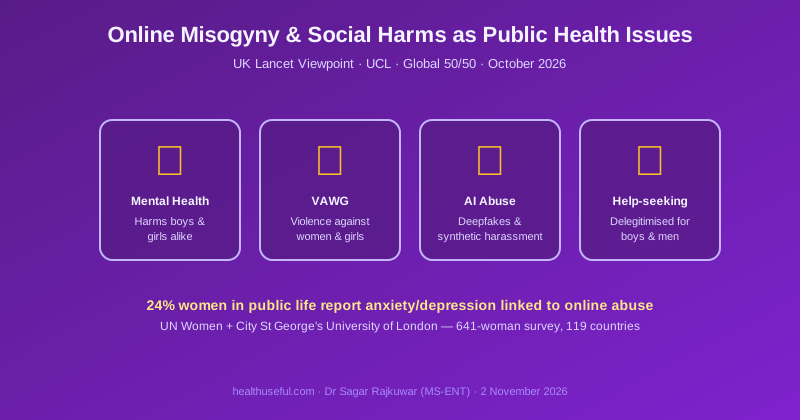
The Lancet viewpoint identifies four population-level health harms underlying online misogyny & social harms as public health issues in the United Kingdom:
- Mental health impact — anxiety, depression, body dysmorphia, self-harm, suicidality, particularly among young people
- Violence against women and girls (VAWG) — including domestic abuse, sexual violence, stalking, harassment, and honour-based abuse
- AI-assisted abuse — deepfake pornography, image-based abuse, doxxing campaigns, and “virtual rape” attacks
- Delegitimised help-seeking — discouraging boys and men from accessing mental health services, therapy and primary care
4. Mental Health Harms
The first major pillar of online misogyny & social harms as public health issues in the United Kingdom is the mental health burden. The Everyday Sexism Project founder Laura Bates told an In Dialogue event at Cambridge that algorithmically promoted extreme content is reaching children at rates “unprecedented.” For girls and women, exposure drives anxiety, depression and self-censorship. For boys and young men, exposure to body-dysmorphia content on “looks-maxxing” and “incel” forums is linked to disordered eating, anabolic-steroid use, growth-hormone misuse, and mental distress including suicidal ideation. A UN Women / City St George’s University of London survey of 641 women journalists and activists across 119 countries, published April 2026, reported that 24% of respondents had experienced anxiety and/or depression linked directly to online violence.
5. Violence Against Women and Girls (VAWG)
The second pillar of online misogyny & social harms as public health issues in the United Kingdom is violence against women and girls (VAWG). The End Violence Against Women Coalition (EVAW) has welcomed the Lancet framing because it recognises misogyny and violence against women as shaped by societal conditions rather than being purely a criminal justice matter. EVAW Deputy Director Deniz Uğur emphasised that a public-health response can address root causes. Within UK policing, VAWG offences — domestic abuse, sexual offences, stalking and harassment — have been designated a national threat on par with terrorism since 2024.
6. AI-Assisted Abuse & Deepfakes
A critical 2025-26 escalation in online misogyny & social harms as public health issues in the United Kingdom is AI-assisted abuse. Laura Bates warned that millions of women are being targeted by AI tools deliberately designed to facilitate abuse on a mass scale. The City St George’s University of London report (April 2026) by Associate Professor Lea Hellmueller found that deepfake pornography, synthetic sexual harassment (“virtual rape”), and AI-powered impersonation are now routine rather than rare. The UK’s Online Safety Act 2023 was updated in 2024 to criminalise non-consensual sharing of intimate deepfake content; the Government announced further 2025 proposals to criminalise the creation (not just sharing) of such content.
7. Delegitimising Help-Seeking in Boys & Men
A less-discussed but clinically important dimension of online misogyny & social harms as public health issues in the United Kingdom is that manosphere communities often delegitimise men’s help-seeking behaviour — explicitly discouraging men and boys from accessing therapy, antidepressants, primary care or supportive peer networks. Professor Hawkes noted that this rhetoric is particularly damaging in the context of the UK’s male suicide rate — three times higher than the female rate in 2024 ONS data. Addressing this requires positive, non-judgemental men’s mental health services and healthier representations of masculinity.
8. Five Public Health Policy Levers
The Lancet authors propose five concrete public-health policy levers for online misogyny & social harms as public health issues in the United Kingdom:
- Education — age-appropriate relationships and sex education (RSE), digital-media literacy, and critical thinking in schools
- Accessible mental health services — early intervention for boys and young men, destigmatised pathways into NHS Talking Therapies
- Healthy masculinity — positive role models, platonic mixed-sex friendships from the youngest age, non-sexualised representation
- Platform accountability — Online Safety Act enforcement, algorithmic transparency, age-gating, independent audits
- Economic opportunity — training, employment, apprenticeships and reconnection with purpose for boys and young men
The authors note that this framework parallels the historical approach to tobacco: regulate the industry, change social norms, and invest heavily in prevention.
9. UK Legal & Policy Response (2025-26)
The UK’s legal and policy response to online misogyny & social harms as public health issues in the United Kingdom is multi-layered:
- Online Safety Act 2023 — fully in force from March 2024; places duties of care on online platforms, enforced by Ofcom
- Illegal content codes — Ofcom published codes of practice for priority offences (child sexual exploitation, terrorism, harassment, stalking) in 2024-25
- Age-assurance requirements for pornographic websites and services likely to be accessed by children (July 2025)
- VAWG Strategic Plan 2026 — launched by the Home Office with cross-departmental delivery targets
- NHS England Men’s Health Strategy — the first standalone national men’s health strategy, launched 2024, expanded 2026
- Criminalisation of deepfake creation — Government 2025 announcement to extend existing criminal law
10. Where to Get Help in the UK
For UK readers directly affected by any of the harms captured under online misogyny & social harms as public health issues in the United Kingdom:
- Refuge — National Domestic Abuse Helpline: 0808 2000 247 (24/7, free)
- Samaritans — 116 123 (24/7, free for anyone in emotional distress)
- Men’s Advice Line — 0808 801 0327 (for male victims of domestic abuse)
- CALM (Campaign Against Living Miserably) — 0800 58 58 58 (men’s mental health, 5pm-midnight)
- Report Harmful Content — swgfl.org.uk (removal of online harmful content)
- Revenge Porn Helpline — 0345 6000 459 (intimate image abuse)
- NHS Talking Therapies — self-refer via your GP or at nhs.uk/service-search
- Papyrus HOPELINE247 — 0800 068 4141 (young people suicide prevention)
11. Frequently Asked Questions (FAQs)
Q1. What is the Lancet 2026 viewpoint on online misogyny?
Published on 30 October 2026, the Lancet viewpoint by Hawkes, Buse and colleagues reframes online misogyny & social harms as public health issues in the United Kingdom — arguing that the manosphere is an under-recognised determinant of population health and recommending education, mental health services, healthy masculinity, platform accountability and economic opportunity as policy levers.
Q2. Is misogyny the same as a mental health condition?
No. Misogyny is a social and behavioural phenomenon, not a mental illness. EVAW Deputy Director Deniz Uğur has specifically emphasised that framing online misogyny & social harms as public health issues in the United Kingdom does not equate misogyny to being a mental health condition — rather, it uses public-health methods (prevention, surveillance, intervention) to address a social harm.
Q3. What is the UK Online Safety Act 2023?
The Online Safety Act 2023 is the UK’s primary legislation on online harms. It places duties of care on providers of user-to-user services and search services, requires age-assurance for pornographic services, and empowers Ofcom to issue codes of practice and fines (up to 10% of global turnover) for non-compliance. It was fully in force from March 2024 with codes rolling out through 2025.
Q4. Are deepfakes illegal in the UK?
Sharing of non-consensual intimate deepfake content was criminalised by the Online Safety Act 2023. The Government announced in 2025 that creation (not just sharing) of non-consensual intimate deepfakes will also be criminalised. AI-assisted abuse is a core part of online misogyny & social harms as public health issues in the United Kingdom.
Q5. How can I protect my child from the manosphere?
Experts recommend: age-appropriate conversations about online content, parental device-controls and screen-time limits, encouraging platonic mixed-sex friendships from the youngest age, supporting school-based RSE and media literacy, and creating a safe environment to discuss what your child is seeing online. Reach out to school safeguarding leads or your GP if concerned.
Q6. What help is available for men and boys?
CALM (0800 58 58 58), Samaritans (116 123), Men’s Advice Line (0808 801 0327), and NHS Talking Therapies (self-refer via GP) all provide accessible support. The NHS Men’s Health Strategy 2024-26 has expanded preventive and mental-health pathways specifically for men and boys.
Q7. How can I report harmful online content?
For immediate harm, call 999. For urgent but non-life-threatening cases, call 101 (police) or report via the Revenge Porn Helpline (0345 6000 459). For content removal, use Report Harmful Content (swgfl.org.uk) — a UK-wide service backed by the UK Safer Internet Centre.
12. Summary and Conclusion
Online misogyny & social harms as public health issues in the United Kingdom is one of the most important UK public-health conversations of 2026. The Lancet 2026 viewpoint has moved the issue from a regulatory to a public-health framing, unlocking education, mental-health, employment and masculinity policy levers in addition to Online Safety Act enforcement. The four documented harms — mental health, violence against women and girls, AI-assisted abuse, and delegitimised help-seeking — each have evidence-based interventions.
For individuals and families, the practical take-home is to know the helplines (Refuge, Samaritans, Men’s Advice Line, CALM, Revenge Porn Helpline), keep open conversations with children about online content, and seek professional support early if you or someone you know is affected. For clinicians and public-health professionals, the Lancet 2026 framework provides a credible evidence-based framework for intervention. The UK response, already among the most developed in Europe, continues to evolve.
13. References
- Hawkes S, Buse K et al. The manosphere as a public health problem — Viewpoint. The Lancet, 30 October 2026.
- UN Women / City St George’s University of London. TIPPING POINT: Online Violence Impacts, Manifestations and Redress in the AI Age. April 2026.
- Global 50/50. In Dialogue: Gender justice in the age of the manosphere. Cambridge, 2026.
- Hippocratic Post. Toxic manosphere is harming girls and boys. 2026 report.
- Bates L. The New Age of Sexism. Simon & Schuster, 2025.
- End Violence Against Women Coalition (EVAW). Response to the Lancet 2026 viewpoint. October 2026.
- UK Government. Online Safety Act 2023. Legislation.gov.uk.
- Ofcom. Online Safety: codes of practice and guidance. 2024-25.
- Home Office. VAWG Strategic Plan 2026. Gov.uk.
- NHS England. Men’s Health Strategy 2024-26 Expansion. 2026.
ENT Consultation & Surgery
Dr. Sagar Rajkuwar (MS-ENT)
Consultant ENT Specialist & Head-Neck Surgeon
Prabha ENT Clinic, Ambad, Nashik, Maharashtra, India
📱 7387590194 | 9892596635
🌐 www.entspecialistinnashik.com
Medical Disclaimer: This article is for educational purposes only and does not replace professional support. If you or someone you know is in immediate danger, call 999 (UK). For urgent but not life-threatening concerns call 101 (police) or NHS 111. The helplines listed above are confidential and free. Information on legislation is accurate at date of review but legal frameworks evolve — always check gov.uk for the latest position.