Wedge Pillow for Acid Reflux: Does It Work? How to Use It, Benefits, and Tips
Quick Answer
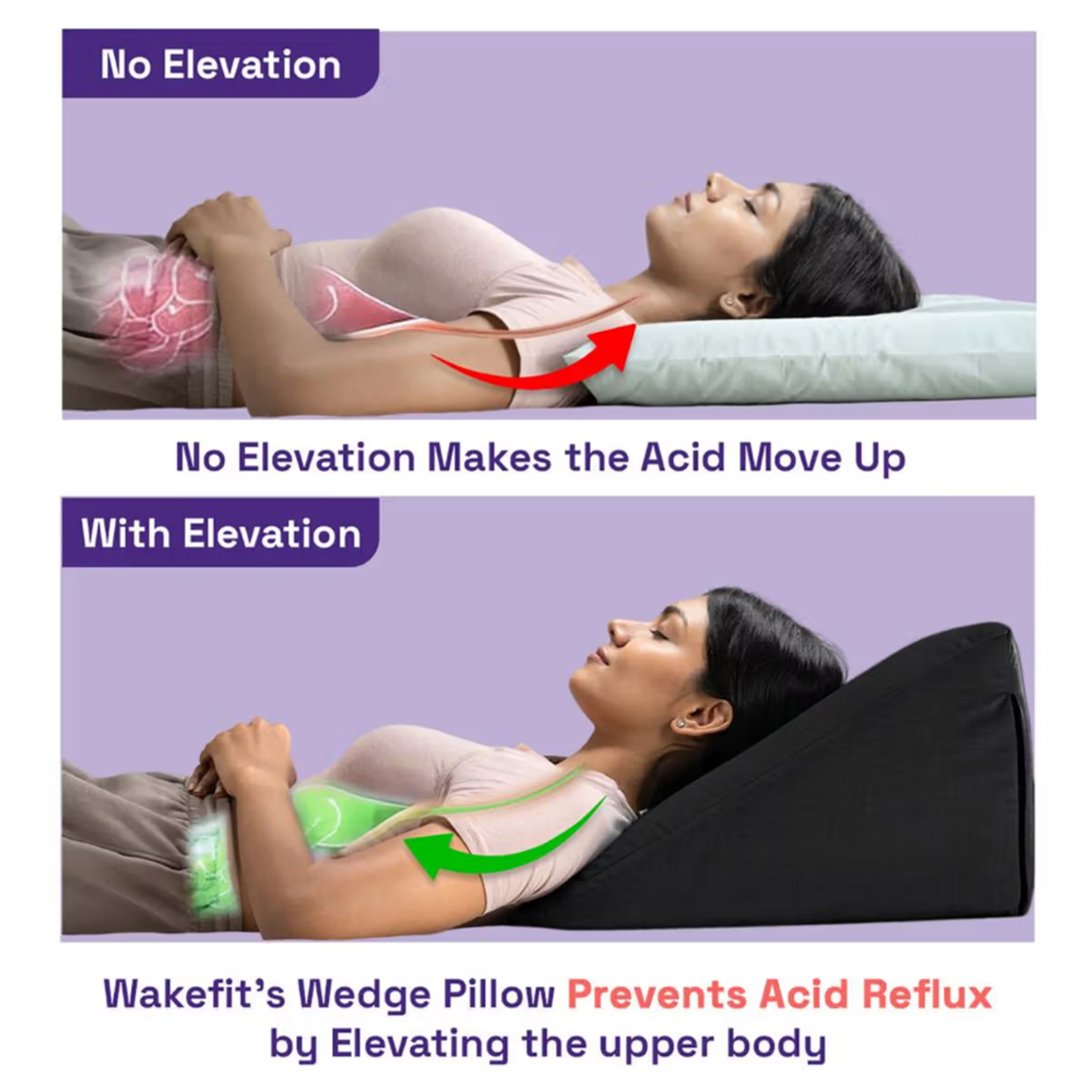
For certain people who have nocturnal acid reflux symptoms such as regurgitation, heartburn, or others, a wedge pillow might be beneficial. A well-designed wedge pillow raises the upper body from the torso up, unlike common pillows which merely lift the head. When you’re lying down, this makes it harder for stomach contents to pass back into your esophagus because of gravity.
Raising the head of the bed for those who experience nighttime GERD symptoms is encouraged by medical advise. This recommendation is made with a condition by the American College of Gastroenterology, and the National Institute of Diabetes and Digestive and Kidney Diseases (NIDDK) refers to raising the head during sleep with a foam wedge or a comparable technique as a lifestyle measure that may help reduce symptoms.
A wedge pillow, however, is not a remedy for the underlying cause of GERD and shouldn’t be used in lieu of prescribed medication or a medical examination.
Author: Dr Sagar Rajkuwar, ENT Specialist, Nashik, Maharashtra, India
🌐 www.entspecialistinnashik.com

What Is a Wedge Pillow for Acid Reflux?
With a gradual slope, a wedge pillow is a pillow with a distinctive form. It elevates your upper body at an angle rather than maintaining your head and neck at the same level as the mattress.
The goal for nighttime acid reflux isn’t only to elevate the head. The benefit of raising the upper body is that it enables gravity to aid in maintaining the stomach’s contents lower in the gastrointestinal system.
This is distinct from supporting your head with several regular pillows.
A typical pillow may cause the neck to bend or create a bent position where the upper abdomen is not sufficiently raised. A more continuous tilt may be achieved by using a wedge that supports the back, shoulders, and upper torso.
While the NIDDK suggests raising the head and upper body during sleep, the Mayo Clinic expressly advises placing a wedge between the box spring and mattress if the bed cannot be elevated.
Table of Contents
- How Does a Wedge Pillow Help Acid Reflux?
- Does a Wedge Pillow Truly Cure Acid Reflux?
- Wedge Pillow vs. Extra Pillows: Which Is Better?
- What’s the Ideal Wedge Pillow Height for Acid Reflux?
- How to Properly Use a Wedge Pillow
- With a wedge pillow, is it possible to sleep on your side?
- Is It Necessary to Sleep with a Wedge Pillow?
- Wedge Pillow and Acid Reflux After Dinner
- What to Look for in a Wedge Pillow for Acid Reflux?
- Can a Wedge Pillow Make Acid Reflux Worse?
- Wedge Pillow for GERD and Heartburn: Is There a Difference?
- Can a Wedge Pillow Replace Acid Reflux Medicine?
- Can a Wedge Pillow Help With Silent Reflux?
- What Other Things Can a Wedge Pillow Be Used For?
- What About Sleeping on a Completely Upright Chair?
- Is a Wedge Pillow Safe?
- When Should You See a Doctor for Acid Reflux?
- Questions about the Wedge Pillow for Acid Reflux that are Frequently Asked
- Wedge Pillow for Acid Reflux: Key Takeaways
How Does a Wedge Pillow Help Acid Reflux?
When stomach contents return to the esophagus, acid reflux develops. Reflux can happen when the lower esophageal sphincter, which often prevents this backward flow, either relaxes excessively or malfunctions.
By lying down, some of gravity’s assistance is lost.
Gravity may lessen the quantity of stomach contents that enter the esophagus and shorten the time that refluxate stays there when the upper body is lifted.
Because a person might lie in a horizontal position for a long time, this is especially true at night.
The ACG guideline points out that nocturnal esophageal acid exposure and nocturnal GERD symptoms have been improved in certain people according to head-of-bed elevation or wedge sleeping studies.
Does a Wedge Pillow Truly Cure Acid Reflux?
It can help, particularly with nighttime symptoms.
According to the available evidence, raising the upper body can alleviate esophageal acid exposure and nocturnal reflux symptoms in certain people.
However, there are flaws in the evidence.
Five controlled trials with 228 individuals were found through a systematic review. Bed blocks were utilized in certain research, a wedge cushion in another, and combinations of techniques in still others. While pointing out important constraints, such as a large chance of bias in many studies, the evaluation found proof indicating benefit.
Thus, a reasonable conclusion is as follows:
A wedge pillow may be an acceptable non-drug treatment for those who have nighttime reflux, but it does not work for everyone and should not be seen as a GERD cure.
Because many online articles depict wedge pillows as if they permanently resolve acid reflux, this difference is crucial.
Wedge Pillow vs. Extra Pillows: Which Is Better?
It is typically not advisable to just place two or three regular pillows under your head if you suffer from reflux.
Additional pillows often elevate the head without providing a continuous slope across the upper torso. They may also place their neck in an awkward posture while sleeping.
A wedge pillow is made to make a little slope under your top half.
Elevating the head with additional pillows is not an effective replacement for raising the head of the bed or the upper body, according to a Mayo Clinic warning.
Better methods are as follows:
- An appropriately placed foam wedge pillow
- A mattress wedge made to raise the upper torso
- Lifting the bed’s head end
- An adjustable bed with a good design
Elevating the neck is less important than elevating the higher body.
What’s the Ideal Wedge Pillow Height for Acid Reflux?
No one wedge-pillow height is guaranteed to be effective for everyone.
According to NIDDK, foam wedges or other methods might be used to elevate the head during sleep by around 6 to 8 inches. Elevating the bed’s head by 6 to 9 inches, according to the Mayo Clinic, may also involve utilizing a wedge to lift the body from the waist up.
Other angles and elevation techniques have also been explored in research. According to one evidence-based consensus, studies that use a foam wedge that is about 20 degrees in height and other techniques that elevate the upper body are described.
Practical point
Instead of opting for the steepest wedge possible, the objective is to gradually and comfortably raise the upper body.
A really steep pillow may be inconvenient, facilitate sliding, or disrupt sleep.
How to Properly Use a Wedge Pillow
Positioning matters.
Step 1: Put the wide end near your top body
The lower section should stretch to the middle of your back or mattress, while the higher portion should support your upper back and shoulders.
Step 2: Keep the upper body supported
Instead of just raising your head, your shoulders and back should be supported by the incline.
Step 3: Avoid bending sharply at the waist
The perfect posture generates a slight incline in the abdomen as opposed to a severe bend.
Step 4: Adopt a relaxing slumber position
For nighttime reflux, sleeping on your left side may be beneficial. Evidence that lying on the left side might lessen nocturnal reflux more than sleeping on the right is cited in the ACG recommendation.
Step 5: Give your body time to adjust
A wedge pillow may seem odd at first. Begin with a comfortable elevation and modify the arrangement if you have pain in your neck, shoulders, hips, or back.
With a wedge pillow, is it possible to sleep on your side?
Yes.
A wedge pillow is appropriate for side sleepers as long as the design provides enough support and does not place the neck in an awkward position.
Left-side sleeping may also be beneficial for those who experience reflux at night.
The reason is anatomical. Reflux may be less likely when lying on your left side than on your right side due to the stomach’s location in relation to the esophagus.
According to the ACG guideline, left-side positioning is less likely to result in nocturnal and post-meal reflux than right-side recumbency.
Therefore, some people may benefit from a combination of:
Upper-body elevation + left-side sleeping
This is a lifestyle strategy, not a surefire cure.
Is It Necessary to Sleep with a Wedge Pillow?
Some individuals might utilize a wedge pillow on a regular basis if it’s comfy and aids in managing nighttime reflux symptoms.
It’s not necessary for everyone who experiences sporadic heartburn to use a wedge pillow.
When is it especially worthwhile to think about:
- Nighttime is when heartburn is at its worst.
- Lying down causes reflux.
- During sleep, acid or food returns into the throat.
- Sleep is disturbed by the symptoms.
- When the upper body is lifted, symptoms get better.
Medical examination may be necessary if you often wake up due to reflux, require progressively steeper elevation to manage your symptoms, or still have noticeable symptoms despite lifestyle adjustments.
Wedge Pillow and Acid Reflux After Dinner
Don’t rely on a wedge cushion as an excuse to consume a huge meal just before bed.
The timing of meals continues to be crucial.
According to NIDDK, eating meals at least three hours before going to bed or lying down can help those who experience GERD symptoms at night. The ACG guideline also advises against eating between 2 and 3 hours before bed.
For example:
Dinner → remain upright → allow several hours → sleep with appropriate upper-body elevation
This could be more helpful than merely using a wedge pillow.
What to Look for in a Wedge Pillow for Acid Reflux?
A helpful wedge cushion ought to provide a slow incline and firm support.
Take into account the following elements.
1. Suitable slope
Instead of causing a severe bend at the neck or abdomen, the pillow should lift the upper body.
2. Adequate breadth
You may be able to roll off the higher area while sleeping if you use a little wedge.
3. Sound construction
The pillow should remain fairly stable on the mattress.
4. pleasant firmness
It ought to be supportive enough without being overly hard or uncomfortable.
5. Appropriate length
A longer wedge might make it easier to go from the shoulders to the lower back.
6. Simple-to-clean covering
A detachable, washable cover is ideal for daily usage.
7. Harmony with your sleeping posture
Side sleepers may need more help than individuals who sleep primarily on their backs.
Important
The most effective wedge pillow isn’t always the most expensive. The essential characteristic is whether it allows for sustained, pleasant upper-body elevation.
Can a Wedge Pillow Make Acid Reflux Worse?
While acid reflux is not typically caused by a wedge pillow, one that is incorrectly designed or positioned can lead to difficulties.
Possible problems include:
- Pain in the neck
- Back pain
- Shoulder pressure
- Falling down while asleep
- a position that is too steep
- Struggling to maintain a comfortable sleep position
- Lack of sleep quality
If the pillow causes a lot of pain, it might not be a good idea to make yourself use it.
Choosing an excessive height is less important than finding a position that is pleasant and sustainable.
Wedge Pillow for GERD and Heartburn: Is There a Difference?
GERD, heartburn, and acid reflux are associated but distinct concepts.
Acid reflux
Acid reflux describes the retrograde motion of gastric contents towards the esophagus.
Heartburn
Heartburn, which is usually felt as a burning feeling behind the breastbone, is a frequent indicator of reflux.
GERD
A persistent condition known as gastroesophageal reflux disease, or GERD, occurs when reflux results in unpleasant symptoms or problems.
GERD is defined by the NIDDK as a more chronic disorder with recurring symptoms or difficulties, as opposed to episodic gastroesophageal reflux.
Even though a wedge pillow might alleviate the symptoms of nighttime reflux, it cannot identify whether someone has GERD.
Can a Wedge Pillow Replace Acid Reflux Medicine?
It should normally not be seen as a straight substitute for prescribed medication.
When appropriate, persons with mild or infrequent symptoms may benefit from lifestyle changes such as meal timing, weight management, and upper-body elevation.
Those with Barrett’s esophagus, erosive esophagitis, diagnosed GERD, or lingering symptoms may need medical attention.
The ACG guideline advises proton pump inhibitors (PPIs) for appropriate individuals, especially for the recovery of erosive esophagitis, and suggests utilizing the lowest effective maintenance dose if long-term treatment is necessary.
A wedge pillow should not be seen as a universal replacement for medicine but rather as a non-drug supportive step.
Can a Wedge Pillow Help With Silent Reflux?
Some individuals refer to “silent reflux” as reflux that causes throat problems rather than typical heartburn.
Sometimes symptoms linked to reflux are listed as:
- Irritation in the throat
- Raspy voice
- Chronic coughing
- Clearing one’s throat
- Feeling of slime
- Sour taste
- Regurgitation
Nevertheless, these symptoms may be caused by a variety of conditions.
While a wedge pillow may lessen nighttime reflux exposure in certain individuals, a reduction in a throat symptom alone does not establish reflux as the cause.
People who experience recurrent hoarseness, chronic coughing, problems swallowing, unexplained weight loss, or other alarming symptoms should be properly evaluated instead of presuming that reflux is to blame.
What Other Things Can a Wedge Pillow Be Used For?
Nighttime reflux treatment is only partly addressed by a wedge pillow.
Additional helpful steps include:
Refrain from lying down immediately after eating
When reflux is a problem at night, allow around three hours to pass between eating and going to bed.
Recognize trigger foods for yourself.
The same food causes are not shared by everyone. High-fat meals, chocolate, coffee or caffeine, mint, spicy foods, citrus, tomatoes, and alcohol are frequently cited as causes. Every person’s reaction is different.
Stay away from overly huge dinners.
For certain people, big meals can exacerbate stomach distention and perhaps make reflux worse.
Keep a healthy weight.
GERD symptoms can be improved by losing weight in those who are overweight or obese. In the ACG guideline, this is highly recommended.
Give up smoking
Smoking can lead to reflux and is not advised for people who exhibit GERD symptoms.
Think about sleeping on your left side.
Compared to sleeping on the right side, lying on the left side may lessen nighttime reflux.
What About Sleeping on a Completely Upright Chair?
Raising the higher body may be accomplished by sitting in a chair, but this is not always the greatest long-term option.
A chair can:
- Fail to provide sufficient assistance.
- Result in neck or back pain
- Decrease the quality of sleep.
- Create pressure areas
- Let the body slide into an uncomfortable position.
A sleeping surface that can be adjusted or a well-made wedge may offer more constant support.
Is a Wedge Pillow Safe?
Most adults may consider a wedge pillow that is correctly positioned to be a low-risk lifestyle intervention.
However, personal situations and comfort are crucial.
People with serious musculoskeletal problems, balance problems, severe mobility constraints, or difficulty independently altering their position may require specific guidance before changing their sleeping arrangements.
The cushion shouldn’t make it difficult to move or breathe.
When Should You See a Doctor for Acid Reflux?
While intermittent heartburn is frequent, ongoing or bothersome symptoms should be addressed by a doctor.
If you have any of the following symptoms, get medical help:
- Heartburn happens often.
- Despite lifestyle changes, symptoms continue to exist.
- Over-the-counter medication is frequently required.
- When I swallow, the food feels like it is stuck.
- Swallowing is difficult for you
- You are constantly puking.
- There has been an unexplained loss of weight.
- You are woken from sleep again and again by symptoms.
- You have a constant pain in your chest
Unexplained or severe chest pain should not automatically be attributed to acid reflux.
Severe chest pain, especially when accompanied by symptoms like arm or jaw pain or shortness of breath, necessitates urgent evaluation, according to the Mayo Clinic.
Questions about the Wedge Pillow for Acid Reflux that are Frequently Asked
1. Does a wedge cushion aid in acid reflux relief?
Some people, especially those who suffer from reflux at night, may find it beneficial. Elevating the upper body may lessen esophageal acid exposure and nocturnal reflux symptoms.
2. What is the proper elevation of a wedge pillow for GERD?
There is no typical height. When raising the head of the bed, the Mayo Clinic suggests about 6-9 inches of elevation, whereas the NIDDK recommends about 6-8 inches. It is critical to have proper upper body support and comfort.
3. Is using a wedge pillow preferable to using extra cushions for acid reflux?
Usually, yes. Extra pillows might merely bend the head and neck, but a wedge is made to elevate more of the higher body.
4. What is the best sleeping position for acid reflux?
Raising the head of the bed may offer further advantages, and sleeping on the left side may be preferred over sleeping on the right side for nighttime reflux.
5. Is it safe for me to use a wedge pillow every night?
Regular usage could be appropriate if it is comfy and alleviates your symptoms. If these actions do not stop the reflux, talk to a doctor.
6. Will using a wedge pillow help with GERD?
Nope. While a wedge cushion can help with nighttime symptoms, it won’t address the core causes of GERD.
7. Is it possible for a wedge pillow to immediately prevent acid reflux?
While some people might observe improvement right away, others might not. The pillow does not solve all causes of reflux, and the response is inconsistent.
8. Can I use a conventional pillow instead? 8.
Because many ordinary cushions may only elevate the head and not the upper torso, they are not typically comparable to a well-designed wedge.
9. After a late meal, should I use a wedge cushion?
A wedge shouldn’t be interpreted as permission to lie down right away after eating. It can be beneficial to wait around three hours between eating and going to bed if you suffer from nighttime reflux.
10. Is silent reflux helped by a wedge pillow?
Although it may lessen nocturnal reflux in certain individuals, there are several causes for throat symptoms. Instead of assuming that reflux causes persistent symptoms, they should be investigated.
Wedge Pillow for Acid Reflux: Key Takeaways
A wedge pillow can be a helpful non-drug approach for nighttime acid reflux, especially when lying down makes symptoms worse.
The key issues are as follows:
- Not just the head, but the whole upper body should be lifted.
- Using a gradual wedge is usually preferred to piling up regular cushions.
- Other clinical sources recommend elevating the bed by 6–9 inches, while the NIDDK typically advises elevating it by 6–8 inches.
- Additional advantages of lying on one’s left side may be gained in terms of nocturnal reflux.
- Do not eat right before going to bed.
- A wedge pillow should not be considered a substitute for GERD therapy that has been advised by a doctor.
- While there is evidence supporting head-of-bed elevation, research has constraints and does not identify a single best pillow for everyone.
- It is advisable to get medical attention if you have symptoms that are persistent, serious, or bothering you.
The aim is not to locate the best cushion available. The objective is to establish an inclination of the upper body that is both stable and cozy enough to last throughout the night.
Medical Disclaimer
This article is for general educational purposes and does not replace an individual medical evaluation, diagnosis, or treatment plan. Acid reflux symptoms can have different causes, and persistent or severe symptoms should be assessed by a qualified healthcare professional. Do not stop or change prescribed medication without discussing it with your healthcare professional.
📞 ENT Consultation & Surgery
Dr. Sagar Rajkuwar (MS-ENT)
Prabha ENT Clinic, Ambad, Nashik
📱 7387590194 | 9892596635
🌐 www.entspecialistinnashik.com
👉 YouTube Channel:
http://www.youtube.com/@healthuseful8539/
Medical References and Further Reading
- National Institute of Diabetes and Digestive and Kidney Diseases (NIDDK) — Treatment for GER and GERD.
- American College of Gastroenterology (ACG) — Clinical Guideline for the Diagnosis and Management of Gastroesophageal Reflux Disease.
- Mayo Clinic — GERD: Diagnosis and treatment.
- Mayo Clinic — Heartburn: Diagnosis and treatment.
- Systematic Review — Head of bed elevation to relieve gastroesophageal reflux symptoms.
- Evidence-based consensus — Management advice for patients with reflux-like symptoms.