Types of Hearing Loss: Conductive, Sensorineural, Mixed & Auditory Neuropathy Explained
Author: Dr Sagar Rajkuwar, ENT Specialist, Nashik, Maharashtra, India
🌐 www.entspecialistinnashik.com
Depending on the area of the ear that is damaged, hearing loss is divided into three primary types and a few specialized classifications. The first step in finding an effective treatment, which can include hearing aids and medical interventions from Johns Hopkins Medicine, is to identify the precise kind of treatment.
1. Sensorineural Hearing Loss (SNHL)
Definition: When the cochlea or auditory nerve pathways are damaged, it results in the most frequent kind of hearing loss. Sounds are often less clear and quieter.
Aging (presbycusis), extended exposure to loud noises, genetics, head injuries, and particular medications are all factors.
Treatment: Typically permanent, but very treatable with cochlear implants or hearing aids to enhance and clarify sound signals.
2. Conductive Hearing Impairment
When sound waves are prevented from traveling effectively from the outer or middle ear to the inner ear, this happens.
Causes: Fluid in the middle ear from infections, an ear canal infection, impacted earwax, a punctured eardrum, or benign tumors.
Treatment: Frequently treatable with medical procedures like antibiotics, earwax removal, or straightforward surgeries (e.g., ear tube placement or eardrum repair).
3. Combined Hearing Loss
What it is: Hearing impairment that is both conductive and sensorineural. This means that in addition to issues in the outer or middle ear, the inner ear is also damaged.
Long-standing persistent ear infections or head traumas that harm both the inner and outer ear structures at once are the causes.
Treatment: necessitates a two-pronged strategy that frequently includes both hearing technology and medical/surgical operations.
Other Specific Classifications
A problem known as auditory neuropathy spectrum disorder (ANSD) occurs when the inner ear is able to receive sound but the signal cannot be transmitted from the ear to the brain.
When pathways or centers inside the brain itself are injured or fail to process sound signals properly, central hearing loss results.
Hearing Impairment Categories
Hearing loss is also assessed by its severity, which determines how loud noises must be for you to be able to hear them:
- Modest: 26 to 40 dB
- Medium: 41 to 55 decibels
- Mildly Severe: 56–70 dB
- High: 71–90 dB
- Deep: greater than 91 dB
If you experience any changes in your hearing, see a licensed audiologist, who will use exams such as pure-tone audiometry to identify the precise kind and severity of your condition.
Table of Contents
- Introduction
- Information needed to know
- Components of the ear
- Four Varieties of Hearing Loss
- Severity of hearing loss
- Summary
- FAQs: Kinds of Hearing Loss
Introduction
One of the most prevalent sensory diseases in the world, hearing loss affects individuals of all ages. It happens if one or more parts of the auditory system, including the outer ear, middle ear, inner ear, auditory nerve, or the brain’s hearing pathways, are malfunctioning. From slight difficulty hearing talks to complete deafness, hearing loss might vary in degree based on the site and extent of the damage. The primary forms of hearing impairment are sensorineural hearing loss, mixed hearing loss, auditory neuropathy spectrum disorder (ANSD), and conductive hearing loss.
Early diagnosis and effective treatment depend on understanding the many forms of hearing loss, their causes, symptoms, and treatment options. This thorough manual outlines the many categories of hearing loss and the ways that contemporary treatments might enhance both hearing and general quality of life.
Information needed to know
- The ear has numerous sections, including the middle, outer, and inner ears.
- Hearing loss can occur when any portion of the auditory (hearing) system or the ear itself is not functioning normally.
- There are four categories of hearing loss: sensorineural, conductive, mixed, and auditory. neuropathy range disorder
- The level of hearing loss can range from moderate to severe.
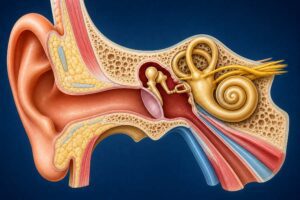
- An image showing the outer, middle, and interior components of the ear, as well as the earlobe, ear canal, and eardrum.
Components of the ear
External ear. The external ear is composed of
- Pinna is the term for the part of our heads that is on either side of them.
- The canal of the ear.
- The tympanic membrane, or eardrum, divides the outer and middle ears.
Ear in the middle. The structure of the middle ear consists of
- The eardrum.
- Ossicles, three little bones that transfer the eardrum’s motion to the inner ear.
The interior ear. The inner ear is made up of
- The snail-shaped hearing organ is called the cochlea.
- The semicircular canals which help maintain equilibrium.
- Nerves that travel to the brain.
ear nerve Sound information is transmitted from the ear to the brain by this nerve.
System for auditory (hearing). In order to facilitate our hearing, the auditory pathway processes sound information as it travels from the ear to the brain. Therefore, our brain pathways contribute to our hearing.
Four Varieties of Hearing Loss
- Hearing loss that is conductive. Hearing loss brought on by something obstructing noises from entering the outer or middle ear. With the use of medication or surgery, this kind of hearing loss can typically be cured.
- Loss of hearing due to sensorineural issues. Loss of hearing resulting from a malfunction in the inner ear or auditory nerve.
- Mixed hearing loss. Both conductive and sensorineural hearing loss are involved in mixed hearing loss.
- Spectrum of disorders caused by auditory neuropathy. Sound enters the ear normally, but due to inner ear or hearing nerve damage, sound isn’t arranged in a manner the brain can understand, leading to hearing loss. Check out the National Institute of Deafness and Other Communication Disorders for additional information.
Severity of hearing loss
- Slight impairment of hearing. Although a person with a slight hearing impairment might be able to pick up some speech sounds, gentle noises are difficult to hear.
- Hearing loss of medium severity. When someone speaks at a normal volume, a person who has a moderate hearing loss may not be able to hear any conversation.
- Significant hearing loss. Someone who is very hard of hearing will only hear some loud sounds and won’t hear any speech when someone is talking at a regular volume.
- Hearing loss that is profound. A profoundly deaf individual will not be able to hear any speech, and only extremely loud noises will be perceptible to them.
Hearing impairment can also be described as:
- Bilateral or unilateral. The loss of hearing can affect either one ear (unilateral) or both ears (bilateral).
- Post- or pre-lingual. Hearing loss occurred either before a person learned to speak (pre-lingual) or after a person did (post-lingual).
- Either symmetrical or asymmetrical. The hearing loss might be symmetrical (the same in both ears) or asymmetrical (different in each ear).
- Gradual or abrupt. Hearing loss either develops gradually (progressively) or quickly (suddenly).
- stable or variable. Over time, hearing loss either improves or worsens (fluctuating) or remains unchanged (stable).
- Congenital or acquired/delayed. Congenital hearing loss is present at birth, while acquired hearing loss or hearing loss that begins at a delayed onset appears later in life.
Summary
When one or more components of the auditory system stop working properly, hearing loss results. The four primary categories of hearing loss are conductive hearing loss, sensorineural hearing loss, mixed hearing loss, and auditory neuropathy spectrum disorder (ANSD). Outer or middle ear damage causes conductive hearing loss, which is usually curable. Usually permanent but treatable with cochlear implants or hearing aids, sensorineural hearing loss is caused by injury to the inner ear or auditory nerve.
Hearing loss that is mixed includes both sensorineural and conductive components. Hearing loss can be mild to profound and impact either one or both ears. Long-term hearing results, quality of life, and communication may be significantly improved with early diagnosis via hearing tests like Pure Tone Audiometry and prompt treatment.
FAQs: Kinds of Hearing Loss
1. What are the primary forms of hearing loss?
The four primary categories of hearing loss are:
- Hearing loss that is conductive in nature
- Hearing Loss, Sensorineural (SNHL)
- Loss of Hearing, Mixed
- Auditory Neuropathy Spectrum Disorder (ANSD)
2. What is conductive hearing loss?
When sound cannot effectively travel through the outer or middle ear, conductive hearing loss results. Earwax blockage, ear infections, fluid in the middle ear, and a perforated eardrum are some frequent causes.
3. Can conductive hearing loss be remedied?
In several situations, yes. Depending on the cause, therapy may include earwax removal, medications, ventilation tubes, or surgery.
4. What exactly is sensorineural hearing loss?
Inner ear or cochlear damage might result in sensorineural hearing loss. Permanent hearing loss of this sort is the most prevalent.
5. What causes hearing loss?
Typical reasons include:
- Presbycusis, or age-related hearing loss.
- Exposure to noise
- Factors such as genetics
- Trauma to the head
- Viral infections.
- Certain drugs (ototoxic medications)
6. Is it possible to undo sensorineural hearing loss?
It’s impossible to undo the majority of situations. However, cochlear implants and hearing aids may greatly enhance hearing and communication.
7. What is combined hearing loss?
Mixed hearing loss is the concurrent manifestation of conductive and sensorineural hearing loss.
8. What is ANSD (Auditory Neuropathy Spectrum Disorder)?
ANSD is a hearing disorder that affects how sounds are transmitted from the inner ear to the brain, even though the sounds themselves enter the ear normally.
9. How does hearing loss manifest itself?
Among the symptoms might be:
- Problems comprehending language
- Asking others to say something twice often
- Increasing the TV volume
- (tinnitus) is a ringing sound in the ears.
- Problem hearing in loud situations
10. What are the varying stages of hearing impairment?
Loss of hearing is classified according to its severity as:
- Gentle
- Average
- Intense
- Deep
11. What is unilateral hearing loss?
Bilateral hearing loss affects both ears, whereas unilateral hearing loss only impacts one ear.
12. What is abrupt hearing loss?
Rapid deterioration in hearing that occurs over a period of hours or days and necessitates rapid medical evaluation by an ENT physician is known as sudden hearing loss.
13. What is the process of identifying hearing loss?
The following are used to diagnose hearing loss:
- Audiometry with Pure Tones (PTA)
- Tympanometry
- Audiometry Speech
- Otoacoustic Emissions (OAE)
- ABR stands for Auditory Brainstem Response.
14. When should I consult an ENT doctor if I have hearing loss?
If you experience any of the following, see an ENT specialist:
- Hearing loss may come on quickly.
- Ongoing hearing problems
- pain in the ear
- Discharge from the ear
- Ringing in the Ears
- Balance issues or lightheadedness
15. Is it possible to prevent hearing loss?
A few forms can be avoided by:
- Stay away from loud noises.
- using hearing protection
- Immediately addressing ear infections.
- Managing chronic health disorders
- Steering clear of pointless ototoxic medicine exposure.
16. The most prevalent sort of hearing loss is what?
The most prevalent kind of hearing loss, particularly among older persons and those who have been exposed to loud noise over time, is sensorineural hearing loss.
17. Do all types of hearing loss benefit from hearing aids?
The best hearing aids are those that treat mixed and sensorineural hearing loss. The appropriateness is determined by the kind and degree of hearing loss.
18. Is it possible for kids to be born with hearing problems?
Yes. At birth, congenital hearing loss may be brought on by hereditary factors, prenatal infections, or other developmental issues.
19. What distinguishes between acquired and congenital hearing loss?
Congenital hearing loss is something you’re born with, but acquired hearing loss happens later in life because of things like sickness, damage, getting older, or being around a lot of noise.
20. Why is it essential to treat hearing loss at an early stage?
Early detection and intervention improve speech, communication, education, social interaction, and overall quality of life.
Medical Disclaimer
Medical Disclaimer: This article is for educational purposes only and is not a substitute for professional medical advice, diagnosis, or treatment. Hearing loss can result from various underlying conditions that require proper evaluation by an ENT specialist or audiologist. If you experience sudden hearing loss, ear pain, dizziness, tinnitus, or worsening hearing, seek immediate medical attention.
References
- National Institute on Deafness and Other Communication Disorders – Hearing Loss and Auditory Disorders Information.
- NIDCD Hearing Loss Resources
- American Speech-Language-Hearing Association – Types and Management of Hearing Loss.
- ASHA Hearing Loss Information
- World Health Organization – World Report on Hearing.
- WHO Deafness and Hearing Loss Factsheet
- American Academy of Otolaryngology–Head and Neck Surgery – Hearing Loss Evaluation and Treatment Guidelines.
- Centers for Disease Control and Prevention – Hearing Loss in Children and Adults.