What Happens If Non-Dissolving Stitches Are Left In?
Risks, Symptoms, Complications & Doctor’s Advice
By: Dr. Sagar Rajkuwar
ENT Specialist, Nashik, Maharashtra
Table of contents-
- (1)Introduction
- (2)What are non-dissolving sutures?
- (3)Why Does it Necessary to Remove Non-Dissolving Sutures?
- (4)What happens if undissolvable stitches are left in place?
- (5)Is It Possible for the Body to Absorb Stitches That Don’t Dissolve?
- (6)How Long Can Non-Dissolving Stitches Be Left In?
- (7)What Would Happen If Stitches Were Accidentally Left Behind?
- (8)Is it risky to take out stitches late?
- (9)The Process by Which Doctors Remove Old or Embedded Stitches
- (10)How to Avoid Issues with Non-Dissolving Sutures
- (11)Specific Considerations for Surgical and ENT Operations
- (12)When Should You Seek Medical Attention Right Away?
- (13)Commonly Asked Questions (FAQs)
- (14)Summary
(1)Introduction
After surgery, injuries, or medical treatments, wounds are often closed with stitches, which are also known as sutures. Non-dissolvable stitches must be taken out by a medical practitioner at the appropriate time, even though some stitches disappear by themselves.
The question asked by many patients is:
- 👉If stitches that don’t dissolve stay in for too long, what happens?
- 👉 Is it possible for the body to absorb them?
- 👉 Is there a chance of long-term consequences?
The short answer is that leaving non-dissolving stitches in might lead to issues, such as slight skin irritation, infection, scarring, and slow healing.
In this piece, we will discuss:
- Non-dissolving sutures include what?
- The reasons why they must be taken out
- What would occur if they were left in?
- Indications that stitches should have been taken out
- When to seek medical advice
(2)What are non-dissolving sutures?
Non-dissolving stitches are composed of substances that the body does not naturally break down. These stitches remain in place until physically taken out, unlike absorbable sutures.
Typical Varieties of Non-Dissolvable Sutures
- Nylon
- Silk
- Polyester
- Prolene (Polypropylene)
- seldomly used stainless steel
When are these stitches typically used?
- Wound support should be robust.
- The healing process is gradual.
- Closure must be precise.
- The wound is tense.
(3)Why Does it Necessary to Remove Non-Dissolving Sutures?
The purpose of non-dissolving sutures is to be temporary. The stitches are no longer useful once the wound has healed sufficiently for it to remain closed on its own.
When left in:
- The body perceives them as a foreign entity
They can begin to develop skin over them.
Around the thread, bacteria can build up.
It may get in the way of the body’s natural healing process.
(4)What happens if undissolvable stitches are left in place?
Leaving non-dissolving stitches in for too long can cause a variety of issues. The degree of severity is determined by:
- Material for sewing
- where the wound is
- How long they are left in there
- The patient’s hygiene and immunity.
Consider the possible outcomes.
1. Inflammation and irritation of the skin
Local irritation is one of the first issues.
The signs are as follows:
- Redness surrounding stitches
- A feeling of itching or burning
- Slight swelling
- Tenderness
The stitch material is treated by the skin as a foreign object, which is why this occurs.
📌This is frequently the case when sutures stay in place longer than advised.
2. Elevated Risk of Infection
Bacteria may thrive on stitches that do not dissolve.
Indications of illness include:
- rising discomfort
- The wound is surrounded by warmth.
- Yellow or pus discharge
- Terrible odor
- fever (in extreme circumstances)
An infected wound may either open up again or heal slowly.
⚠️ Untreated infections may extend to the bloodstream or deeper tissues.
3. Delayed or Inadequate Wound Healing
When stitches are left in for too long:
- The skin is unable to regenerate effectively
- Healing becomes uneven.
- The margins of wounds may not heal on their own.
As a consequence, the wound heals more slowly, and there is a greater chance that it may open again after the sutures are taken out too soon.
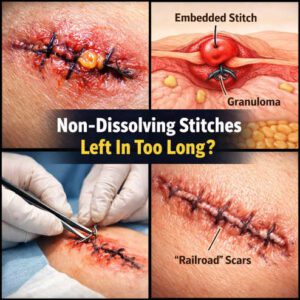
4. A Lot of Scars and Stitches
It can result from leaving stitches in place for too long:
- Permanent stitch lines
- Scars resembling rail tracks
- Thick or elevated scars (hypertrophic scars)
This is particularly prevalent on:
- Face
- The neck
- Hands
- Areas of surgical cosmetics
📌Removing stitches early (when necessary) minimizes scarring.
5. Stitch Integration into the Skin
Embedded stitches are one of the most troublesome consequences.
What transpires?
- The stitch is covered by skin.
- The skin traps Stitch.
- Removing becomes difficult and painful.
A small surgical excision is occasionally necessary.
6. Granuloma Development
Leaving stitches in place for an extended period of time might result in the development of a foreign body granuloma.
Symptoms:
- A little, firm knot at the location of the suture
- Skin-colored or reddish swelling
- Continuing pain
Sometimes, a little excision or medical care is all that is needed for granulomas.
7. Persistent wound discharge
Some patients go through:
- constant seeping
- Discharge that is clear or purulent
- edges of wounds that won’t heal
The reason for this is that the tissue is continuously irritated by the stitch.
(5)Is It Possible for the Body to Absorb Stitches That Don’t Dissolve?
❌No.
Non-dissolvable sutures are made to remain in place rather than be absorbed. They are not digestible by the body. It either:
- Reacts with inflammation
- Gently pushes them out via the skin
- Envelops them with scar tissue
None of these are optimal results.
(6)How Long Can Non-Dissolving Stitches Be Left In?
The removal time depends on the location of the wound.
| Body Area | Removal Time |
|---|---|
| Face | 5–7 days |
| Neck | 7–10 days |
| Scalp | 7–10 days |
| Arms | 10–14 days |
| Legs | 10–14 days |
| Joints | 14 days |
| Back | 14 days |
Indications That Your Stitches Should Have Been Removed by Now
If you see any of the following, get medical help:
- after the recommended day, there are still stitches
- The stitch is covered in skin.
- Pus or redness
- The discomfort is getting worse rather than better.
- The thread may either pierce the skin or snap.
(7)What Would Happen If Stitches Were Accidentally Left Behind?
Don’t try to get rid of them on your own.
What to do:
- See your physician or surgeon.
- Maintain a clean environment
- Don’t try to cut or pull the stitch.
- Be on the lookout for signs of infection.
Although it’s generally feasible to remove it late, caution must be used.
(8)Is it risky to take out stitches late?
Generally speaking:
- The stitches can still be removed safely.
- There could be slight discomfort.
- After that, there is generally an improvement in recovery.
But medical intervention is required if embedding or infection has occurred.
(9)The Process by Which Doctors Remove Old or Embedded Stitches
Doctors may:
- Use tools that are sterile.
- If necessary, use local anesthetic.
- If stitches are embedded, remove scar tissue
- If there is an infection, prescribe antibiotics.
Early assessment helps avoid difficulties.
(10)How to Avoid Issues with Non-Dissolving Sutures
Advice for Providing Patient Care
- Keep your stitch removal appointment.
- Keep wounds clean.
- Don’t scratch or soak anything.
- Obey the instructions following surgery.
Recommendation from a doctor
- Inquire about the absorbability of stitches at all times.
- Before release, make sure the stitch removal date is clear.
- Don’t put off follow-up appointments.
(11)Specific Considerations for Surgical and ENT Operations
During ENT procedures (nose, ear, throat, skin incisions):
- Timing of stitches is crucial.
- The cosmetic result is important
- Function can be impacted by the chance of infection.
Frequent follow-up guarantees the best possible recovery.
(12)When Should You Seek Medical Attention Right Away?
Get immediate treatment if:
- A fever starts.
- The pain is excruciating.
- More pus is released
- The complexion becomes dark or black
- The wound breaks open out of nowhere.
(13)Commonly Asked Questions (FAQs)
❓ What happens if non-dissolving stitches are not removed?
If non-dissolving stitches are not removed on time, they may cause skin irritation, infection, scarring, or become embedded in the skin.
❓ Can the body absorb non-dissolving stitches?
No, non-dissolving stitches are not absorbed by the body and must be removed by a healthcare professional.
❓ Is it dangerous to leave stitches in too long?
Yes, leaving stitches in longer than recommended increases the risk of infection, poor healing, and permanent stitch marks.
❓ What should I do if my stitches were forgotten?
You should visit a doctor as soon as possible. Do not attempt to remove stitches at home.
For important health related topics please click on our facebook page link given below or copy paste this link into google search –
https://www.facebook.com/positivemind.healthcare
For important health related videos please click on the link of our youtube channel given below or copy paste this link into google search-
http://www.youtube.com/@healthuseful8539
(14)Summary
Although non-dissolving stitches are essential for wound healing, they must be removed at the appropriate moment. Keeping them in place for too long might result in irritation, infection, scarring, and a prolonged recovery period.
✔Make sure to always adhere to the schedule for stitch removal provided by your doctor.
✔Never take out stitches on your own.
✔If stitches are forgotten or cause problems, seek medical assistance.
It’s just as crucial to remove stitches in a timely manner as it is to perform the surgery.
Disclaimer:
This article is for educational purposes only and does not substitute professional medical advice. Always consult a qualified doctor for proper diagnosis and treatment.
If any patient has any ENT -Ear nose throat problems and requires any , consultation ,online consultation ,or surgery in clinic of ENT specialist Doctor Dr Sagar Rajkuwar ,he may TAKE APPOINTMENT BY CLICKING ON THE LINK GIVEN BELOW-
Clinic address of ENT SPECIALIST doctor Dr Sagar Rajkuwar-
Prabha ENT clinic, plot no 345,Saigram colony, opposite Indoline furniture Ambad link road ,Ambad ,1 km from Pathardi phata Nashik ,422010 ,Maharashtra, India-Dr Sagar Rajkuwar (MS-ENT), Cell no- 7387590194 , 98925966