This Small Change in Your Breathing Rhythm Can Naturally Calm the Nervous System
(And Most People Do It Wrong)
Have you ever felt anxious for no obvious reason—standing in a line, sitting in traffic, or scrolling your phone late at night—when nothing technically bad was happening, yet your body reacted as if danger was near?
Your heart speeds up. Your chest tightens. Your breathing becomes shallow and rushed. And your mind starts repeating that familiar warning loop: “Something’s wrong.”
What’s happening in those moments isn’t weakness or imagination. It’s your nervous system misreading the environment.
And there’s a surprisingly small change you can make—right now, without medication, apps, or equipment—that can tell your body to calm down.
Most people breathe every minute of their lives.
Most people also breathe in a way that keeps their nervous system on high alert.
Let’s fix that.
By Dr. Sagar Rajkuwar, ENT Specialist, Nashik, Maharashtra, India
🌐 www.entspecialistinnashik.com
Why Your Breathing Pattern Matters More Than You Think
Breathing is unique.
It’s automatic—yet also under your control.
You don’t have to remember to breathe, but you can consciously change how you breathe. That makes it one of the fastest ways to communicate with your nervous system.
When stress hits, your breathing changes before your thoughts catch up.
Short, rapid breaths signal danger.
Slow, controlled breaths signal safety.
Your brain listens to the lungs more than it listens to logic.
That’s why reasoning with anxiety often fails—but breathing works.
The Hidden Breathing Mistake Most Stressed People Make
The next time you’re stressed, notice your breathing carefully.
You’ll likely observe:
-
Quick, shallow inhales
-
Rising shoulders
-
Tight chest
-
Very short or rushed exhales
This pattern tells your body:
“Stay alert. Stay ready. Something might go wrong.”
Most people think calming down means taking a deeper breath in.
That’s the mistake.
The real issue isn’t the inhale.
It’s what happens after.
The One Small Change Your Nervous System Actually Responds To
Instead of focusing on breathing in more, focus on breathing out longer.
That’s it.
Keep your inhale normal.
Make your exhale just a little longer.
Examples:
-
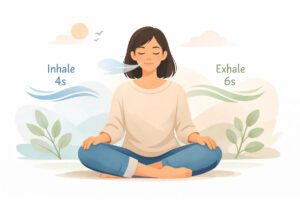
Inhale for 4 seconds → Exhale for 6 seconds
-
Inhale for 3 seconds → Exhale for 5 seconds
This small ratio change sends a powerful message to your body:
“We’re safe enough right now.”
No mantras.
No visualization.
Just air and timing.
Why a Longer Exhale Calms the Body (The Science Explained Simply)
Your nervous system has two main modes:
Sympathetic Nervous System
-
Fight or flight
-
Activated during stress
-
Increases heart rate and alertness
Parasympathetic Nervous System
-
Rest and digest
-
Supports recovery and calm
-
Slows heart rate
Here’s the key:
-
Inhaling gently activates alertness
-
Exhaling slowly activates relaxation
When you lengthen your exhale, you stimulate the vagus nerve, which plays a major role in calming the body.
Think of it like this:
-
Inhale = gas pedal
-
Exhale = brake pedal
Most anxious breathing patterns are all gas, no brakes.
A longer exhale presses the brakes.
Real-Life Example: Stress in Action
Imagine a young lawyer sitting in her car outside a courthouse.
Her hands feel shaky.
Her jaw is clenched.
Her mind is racing through worst-case scenarios.
Nothing bad is happening yet—but her body is already bracing for impact.
A colleague once shared a simple technique:
“Breathe in for four. Out for six. Ten times.”
She tries it.
At first, it feels awkward.
By the fourth breath, her jaw loosens.
By the seventh, her shoulders sink back into the seat.
Her thoughts haven’t disappeared.
But they’re no longer screaming.
Nothing in her life changed.
Her breathing rhythm did.
How to Practice Long-Exhale Breathing (Step-by-Step)
You can do this almost anywhere.
Basic Method
-
Sit or stand comfortably
-
Close your mouth gently
-
Inhale through your nose for 4 seconds
-
Exhale through your nose or lightly parted lips for 6 seconds
-
Repeat for 8–10 breaths
That’s enough to create a shift.
If That Feels Too Much
Try:
-
3 seconds in
-
5 seconds out
The ratio matters more than the exact numbers.
Common Mistakes That Make Breathing Exercises Fail
Many people try this once, feel nothing dramatic, and quit.
Here’s why it sometimes doesn’t work:
1. Forcing the Breath
Huge inhales and exaggerated sighs can cause dizziness and anxiety.
Fix: Keep it gentle and quiet.
2. Expecting Instant Bliss
This isn’t a magic switch. It’s a nervous-system nudge.
Fix: Look for subtle changes, not fireworks.
3. Turning It Into a Performance
Counting obsessively or “doing it right” creates tension.
Fix: Lose the count if needed. Restart calmly.
When and Where to Use This Technique
This works best during micro-stress moments, such as:
-
Waiting in traffic
-
Before opening a stressful email
-
Standing in a queue
-
Before an important conversation
-
Lying in bed before sleep
-
During early signs of panic
You don’t need privacy.
You don’t need silence.
You just need a few breaths.
How Long It Takes to Feel Results
Most people notice a shift within:
-
2–5 minutes, or
-
8–20 breaths
On tough days, repeat it multiple times instead of doing one long session.
Consistency beats duration.
Frequently Asked Questions (FAQ)
How long should I practice to feel calmer?
Most people feel a noticeable change within a few minutes. Even short sessions provide relief.
Can I do this if I have asthma or breathing problems?
Yes, but keep the counts shorter and avoid forcing deep breaths. Comfort comes first. If unsure, consult your healthcare provider.
Is this the same as meditation?
No. This is a simple breathing-based nervous system tool. It works even if your mind is restless.
Should I use an app?
Apps can help initially, but it’s useful to practice without one so you can use the technique anywhere.
What if my thoughts stay anxious?
That’s okay. The body often calms first. Thoughts usually follow later.
11. Key Takeaways
| Key Point | What It Means | Benefit |
|---|---|---|
| Longer exhales calm the nervous system | Activates the parasympathetic response | Reduces tension naturally |
| Simple ratios work | 3–5 or 4–6 breathing | Easy, practical, anywhere |
| Consistency matters | Short daily use beats perfection | Long-term stress resilience |
Letting Your Body Lead, For Once
You don’t always need to think your way out of anxiety.
Sometimes, the fastest path to calm runs through your lungs.
Your breath is already there—automatic, reliable, patient.
Lengthening your exhale is like whispering to your nervous system:
“You don’t have to fight right now.”
And more often than not, your body listens.
Medical Disclaimer
This article is for educational purposes only and does not replace professional medical advice. If you have ongoing anxiety, panic symptoms, or breathing disorders, consult a qualified healthcare professional.
📞 ENT Consultation & Surgery
Dr. Sagar Rajkuwar (MS-ENT)
Prabha ENT Clinic, Ambad, Nashik
📱 7387590194 | 9892596635
🌐 www.entspecialistinnashik.com