Do Stitches Heal Faster, Covered or Uncovered?
By: Dr. Sagar Rajkuwar
ENT Specialist, Nashik, Maharashtra
Table of contents-
- Introduction
- Understanding How Stitches Heal
- Covered vs Uncovered Stitches: The Core Difference
- Do Stitches Heal Faster When Covered?
- Why Keeping Stitches Covered Helps Healing
- When Should Stitches Be Kept Covered?
- Can Stitches Ever Be Left Uncovered?
- Common Myths About Stitches & Air Exposure
- How to Properly Care for Covered Stitches
- Covered Stitches in Different Body Areas
- Signs Your Stitches Are Healing Well
- Warning Signs — See a Doctor Immediately
- Covered vs Uncovered: Final Medical Verdict
- Frequently Asked Questions (FAQ)
- Expert ENT Advice
- Disclaimer
(1)Introduction
One of the most frequent queries that patients make following surgery or an accident is:
“For quicker healing, should I keep my stitches covered or exposed?”
This misunderstanding is understandable. Older advice frequently recommended “airing out” wounds, but current medical science heavily favors wet wound healing with adequate coverage.
So, what’s the real story?
Based on medical evidence, surgical recommendations, and actual healing results in the real world, we will discuss in this article if stitches heal quicker when covered or uncovered.
(2)Understanding How Stitches Heal
Wound edges are held together by stitches (sutures) to allow your body to heal injured tissue. There are four recognizable phases to recovery:
1. Hemostasis (First 24 Hours)
- Formation of a blood clot
- The bleeding ceases.
2. Inflammation (Days 1–4)
- Redness, light discomfort, swelling
- White blood cells combat illness.
3. Days 4–21: Proliferation
- New skin cells develop
- Formation of collagen
4. Maturation (Weeks to months)
- The scar becomes more prominent.
- The skin becomes more flexible once again.
👉 Proper wound coverage directly influences all these stages
(3)Covered vs Uncovered Stitches: The Core Difference
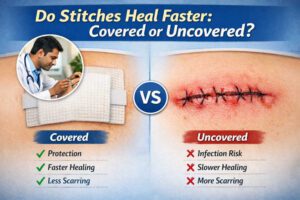
| Factor | Covered Stitches | Uncovered Stitches |
|---|---|---|
| Moisture | Maintained | Lost |
| Infection risk | Lower | Higher |
| Healing speed | Faster | Slower |
| Scar quality | Better | Poorer |
| Pain | Less | More |
(4)Do Stitches Heal Faster When Covered?
✅ Yes — medical evidence strongly supports covered stitches
Studies conducted today demonstrate that wounds that are covered recover up to 40% quicker than wounds that are not.
Why?
- Cell migration is facilitated by a humid atmosphere.
Less crusting
Reduced bacterial pollution
Temperature stability promotes the action of healing enzymes
🩺 Medical Consensus:
“A moist, protected wound heals faster and with less scarring.”
(5)Why Keeping Stitches Covered Helps Healing
1. Prevents Illness
- Dust, sweat, pollutants, and bacteria are all blocked by bandages.
- Particularly crucial in the Indian climate
2. Decreases the Development of Scabs
- Skin cell movement is slowed by scabs.
- New skin develops over covered wounds rather than a crust.
3. Enhances the Aesthetic Result
- Less expansion of scars
- Improved match for skin tone
4. Lessens Pain & Itching
- Nerve endings are shielded.
- less dryness and pulling sensation
(6)When Should Stitches Be Kept Covered?
It is advised to keep it covered if:
The first 24 to 72 hours after surgery
The wound is:
- Oozing
- Big
- Profound
Located at:
- The face
- The neck
- Joints
- Hands or feet
The patient has:
- Diabetes
- Low immunity
- History of smoking
(7)Can Stitches Ever Be Left Uncovered?
✔️ Yes — but only under specific conditions
If the initial healing process leaves stitches exposed, they may remain uncovered.
- No bleeding or discharge
- The borders of the skin are closed.
- There was no redness, discomfort, or edema.
- The recommendation came from the doctor.
⛔ Never uncover stitches if:
-
There is a foul or unpleasant odor.
-
The wound is either red or painful.
-
There is a fever.
(8)Common Myths About Stitches & Air Exposure
❌Myth 1: “Air helps wounds heal”
Truth: Air dries wounds and delays cell restoration
❌Myth 2: “Bandages cause infection”
Reality: Infection is brought on by unclean bandages, not by clean ones.
❌Myth 3: “Scab means healing”
Fact: Scabs prolong the healing process and exacerbate scarring.
(9)How to Properly Care for Covered Stitches
A Step-by-Step Approach
1.Maintain cleanliness once every day
- Use saline or clean water
- Do not use powerful antiseptics unless directed.
2.Use the recommended ointment.
- Petroleum jelly or antibiotics
- Just a thin coating
3.Apply a sterile covering
- The gauze shouldn’t be sticky.
- If it rains, or if it’s just a day-to-day occurrence, switch it out.
4.Maintain a dry environment
- Don’t soak
- After 24–48 hours, a light shower is permitted.
(10)Covered Stitches in Different Body Areas
The Neck and Face
- Keep covered for 24 to 48 hours.
- Later reveal for cosmetic healing
The abdomen
- Covered for five to seven days
- a location with a lot of traffic
Joints
- Protected until the stitches are taken out
- Avoids the possibility of reopening
Operations on the ear, nose, and throat
- When protected, incisions in the nose, neck, and ears heal the best.
- Reduced infection and scar visibility
(11)Signs Your Stitches Are Healing Well
✅ Mild itch
✅ There is no discharge.
✅ Pink borders on the wound
✅ Reduction of pain over time
(12)Warning Signs — See a Doctor Immediately
🚨 Pain is getting worse.
🔥 Redness is getting worse.
🚨 Pus or unpleasant odor
🔥 Fever
🚨 Unraveling stitches
(13)Covered vs Uncovered: Final Medical Verdict
✔️The stitches are covered, which makes for a quicker, safer, and aesthetically pleasing healing process.
Too soon disclosure may result in:
- Postpone recovery
- raise the possibility of infection
- Cause thicker scars.
🩺 Doctor’s Recommendation:
Keep stitches covered initially, then uncover only when advised.
(14)Frequently Asked Questions (FAQ)
❓ For how long should stitches be covered?
Typically between 24 and 72 hours, though it may vary depending on the location.
❓Is it possible to sleep without covering my stitches?
Only with the approval of a doctor and no discharge.
❓Do stitches need to be covered up after taking a shower?
Pat dry and re-cover, yes.
❓Is Vaseline preferable to antibiotic ointment?
If there is no chance of infection, petroleum jelly works well.
For important health related topics please click on our facebook page link given below or copy paste this link into google search –
https://www.facebook.com/positivemind.healthcare
For important health related videos please click on the link of our youtube channel given below or copy paste this link into google search-
http://www.youtube.com/@healthuseful8539
Disclaimer
This piece is meant to be informative and should not be used in place of seeing a doctor. For wound care, always follow the advice of your surgeon.
Expert ENT Advice
As an ENT surgeon, I highly recommend keeping wounds moist and properly covered, particularly those on the face, neck, and surgical wounds. Patient comfort is increased and problems are minimized by this strategy.
If any patient has any ENT -Ear nose throat problems and requires any , consultation ,online consultation ,or surgery in clinic of ENT specialist Doctor Dr Sagar Rajkuwar ,he may TAKE APPOINTMENT BY CLICKING ON THE LINK GIVEN BELOW-
Clinic address of ENT SPECIALIST doctor Dr Sagar Rajkuwar-
Prabha ENT clinic, plot no 345,Saigram colony, opposite Indoline furniture Ambad link road ,Ambad ,1 km from Pathardi phata Nashik ,422010 ,Maharashtra, India-Dr Sagar Rajkuwar (MS-ENT), Cell no- 7387590194 , 98925966