Can a CT Scan See Nasal Polyps? (Complete ENT Guide with Imaging Insights)
If you’re experiencing persistent nasal blockage, sinus pressure, or loss of smell, your doctor may recommend imaging. One of the most common questions patients ask is:
👉 Can a CT scan see nasal polyps?
✅ Short Answer:
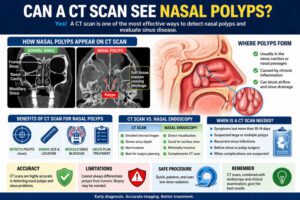
Yes, a CT scan can clearly detect nasal polyps. It is one of the most effective tools to evaluate their size, location, and impact on the sinuses.
In this article, you’ll learn how CT scans detect Nasal Polyps, when they are needed, and how they guide treatment decisions.
By Dr. Sagar Rajkuwar, ENT Specialist, Nashik, Maharashtra, India
🌐 www.entspecialistinnashik.com
📌 Table of Contents
- What Are Nasal Polyps?
- Can a CT Scan Detect Nasal Polyps?
- How CT Scans Work for Sinuses
- What a CT Scan Shows
- CT Scan vs Nasal Endoscopy
- When Do You Need a CT Scan?
- Accuracy of CT Scan
- Benefits of CT Imaging
- Limitations of CT Scan
- Diagnosis Process
- Treatment Planning
- FAQs
- Conclusion
What Are Nasal Polyps?
Nasal Polyps are soft, painless, non-cancerous growths that form due to chronic inflammation in the nasal lining or sinuses.
They are often associated with:
- Chronic Sinusitis
- Allergic Rhinitis
- Asthma
Can a CT Scan Detect Nasal Polyps?
👉 Yes, a CT scan is highly effective in detecting nasal polyps.
It helps doctors:
- Identify the presence of polyps
- Measure their size
- Determine how much blockage they cause
- Evaluate sinus involvement
How CT Scans Work for Sinuses
A CT (Computed Tomography) scan uses X-rays to create detailed cross-sectional images of:
- Nasal passages
- Sinus cavities
- Surrounding bone structures
👉 It provides a clear 3D view, making it superior to standard X-rays.
What a CT Scan Shows
A CT scan can reveal:
✅ Polyps
- Soft tissue masses inside nasal cavities
✅ Sinus Blockage
- Mucus buildup
- Fluid levels
✅ Inflammation
- Thickened sinus lining
✅ Structural Issues
- Deviated septum
- Narrow sinus openings
CT Scan vs Nasal Endoscopy
👉 Nasal Endoscopy
| Feature | CT Scan | Nasal Endoscopy |
|---|---|---|
| View Type | Internal imaging | Direct visualization |
| Detects Polyps | Yes | Yes |
| Shows Sinus Depth | Excellent | Limited |
| Invasiveness | Non-invasive | Minimally invasive |
👉 Best approach: Both are often used together.
When Do You Need a CT Scan?
Doctors recommend CT scan if:
- Symptoms persist >10–14 days
- Suspected large polyps
- Recurrent sinus infections
- Before surgery planning
Accuracy of CT Scan
CT scans are:
- Highly sensitive
- Very accurate for sinus evaluation
- Essential for surgical planning
👉 They are considered the gold standard imaging test for sinus diseases.
Benefits of CT Imaging
- Detailed visualization
- Quick procedure (few minutes)
- Non-invasive
- Helps in treatment planning
Limitations of CT Scan
- Cannot always differentiate polyp vs tumor
- Radiation exposure (low but present)
- May require correlation with endoscopy
Diagnosis Process
Diagnosis usually involves:
- Clinical history
- Physical examination
- 👉 Nasal Endoscopy
- CT scan imaging
📞 ENT Consultation & Surgery
Dr. Sagar Rajkuwar (MS-ENT)
Prabha ENT Clinic, Ambad, Nashik
📱 7387590194 | 9892596635
🌐 www.entspecialistinnashik.com
Role in Treatment Planning
CT scan helps guide:
👉 Endoscopic Sinus Surgery
It allows surgeons to:
- Locate polyps precisely
- Avoid complications
- Improve outcomes
FAQs
Can a CT scan miss nasal polyps?
Rarely. Large polyps are easily visible, but very small ones may require endoscopy.
Is CT scan painful?
No, it is completely painless.
Is CT scan necessary for all patients?
No, only in moderate to severe cases or before surgery.
Can CT scan differentiate cancer?
Not always—biopsy may be needed.
Conclusion
So, can a CT scan see nasal polyps?
👉 Yes, very clearly. It is one of the most reliable tools for diagnosing and evaluating nasal polyps.
🏆 Final Takeaway:
- CT scan provides detailed imaging
- Helps confirm diagnosis
- Essential for surgical planning
👉 Early diagnosis leads to better treatment outcomes and improved quality of life.
🔗 Read More
⚠️ Medical Disclaimer
This article is for educational purposes only and does not replace professional medical advice. Consult an ENT specialist for proper diagnosis and treatment.
🔬 How Nasal Polyps Appear on CT Scan (Radiology Insight)
On a CT scan, Nasal Polyps typically appear as:
- Soft tissue density masses inside nasal cavities
- Smooth, rounded or lobulated shapes
- Often non-enhancing (do not light up strongly with contrast)
- Associated with sinus opacification (whitening)
👉 Radiologists also look for:
- Mucosal thickening
- Blocked sinus openings (ostiomeatal complex)
- Fluid levels
🔬 How Nasal Polyps Appear on CT Scan (Radiology Insight)
On a CT scan, Nasal Polyps typically appear as:
- Soft tissue density masses inside nasal cavities
- Smooth, rounded or lobulated shapes
- Often non-enhancing (do not light up strongly with contrast)
- Associated with sinus opacification (whitening)
👉 Radiologists also look for:
- Mucosal thickening
- Blocked sinus openings (ostiomeatal complex)
- Fluid levels
🧠 CT Scan vs MRI: Which Is Better?
| Feature | CT Scan | MRI |
|---|---|---|
| Bone Detail | Excellent | Poor |
| Soft Tissue | Good | Excellent |
| Sinus Evaluation | Best | Limited |
| Tumor Detection | Moderate | Better |
👉 CT scan is preferred for nasal polyps and sinus disease.
👉 MRI is used when tumor or complications are suspected.
🦠 Can CT Scan Differentiate Polyps from Tumors?
⚠️ Important clinical point:
- CT scan cannot always clearly distinguish between:
- Polyps
- Benign tumors
- Malignant growths
👉 Red flags requiring further evaluation:
- One-sided mass
- Bone destruction
- Irregular margins
👉 In such cases:
- Biopsy may be needed
- MRI may be advised
👁️ What ENT Surgeons Look for Before Surgery
Before performing
👉 Endoscopic Sinus Surgery
CT scan helps identify:
- Exact location of polyps
- Anatomical variations
- Proximity to:
- Eyes (orbit)
- Brain (skull base)
👉 This reduces surgical risk and improves outcomes.
⚠️ Radiation Safety: Is CT Scan Safe?
CT scans involve low-dose radiation, but are generally safe.
Key Points:
- One sinus CT = low radiation exposure
- Not recommended repeatedly unless needed
- Use cautiously in children and pregnancy
👉 Benefits usually outweigh risks in moderate to severe cases.
🧪 When CT Scan Is NOT Needed
CT scan may NOT be required if:
- Mild symptoms
- Clear diagnosis via
👉 Nasal Endoscopy - Good response to medical treatment
📉 Common CT Scan Findings in Nasal Polyps
Radiology reports may include:
- “Soft tissue mass in nasal cavity”
- “Bilateral ethmoidal polyposis”
- “Maxillary sinus opacification”
- “Blocked ostiomeatal complex”
👉 These findings confirm extent of disease.
🔁 Role of CT Scan in Follow-Up
CT scan is used for:
- Pre-surgery planning
- Complex or recurrent cases
- Not routinely for simple follow-up
👉 Clinical symptoms + endoscopy are usually sufficient.
🧘 Practical Patient Tips Before CT Scan
- No fasting required (in most cases)
- Remove metal objects
- Inform doctor if pregnant
- Stay still during scan
🏆 Expert Summary
Can a CT scan see nasal polyps?
Yes, a CT scan can clearly detect nasal polyps by showing soft tissue growths, sinus blockage, and inflammation, making it essential for diagnosis and surgical planning.
🏁 Final Expert Insight
While Nasal Polyps can often be diagnosed clinically, a CT scan provides:
- Detailed anatomical mapping
- Accurate disease extent
- Safe surgical guidance
👉 It remains the gold standard imaging tool for sinus disease.