Parkinson’s Breakthrough 2026: New Discovery Could Help Slow Disease Progression
Scientists Discover Potential New Tactic That Might Help Halt the Progression of Parkinson’s Disease
The way Parkinson’s disease is treated may one day be revolutionized by a fascinating new scientific breakthrough. A crucial immune-related protein that may have a significant impact on how Parkinson’s disease spreads throughout the brain has been discovered by scientists at the University of Pennsylvania School of Medicine.
The study, which was just published in the medical journal Neuron, discovered that using targeted antibodies to block a protein known as GPNMB (glycoprotein nonmetastatic melanoma B) lessened the transmission of hazardous Parkinson’s-related proteins in laboratory studies. Although the study is still in its infancy, scientists think that it may one day aid in slowing the course of Parkinson’s disease, which is something that is not possible with existing therapies.
Table of Contents
- 🔍 Introduction
- What Exactly Is Parkinson’s Disease?
- What Did the Researchers Find?
- What path might this take toward a novel therapy for Parkinson’s disease?
- The Significance of This Discovery
- Human brain tissue was also examined by researchers.
- Does This Treat Parkinson’s Disease?
- The Opinions of Experts
- Conclusion
- ❓ FAQ – New Parkinson’s Disease Research
🔍 Introduction
Research on Parkinson’s Disease has made a potential breakthrough that might one day aid in slowing the course of this terrible neurological illness. A brain-related immune protein called GPNMB, which may be involved in the transmission of hazardous proteins associated to Parkinson’s disease, has been found by scientists at the University of Pennsylvania School of Medicine. The medical journal Neuron published early laboratory research demonstrating that specifically created antibodies may limit the transmission of these harmful proteins between brain cells.
Despite the fact that the study is still in the preclinical phase and has not yet been evaluated as a therapy for people, experts think it is a promising step toward future treatments that may slow brain injury rather than simply address symptoms. Currently, there is no known cure for Parkinson’s disease, and the available treatments are mostly centered on treating tremors, stiffness, balance issues, and movement impairments. This new study provides optimism that disease-modifying treatments will eventually be a reality.
What Exactly Is Parkinson’s Disease?
Parkinson’s disease is a progressive neurological condition that impairs movement, balance, and coordination.
It occurs when the brain’s dopamine-producing nerve cells, which are responsible for controlling movement, slowly degenerate or die.
Typical symptoms are:
- Tremors or shaking
- Low speed
- Rigidity of muscles
- Having trouble walking
- issues with balance
- Having difficulty swallowing
- Trouble speaking
The symptoms usually get worse with time, making daily tasks harder and harder.
According to researchers, millions of individuals are now impacted by Parkinson’s disease globally, and while medicines can help alleviate symptoms, there is still no cure that can slow or halt the course of the illness.
What Did the Researchers Find?
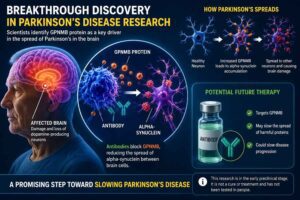
A protein known as GPNMB, which is associated with the immune system of the brain, may have a significant role in the transmission of Parkinson’s disease from one brain cell to another, according to researchers.
The accumulation of alpha-synuclein, a harmful protein, is closely associated with the advancement of Parkinson’s disease.
Alpha-synuclein usually aids nerve cell function. The protein, though, aggregates abnormally within neurons in Parkinson’s illness. These harmful masses impair brain cells and gradually extend to healthy regions of the brain.
According to the new research, GPNMB may speed up this spreading process. Researchers believe that immune cells in the brain produce more GPNMB as a result of brain cell injury, which sets off a vicious cycle that accelerates the course of the disease.
What path might this take toward a novel therapy for Parkinson’s disease?
Monoclonal antibodies, which are specifically engineered proteins capable of blocking harmful biological processes, were tested by scientists.
These antibodies effectively inhibited GPNMB activity in laboratory experiments and slowed the transmission of alpha-synuclein between brain cells.
Scientists hypothesize that this may be able to break the cycle of the illness.
In other words:
Increased GPNMB due to injured neurons leads to a quicker spread of hazardous proteins, which causes greater brain damage.
Researchers are hoping to halt or perhaps break this chain reaction by blocking GPNMB.
The Significance of This Discovery
The main reason for the buzz surrounding this study is that current Parkinson’s treatments primarily concentrate on symptom management rather than halting the course of the illness.
Currently, there are the following options:
- Levodopa and other medications
- Physical therapy
- Management of one’s way of life
- Methods of stimulating the brain
Although these therapies may offer short-term relief from symptoms, none of them specifically prevent the illness from progressing in the brain.
By directly targeting GPNMB, a treatment could become one of the first therapies that modifies the course of the disease, which means that it may genuinely slow down neurological damage rather than just manage symptoms.
Human brain tissue was also examined by researchers.
Researchers looked at tissue specimens from 1,675 brains held in the Penn Brain Bank to support their results.
They discovered that people with genetic mutations associated with increased GPNMB production also exhibited greater brain damage related to Parkinson’s disease.
It’s worth noting that researchers discovered that there wasn’t a strong correlation between higher GPNMB activity and indicators of Alzheimer’s disease, implying that this protein may be more directly related to the course of Parkinson’s disease.
Does This Treat Parkinson’s Disease?
No, and it’s a crucial difference.
This finding does not constitute a treatment nor a cure.
The research has produced encouraging findings just in:
- Laboratory tests
- Cultured brain cells
- Analysis of human brain tissue
What scientists still have to finish:
- Testing on animals
- human clinical trials
- Safety assessments
- Regulatory permission
According to experts, it may take years before this study develops into a real cure for individuals.
The Opinions of Experts
The study’s researchers referred to the results as “encouraging,” particularly since many patients are diagnosed early when symptoms are still minor.
If the course of the disease can be slowed at these early stages, scientists believe that patients may be able to live better lives for longer. Before any real-world therapy can be made available, though, they emphasize that far more investigation is necessary.
Conclusion
The discovery of the function of the GPNMB protein in the course of Parkinson’s disease represents an exciting development in neurological research.
Scientists have a promising new target that may aid in slowing the progression of Parkinson’s in the brain, though it is still too early to declare this a breakthrough therapy.
This study provides something really helpful to the millions of individuals and families impacted by Parkinson’s disease: the hope that future treatments would address the illness itself rather than just treating the symptoms.
Disclaimer: This article is just for informational purposes and should not be construed as medical guidance. Patients should always speak with a neurologist or other healthcare provider about their diagnosis or treatment options for Parkinson’s disease.
❓ FAQ – New Parkinson’s Disease Research
Q1. What is the new discovery in Parkinson’s disease research?
Researchers discovered that a protein called GPNMB may help harmful Parkinson’s-related proteins spread through the brain.
Q2. What is GPNMB?
GPNMB is an immune-related protein found in the brain that may play a role in the progression of Parkinson’s disease.
Q3. Can this new discovery cure Parkinson’s disease?
❌ No. The research is still experimental and has not yet been proven as a cure or approved treatment for humans.
Q4. What harmful protein is linked to Parkinson’s disease?
A protein called alpha-synuclein is strongly associated with Parkinson’s disease progression.
Q5. How might antibodies help Parkinson’s disease?
Scientists found that targeted antibodies may slow the spread of harmful proteins between brain cells in laboratory studies.
Q6. Has this treatment been tested in humans?
❌ No. The research is currently limited to laboratory studies, cultured brain cells, and analysis of human brain tissue.
Q7. What are the common symptoms of Parkinson’s disease?
Common symptoms include:
- Tremors
- Muscle stiffness
- Slow movement
- Balance problems
- Difficulty walking
- Speech and swallowing problems
Q8. What treatments are currently available for Parkinson’s disease?
Current treatments include:
Levodopa medications
Physical therapy
Lifestyle management
Brain stimulation therapies
Q9. Why is this discovery important?
The discovery may help scientists develop therapies that slow disease progression instead of only reducing symptoms.
Q10. How long could it take for this research to become a treatment?
Experts say it may take years because animal testing, clinical trials, safety studies, and regulatory approval are still required.
⚕️ Medical Disclaimer
This article is intended for informational and educational purposes only and should not be considered medical advice, diagnosis, or treatment. The research discussed regarding Parkinson’s disease, GPNMB protein, and antibody therapy is still in the experimental and preclinical stage and has not yet been approved as a proven treatment for humans.
Always consult a qualified neurologist, physician, or healthcare professional regarding any symptoms, diagnosis, or treatment decisions related to Parkinson’s disease or any other medical condition. Never ignore professional medical advice or delay seeking treatment because of information read online.
Results from ongoing scientific studies may change as additional research, clinical trials, and regulatory reviews become available.
📚 References
- University of Pennsylvania Perelman School of Medicine
- Neuron Journal
- Parkinson’s Foundation
- National Institute of Neurological Disorders and Stroke (NINDS) – Parkinson’s Disease
- Michael J. Fox Foundation for Parkinson’s Research
- World Health Organization (WHO) – Parkinson Disease
- National Institute on Aging – Parkinson’s Disease Basics
- MedlinePlus – Parkinson Disease
A recently discovered pathway in the brain may help shield vulnerable neurons in Parkinson’s disease.
By protecting the brain’s dopamine-producing neurons, scientists have discovered a brain pathway that may help slow the progression of Parkinson’s disease. The advantage, though, was only seen in women.
Researchers discovered in a study published in the Journal of Neuroscience that boosting the activity of nicotine-responsive receptors helped protect dopamine-producing neurons and lessen indicators of degeneration in female models. The crucial thing is that the result was attained without the use of nicotine at all. The results point to a possible course of action for slowing the progression of the disease, rather than merely addressing its symptoms.
“The aim of this research is to prolong the life of neurons,” said Dr. Rahul Srinivasan, an associate professor of neuroscience at the Texas A&M University Naresh K. Vashisht College of Medicine. “You have a genuine chance to halt the course of the illness if you can safeguard dopamine-producing cells.”
Looking Past Nicotine
The relationship between nicotine and Parkinson’s disease has been a topic of discussion for scientists for a long time. However, nicotine is not thought to be a viable long-term therapy option because it is addictive and has an impact on several bodily functions.
The new study, however, concentrated on the brain pathways affected by nicotine, leaving out the substance altogether.
“Despite the nicotine connection, these receptors are there to support regular brain function,” stated Srinivasan, whose team includes Dr. Gauri Pandey, a Ph.D. graduate of the College of Medicine, and current M.D./Ph.D. student Roger Garcia. “Nicotine merely hijacks a receptor system that already exists.”
The study focused on receptors that react to acetylcholine, a naturally occurring brain molecule that mediates communication between neurons and regulates movement. Nicotine also targets these receptors.
Improving the Brain’s Natural Defenses
Parkinson’s disease develops as dopamine-producing neurons gradually die. While existing treatments may mimic or replace dopamine in order to alleviate symptoms, they are unable to prevent the continuous death of neurons.
Past research from Srinivasan’s laboratory demonstrated that certain nicotine-related medications may safeguard dopamine-producing neurons in female models. The goal of the new study was to see if the brain’s natural defense mechanisms could be boosted without using nicotine or nicotine-like substances.
They accomplished this by increasing the quantity of nicotine-responsive receptors in neurons through gene editing. This facilitated the passage of more receptors to the areas of the neuron where they are required.
The study discovered that reinforcing this route aided dopamine-producing cells in withstanding circumstances that would typically cause them to degenerate. Additionally, neighboring brain cells had lower reactivity levels, indicating healthier brain tissue.
An Impact That is Unique to Women
One of the study’s most important results was that the protective effect was only seen in female models. Across the board, females exhibited healthier dopamine neurons, less activation of cell death signals, and healthier brain tissue around them. Male models did not respond in the same manner.
“This was not a minor distinction,” Srinivasan stated. “It was obvious that the protective route was used by women but not by men.”
According to scientists, the discovery contributes to increasing evidence that Parkinson’s disease has different effects on men and women. A neuron’s response to harm can be influenced by hormones, receptor trafficking, and cellular regulation, which are the mechanisms that control cell activity.
“This study reinforces that sex differences are not secondary details; rather, they are essential to how the illness manifests and how treatments may need to be developed,” Srinivasan stated.
Towards Treatments that Change the Course of the Illness
The research suggests ongoing attempts to create disease-modifying treatments for Parkinson’s disease, since the pathway seems to protect dopamine-producing neurons rather than merely compensate for lost dopamine.
“It matters every more year that these neurons remain functional,” Srinivasan stated. “By strengthening protective brain pathways early on, we may be able to significantly delay the course of Parkinson’s and enhance the quality of life for those who have the condition.”
Before scientists can determine if this route may be targeted in humans, further study is necessary. However, the research highlights a potential strategy for slowing Parkinson’s disease: assisting the brain in protecting the neurons it is unable to regenerate.