Mindfulness Isn’t About Finding Calm — It’s About Learning to Stay Present When Your Thoughts Feel Overwhelming
Author: Dr Sagar Rajkuwar, ENT Specialist, Nashik, Maharashtra, India
🌐 www.entspecialistinnashik.com
Mindfulness is frequently advertised as a quick route to tranquility, optimism, and emotional stability in our rapidly changing environment. On social media, mindfulness is often depicted as being in a state of calm and serenity while sitting by the ocean, taking deep breaths in silence, and immediately experiencing relaxation.

However, mindfulness has a far more profound and challenging reality.
Mindfulness isn’t really about trying to get away from stress or forcing yourself to be at peace.
It’s about mastering the skill of remaining in the moment when your thoughts are overpowering and your emotions are hard to handle.
True mindfulness teaches individuals how to stay emotionally present even when life feels burdensome due to fear, worry, sadness, or other emotional distress.
Table of Contents
- The True Meaning of Mindfulness
- The widespread misconception concerning mindfulness
- The Reasons Behind Why Individuals Steer Clear of Tough Feelings
- Maintaining presence while experiencing intense emotion
- Being aware doesn’t mean feeling better right away.
- The Strength of Emotional Awareness
- Practices for Everyday Mindfulness
- The Reason Mindfulness Requires Courage
- Conclusion
- FAQs
The True Meaning of Mindfulness
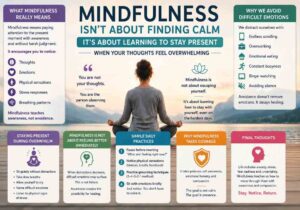
In essence, mindfulness is being consciously present in the here and now without passing harsh judgment.
You are not asked to stifle your emotions or get rid of unpleasant ideas.
Mindfulness, on the other hand, urges you to be truthful about your inner experiences:
- Considerations
- Feelings
- physical feelings
- Responses to stress
- The way one breathes
Mindfulness promotes awareness rather than avoidance.
The Widespread Misconception About Mindfulness
Many people start mindfulness with the hope of finding quick comfort from stress or worry.
They hope that breathing techniques or meditation can:
- Overthinking in silence
- Reduce emotional suffering
- Get rid of dread or grief
- Establish immediate peace
Many people believe that they are “failing” at mindfulness when they continue to experience negative emotions.
However, mindfulness is not intended to eliminate discomfort.
Its goal is to assist individuals in ceasing to flee from it.
The Reasons Why People Stay Away from Painful Feelings
Many individuals automatically divert their attention when unpleasant feelings arise.
Typical examples of emotional avoidance behavior include:
- constant browsing on social media
- Overwork
- Eating when you’re experiencing emotions
- Ongoing activity
- Watching entertainment incessantly
- not speaking
Because confronting unpleasant feelings makes people feel emotionally insecure, they frequently steer clear of them.
It’s possible to feel overpowered by sorrow, loneliness, uncertainty, shame, dread, and sadness.
But emotions are seldom completely eliminated by suppressing them.
Unprocessed emotions tend to get more intense with time.
Mindfulness gently urges individuals to start seeing reality with awareness and stop struggling against it.
If Your Thoughts Seem Overwhelmed
The mind can sometimes be emotionally draining.
You could have:
- At night, racing thoughts
- Chest-constricting anxiety
- Constant worry
- feeling nothing
- Overthinking discussions
- Concern for the future
At these times, mindfulness does not necessitate excellence or optimism.
On the other hand, mindfulness promotes basic awareness.
To illustrate:
- “I can feel the tension in my body.”
- “I can see evidence of anxiety.”
- “Right now, my thoughts are racing.”
- “I’m experiencing a lot of emotion.”
Although these observations may appear minor, they provide room for emotion.
That area helps people understand a crucial reality:
You are not your thoughts.
You are the one watching them.
It’s not about having an instant sense of well-being when practicing mindfulness.
The fact that people sometimes feel more emotional prior to feeling calmer is one of the most misunderstood aspects of mindfulness.
Previously ignored emotions tend to surface as distractions lessen.
This could involve:
- Sorrow
- Fear
- Old emotional pain
- Anxiety
- Pain
- Emotional fatigue
Mindfulness isn’t failing because of this.
It frequently implies that emotional awareness is at last growing.
Refusing to address the problem will only make the healing process take longer.
Understanding and healing are made possible by awareness.
The Strength of Maintaining the Present
People learn through mindfulness how to maintain emotional presence rather than emotionally vanish.
“Remaining in the space” emotionally may appear as follows:
- Being still and free from interruptions
- breathing gently when under pressure
- Letting yourself weep
- Identifying challenging emotions truthfully
- paying attention to bodily signs of stress
Mindfulness promotes curiosity rather than self-judgment.
Mindfulness asks, rather than seeing emotions as adversaries:
“What is this emotion trying to tell me?”
The desire for safety may be reflected in fear.
Emotional loss may be indicated by sadness.
The brain may be attempting to defend itself by expressing anxiety.
Observing feelings with awareness rather than resistance tends to lessen their intensity over time.
Being mindful doesn’t require you to be flawless.
No mindfulness technique is flawless.
You’ll have a wandering mind.
You’ll have some emotionally challenging days.
Ideas might continue to be loud and disruptive.
That is expected.
The goal of mindfulness is not to empty the mind.
The goal is to repeatedly bring one’s focus back to the current moment in a kind manner.
Part of mindfulness is even recognizing when you’re distracted.
The behavior is not ideal.
The practice is making a comeback.
Basic Regular Mindfulness Activities
You may practice mindfulness in minor, everyday situations.
1. Wait Before Taking Action
Take a brief pause before answering as stress increases.
Ask yourself:
“What do I feel right now?”
2. Pay Attention to Physical Sensations
Pay attention to the physiological symptoms of stress:
- Shoulders that are tense
- tight mouth
- A rapid heartbeat
- shallow respiration
Being aware of one’s body and mind is essential for regaining connection between them.
3. Use Grounding Strategies
During times of overwhelming emotion, grounding activities can be beneficial.
Try to identify:
- 5 things to see
- 4 things you can experience
- three audible things
- 2 things you can detect via your sense of smell
- something you can taste
It could assist in lowering anxiety and bringing one’s focus back to the current situation.
4. Experience Emotions for a Short While
Try observing difficult feelings for a little while rather than immediately diverting yourself.
There is no need to immediately address the emotion.
Just observing it makes a difference.
The Reason Mindfulness Requires Courage
From the outside, mindfulness may appear calm, but in reality, it sometimes takes bravery.
It can be challenging to maintain presence when experiencing anxiety, sorrow, uncertainty, or emotional heaviness.
It requires:
- tolerance
- self-knowledge
- honesty in one’s feelings
- self-compassion
Although peace may eventually happen, it is not the main objective.
Mindfulness’s ultimate goal is to teach you that you can remain in the moment even when experiencing intense emotions.
Conclusion
The majority of people think that mindfulness entails always being at peace.
Mindfulness, in fact, is all about being in the moment, particularly when it’s challenging.
Life is filled with instances of:
- Stress
- Emotional discomfort
- Stress
- Fear
- Uncertainty
- Sadness
Mindfulness doesn’t require individuals to stay away from these events.
It teaches them how to approach challenging feelings with mindfulness, tolerance, and empathy.
Since mindfulness is not about escaping yourself.
It’s all about figuring out how to stick with yourself, even on the most difficult days.
FAQs
1. What is mindfulness really about?
Mindfulness is about staying present and aware of your thoughts, emotions, and surroundings without judgment, even during difficult emotional moments.
2. Can mindfulness help with anxiety?
Mindfulness may help reduce anxiety by encouraging awareness, grounding techniques, and healthier responses to stressful thoughts and emotions.
3. Is mindfulness the same as meditation?
Meditation is one way to practice mindfulness, but mindfulness can also be practiced during everyday activities like breathing, walking, or eating.
4. Why does mindfulness sometimes feel uncomfortable?
Mindfulness may feel uncomfortable because it increases awareness of emotions and thoughts that people often avoid or suppress.
5. Does mindfulness stop negative thoughts?
Mindfulness does not eliminate negative thoughts. Instead, it teaches people to observe thoughts without becoming overwhelmed by them.
6. How can beginners practice mindfulness daily?
Beginners can practice mindfulness by focusing on breathing, noticing physical sensations, pausing before reacting, and practicing grounding exercises.
7. Can mindfulness improve emotional health?
Regular mindfulness practice may support emotional health by improving self-awareness, emotional regulation, and stress management.
8. What are grounding techniques in mindfulness?
Grounding techniques help bring attention back to the present moment using the senses, such as noticing things you can see, hear, touch, smell, and taste.
9. Is mindfulness helpful for overthinking?
Mindfulness may help manage overthinking by teaching people to observe thoughts without reacting to every worry or mental distraction.
10. How long does mindfulness take to work?
Mindfulness effects vary from person to person. Some people notice benefits quickly, while others experience gradual emotional improvements over time.
Medical Disclaimer
This article is for informational and educational purposes only and should not replace professional mental health advice, diagnosis, or treatment. Individuals experiencing severe anxiety, depression, panic attacks, or emotional distress should consult a qualified healthcare professional or mental health specialist.
👉 YouTube Channel:
http://www.youtube.com/@healthuseful8539/
📞 ENT Consultation & Surgery
Dr. Sagar Rajkuwar (MS-ENT)
Prabha ENT Clinic, Ambad, Nashik
📱 7387590194 | 9892596635
🌐 www.entspecialistinnashik.com
📲 For Health-Related Articles & Videos
🔹 Facebook: https://www.facebook.com/positivemind.healthcare
🔹 YouTube: http://www.youtube.com/@healthuseful8539/
References
- Mindful – What Is Mindfulness?
- American Psychological Association – Mindfulness Meditation
- Mayo Clinic – Meditation and Stress Relief
- National Center for Complementary and Integrative Health – Meditation and Mindfulness
- Harvard Health Publishing – Benefits of Mindfulness
- Mindfulness-Based Stress Reduction (MBSR) Overview